

Forex Margin Calculation: How to Calculate Required Margin with Leverage
In forex and contract-for-difference (CFD) trading, margin is the collateral you set aside to open and hold a position. It is not a fee or trading cost — it is capital temporarily reserved as performance security, and it returns to your balance once the position is closed.
Leverage lets you control a much larger notional position with a relatively small amount of margin. The trade-off is symmetrical: leverage amplifies both potential gains and potential losses, which is why a clear grasp of how margin is calculated is essential before placing any order.
This guide walks through the core concept of margin, the relationship between margin requirement and leverage, the three main types of margin shown in trading platforms, how margin call and stop-out are triggered, three worked calculation examples for different currency-pair scenarios, and how to use the Titan FX margin calculator to plan position sizes safely.
- Margin is collateral, not a cost. It is temporarily locked and returns once the position closes.
- Margin requirement = 1 ÷ leverage × 100%. Higher leverage means less margin needed but greater risk.
- Three margin types matter. Used, free, and total margin define your real position capacity.
- Margin level signals risk. Watch it to anticipate margin calls and stop-outs in time.
- Cross-currency trades need two-step math. Convert via USD before applying account-currency rates.
1. What Is Margin in Forex Trading?
Margin is the collateral you deposit with your broker when opening a forex or contract-for-difference (CFD) position. It is the financial guarantee that you can meet potential losses on the trade.
Because margin lets you control a much larger notional position than your deposit would normally allow, this trading model is known as leverage trading. With 100:1 leverage, for example, you only need 1% of the position value as margin.
However, margin is not a trading cost. It is capital that is temporarily reserved while your position is open. If the market moves against you and your account equity falls, your broker may issue a margin call or trigger an automatic stop-out to close positions and limit further losses.
Compared with traditional spot trading, margin trading has three distinctive characteristics:
- You can participate in larger markets without putting up the full notional amount.
- You can take either long or short positions.
- Both potential gains and potential losses are amplified.
Understanding how margin works is the first step toward using leverage responsibly.
2. How Margin Works in Forex and CFD Trading
Margin is the structural backbone of the forex and CFD markets. It lets traders deploy capital efficiently by controlling positions far larger than their cash deposit — but it is not borrowed money. It is collateral, posted to cover the broker's exposure to potential losses from your trade.
Leverage and Margin Requirement
The math behind margin is governed by the relationship between leverage and margin requirement:
Margin Requirement = 1 ÷ Leverage × 100%
For example:
- 1:100 leverage → requires 1% of the notional position value as margin.
- 1:50 leverage → requires 2% of the notional position value.
Higher leverage reduces the up-front margin but magnifies the percentage swing of any price movement. A 1% adverse move on a 100:1 leveraged position can wipe out 100% of the margin posted on that trade.
In other words: high leverage scales gains and losses in exactly the same proportion.
The Three Categories of Margin
On platforms such as MT4 and MT5, margin is displayed under three categories, each tied to a different stage of trade lifecycle and risk management:
| Type | Common Name | Description |
|---|---|---|
| Used Margin | Required Margin / Used Margin | Margin already locked into open positions. Updated automatically each time you open or close a trade. |
| Free Margin | Free Margin / Usable Margin | Equity minus used margin. The capital still available for opening new positions or absorbing floating losses. |
| Total Margin | Account Margin | The combined view of used and free margin across the entire account. |
In addition, regulators and brokers distinguish:
- Initial Margin — the minimum capital required to open a new position.
- Maintenance Margin — the minimum equity required to keep an existing position open.
When account equity falls below the maintenance margin, the platform's risk-control mechanism activates.
Margin Call and Stop-Out
As the market moves against your positions, your margin level (defined below) drops. Once it falls below the broker's warning threshold, you will receive a margin call — a notification asking you to either deposit additional funds or reduce position size.
If equity continues to fall without action, the platform will trigger an automatic stop-out, closing positions one by one to prevent the account from going negative.
At Titan FX:
- Stop-out level: margin level at 20%.
- Notification threshold: a warning email is sent when margin level falls below 90%.
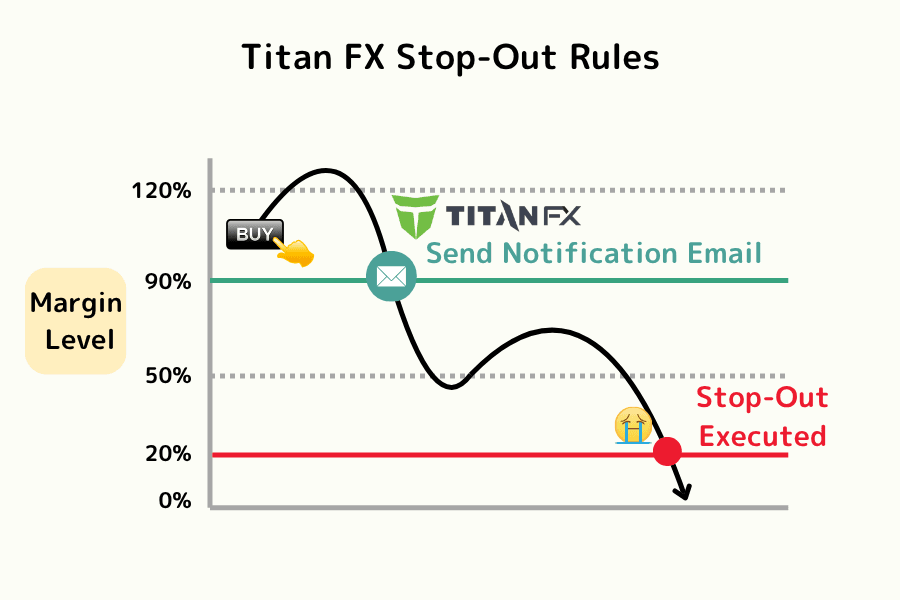
These rules give traders an automated safety net during extreme market volatility, but they should not be relied on as a substitute for active risk management.
Margin Level and Risk Monitoring
Margin level is the single most important real-time indicator of account health:
Margin Level (%) = (Account Equity ÷ Used Margin) × 100%
Example: If account equity is USD 1,500 and used margin is USD 1,000, then margin level = (1,500 ÷ 1,000) × 100% = 150%.
How to interpret it:
- Above 100% — your account has spare capacity to absorb adverse moves.
- Approaching the warning threshold — risk is building; review positions.
- Below the stop-out level — the platform will close positions automatically.
Important: Margin requirement (used to calculate the capital needed to open a position) and margin level (used to monitor ongoing risk) sound similar but serve very different purposes.
Further reading: Stop-out mechanics and how to manage their impact
Margin Terminology Across MT4 and MT5
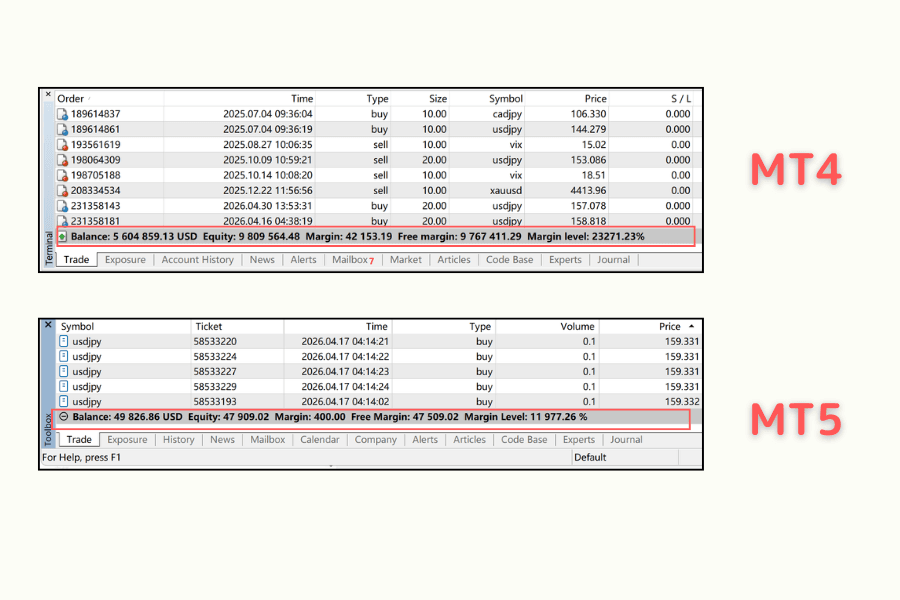
While the underlying margin mechanism is identical on MT4 and MT5, the on-screen labels differ slightly. The table below maps the key terms so you can read either platform fluently.
| Concept | MT4 Label | MT5 Label | English Term | Description |
|---|---|---|---|---|
| Balance | Balance | Balance | Balance | Account cash total, excluding floating P&L. |
| Equity | Equity | Equity | Equity | Account value including all floating P&L. Equity exceeds balance when positions show profit and falls below balance when in loss. |
| Used Margin | Margin | Margin | Used Margin | Total margin locked by all open positions. Released only when positions close. |
| Free Margin | Free Margin | Free Margin | Free Margin | Equity minus used margin — capital available for new positions or to absorb losses. |
| Margin Level | Margin Level | Margin Level | Margin Level | Equity ÷ used margin × 100%, a real-time risk gauge. |
3. How to Calculate Required Margin
Calculating the required margin before opening a position is the foundation of disciplined trading. With a clear formula, you can size positions accurately, use leverage responsibly, and keep risk inside the limits you set for your account.
Required margin depends on three variables: contract size per lot, number of lots traded, and the leverage applied.
Because base currencies, quote currencies, and account currencies vary, the formula changes slightly depending on the pair. The three scenarios below cover the most common cases.
Case 1: Base Currency Is USD (e.g., USD/JPY, USD/CHF)
When the base currency is USD, no exchange-rate conversion is required:
Required Margin (USD) = Contract Size × Lots ÷ Leverage
Example (USD/JPY, 1 lot, 1:100 leverage):
100,000 × 1 ÷ 100 = USD 1,000
Case 2: Base Currency Is Not USD (e.g., EUR/USD, GBP/USD)
When the base currency is not USD, you must convert the notional amount into USD at the prevailing rate.
Required Margin (USD) = (Contract Size × Lots ÷ Leverage) × (Base Currency / USD rate)
"Base currency / USD rate" is the live exchange rate that converts one unit of base currency into USD.
- Example: EUR/USD = 1.0786 means 1 EUR = 1.0786 USD.
Example (EUR/USD, 1 lot, 1:100 leverage, rate 1.0786):
100,000 × 1 ÷ 100 × 1.0786 = USD 1,078.6
Case 3: Non-USD Account Trading a Non-USD Pair (e.g., JPY Account Trading EUR/JPY)
When neither the account currency nor the base currency is USD (for example, a JPY-denominated account trading EUR/JPY), the calculation has two steps:
- Step 1: Calculate the USD margin using USD as an intermediate currency.
- Step 2: Convert the USD margin into the account currency using the current rate.
Required Margin (Account Currency) = [(Contract Size × Lots ÷ Leverage) × (Base Currency / USD rate)] × (USD / Account Currency rate)
Example (EUR/JPY, 1 lot, 1:100 leverage, EUR/USD = 1.0786, USD/JPY = 150.00):
- = [(100,000 × 1 ÷ 100) × 1.0786] × 150.00
- = (1,000 × 1.0786) × 150.00
- = JPY 161,790
So this EUR/JPY trade in a JPY account requires roughly JPY 161,790 in margin.
4. Using the Titan FX Margin Calculator
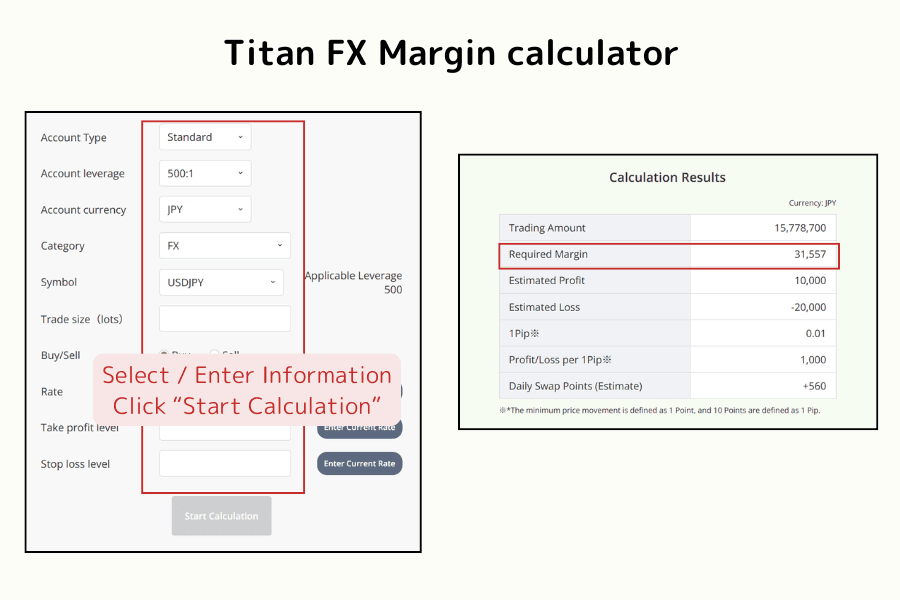
Estimating required margin before you open a position is a critical part of risk planning. Titan FX provides a dedicated Margin Calculator that returns the exact margin and notional value for any combination of instrument, lot size, account currency, and leverage.
The calculator is most useful in two situations: when sizing a new position and when stress-testing a multi-position portfolio. Plugging in different leverage scenarios shows immediately how much room each position leaves before it threatens the account's margin level.
Trade Forex CFDs with Titan FX
Titan FX offers 50+ currency pair CFDs on MT4/MT5 with up to 1,000:1 leverage on major pairs, tight spreads, and the flexibility to go long or short. Micro accounts can reach up to 2,000:1 leverage when eligible.
5. Frequently Asked Questions
Below are the most common questions traders ask once they start working with margin in real accounts.
Q1. What is the difference between margin and margin requirement?
Margin is the actual cash amount locked when you open a position. Margin requirement is that amount expressed as a percentage of the notional position value, calculated as 1 ÷ leverage × 100%. One is a dollar figure, the other is a ratio, and confusing them is a common source of position-sizing errors.
Q2. When are margin calls and stop-outs triggered?
A margin call is triggered when margin level falls below the broker's warning threshold, and a stop-out closes positions when margin level drops below the cutoff. At Titan FX, the warning email is sent at 90%, and stop-out occurs at 20%. Thresholds vary by broker and account type — always confirm the exact figures before live trading.
Q3. What leverage should a beginner use?
Higher leverage magnifies both gains and losses. Beginners are generally better off starting with low leverage in the 1:10 to 1:50 range, paired with strict stop-loss discipline and a small per-trade risk percentage. Higher leverage can be introduced gradually once both risk management habits and emotional control are firmly established.
Q4. What is a healthy margin level to maintain?
There is no universal number, but a common guideline is to keep margin level above 300% during active trading. A reading near 100% means almost all available capital is committed and even a small adverse move could breach the margin-call threshold. Conservative discretionary traders often work well above 500%.
Q5. How do I estimate margin quickly for cross-currency pairs?
For pairs like EUR/JPY traded in a JPY account, you first convert via USD and then back into the account currency. Doing this manually under live conditions is error-prone — the Titan FX Margin Calculator handles both steps in a single screen so the margin requirement is unambiguous before you place the order.
Titan FX Margin Calculator6. Conclusion: Understand Margin, Stay in Control of Risk
Margin is the mechanism that makes forex and CFD trading capital-efficient — and it is also the mechanism most often misunderstood by new traders.
The ability to calculate required margin, monitor margin level, and anticipate when a margin call or stop-out is approaching is more than a technical skill. It is the operational foundation of any trading system designed to last.
Treat margin not as a constraint but as a feedback loop: each position you open is a statement about how much risk you are willing to accept, and the margin level you see on your screen is the running scorecard of that decision.
Further Reading
- Forex margin trading basics
- Stop-out mechanics and how to manage their impact
- Leverage trading: a complete guide
- What is a CFD?
- Forex Trading Strategy: A Complete Guide for Beginners
Titan FX Research and Review Team — covering forex (FX), commodities (oil, precious metals, agricultural products), stock indices, US equities, and crypto assets, producing educational content for retail and institutional investors.
Primary Sources by Category
- Official data and regulators: Vanuatu Financial Services Commission (VFSC), Bank for International Settlements (BIS) Triennial Central Bank Survey on FX Turnover, ESMA Product Intervention Measures on CFDs (European leverage caps).
- Market data and liquidity: BIS OTC Foreign Exchange Statistics, CFTC Commitments of Traders Reports (COT).
- Academic research: John C. Hull, "Options, Futures and Other Derivatives" (chapters on margin mechanics); Daniel Kahneman & Amos Tversky, "Prospect Theory" (1979) on loss aversion in leveraged trading.
- Industry and third-party references: Investopedia (Margin Requirement, Margin Call, Maintenance Margin); MetaQuotes MT4/MT5 official documentation on margin fields; Titan FX product specifications and risk disclosure documentation.