

Gray Rhino
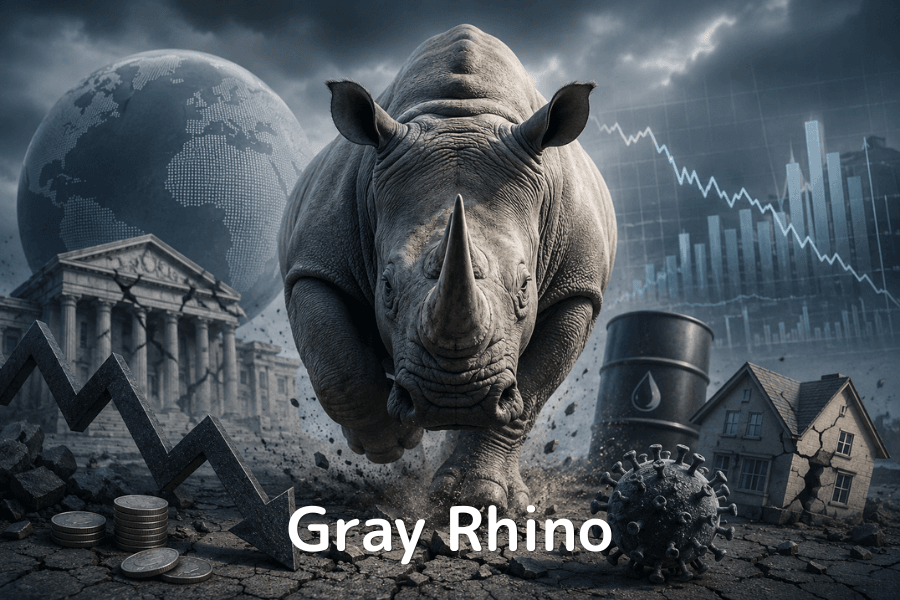
The term comes from American analyst Michele Wucker. It describes a danger that, like a rhino, is enormous and charging straight at you—but goes unaddressed precisely because it is visible and underestimated. Unlike a black swan, which is genuinely hard to predict, a gray rhino builds up over years of accumulating evidence. It gets ignored anyway, thanks to short-term incentives, political pressure, or plain cognitive bias.
This article covers what a gray rhino is and where the term came from, its defining characteristics, how it differs from a black swan and other lookalike concepts, the five stages and four types a crisis moves through, well-known cases from financial markets, and what investors can actually do about it.
- A gray rhino is a high-probability, high-impact risk with visible warning signs that goes unaddressed. The point is not that nobody could see it—it is that everybody could.
- Michele Wucker introduced the concept at Davos in 2013 and set out the framework in her 2016 book of the same name.
- The key difference from a black swan is foreseeability: a black swan is genuinely unpredictable, while a gray rhino has been discussed for years without anyone acting.
- Crises move through five stages—denial, muddling, diagnosis, panic, action. The earlier you recognise one, the more options you have and the less it costs.
- 1. What Is a Gray Rhino? Definition and Origin
- 2. What Are the Characteristics? Why Visible Risks Get Ignored
- 3. Gray Rhino vs Black Swan: Comparing the Lookalikes
- 4. How a Crisis Unfolds: Five Stages and Four Types
- 5. Gray Rhino Examples in Financial Markets
- 6. How Should Investors Handle Gray Rhino Risk?
- 7. Gray Rhino FAQ
- 8. Summary
1. What Is a Gray Rhino? Definition and Origin
Definition: What a Gray Rhino Means
A gray rhino is a risk that is highly probable and wide-reaching, that has already produced obvious warning signs, and that still has not been dealt with. What Wucker stresses is that the point is not unpredictability but choice: the danger is right in front of you, and you can act early or keep waiting.
In finance, the term describes the kind of slow-building threat that eventually triggers sharp market moves.
Why a "Gray" Rhino?
Ask most people about rhinos and they think of black rhinos and white rhinos. In reality both species are grey. That is exactly Wucker's point: names mislead us about what things actually are, and a risk labelled "unlikely" may in fact be both obvious and imminent.
Where the Term Came From
Wucker first presented the concept at the World Economic Forum's annual meeting in Davos in 2013, then laid out the full framework in her 2016 book The Gray Rhino: How to Recognize and Act on the Obvious Dangers We Ignore.
The idea grew out of years spent studying sovereign debt. Whether in Argentina or Greece, the warning signs of a debt crisis appeared early; the real problem was how long it took anyone to move. The concept has since been widely adopted across financial markets and risk management as a way of framing macroeconomic and market risk.
2. What Are the Characteristics? Why Visible Risks Get Ignored
Gray rhinos matter to markets because they are not accidents. They are a category of risk with recognisable traits.
Trait 1: Foreseeable and Slow-Building
Before a crisis surfaces, the signs are usually already there—overheating asset prices, rising corporate debt, persistent inflation, or deteriorating public finances. These problems accumulate over long periods rather than appearing overnight.
Trait 2: High Probability, Broad Impact
Compared with low-probability events, gray rhinos are far more likely to actually happen—and when they do, they tend to hit financial markets, corporate earnings, and the wider economy at the same time.
Trait 3: Very Little Time to React Once It Hits
A risk may take years to build and then only days to detonate. That asymmetry—slow to form, fast to break—is what makes gray rhinos so awkward. By the time markets start reacting, most of the good options are gone.
So Why Do Visible Risks Still Get Ignored?
The problem is rarely a shortage of information. It is psychological and institutional resistance:
- Optimism bias: believing bad outcomes won't arrive this quickly, or at least not to you.
- Confirmation bias: noticing only the data that supports the case for markets continuing to rise.
- Groupthink: when nobody else is worried, the person raising the alarm carries the cost of being early.
- Short-term incentives: the cost of acting lands immediately, while the benefit shows up much later—so it gets deferred.
Stack these together and complacency sets in. Once confidence finally turns, problems that took years to build can surface all at once.
3. Gray Rhino vs Black Swan: Comparing the Lookalikes
A gray rhino and a black swan are both common risk terms in financial markets. The essential difference: a gray rhino is a known risk that accumulates over time, while a black swan is a genuinely unforeseeable shock.
Gray Rhino vs Black Swan
| Gray Rhino | Black Swan | |
|---|---|---|
| Nature of risk | Known | Unknown |
| Warning signs beforehand | Yes, often for years | Almost none |
| Probability | Relatively high | Extremely low |
| How it forms | Builds up, then breaks | Triggered by a sudden event |
| Core problem | Seen but not acted on | Impossible to anticipate |
| Typical examples | Financial crises, the European debt crisis | Major natural disasters, terrorist attacks |
Worth noting: Wucker herself does not regard the 2008 financial crisis as a black swan. Her argument is that many events labelled black swans were really several gray rhinos charging at once—the warnings were there the whole time, and nobody hit the brakes.
Other Concepts People Confuse With It
| Concept | Core characteristic | How it differs from a gray rhino |
|---|---|---|
| Gray swan | Very low probability but not entirely unforeseeable, with severe consequences | A gray rhino is far more likely to occur |
| Green swan | Systemic financial risk arising from climate change, hard to size or time | A category tied to one domain; increasingly a focus for financial regulators |
| Elephant in the room | Something everyone knows about but nobody is willing to raise | The elephant is about silence; the gray rhino is talked about constantly and still not acted on |
That last one is the easiest to confuse. Wucker's distinction is clean: the elephant is collective silence, whereas a gray rhino gets discussed at length, generates report after report, and never moves past the discussion stage. A quick test: if a risk has been debated for years and shows up in the data but nobody has acted, it is a gray rhino; if there was almost no prior signal, it is closer to a black swan.
4. How a Crisis Unfolds: Five Stages and Four Types
The gray rhino is more than a metaphor—it is a framework you can hold your own situation up against, to work out where you are and how much room to manoeuvre is left.
The Five Stages
- 1. Denial: the warnings are already visible, but the problem is dismissed as overstated—or "this time is different".
- 2. Muddling: the problem is acknowledged, then kicked down the road with short-term measures.
- 3. Diagnosis: the risk finally gets assessed seriously, but the debate over which fix to use drags on.
- 4. Panic: the risk is upon you or already breaking, sentiment turns hard, and options narrow sharply.
- 5. Action: something is finally done, at a cost far higher than early intervention would have been.
The lesson: the sooner you reach the action stage, the more tools you have and the less it costs. Most of the real damage in a crisis is done during denial and muddling.
The Four Types
| Type | What it looks like | What to focus on |
|---|---|---|
| Charging rhino | Already coming straight at you, with little time left | Act now; stop the bleeding first |
| Recurring rhino | The same problem keeps happening | Find the structural cause instead of firefighting again |
| Meta-rhino | A risk to your capacity to respond—dysfunctional decision-making, lack of resources | Repair the response mechanism first |
| Unidentified rhino | Signals are ambiguous and it may not materialise | Keep watching; preserve room to adjust |
For investors, the practical value is this: when a risk keeps recurring, the answer is usually not to reshuffle positions each time, but to check whether the portfolio has a structural weakness.
5. Gray Rhino Examples in Financial Markets
Most major financial crises showed signs of imbalance, mounting debt, or overheating asset prices well before they surfaced, and grew over time into events that moved global markets.
2017: China's Gray Rhino Warning and the Market Reaction
In Chinese-speaking markets, the most direct example is the concept itself moving prices. On 17 July 2017, following the National Financial Work Conference, the People's Daily ran a front-page commentator's article calling for guarding against "both the black swan and the gray rhino", and naming shadow banking, abnormal capital-market volatility, high leverage, and property bubbles as specific risks.
That day the ChiNext index fell about 5.1% to close at 1,656.43, its lowest since January 2015, while the Shenzhen SME index dropped about 4.3%. It is a rare case of a risk metaphor alone shifting market sentiment. The property bubble it named went on to materialise in the liquidity crises of major developers—a textbook case of a risk flagged early and realised anyway.
2008: The Global Financial Crisis
The 2008 financial crisis is the most frequently cited gray rhino. Before it surfaced, the US housing market was already showing overheated prices, expanding subprime lending, and excessive leverage at financial institutions, and some analysts were warning publicly—but the market broadly believed prices would keep climbing.
When housing turned, mass defaults set off a chain reaction. Equity volatility spiked, money rotated into safe havens such as the US dollar, the yen, and gold, and the fallout included bank failures and a recession.
The European debt crisis that followed had the same shape. Fiscal deficits in Greece, Spain and elsewhere had existed for years, yet European bond markets and the euro only moved sharply once investors began doubting these countries could pay.
6. How Should Investors Handle Gray Rhino Risk?
Gray rhino risks usually come with a build-up period, which is precisely what gives investors a chance to act before a crisis widens.
Raise Your Risk Awareness—and Check You Aren't Stuck in "Muddling"
More useful than gathering additional information is stopping to ask: have I known about this risk for a long time without adjusting anything? Identifying which stage you are in tends to help more than trying to predict when it breaks. Setting position limits and stop-loss conditions in advance also keeps you from overreacting when markets move fast.
Diversify to Soften the Blow
Spreading capital across different markets, sectors, and asset classes limits how much any single event can affect the whole portfolio. When some holdings take a hit, others still have room to do their job.
Track the Data That Matters
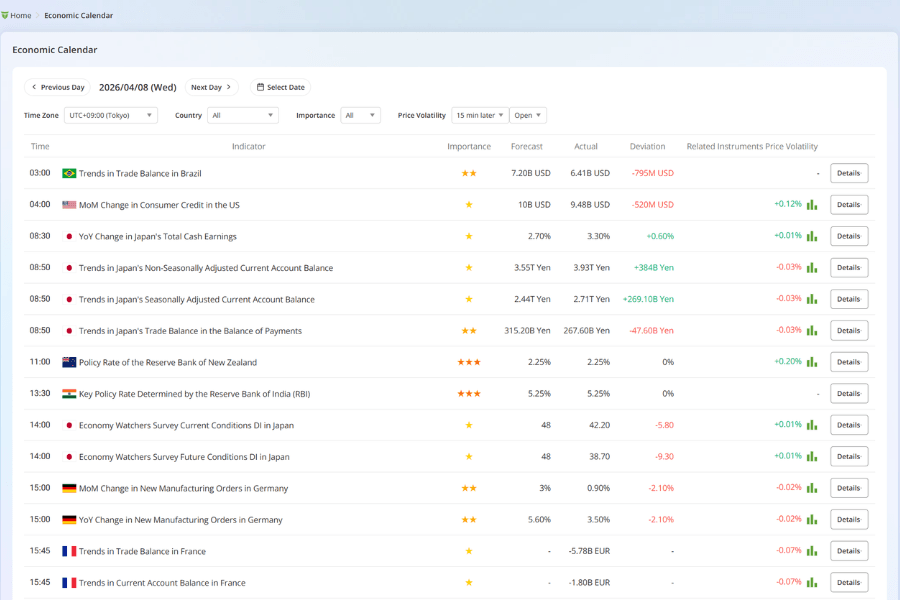
GDP, CPI, PMI, unemployment, and central bank decisions to raise or cut rates are all key readings on the economic cycle and market risk. No single print signals a crisis on its own, but several weakening together is worth paying attention to. Titan FX's economic calendar lets you track central bank rate decisions, inflation prints, and employment reports as they are released.
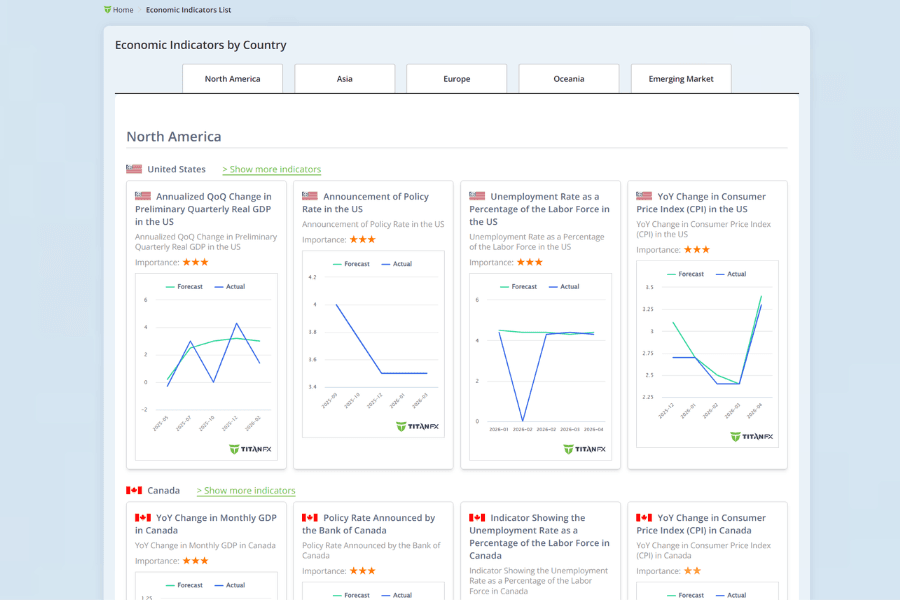
The global economic indicators tool lets you follow GDP, PMI, CPI and other readings over time, which helps in judging whether conditions are turning.
7. Gray Rhino FAQ
Q1. Which has the bigger impact, a gray rhino or a black swan?
Both can deliver serious shocks, but they are different in kind, so there is no direct comparison—it depends on the scale of the event and how far the effects reach. That said, in terms of what an investor can actually prepare for, a gray rhino normally leaves more time to respond.
Q2. Was COVID-19 a gray rhino or a black swan?
Opinion is split. Those calling it a black swan emphasise how suddenly the outbreak arrived. Wucker herself argues it was a gray rhino, on the grounds that public health experts had warned about pandemics for years while preparation stayed inadequate. The disagreement itself shows that the dividing line comes down to whether real warning signs existed beforehand.
Q3. Which gray rhino risks are worth watching now?
High global debt levels, geopolitical tension, ageing populations, climate change, supply chain restructuring, and property market adjustments in some regions are all frequently named as potential gray rhinos. Bear in mind that lists like these largely reflect market commentary rather than settled fact.
Q4. Do markets always fall sharply after a gray rhino event?
Not necessarily. The reaction depends on the scale of the event, how quickly policymakers respond, and what investors already expected. If the risk was priced in ahead of time, the actual impact can be limited; if the situation deteriorates quickly, the move can be large.
8. Summary
A gray rhino is a high-probability risk with clear warning signs that markets nonetheless tend to overlook. The hard part is rarely seeing the risk—it is acting once you have seen it.
For investors, understanding how these risks form, recognising the five stages, working out where you currently sit, and keeping track of key economic data and policy shifts all make for steadier decisions when markets move.
Further Reading
- What Is GDP (Gross Domestic Product)?
- What Is the Consumer Price Index (CPI)?
- What Is the Purchasing Managers' Index (PMI)?
- What Is Monetary Policy?
- What Are Government Bonds?
Titan FX Trading Strategy Lab. We produce investor-education content covering forex, commodities (crude oil, precious metals, agricultural goods), stock indices, US equities, and digital assets.
Primary Sources (by category)
- Original concept: Michele Wucker, The Gray Rhino: How to Recognize and Act on the Obvious Dangers We Ignore (2016); Gray Rhino & Co official site — the five stages and rhino types
- Government & policy: People's Daily, front-page commentator's article on effectively guarding against financial risk, 17 July 2017; Bank for International Settlements, The Green Swan (2020) — climate-related systemic financial risk
- Statistics & market data: central bank rate decisions and inflation statistics; historical data for major equity indices