

MAS (Monetary Authority of Singapore)
MAS runs monetary policy differently from most central banks. It has no policy interest rate and manages the Singapore dollar's exchange rate instead. MAS issues a monetary policy statement four times a year, and these statements are the biggest scheduled events for traders of USD/SGD and other Singapore dollar pairs.
This guide explains what MAS does, why it uses the exchange rate for monetary policy, how its policy band is adjusted, its recent policy decisions and release schedule, and how MAS decisions affect the Singapore dollar.
- MAS began operating in 1971 and serves as both Singapore's central bank and its financial regulator
- Since 1981, MAS has run monetary policy by managing the Singapore dollar exchange rate and does not control domestic interest rates
- Its policy tool is a band for the Singapore dollar nominal effective exchange rate (S$NEER), adjusted through its slope, width and level
- MAS has no explicit inflation target, but considers core inflation of just under 2% consistent with price stability
- Monetary policy statements are released four times a year, in January, April, July and October
- 1. What Is the Monetary Authority of Singapore (MAS)?
- 2. The Main Functions of MAS
- 3. MAS Monetary Policy: Centered on the Exchange Rate
- 4. Recent MAS Policy Decisions
- 5. When Does MAS Announce Monetary Policy?
- 6. How MAS Decisions Affect the Singapore Dollar (SGD)
- 7. How to Trade the Singapore Dollar with Titan FX
- 8. FAQ
- 9. Conclusion
1. What Is the Monetary Authority of Singapore (MAS)?
MAS began operating on January 1, 1971. At first, Singapore's currency was issued by a separate body, the Board of Commissioners of Currency. The two merged in 2002, and MAS took over currency issuance.
The goal of MAS monetary policy is set out in law: to keep prices stable so the economy can grow sustainably. MAS is currently led by its managing director, Chia Der Jiun.
2. The Main Functions of MAS
-
Monetary policy: manages the Singapore dollar exchange rate to keep prices stable over the medium term
-
Financial regulation: supervises banks, insurers, securities firms and other financial institutions
-
Currency issuance: issues Singapore dollar notes and coins
-
Reserve management: manages Singapore's official foreign reserves
-
Financial center development: works with the industry to develop Singapore as an international financial center
Many countries split central banking and financial regulation between two bodies. In Switzerland, for example, the Swiss National Bank runs monetary policy and FINMA regulates financial institutions. In Singapore, MAS does both.
3. MAS Monetary Policy: Centered on the Exchange Rate
Why Doesn't MAS Use Interest Rates?
Singapore is a small economy that trades heavily with the rest of the world, and imports make up a large share of what people buy. MAS explains that for an economy like this, the exchange rate has a bigger influence on domestic inflation than interest rates do.
That is why, since 1981, MAS has run monetary policy by managing the Singapore dollar exchange rate, and it does not control domestic interest rates or money supply growth. A stronger Singapore dollar makes imports cheaper and helps hold down inflation; a weaker one does the opposite.
The S$NEER and the Policy Band
The rate MAS manages is the Singapore dollar nominal effective exchange rate (S$NEER), a trade-weighted average of the Singapore dollar against a basket of its main trading partners' currencies. Because MAS looks at the Singapore dollar's overall strength, its policy does not always line up with moves in USD/SGD.
MAS lets the S$NEER move within a policy band and adjusts policy in three ways:
| Setting | What it controls |
|---|---|
| Slope | Pace of SGD appreciation |
| Width | Range the S$NEER can move in |
| Level | Midpoint of the band |
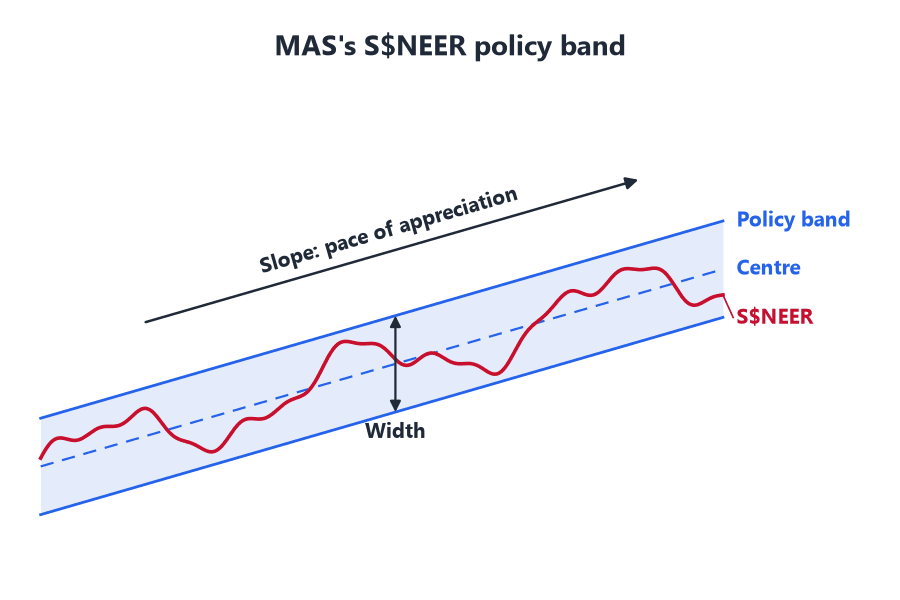
Raising the slope lets the Singapore dollar appreciate faster, which tightens policy; lowering it eases policy. Moving the level up shifts the S$NEER to a higher position straight away, so it has a more immediate effect than a change in the slope.
MAS describes its changes only in words such as "slightly" or "very slightly" and does not publish exact figures for the slope or the band.
FX Operations
MAS keeps the S$NEER inside the policy band mainly by buying and selling US dollars against Singapore dollars. This is a form of FX intervention and the main tool MAS uses to carry out monetary policy.
MAS Core Inflation
When MAS assesses prices, it focuses on MAS Core Inflation, which is consumer price index (CPI) inflation excluding accommodation and private transport. Both items are volatile and heavily shaped by government policy, so leaving them out gives a clearer view of price changes driven by demand.
MAS does not have an explicit inflation target. It says core inflation of just under 2% is consistent with overall price stability and close to its historical average.
4. Recent MAS Policy Decisions
The table below is based on MAS's record of past monetary policy decisions, as of October 2026:
| Date | Change |
|---|---|
| March 2020 | Slope set to 0%, level lowered |
| October 2021 | Slope raised slightly |
| 2022 | Four moves, two off-cycle |
| January and April 2025 | Slope lowered slightly twice |
| April 2026 | Slope raised slightly |
| July 2026 | Slope raised very slightly |
| October 2026 | No change |
During the COVID-19 pandemic in 2020, MAS cut the slope to 0% and lowered the level of the band. It began tightening in October 2021, and as inflation rose in 2022 it adjusted policy four times in one year, twice outside its scheduled dates.
Once inflation eased, MAS lowered the slope twice in 2025. In 2026, rising import costs led MAS to raise the slope again in April and July.
According to the October 14, 2026 statement, MAS Core Inflation rose from 1.5% in the second quarter to 2.1% in July and August, and MAS expects it to average 1.5% to 2.0% for 2026. MAS judged that the current pace of appreciation was enough to lean against imported inflation and left policy unchanged, while saying that inflation risks remain tilted to the upside.
5. When Does MAS Announce Monetary Policy?
| Release | Frequency | Content |
|---|---|---|
| Monetary Policy Statement | Four times a year | Policy band changes |
| Core inflation data | Monthly | MAS Core Inflation and CPI |
MAS published its first Monetary Policy Statement (MPS) in 2001. Since 2024, statements have been released four times a year, in January, April, July and October; before that, they were usually released twice a year. Statements are typically released in the morning, Singapore time, and the exact dates are listed on MAS's advance release calendar.
As of November 2026, the calendar shows the next statement in January 2027, no later than January 29. MAS can also change policy outside its scheduled dates when conditions call for it, as it did twice in 2022.
6. How MAS Decisions Affect the Singapore Dollar (SGD)
Changes to the Policy Band
All else being equal, the Singapore dollar tends to strengthen when MAS raises the slope or moves the level up, and to weaken when MAS lowers the slope or moves the level down.
What moves the market, though, is the gap between the decision and expectations. If traders already expect MAS to tighten, the Singapore dollar may react only a little even when MAS does raise the slope.
US Interest Rates and the Dollar
Interest rates in Singapore are set by the market, not directly by MAS. As a result, changes in US interest rates and the strength of the US dollar also have a big effect on USD/SGD.
| Scenario | SGD | USD/SGD |
|---|---|---|
| MAS raises the slope | Stronger | Tends to fall |
| MAS raises the level | Stronger | Tends to fall |
| MAS lowers the slope | Weaker | Tends to rise |
| Broad US dollar strength | Under pressure | Tends to rise |
These are typical reactions with all else equal; actual moves also depend on economic data and market sentiment. For more on the currency itself, see our guide to the Singapore dollar (SGD).
7. How to Trade the Singapore Dollar with Titan FX
Titan FX offers several Singapore dollar pairs on MT4 and MT5:
| Pair | Description |
|---|---|
| USD/SGD | US dollar vs Singapore dollar |
| EUR/SGD | Euro vs Singapore dollar |
| GBP/SGD | British pound vs Singapore dollar |
| AUD/SGD | Australian dollar vs Singapore dollar |
| SGD/JPY | Singapore dollar vs Japanese yen |
USD/SGD shows how many Singapore dollars one US dollar buys. When the Singapore dollar strengthens, USD/SGD usually falls; when it weakens, USD/SGD usually rises.
Trading Steps
-
① Check the release time: use the Economic Calendar to see when the next MAS statement and Singapore CPI are due
-
② Compare the outcome with expectations: first check whether the slope, width or level changed, then whether MAS revised its inflation and growth forecasts
-
③ Manage risk: spreads can widen and prices can gap around the release, so use a stop loss and keep position sizes under control
Track the Singapore Dollar's Overall Strength with Effective Exchange Rate Analysis
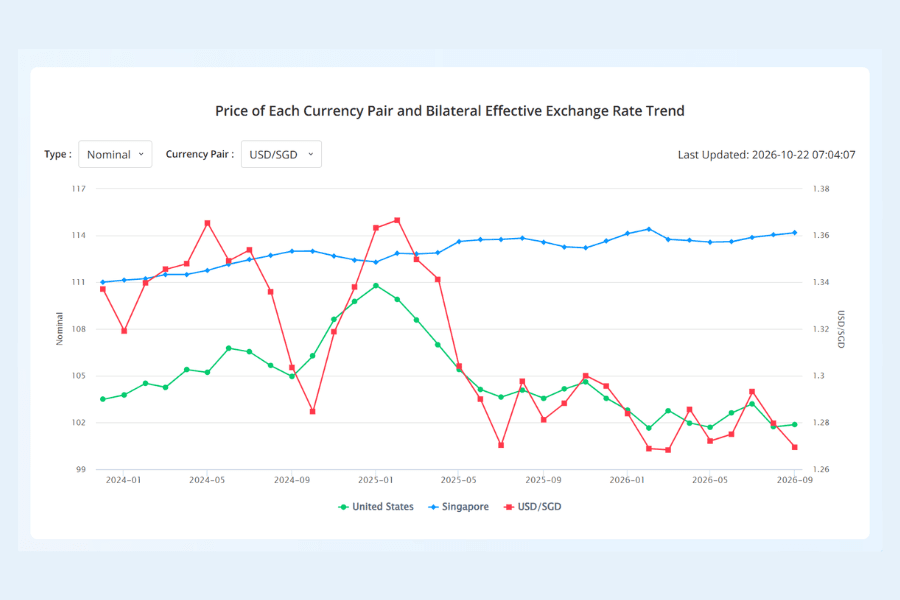
Titan FX's Effective Exchange Rate Analysis shows the Singapore dollar's nominal and real effective exchange rates, along with pairs such as USD/SGD, over periods from year-to-date to 10 years.
An effective exchange rate measures the Singapore dollar's overall strength against several currencies, the same kind of measure as the S$NEER that MAS manages. After a policy change, you can use it to see which way the Singapore dollar is moving overall. The tool's calculation may differ from MAS's own S$NEER, so use it for direction rather than comparing the numbers directly.
Open Effective Exchange Rate AnalysisFor Singapore CPI releases and history, see the Singapore Consumer Price Index (CPI) page.
8. FAQ
Q1. Is MAS the same as Singapore's central bank?
Yes. MAS, the Monetary Authority of Singapore, is Singapore's central bank and also its financial regulator.
Q2. Why doesn't MAS use a policy interest rate?
Singapore is a small economy that trades heavily with the world, so the exchange rate affects domestic inflation more than interest rates do. Since 1981, MAS has run monetary policy by managing the Singapore dollar exchange rate and does not control domestic interest rates.
Q3. How often does MAS announce monetary policy?
Since 2024, MAS has released monetary policy statements four times a year, in January, April, July and October. It can also change policy outside these dates in special circumstances.
Q4. What does it mean when MAS raises the S$NEER slope?
It means MAS is letting the Singapore dollar appreciate faster against the basket of currencies, which tightens policy. All else being equal, the Singapore dollar tends to strengthen.
Q5. Does MAS publish the exact figures for its policy band?
No. MAS describes its changes only in words such as "slightly" or "very slightly" and does not disclose exact figures for the slope, width or level.
Q6. How do MAS decisions affect USD/SGD?
When MAS raises the slope or the level, the Singapore dollar tends to strengthen and USD/SGD tends to fall; when it lowers the slope, USD/SGD tends to rise. USD/SGD is also driven by US interest rates and the dollar, and it can be volatile around MAS releases, so watch spreads and price gaps.
9. Conclusion
The Monetary Authority of Singapore (MAS) is Singapore's central bank and financial regulator. It has no policy interest rate; instead, it lets the Singapore dollar nominal effective exchange rate (S$NEER) move within a policy band and adjusts the band's slope, width and level. It releases monetary policy statements four times a year.
When MAS raises the slope or the level, the Singapore dollar tends to strengthen, while the US dollar and US interest rates also drive USD/SGD. Before trading Singapore dollar pairs, check when the next statement is due and compare the outcome with market expectations.
Further Reading
Titan FX Trading Strategy Lab. We produce educational content for investors covering FX, commodities (crude oil, precious metals, agricultural products), stock indices, U.S. equities, and cryptocurrencies.
Primary Sources
- MAS official sources: Monetary Authority of Singapore, "Who We Are," "Our History," "Monetary Policy," "Singapore's Monetary Policy Framework" and its FAQs, "How does MAS carry out monetary policy?," "Past Monetary Policy Decisions," "MAS Core Inflation," Monetary Policy Statement of October 14, 2026, and the Advance Release Calendar