

FX Intervention

FX intervention is the buying or selling of a country's own currency in the foreign exchange market by its central bank or government, aimed at influencing the exchange rate's level or curbing excessive swings. Exchange rates are normally left to market supply and demand — but when a move runs too fast, drifts far from fundamentals, or threatens financial stability, the authorities may step in and shift that supply and demand with real money.
For traders, intervention is among the most violent events the currency market produces: a rate can reverse hard within minutes, flipping trend positions from profit to loss on the spot. The most watched case in recent years is Japan — its yen-buying interventions during sharp yen slides made global headlines, and reading intervention risk has become required coursework for yen traders. Knowing how intervention works and when it tends to appear is basic fitness for trading the major pairs.
This article covers the definition and types of FX intervention, the mechanics and funding behind it, the classic cases of Japan, the Plaza Accord, and the Swiss National Bank, the limits and side effects, and what traders should do about it.
- FX intervention is official buying or selling of the home currency to influence its exchange rate; in Japan, the Ministry of Finance decides and the Bank of Japan executes.
- Four dimensions classify it: buying vs selling the home currency, unilateral vs coordinated, sterilized vs unsterilized, and verbal intervention that spends words instead of money.
- Defending a falling currency draws down foreign exchange reserves — a war of attrition; capping a rising one is not directly limited by reserves, but policy costs pile up.
- Goals differ by regime: floating-rate countries mostly manage the speed of moves, while band or floor regimes manage the level itself.
- Classic cases: Japan's yen buying in 2022 and 2024, the Plaza Accord's coordinated action, and the SNB's 1.20 floor.
- For traders: track the escalation of official language, cut leverage in alert periods, and treat intervention as a low-frequency, high-impact policy event in risk management.
- 1. What Is FX Intervention?
- 2. Types of FX Intervention: Buying, Selling, Sterilized, and Verbal
- 3. How Intervention Works: Mechanics and Funding
- 4. FX Intervention Case Studies: Japan, the Plaza Accord, and the SNB
- 5. Does Intervention Work? Limits and Side Effects
- 6. How Traders Should Prepare for Intervention
- 7. FX Intervention FAQ
- 8. Conclusion
1. What Is FX Intervention?
FX intervention is the official sector entering the foreign exchange market directly to buy or sell its own currency and influence the rate. Who decides varies by country: some central banks act on their own authority, while in Japan the Ministry of Finance holds the decision and the Bank of Japan executes as its agent — which is why Japanese headlines credit interventions to "the government and the BOJ" together.
Why authorities act differs by country and exchange rate regime. Common triggers include one-way moves running too fast, a rate drifting clearly away from fundamentals, and disorderly volatility that threatens financial stability; in regimes with bands, floors, or ceilings, defending the regime itself is the goal. Under floating rates, intervention rarely tries to pin the rate to a number — the usual aim is to slow the move and break one-way expectations, reminding a market full of trend-riders that prices can go the other way.
Intervention and capital flows are two sides of one coin: when money rushing out presses the currency down, the authorities selling foreign currency and buying their own are, in effect, plugging that outflow with their own balance sheet. To understand intervention is to understand how officials arm-wrestle the market's money.
2. Types of FX Intervention: Buying, Selling, Sterilized, and Verbal
Practitioners sort interventions along four dimensions:
| Dimension | Types | Notes |
|---|---|---|
| Direction | Currency buying / selling | Buying the home currency resists depreciation; selling it caps appreciation. Funding and limits differ |
| Participants | Unilateral / coordinated | One country alone, or several central banks acting together — coordination usually sends a stronger signal |
| Monetary impact | Sterilized / unsterilized | Whether offsetting liquidity operations neutralize the effect on domestic monetary conditions; practice varies by policy framework |
| Method | Actual / verbal | Real money in the market, or officials talking the market's expectations — words often precede money, but do not always lead to it |
Sterilization deserves a sentence more. Buying and selling foreign currency also moves domestic monetary conditions — buying the home currency, for instance, drains liquidity and works like a tightening. When authorities do not want intervention to disturb the existing stance of monetary policy, they run offsetting operations to neutralize the direct liquidity impact as far as possible. That is sterilized intervention.
Verbal intervention is the cheapest first step: officials lean on the market with phrases like "watching closely" and "no options are off the table," moving expectations before money moves. Its power rests entirely on the credibility that real action could follow — which is why markets parse every shift in official language.
3. How Intervention Works: Mechanics and Funding
Currency buying: sell foreign currency, buy your own
When the home currency is falling too fast, the authorities deploy foreign exchange reserves in three steps:
- ① Sell dollar and other foreign-currency assets held in reserves
- ② Buy back the home currency
- ③ Selling pressure is absorbed and the rate finds support
The ammunition is foreign assets accumulated in the past — every shot spends some — and not all headline reserves can be mobilized at will. That is why markets read reserve size and liquidity as the gauge of "how long they can hold out."
Currency selling: sell your own, buy foreign currency
When the home currency is rising too fast, the operation reverses:
- ① Supply the currency the authorities themselves issue
- ② Buy foreign currency (accumulating reserves in the process)
- ③ Appreciation momentum is met with selling
Selling your own currency is not directly capped by reserve holdings — you are selling something you can issue. But that is not a license for endless operation: balance sheet expansion, excess domestic liquidity and inflation pressure, sterilization costs, and conflicts with interest rate policy are all real constraints.
Asymmetry and the signal effect
The two directions carry different limits, and markets price their credibility differently. Currency buying is a war of attrition with a visible bottom, which invites speculative probing; the limits of currency selling hide inside policy costs. The same pledge to "defend the currency" is weighed differently depending on direction.
Intervention's power was never about out-buying the market. Operations concentrate on specific pairs and moments, trip stop-losses, and force crowded one-way positions to unwind — amplifying the effect. And the act of stepping in is itself information: a declaration that the current level or speed is unacceptable. The expectation shift from this signal effect often carries no less force than the flows themselves.
4. FX Intervention Case Studies: Japan, the Plaza Accord, and the SNB
Japan: the case traders watch most closely
Japan's setup is the clearest: the Ministry of Finance decides, the Bank of Japan executes, and the MOF publishes intervention results on a regular schedule — so the market can verify after the fact whether officials really were in.
The record is concrete, too. In 2022, as the yen slid sharply, Japan conducted its first yen-buying intervention since 1998, totaling roughly ¥9 trillion for the year. In 2024 it stepped in again — about ¥9.8 trillion combined in late April and early May, and roughly ¥5.5 trillion more in mid-July.
The yen also carries a seasonal layer of real-demand selling: Japanese importers habitually concentrate their dollar purchases on gotobi settlement dates (the 5th, 10th, and so on), creating recurring dollar demand. When that flow stacks onto speculative yen selling and the slide accelerates, intervention alerts and chatter cycle back into the market — a theme that keeps returning for yen traders.
The Plaza Accord: the coordination textbook
The textbook case of coordinated intervention is the Plaza Accord: the major industrial nations formed a common position that the dollar was overvalued, sold it together, and — combined with subsequent policy coordination — hardened market expectations of a dollar turn. The dollar then entered a falling cycle. Coordination draws its power from the signal that the broad direction now carries official consensus, a far heavier message than any single country can send.
Switzerland: defending a level, taken to the extreme
To fight excessive franc strength, the Swiss National Bank (SNB) set a floor of 1.20 on EUR/CHF in 2011 and pledged unlimited foreign currency purchases to hold it — the extreme form of intervention managing a level outright.
The cost was equally extreme: a ballooning balance sheet. In January 2015 the SNB abruptly abandoned the floor, the franc exploded higher within minutes, and currency markets received one of their most famous lessons in liquidity risk. Two takeaways for traders: intervention is not only about managing speed — and an official price line does more damage on the day it is abandoned than in all the days it holds.
5. Does Intervention Work? Limits and Side Effects
- ① The power is not in outspending the market. Against the market as a whole, intervention amounts are always limited. The effect comes from striking where it counts — picking the moment, tripping stops and forcing position unwinds, and changing the market's read of official intent. When the one-way consensus is strong enough, intervention alone rarely turns it.
- ② Consistency with policy is the key condition for lasting effect. Intervention aligned with monetary policy and fundamentals finds a cooperative market; when policy signals fight each other, sustaining the effect on currency trades alone is far harder. Interventions that lean against fundamentals mostly buy time while waiting for fundamentals to turn.
- ③ The side effects are real. Currency buying burns reserves; currency selling bloats the balance sheet; frequent intervention invites accusations of currency manipulation and trade friction. Officials are careful with timing precisely because every shot comes with a bill.
Hence the practical pattern under floating rates: intervention mostly manages speed — officials care about one-day routs and disorderly moves, and generally have no intention of defending an exact number. A Swiss-style level defense is a different regime choice altogether (see Section 4); the two should not be conflated.
6. How Traders Should Prepare for Intervention
Intervention cannot be precisely predicted, but the warnings follow a pattern:
- ① Track the escalation in official language. Wording differs by country and official — there is no universal ladder. What matters is the escalation: naming "excessive," "one-sided," or "speculative" moves, or stating readiness to act. When language heats up while the rate keeps accelerating one way, alert levels peak. Still, words alone never prove that money is coming.
- ② Price zones are psychological references, not official lines. Markets anchor on levels where intervention last occurred and on round numbers, but no authority — Japan included — publishes a fixed trigger level. Watch instead for the speed of short-window one-way moves, thinning liquidity, and whether official language is escalating in step.
- ③ Cut leverage and pre-write the script. The signature of an intervention moment is a violent reversal into a liquidity vacuum, with slippage far beyond normal. Test in advance whether your position survives a reversal far larger than usual arriving in seconds. In alert periods, run lower leverage — and do not bet on guessing the exact moment officials pull the trigger.
For tracking central banks and official signals, Titan FX's Central Bank Watch tool keeps the major banks' meeting schedules and policy developments on one page — standard equipment for intervention alert periods:
Central Bank Watch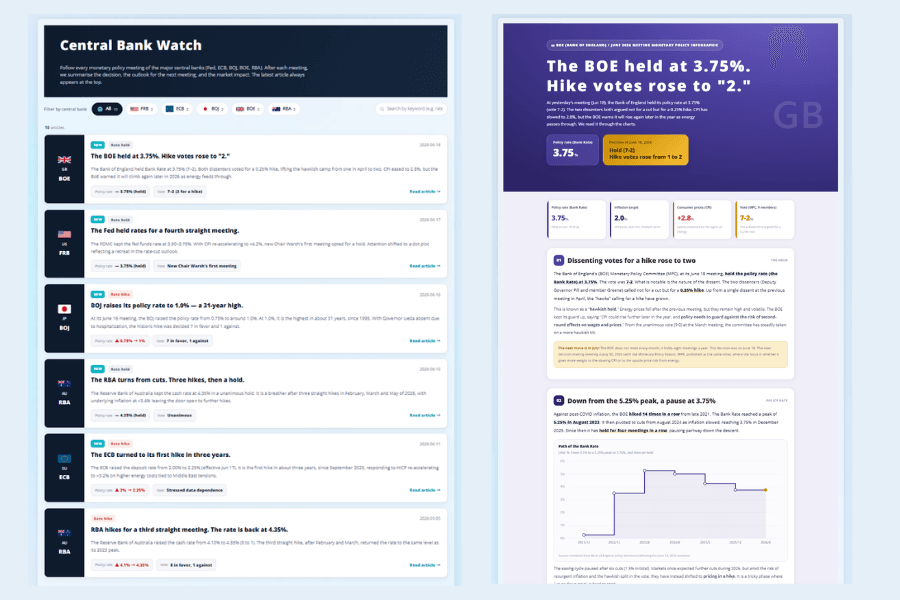
7. FX Intervention FAQ
Q1: How is FX intervention different from monetary policy?
Different tools, different targets. Monetary policy works through policy rates, liquidity, and the balance sheet to steer overall financial conditions — a standing instrument. FX intervention buys and sells currency in the market, targeting the exchange rate itself, and how often it is used varies widely by country and regime. The two can operate separately or in concert — and intervention aligned with the direction of monetary policy is far more convincing to markets.
Q2: What is sterilized intervention?
Intervention paired with offsetting liquidity operations that neutralize, as far as possible, the direct impact on domestic monetary conditions. Buying the home currency drains liquidity, for example, so the authorities inject an equivalent amount back, keeping the currency operation as separate as possible from the existing policy stance. Whether to sterilize depends on each country's policy framework.
Q3: How do you know whether an intervention happened?
Japan offers the most transparency: the MOF first publishes the intervention total for a period, then later the daily breakdown — so in the moment, the market often can only call it "suspected intervention" until official data confirms. Real-time reads rely on price behavior: a sudden violent reversal on no obvious news, with volume surging, immediately sets off intervention chatter. Authorities sometimes decline to confirm or deny — the ambiguity itself is part of the deterrent.
Q4: Can intervention reverse a currency trend?
There is no fixed answer. Intervention can move short-term prices and expectations sharply, but whether that becomes a lasting trend depends on monetary policy, fundamentals, capital flows, and market positioning lining up. Historically, the interventions that changed trends mostly coincided with turns in policy or fundamentals; intervention alone, leaning against fundamentals, rarely holds the line for long.
Q5: What is verbal intervention?
Influencing market expectations through official statements without actually trading — "watching the market closely" and "deeply concerned about speculative moves" are the classic phrasings. It is cheap and repeatable, but its force depends on the market believing the authorities have both the ability and the will to act. Talk that is never backed by action loses credibility with each repetition, and its power fades accordingly.
Q6: What is coordinated intervention? Any examples?
Intervention in which several central banks act in the same direction at the same time — the landmark case is the Plaza Accord, where the major economies sold dollars together and, combined with policy coordination, hardened expectations of a dollar turn. Joint action usually sends a stronger signal than a unilateral move, though lasting effect still depends on policy staying consistent afterward. Because it requires aligned interests across countries, coordinated intervention is rare.
8. Conclusion
FX intervention is the authorities laying hands directly on the exchange rate: real money deployed to kill the speed of a runaway move and break one-way expectations. Currency buying is a war of attrition funded by finite reserves; currency selling escapes that limit but runs up policy costs. Sterilization keeps intervention out of domestic policy's way, verbal intervention spends credibility before cash — and whether any of it lasts depends on pointing the same way as policy and fundamentals.
For traders, intervention belongs in risk management as a low-frequency, high-impact event: track the escalation of official language, treat price zones as psychological references rather than defended lines, and cut leverage with a script ready in alert periods. Trade the trend by all means — just don't arm-wrestle the official wallet at the exact spot where it has shown its hand.
Further Reading
- What Are the Global Central Banks?
- What Is the Policy Interest Rate?
- What Is a Rate Hike? (Raising Interest Rates)
- What Is Inflation?
- What Are Hawks?
The financial market research and analysis team at Titan FX. We produce educational content for investors across a wide range of instruments, including foreign exchange (FX), commodities (crude oil, precious metals, agricultural products), equity indices, US stocks, and crypto assets.
Primary Sources (by Category)
- Institutions and cases: Japan's Ministry of Finance foreign exchange intervention records; the Bank of Japan's explanation of intervention operations; public records of the SNB's EUR/CHF floor and the Plaza Accord
- Theory: the exchange-rate policy chapters of Krugman & Obstfeld, "International Economics"; IMF and BIS research on the mechanics and effectiveness of FX intervention
- Platform and tools: Titan FX's Central Bank Watch tool; Titan FX price and volatility data by instrument