

Capital Flows
Capital flows are movements of money across borders for investment and funding purposes. The common forms are direct investment (building or acquiring businesses), portfolio investment (buying and selling stocks and bonds), and other investment such as cross-border bank lending. Exchange rates are set by the relative supply and demand for currencies, and cross-border money is one of the main sources of that demand: inflows usually create currency-conversion or hedging needs, and outflows work in reverse. Read where capital is heading and why, and you hold one of the main threads behind an exchange rate's medium-term direction.
For traders, capital flows are anything but abstract. Carry money chasing rate differentials, safe-haven retreats triggered by risk events, sudden stops in emerging markets — all are capital flows in concrete form, and all of them print directly onto currency charts. Once you can read the money's comings and goings, many of the market's "whys" answer themselves.
This article covers the definition and types of capital flows, the three drivers that push money across borders, how flows affect exchange rates and asset prices, the policy tools central banks and governments use in response, and the indicators commonly used to track where money is going.
- Capital flows are cross-border investment and funding movements — three main types: direct investment (FDI), portfolio investment, and other investment (the formal classification adds derivatives and reserve assets).
- Three drivers move money: rate differentials, growth prospects, and shifts in risk appetite.
- Unhedged inflows put appreciation pressure on a currency; outflows the reverse. Externally funded economies fear the sudden stop most.
- Flows are recorded in the financial account; net of the small capital account and errors, current account deficits are financed by financial inflows.
- Central banks respond on three levels: FX intervention, rate policy, and capital controls.
- Two tracking tiers: real flow statistics (balance of payments, TIC) and market positioning (CFTC futures data).
- 1. What Are Capital Flows?
- 2. Types of Capital Flows: FDI, Portfolio Investment, and Hot Money
- 3. Why Does Money Cross Borders? The Three Drivers
- 4. How Capital Flows Move Exchange Rates and Asset Prices
- 5. How Central Banks and Governments Respond
- 6. How to Track Capital Flows: Balance of Payments, TIC, and Market Positioning
- 7. Capital Flows FAQ
- 8. Conclusion
1. What Are Capital Flows?
Capital flows are movements of money across borders for investment and funding. A foreign company building a local plant, an overseas fund buying local stocks and government bonds, an international bank lending to local firms — these are inflows. Local money heading into overseas assets is an outflow. The net of the two shows whether an economy is attracting money or exporting it.
In official statistics, these cross-border financial transactions are recorded mainly in the balance of payments' financial account. Exports and imports of goods and services sit in the current account, and the two correspond in accounting terms: setting aside the usually small capital account and statistical errors, a country running a current account deficit typically finances it with financial inflows, while long-standing surplus countries tend to accumulate foreign assets.
In the foreign exchange market, financial demand has long been the main event. Global FX turnover each day far exceeds the currency conversion that goods trade directly requires, and most of it comes from investment, hedging, funding, and market-making. That is why rate decisions and risk events often move currencies as much as trade data, or more — they change where the money goes.
2. Types of Capital Flows: FDI, Portfolio Investment, and Hot Money
In practice the three classic types plus derivatives make a workable map; the balance of payments' formal classification also includes reserve assets:
| Type | What it covers | Character |
|---|---|---|
| Direct investment (FDI) | Building plants, acquisitions, controlling stakes | Long decision cycles, sticky money; rarely moves on short-term price action |
| Portfolio investment | Stocks, bonds, and other securities | Liquid, sensitive to rate gaps and risk appetite; moves fast |
| Financial derivatives | Forwards, futures, options, swaps held across borders | Mostly tied to hedging and risk management |
| Other investment | Cross-border bank lending, trade credit, deposits | Tracks funding conditions; contracts sharply in crises |
Another common cut is speed. Markets loosely call cross-border money that is liquid, sensitive to rates and risk sentiment, and quick to leave hot money — not an official statistical category, and mostly associated with short-term securities positions and bank funding.
Hot money is a major driver of short- and medium-term currency swings: it adds fuel on the way in, and a rapid exit amplifies moves in both the currency and asset prices. By contrast, "slow money" like direct investment moves gradually and ignores short-term price action — the stable part of the flow picture.
3. Why Does Money Cross Borders? The Three Drivers
Rate differentials and expected returns
Money naturally flows toward higher returns. When the gap between two countries' rates is wide enough, the carry trade — borrowing the low-yield currency to invest in the high-yield one — comes alive. It is the classic engine of portfolio and short-term flows. For how rate gaps feed into forward pricing and holding costs, see the interest rate parity framework.
Growth and earnings prospects
Markets with strong growth and upgraded earnings tend to hold more appeal for direct investment and equity money. These inflows chase the growth story, usually last longer, and are better able to support a currency's medium-term trend — though whether the money actually arrives still depends on valuations, the policy environment, and global financial conditions.
Shifts in risk appetite
Market sentiment swings between risk-on and risk-off. In risk-on phases, money leans toward higher-yield, higher-growth assets, and emerging markets and commodity currencies often benefit. In risk-off phases, money cuts risk exposure and retreats to the usual havens, with high-yield and emerging market currencies typically first to be sold. Sentiment-driven reversals often move faster than fundamentals do.
When all three drivers point the same way, the direction of flows is usually clearest. When they conflict, avoid judging a currency on any single one.
4. How Capital Flows Move Exchange Rates and Asset Prices
The transmission path: inflows build appreciation pressure
Foreign money entering a market usually starts with a conversion or hedging need. The main line breaks into three steps:
- ① Capital flows in → conversion and hedging demand appears
- ② The unhedged portion buys the local currency → appreciation pressure builds
- ③ The money enters local markets → stocks and bonds get a simultaneous bid
When capital leaves, the machine runs in reverse: assets are sold, money is converted back, the currency comes under pressure, and prices fall.
How large the actual reaction is depends on three things: the size and speed of the flows, whether the money is hedged, and what currency funds it. Inflows locked in with forwards or swaps produce less spot buying than the headline amount suggests.
The sudden stop: this chain's most dangerous form
A sudden stop is when steady foreign inflows abruptly halt or reverse. Take the Asian financial crisis as the textbook case: in economies reliant on external funding, three things hit at once when the money left —
-
the currency plunged
-
asset prices slumped
-
funding costs spiked
The three feed on each other: the weaker the currency, the heavier the foreign-currency debt burden, and the more the remaining money wants out. This is why emerging markets with high external debt and wide current account deficits are especially sensitive to global funding conditions.
Mature markets: redrawing the rate-gap map
Mature markets feel it too. Major central banks' hiking and cutting cycles redraw the world's rate-differential map, prompting money to rotate among the major currencies — and a policy turn by a large economy is often where a currency's medium-term trend begins.
5. How Central Banks and Governments Respond
Large swings of money in and out can threaten financial stability. The toolkit has roughly three layers:
- ① FX intervention: the central bank buys or sells its own currency directly — selling foreign exchange reserves to support the currency, or buying foreign currency to cap appreciation. The depth of reserves is a key card when facing outflows.
- ② Interest rates and monetary policy: hiking usually makes local-currency assets more attractive and helps retain money; cutting and easing can speed up outflows. Capital flows are therefore a variable no monetary policy decision can ignore.
- ③ Capital controls and macroprudential measures: administrative limits on money crossing the border — approval requirements for conversion and remittance, taxes on short-term inflows, foreign ownership caps. Controls can damp panic-driven swings and buy time; the costs are transaction friction and market liquidity, and they can weigh on investors' willingness to allocate.
Each layer has its price: intervention burns reserves, rates spill into the domestic economy, controls affect market efficiency. In practice they are used in combination, escalating with the pressure.
6. How to Track Capital Flows: Balance of Payments, TIC, and Market Positioning
Capital flows have no single real-time quote. The usual channels fall into two tiers — the first three are genuine flow statistics, the fourth is market-positioning information:
- ① Balance of payments statistics: the financial account breakdowns that central banks and statistics agencies publish periodically. The most authoritative source, but low-frequency and lagged — best for confirming the big picture.
- ② The US TIC report: the US Treasury's monthly international capital data, showing how foreign money is buying and selling US securities — a standard window on the pull of dollar assets.
- ③ Fund flow statistics: subscription and redemption data for equity and bond funds tracked by research firms, available weekly — often used to catch short-term swings in risk appetite.
- ④ Futures positioning: the CFTC's Commitments of Traders report shows speculative positioning and crowding in major currency futures. It is not a direct statistic of cross-border capital flows — treat it as supplementary information on market positioning and risk sentiment. Titan FX's tool lays out positioning changes in the major currencies so you can read the net-position trend directly:
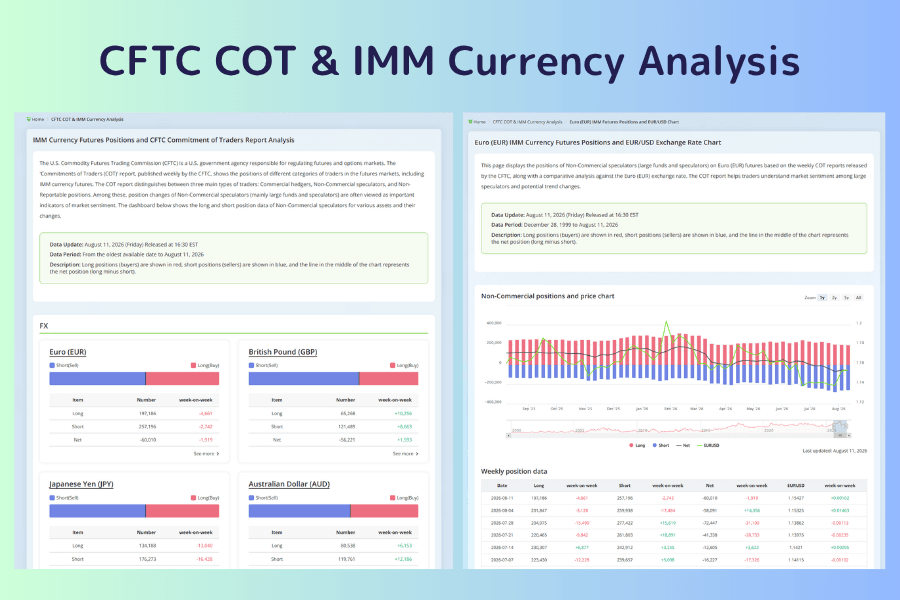
Two things to remember when reading these: the sources differ in scope and frequency, so cross-check them rather than leaning on any single one; and they all show allocations that have already happened — good for confirming trends and gauging crowding, not for precise timing.
7. Capital Flows FAQ
Q1: What is hot money?
A loose market term for cross-border money that is liquid, sensitive to rates and risk sentiment, and able to exit quickly — mostly short-term securities positions and bank funding. It is not an official statistical category. Hot money can push a currency and its asset markets up quickly on the way in, and amplify volatility on a fast exit — a major source of short- and medium-term swings.
Q2: Are capital flows the same thing as the balance of payments' "capital account"?
No — and this is the most commonly confused pair. Capital flows in everyday usage refers broadly to cross-border money movements, which the balance of payments records mainly in the financial account. The "capital account" is a separate, usually small item covering capital transfers and transactions in non-produced, non-financial assets. Similar names, different contents.
Q3: How do capital flows relate to the current account?
They are the two main parts of the balance of payments and correspond in accounting terms: setting aside the small capital account and statistical errors, a current account deficit is typically financed by financial inflows, while surplus countries accumulate foreign assets. It is a bookkeeping correspondence, not a strict one-to-one mirror. For a currency's medium-term direction, read the two accounts together.
Q4: Why do emerging markets fear capital outflows so much?
Because dependence and fragility stack. Emerging economies that rely more on external funding, carry high short-term external debt, or borrow heavily in foreign currency are especially exposed: outflows weaken the currency, the foreign-currency debt burden grows, funding costs rise, and the rising costs scare away still more money — a self-reinforcing loop. Reserve depth, debt structure, and the current account position together decide how much resistance an economy has.
Q5: Do capital inflows always make a currency appreciate?
The direction is appreciation pressure; the size is not guaranteed. The central bank may buy foreign currency to offset the rise (accumulating reserves as it does). If foreign investors hedge with forwards or swaps, spot buying of the currency can be much smaller than the headline inflow. The type of flow matters too — direct investment's effect is steady and durable, while a hot-money rally can leave as fast as it came.
Q6: How can an individual trader track capital flows?
No need to build your own database — a few public windows go a long way: follow the periodic balance of payments and TIC releases, use market summaries of fund flows, and watch CFTC positioning for market positioning — remembering it measures futures-market position structure, not cross-border flows directly. The goal is a working sense of which way the money leans, then verifying it against price action.
Q7: What are capital controls, and what forms do they take?
Administrative limits a government places on money crossing its borders. Common forms include approval requirements for conversion and remittance, taxes on short-term inflows, caps on foreign ownership, and minimum holding periods. They can damp short-term volatility and buy time in a panic; the costs are transaction friction and market liquidity, and they can weigh on investors' willingness to allocate. The net effect depends on the specific regime and market conditions.
8. Conclusion
Capital flows are the money thread running behind exchange rates: rate differentials supply the incentive, growth supplies the story, risk appetite supplies the timing, and together they decide where money goes. Inflows bring appreciation pressure and an asset bid; the sudden stop is the deepest scar for economies that depend on foreign funding. The current and financial accounts correspond on the books, and central banks' intervention, rate, and control tools all exist to wrestle with this force.
For traders, capital flows provide medium-term direction — entry signals belong to other tools. Piece together where the money is going from balance of payments data, TIC, and fund flows, check market positioning with CFTC data, and verify against price action. Working with the broad direction of money is far easier than fighting it.
Further Reading
- What Are Exchange Rates?
- What Is QE (Quantitative Easing)?
- What Is a Rate Hike? (Raising Interest Rates)
- What Is Inflation?
- What Is a Commodity Currency?
The financial market research and analysis team at Titan FX. We produce educational content for investors across a wide range of instruments, including foreign exchange (FX), commodities (crude oil, precious metals, agricultural products), equity indices, US stocks, and crypto assets.
Primary Sources (by Category)
- Theory and statistical framework: IMF, "Balance of Payments and International Investment Position Manual" (the classification standard for balance of payments statistics); the capital flows and exchange rate chapters of Krugman & Obstfeld, "International Economics"
- Market data: the US Treasury's TIC (Treasury International Capital) report; the CFTC's Commitments of Traders report; the BIS Triennial Central Bank Survey of foreign exchange markets
- Platform and tools: Titan FX's IMM currency futures positioning and CFTC Commitment of Traders tool