

Risk-on and Risk-off
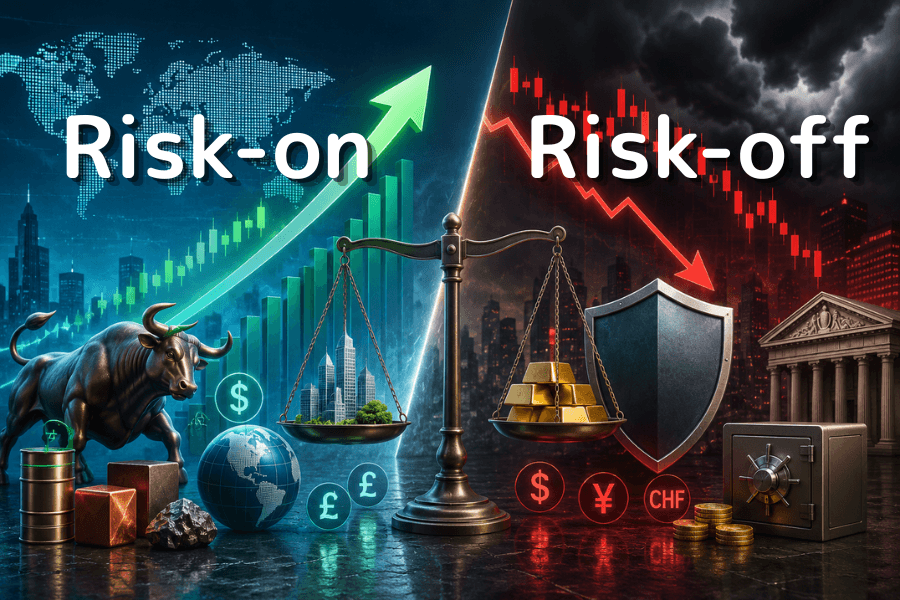
These concepts matter because they give you a framework for understanding where money is going. Much of the time, what really drives currencies, equities, and bonds is the overall risk appetite of global investors, with the fundamentals of any single country taking a back seat. Reading whether the market is leaning Risk-on or Risk-off often tells you more about the big picture than analyzing individual headlines one by one.
This article explains what Risk-on and Risk-off mean, why markets switch between them, how they affect the currency market, which indicators you can use to observe them, and how traders should think about risk sentiment.
- Risk-on means capital flows into risk assets; Risk-off means capital retreats into safe-haven assets. Markets swing between the two.
- In Risk-on phases, commodity currencies, emerging-market currencies, and equities tend to strengthen; in Risk-off phases, the yen, the Swiss franc, gold, and government bonds tend to strengthen.
- The triggers for a switch include economic data, central-bank policy, geopolitics, and sudden shocks.
- Common risk-sentiment indicators include the VIX (the fear gauge), equity indices, gold, the yen, and government-bond yields.
- Risk sentiment is the market-wide "backdrop." Understanding it helps you judge the broad direction, but it can shift fast, so it should not be used as a standalone entry signal.
1. What Are Risk-on and Risk-off?
Risk-on and Risk-off are a pair of relative concepts the market uses to describe overall investor sentiment, often abbreviated in English as "RORO."
When the economic outlook looks optimistic and market confidence is high, investors are willing to chase higher returns and take on more risk, so capital flows into risk assets such as equities, commodity currencies, and emerging-market assets. That state is Risk-on. Conversely, when unease, fear, or uncertainty rises, investors prioritize protecting their capital, and money leaves risk assets for relatively safe alternatives. That state is Risk-off.
The key thing to grasp is that Risk-on and Risk-off describe the overall tilt of market sentiment — the aggregate flow of money between risk assets and safe-haven assets. It is like the market's "weather," influencing the performance of most assets.
2. Why Do Markets Switch Between the Two?
Risk sentiment shifts constantly as new information arrives. The factors that push the market between Risk-on and Risk-off fall into a few broad categories.
- Economic data: Strong employment, growth, and consumption figures lift confidence and lean toward Risk-on; weak data tends to trigger Risk-off.
- Central-bank policy: Accommodative monetary policy usually supports risk appetite; expectations of tightening or a policy pivot can set off Risk-off.
- Geopolitics and sudden shocks: Geopolitical risk, war, and financial crises can push the market into a strong Risk-off in a very short time.
It is worth noting that the switch can be very fast. Market sentiment can flip from Risk-on to Risk-off within hours on the back of a single headline or data release. That rapid reversal is exactly what makes risk sentiment so hard to pin down — and why it demands vigilance.
3. How Does Risk Sentiment Affect FX?
In the currency market, risk sentiment shows up as a divergence between currencies — currencies with different characters often move in opposite directions during Risk-on and Risk-off.
In Risk-on phases, capital chases higher returns, so commodity currencies (the Australian, New Zealand, and Canadian dollars) and emerging-market currencies typically strengthen, while low-yielding safe-haven currencies are relatively weak.
In Risk-off phases, capital flows back into relatively safe currencies. The most typical are the Japanese yen and the Swiss franc, and the US dollar also plays a safe-haven role in many situations; commodity currencies and emerging-market currencies, by contrast, come under pressure.
This divergence is also closely tied to the carry trade. In Risk-on phases, investors tend to borrow low-yielding currencies to buy higher-yielding ones and pocket the interest differential. Once the market turns Risk-off, these positions are unwound quickly, capital is bought back into the low-yielding safe-haven currencies, and a violent reverse move follows. This is one reason the yen and similar currencies often surge sharply during Risk-off episodes.
4. How Do You Read the Market's Risk Sentiment?
Risk sentiment is invisible, but you can read it through a few commonly cited indicators.
- The VIX (fear gauge): It reflects the market's expectation of future volatility in US equities; a spike usually signals rising fear and Risk-off.
- Equity indices: Broad gains across major stock markets usually correspond to Risk-on, while a broad sell-off is often a Risk-off signal.
- Gold and government bonds: As traditional safe-haven assets, gold and major-country government bonds usually attract buying in Risk-off phases, and yields fall.
- Safe-haven currencies: The strength of the yen and the Swiss franc is itself a thermometer of market risk sentiment.
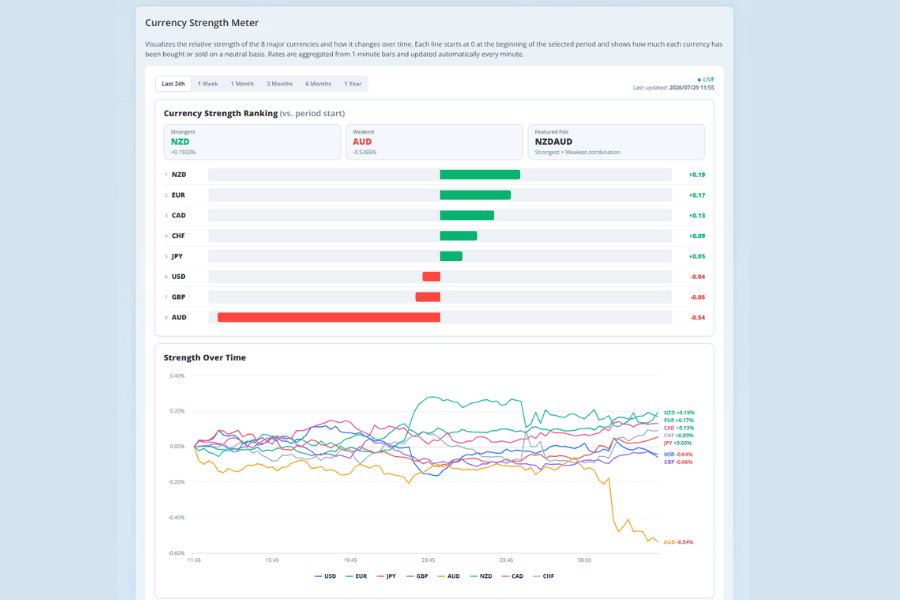
In practice, traders cross-reference these indicators to judge the overall tilt of the market. When you want to see the relative strength of each currency at a glance, the Currency Strength Meter helps: it visualizes the strength ranking of the major currencies, so you can quickly tell whether commodity currencies (the Australian, New Zealand, and Canadian dollars) or safe-haven currencies (the yen and the Swiss franc) are stronger right now — which maps directly onto a Risk-on or Risk-off tilt.
5. How Traders Think About Risk Sentiment
For traders, risk sentiment is a framework for judging the broad environment; it can rarely be used directly as a precise buy or sell signal. In practice, you can apply it from a few angles.
First, go with the broad environment. In a clear Risk-off market, going long commodity currencies or shorting the yen against the trend is usually a thankless task. Confirming whether the market is leaning Risk-on or Risk-off first, then choosing a direction that follows the trend, is generally more robust.
Second, watch for extremes and turning points. When risk sentiment reaches an extreme — for example, the VIX spiking to a very high level and safe-haven assets rallying hard — the market may also be setting up for a reversal. After an extreme Risk-off, capital often flows quickly back into risk assets once the panic eases.
Finally, keep your expectations realistic. Risk-on and Risk-off are powerful tools for understanding capital flows, but they are influenced by many factors such as central banks and geopolitics, and they can shift quickly. Treating risk sentiment as a thermometer for reading the market's mood, and combining it with other analysis, is more reliable than relying on it alone.
6. Risk-on / Risk-off FAQ
Q1: What do Risk-on and Risk-off mean?
Risk-on describes a market that is optimistic and where investors are willing to take on risk, so capital flows into risk assets such as equities and commodity currencies. Risk-off describes a market gripped by fear and focused on protecting capital, so money retreats into safe-haven assets such as the yen, the Swiss franc, gold, and government bonds. Markets swing back and forth between these two modes.
Q2: Which currencies are safe-haven currencies, and which are risk currencies?
The most typical safe-haven currencies are the Japanese yen and the Swiss franc, and the US dollar has safe-haven characteristics in many situations. Risk currencies are represented by commodity currencies such as the Australian, New Zealand, and Canadian dollars, along with emerging-market currencies. In Risk-off phases the former tend to strengthen and the latter to weaken; in Risk-on phases it is the reverse.
Q3: Why does the yen often surge during Risk-off?
Beyond the yen's own safe-haven status, it has to do with the unwinding of carry trades. When markets are calm, investors often borrow the low-yielding yen to buy higher-yielding assets; once the market turns Risk-off, these positions are unwound quickly and the yen is bought back, pushing it up in a short space of time. As a result, the yen's rallies in Risk-off markets tend to be fast and sharp.
Q4: What can you use to gauge the market's risk sentiment?
Common gauges include the VIX (the fear gauge), the major equity indices, gold and government-bond yields, and the strength of safe-haven currencies such as the yen and the Swiss franc. Cross-referencing these indicators helps you judge whether the market is leaning Risk-on or Risk-off. Looking at just one can be misleading, so viewing several together is more reliable.
7. Summary
Risk-on and Risk-off describe the overall tilt of market sentiment: in the former, capital chases risk assets; in the latter, it retreats into safe-haven assets — and the market swings between the two. In FX, this sentiment produces a divergence between currencies: commodity currencies strengthen in Risk-on phases, while the yen and the Swiss franc strengthen in Risk-off phases.
The value of understanding risk sentiment lies in the framework it gives you for judging capital flows and the broad direction. By observing it alongside indicators such as the VIX, equities, gold, and safe-haven currencies, and by going with the environment of the moment, you can read the market more calmly even when sentiment switches rapidly. It works more like a thermometer for the market's mood — a useful backdrop for your judgment.
Further Reading
- What Is a Black Swan Event?
- What Is Volatility?
- What Is Gold CFD Trading?
- The Lehman Brothers Crisis and the 2008 Global Financial Crisis
- FX Trading Basics: An Introduction to Forex Margin Trading
The financial market research and analysis team at Titan FX. We produce educational content for investors across a wide range of instruments, including foreign exchange (FX), commodities (crude oil, precious metals, agricultural products), equity indices, US stocks, and crypto assets.
Primary Sources (by category)
- Market data: Titan FX real-time rates and spread information for each currency pair; historical data for the VIX index, major equity indices, gold, and government-bond yields
- Research and reference: General explanations of Risk-on / Risk-off, safe-haven currencies, and the carry trade from major investment-education resources (Investopedia and others)
- Market observation: The relative performance of the yen, the Swiss franc, gold, and commodity currencies during past Risk-off episodes (such as the 2008 Global Financial Crisis)