

Interest Rate Parity
Interest rate parity (IRP) is a financial theory that links the interest rate differential between two currencies to their exchange rate: the same funds should earn the same return in either currency once exchange rates are taken into account. It comes in two versions — covered interest rate parity (CIP), where the future exchange rate is locked in with a forward contract, and uncovered interest rate parity (UIP), where it is left open. The forward rates, currency futures bases, and swap charges traders face every day are all priced off this rate differential.
To most traders, interest rate parity sounds like a textbook concept. In practice it shows up in the account every day: the swap paid or received for holding a position overnight, the gap between currency futures and spot, the forward rates banks quote — behind each of them sits the interest rate differential between two currencies. Understanding IRP means understanding where these costs and price gaps come from.
This article covers the core idea of interest rate parity, the difference between the covered and uncovered versions, how IRP relates to swaps and futures bases, how it differs from purchasing power parity, and how traders can put the framework to use.
- Interest rate parity (IRP) describes the equilibrium between two currencies' interest rate gap and their exchange rate, in two versions: covered (CIP) and uncovered (UIP).
- Covered (CIP): the exchange rate is locked in with a forward contract; the rate gap is offset by the forward-spot spread, making CIP the pricing benchmark for forwards.
- Uncovered (UIP): no hedge is used; in theory the high-yield currency should depreciate enough to offset the gap, but the evidence often disagrees over short and medium horizons.
- Forward points, futures bases, and swaps are all tied to the rate differential, yet each market structures and prices them differently.
- CIP is about pricing today; UIP is about expectations for the future. Neither is a standalone tool for predicting short-term direction.
- 1. What Is Interest Rate Parity?
- 2. Covered Interest Rate Parity (CIP): How Forward Rates Are Priced
- 3. Uncovered Interest Rate Parity (UIP) and the Carry Trade
- 4. IRP in Your Trading Account: Swaps, Bases, and Forward Points
- 5. Interest Rate Parity vs Purchasing Power Parity (PPP)
- 6. How Traders Can Use Interest Rate Parity
- 7. Interest Rate Parity FAQ
- 8. Summary
1. What Is Interest Rate Parity?
Interest rate parity (IRP) rests on one idea: when capital can move freely, the same funds should end up with the same return in either currency once the exchange rate is accounted for. Arbitrage is the force that keeps this equilibrium in place.
Suppose US dollar deposits yield 5% and Japanese yen deposits yield 1%. Looking at interest alone, swapping yen for dollars appears to earn an extra 4% a year. Markets do not leave free lunches on the table: the extra 4% gets clawed back through the exchange rate, and the clawback can happen in two ways — which is exactly why IRP comes in two versions.
Covered interest rate parity (CIP): at the same time you deposit the dollars, you lock in the rate for converting back to yen a year later using a forward contract. "Covered" means the currency risk has been covered up. The forward rate will already sit below the spot rate, and the currency loss on conversion exactly offsets the extra interest earned.
Uncovered interest rate parity (UIP): you leave the exchange rate open and convert back at whatever the market offers in a year. In theory, the high-yield currency is expected to depreciate by the size of the rate gap, so on average the extra interest still disappears. That is only an expectation, though — no mechanism guarantees it.
The two versions could hardly differ more in nature: CIP is a pricing relationship pinned down by arbitrage, while UIP is an expectations hypothesis that reality frequently breaks. The next sections take them in turn.
2. Covered Interest Rate Parity (CIP): How Forward Rates Are Priced
Continuing with the same numbers, here is covered arbitrage in action. Spot USD/JPY is 150.00, dollar rates are 5%, yen rates are 1% — and suppose the forward rate is also stuck at 150. The idea is to borrow the cheap yen, hold dollars at the higher rate, and convert back at the pre-locked forward rate to repay the loan. The table shows the full cash flow:
| Timing | Action | JPY | USD |
|---|---|---|---|
| Start | ① Borrow yen (1% p.a.) | +1,500,000 | — |
| Start | ② Convert it all at spot 150.00 | −1,500,000 | +10,000 |
| Start | ③ Sign a forward contract to sell dollars at 150.00 in one year (a price lock only — no cash moves) | — | — |
| One year later | ④ Dollar deposit matures (5% p.a.) | — | 10,000 → 10,500 |
| One year later | ⑤ Convert back at the forward rate of 150.00 | +1,575,000 | −10,500 |
| One year later | ⑥ Repay yen principal and interest | −1,515,000 | — |
| Net result | +60,000 | 0 |
Every condition is fixed at the start; a year later you simply execute the table. Ignoring transaction costs and funding constraints, the ¥60,000 is a riskless profit.
Riskless profit attracts arbitrage capital in size, and that flow pushes the forward rate down to the level where the rate gap exactly disappears:
Forward rate = Spot rate × (1 + quote-currency rate) ÷ (1 + base-currency rate)
Exchange rates are quoted as "1 unit of the base currency = X units of the quote currency" (USD/JPY = 150 means 1 dollar = 150 yen); interest is simplified to one-year simple rates. Plugging in the example: 150.00 × 1.01 ÷ 1.05 ≈ 144.29
In other words, forward USD/JPY has to settle near 144.29, almost 6 yen below spot. That generalizes into a rule: under CIP conditions, the higher-yielding currency usually trades at a forward discount, and the lower-yielding currency at a forward premium.
Two caveats. First, this is the product of arbitrage pricing; it says nothing about where the market thinks the exchange rate is heading. Second, when reading whether a specific pair's forward quote is higher or lower, first check which currency is the base and which is the quote — the same rate gap points the number in opposite directions in direct and inverse quotes.
In the interbank market for major currencies, forward quotes are essentially generated from this formula, which is why CIP is treated as the benchmark for forward pricing. The exception emerged after the 2008 global financial crisis: some major currency pairs began showing persistent deviations, measured as the cross-currency basis, driven mainly by bank regulatory costs and demand for dollar funding. For retail traders, the practical effect is that quoted swap rates can drift away from the theoretical rate gap.
3. Uncovered Interest Rate Parity (UIP) and the Carry Trade
Remove the forward contract from the trade above and you have the uncovered (UIP) version: you hold the high-yield currency with the exchange rate left open, bearing the currency risk yourself. UIP claims the high-yield currency is expected to depreciate by exactly the rate gap, so that on average the extra interest gets eaten by currency losses.
The decisive difference between the two versions is whether arbitrage can operate. The four prices involved in CIP — spot, forward, and the two interest rates — can all be traded today, so deviations get arbitraged away at once. Next year's spot rate, however, cannot be traded today; no arbitrage force exists anywhere in the market to pin the future spot to its theoretical value.
And the empirical record shows that UIP frequently fails over short and medium horizons: high-yield currencies do not reliably depreciate as predicted. Over these horizons, exchange rates answer to capital flows, policy expectations, and market sentiment.
The carry trade earns exactly this gap: borrow the low-yield currency, buy the high-yield one, and skip the forward hedge — the interest keeps coming in while the currency risk stays on your book. Whenever the exchange rate fails to depreciate as the theory predicts, the interest differential stays in your pocket. Such stretches occur often enough that the strategy has persisted for decades. The price is tail risk: when markets turn risk-off, high-yield currencies can fall hard, and months of accumulated carry can vanish in days.
Side by side, the two versions compare like this:
| Comparison | Covered (CIP) | Uncovered (UIP) |
|---|---|---|
| Future exchange rate locked? | Yes (hedged with a forward) | No (currency risk stays open) |
| Core relationship | No-arbitrage pricing | Rate gap vs expected currency move |
| Empirical behavior | Benchmark for forward pricing; a cross-currency basis can appear | Often deviates from theory over short/medium horizons |
| Related market activity | Forward points, FX swap pricing | Carry trades, currency views |
4. IRP in Your Trading Account: Swaps, Bases, and Forward Points
Retail traders never run covered arbitrage themselves, yet interest rate parity shows up on the account statement every day. The same rate differential takes a different form in each of three markets:
| Form | Where it appears | Settlement |
|---|---|---|
| Forward points | Interbank forward market | Once, at maturity |
| Futures basis | Currency futures | Converges toward expiry; realized on rollover |
| Swap | Margin FX trading | Credited or debited daily |
In margin trading, the swap works like this in theory: the side holding the relatively higher-yielding currency receives it, and the other side pays. Actual quotes, though, reference short-term funding rates and add the broker's markup, so long and short swaps can both be negative at the same time. Don't infer the direction from two policy rates alone — check the actual numbers in the swap history before placing the trade.
Currency futures carry no daily swap: the rate differential is priced once into the futures-spot gap (the basis), which converges as expiry approaches. All three forms are driven by rate differentials and carrying costs, but their market structures and calculations differ, so the numbers cannot simply be set equal to one another.
5. Interest Rate Parity vs Purchasing Power Parity (PPP)
Purchasing power parity (PPP) is another equilibrium theory of exchange rates with a similar name, but the two cut in from entirely different angles:
| Dimension | Interest rate parity (IRP) | Purchasing power parity (PPP) |
|---|---|---|
| Core variables | Interest rates, spot and forward rates | Price levels in the two countries |
| Main use | CIP explains forward pricing; UIP links rate gaps to currency expectations | Judging long-run over- or undervaluation |
| Time horizon | CIP is today's no-arbitrage pricing; UIP concerns future expectations | Long-run analysis measured in years |
| Angle | Financial (capital and rate gaps) | Real economy (goods and prices) |
To view the interest-rate line and the price line together, the real interest rate helps: the return gap left after subtracting expected inflation adds the perspective that nominal rate gaps alone miss.
6. How Traders Can Use Interest Rate Parity
① Know where your carrying cost comes from. A positive swap adds a small cash inflow every day the position is held; a negative one is a cost that accumulates with time. Before holding for the long term, confirm the direction and size and build it into your P&L target — its source is the rate differential plus funding costs and markup.
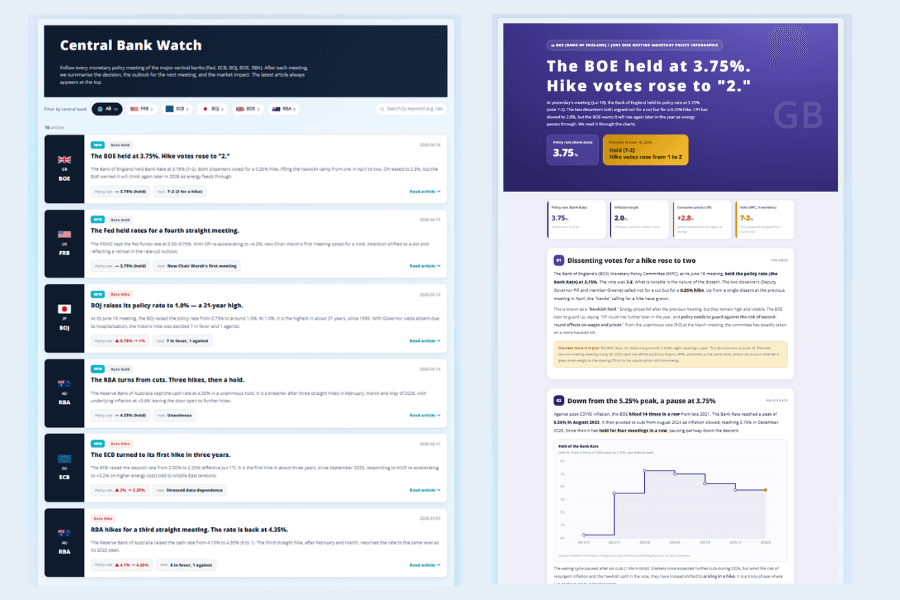
② Track the rate differential as it changes. Today's number is only the starting point. What moves the differential is the two central banks' policy rates and the market's expected rate path. When central banks hike, cut, or adjust forward guidance, forward points and swaps move with them — around major decisions, avoid treating your current swap income as a given. The latest policy rates and central bank news are collected in one place:
③ Separate structural costs from market direction. Interest rate parity governs the structure of price gaps — forward points, bases, swaps — while short-term exchange rates are still driven by flows, sentiment, and events. Carry trades in particular need protection against risk-off selloffs: the rate differential pays a slow trickle, while the currency risk can be realized all at once.
7. Interest Rate Parity FAQ
Q1: Does interest rate parity always hold?
It depends on the version. CIP is the benchmark for forward pricing: in an ideal market, deviations are arbitraged away quickly, while in practice funding and regulatory constraints can leave a persistent cross-currency basis. UIP is a theoretical relationship about expectations, and the evidence shows it often fails over short and medium horizons.
Q2: Is the forward rate the market's forecast of the future exchange rate?
The forward rate is computed from the spot rate plus the interest rate differential — an arbitrage price with no forecast content of its own. Under CIP pricing, when dollar rates exceed yen rates, the theoretical forward USD/JPY sits below spot. That reflects the existence of the rate gap, which is a different thing from "the market expects the dollar to fall."
Q3: Why doesn't a high-yield currency always appreciate?
High rates can reflect high inflation, an overheating economy, or tight monetary policy, so the nominal rate level alone cannot tell you a currency's direction. Short- and medium-term exchange rates also answer to flows and sentiment: carry inflows can lift a high-yield currency, and when risk aversion spikes, the same money exits together — the declines tend to be fast and deep.
Q4: How is interest rate parity related to the overnight swap?
They share the same pricing background. You can loosely think of the swap as the rate differential showing up daily on an open position — but it references short-term funding rates and includes the broker's markup, so it will not simply equal the theoretical differential divided by the number of days.
Q5: What separates covered from uncovered interest rate parity?
Whether the currency risk is locked. Covered (CIP) fixes the conversion rate with a forward contract and, under idealized conditions, is a no-arbitrage pricing relationship. Uncovered (UIP) leaves the rate open, the investor bears the currency swings, and the theory's predictions are frequently broken by the market.
Q6: If the rate differential widens, will the pair move toward the higher-yielding currency?
Not necessarily. Markets trade expectations: if the wider differential was already priced in, the announcement may move nothing, or even move the pair the other way. Risk sentiment is another major driver of carry flows — however wide the differential, a risk-off wave still knocks high-yield currencies down hard. The differential sets the backdrop; direction needs price action and sentiment on top.
8. Summary
Interest rate parity translates rate differentials into prices. The covered version (CIP) carves the differential into forward rates and futures bases through arbitrage; the uncovered version (UIP) extends it into expectations for future exchange rates, and its empirical failures created the room in which the carry trade lives.
For traders, the value of IRP lies in reading what happens in the account every day: why swaps are positive here and negative there, why futures trade away from spot, why forwards deviate from the spot rate — direct arbitrage itself remains the interbank market's business. Once the structural costs set by rate differentials are separated from the market direction set by supply and demand, both cost management and entry and exit decisions stand on firmer ground.
Further Reading
- What Is a Rate Hike? (Raising Interest Rates)
- What Is the Federal Funds Rate?
- What Is Forward Guidance?
- What Are Exchange Rates?
- What Is Inflation?
The financial market research and analysis team at Titan FX. We produce educational content for investors across a wide range of instruments, including foreign exchange (FX), commodities (crude oil, precious metals, agricultural products), equity indices, US stocks, and crypto assets.
Primary Sources (by Category)
- Theory: J. M. Keynes, "A Tract on Monetary Reform" (1923), an early systematic treatment of interest rate parity; the interest-rate-parity and exchange-rate chapters of Krugman & Obstfeld, "International Economics"
- Market research: BIS (Bank for International Settlements) research on covered interest parity deviations (the cross-currency basis); CME Group currency futures contract specifications and pricing notes
- Rate data: The Federal Reserve's federal funds rate; the Bank of Japan's policy rate; Titan FX swap history by instrument