

What Are FX Futures? Contract Specs, Differences from Spot FX & the COT Report
FX futures (currency futures) are standardized contracts listed on an exchange, committing two parties to exchange two currencies on a fixed future date at a rate agreed today. They trade the same exchange rates as the spot forex (margin/CFD) trading most retail investors know — but the venue, contract specifications, leverage, expiry mechanics, and cost structure are fundamentally different.
FX futures were born in 1972. As the Bretton Woods system collapsed and major currencies moved to floating rates, the Chicago Mercantile Exchange (CME) created the International Monetary Market (IMM) and listed the world's first financial futures — on currencies. CME remains the global hub of FX futures today; still, across the foreign exchange market as a whole, the vast majority of turnover happens in the interbank and retail over-the-counter (OTC) market, with exchange-traded futures accounting for only a small slice.
For most retail traders, this guide pays off in two ways: first, understanding exactly how FX futures differ from the spot FX you already trade, so you can judge which product fits you; second, learning to use the futures market's public data — above all the COT positioning report — as a window into institutional flows for your spot trading.
- FX futures are standardized, exchange-listed currency contracts, first launched by CME in 1972 as the world's earliest financial futures.
- Specifications are fixed (one euro contract = 125,000 EUR) with quarterly expiries in March, June, September, and December; keeping a position requires rolling over. Spot FX offers flexible lot sizes and no expiry.
- CME's major currency futures are all quoted as "US dollars per unit of foreign currency," so the yen futures chart moves inversely to spot USD/JPY.
- The gap between futures and spot prices (the basis) reflects the interest-rate differential — the same thing spot traders pay or receive daily as swap, in a different form.
- Futures positioning is published weekly: the CFTC's COT report reveals large speculators' longs and shorts, a valuable institutional-sentiment reference for spot traders.
1. What Are FX Futures?
FX futures are futures contracts whose underlying asset is a currency: buyer and seller agree, through an exchange, to swap set amounts of two currencies on a specific future date at the rate fixed when the trade is struck. For the general mechanics of futures as a product — margin, daily mark-to-market, settlement — start with our futures trading primer; this article focuses on the currency underlying and the comparison with spot FX.
The birth of FX futures marks a turning point in market history. In 1971 the US dollar's link to gold was severed and Bretton Woods unraveled; major exchange rates began to float, and companies and financial institutions faced large-scale currency risk for the first time. In May 1972 the Chicago Mercantile Exchange founded the International Monetary Market (IMM) and listed the world's first financial futures — seven currency contracts — giving hedging demand a centralized, standardized venue. Until then, futures markets had traded only physical commodities such as grains and metals.
Today's FX futures market centers on CME, with the main contracts covering the euro, yen, pound, Australian dollar, Canadian dollar, and Swiss franc against the US dollar. Participants are predominantly institutional: corporates locking in exchange costs, asset managers hedging currency exposure, funds expressing directional views. Retail investors, by contrast, access currency markets almost entirely through brokers in the over-the-counter margin-trading structure — and that is the first fork in the road between the two products.
2. Contract Specifications: CME as the Example
Everything about a futures contract is standardized — size, expiry, quoting convention — all set by the exchange. Before reading the specs, remember the single point that trips up chart readers most: currency futures are uniformly quoted as "foreign currency against the dollar," so the yen futures chart is the exact inverse of spot USD/JPY (details under Point 1). Here are CME's flagship currency futures:
| Contract (code) | Size per contract | Quoted as |
|---|---|---|
| Euro FX (6E) | 125,000 EUR | USD per EUR |
| Japanese Yen (6J) | 12,500,000 JPY | USD per JPY |
| British Pound (6B) | 62,500 GBP | USD per GBP |
| Australian Dollar (6A) | 100,000 AUD | USD per AUD |
| Canadian Dollar (6C) | 100,000 CAD | USD per CAD |
Three points in the specifications deserve a closer look.
Point 1: All quotes run "foreign currency first"
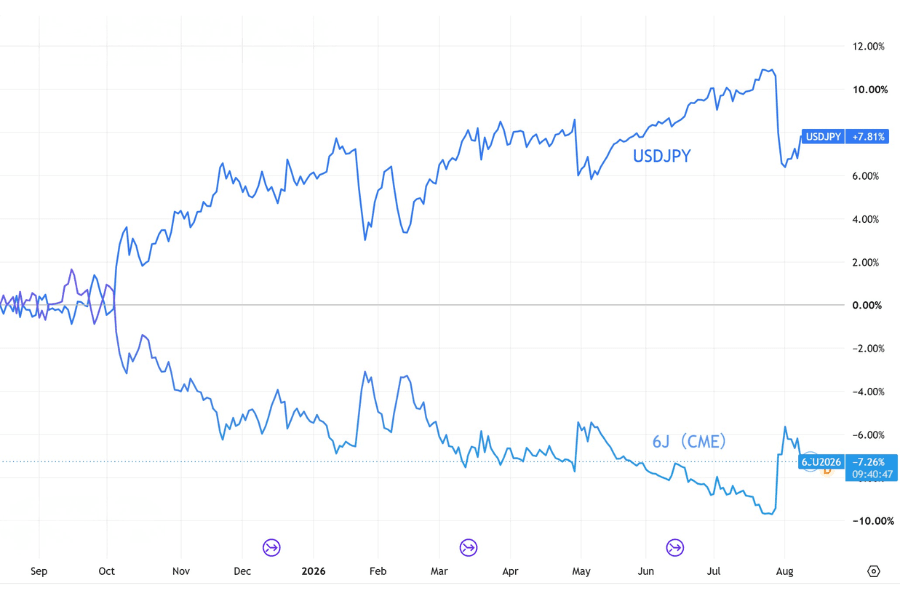
CME's major G10 currency futures are quoted as "US dollars per one unit of foreign currency" (conventions can differ on other exchanges or products). For the euro, pound, and Australian dollar this matches spot convention — EUR/USD, GBP/USD, and AUD/USD already put the foreign currency first. The yen is the exception: spot convention is USD/JPY (yen per dollar), while yen futures 6J quote "dollars per yen" (roughly 0.006–0.007). So when the yen strengthens, 6J futures rise while spot USD/JPY falls — the two charts are natural mirror images, and you must check the direction before reading either one.
Point 2: The fixed quarterly expiry cycle
Currency futures run on a March–June–September–December quarterly cycle, each contract with a defined last trading day (typically two business days before the third Wednesday of the expiry month). To hold a position long term you must "roll over" before expiry — close the near-month contract and open the next month — absorbing the price gap between months plus transaction costs.
Point 3: Physical delivery in principle — which most traders never see
CME's major G10 currency futures settle by physical delivery at expiry (an actual exchange of bank balances in the two currencies); some products, such as certain emerging-market currency futures, are cash-settled instead. In practice, the vast majority of positions are closed or rolled before expiry; only a minority of institutions with genuine conversion needs go through delivery.
CME also lists micro contracts at one-tenth standard size (Micro FX Futures — the micro euro contract M6E covers 12,500 EUR), lowering the entry bar, though total capital requirements still exceed the micro lots of spot margin trading.
3. FX Futures vs Spot FX: Seven Differences
Trading "the ups and downs of EUR/USD" feels very different in futures and in spot (margin/CFD):
| Comparison | FX futures | Spot FX (margin/CFD) |
|---|---|---|
| Venue | Centralized exchange matching (CME) | Over the counter, against a broker or liquidity provider |
| Contract unit | Standardized (6E = 125,000 EUR per contract) | Flexible lots, down to 0.01 or less |
| Price & transparency | One market-wide traded price; volume and open interest published | Quotes vary slightly by broker; no centralized positioning data |
| Leverage | Set by exchange margin, typically tens of times | Flexible retail terms — up to 1,000:1 at Titan FX |
| Holding period | Quarterly expiries; close or roll | No expiry; hold indefinitely |
| Carrying cost | Priced into the futures basis, realized at rollover | Daily swap debits/credits |
| Trading hours | CME Globex, about 23 hours × 5 days | 24 hours from Monday to Friday |
Three of these differences matter most in practice:
Difference 1: Capital threshold and position granularity
One futures contract represents a six-figure notional; even a micro contract runs above ten thousand dollars. Spot margin trading starts from 0.01 lots (1,000 units) or less. The granularity for testing strategies and tuning risk is in a different league.
Difference 2: Rollover vs indefinite holding
A futures position faces rollover every quarter: the operation itself costs money, and the spread between months shapes your equity curve. A spot position never expires — the price is a daily swap debit or credit, which compounds into a meaningful amount on long holds.
Difference 3: Price formation and transparency
Futures trade at one price for everyone, with volume and open interest published daily. The spot market is scattered across countless banks and brokers, its price an aggregation of quotes. For traders who care about "how many people are actually positioned on which side," futures data offers what OTC simply cannot.
4. Futures Price vs Spot Price: Basis and Rate Differentials
At any given moment, the euro's futures price and spot price usually differ. That gap is the basis — and its main driver is the interest-rate differential between the two countries.
The logic is straightforward. Buying a future means "agreeing to pay and receive later," so in the meantime your money can sit in the higher-yielding currency. To leave no risk-free arbitrage between "buy spot now" and "agree on future delivery," the futures price must price in that period's rate differential. The result:
- When US rates exceed euro rates, euro futures trade slightly above spot EUR/USD, and the further the expiry, the larger the premium.
- As expiry approaches, fewer differential days remain; the futures price converges on spot until the two meet at expiry.
This systematic relationship between futures and spot prices driven by rate differentials is known in finance as interest rate parity.
To a spot trader, none of this is actually new: the swap you pay or receive each night is the very same rate differential, expressed as a daily settlement. Futures price the differential into the contract once; spot splits it into daily debits and credits — two products charging (or paying) the same money in different ways. Actual swap rates by instrument are listed in the Titan FX swap history.
5. Useful Even If You Only Trade Spot: The COT Report
The greatest public good the futures market produces is its positioning transparency. Every Friday the US Commodity Futures Trading Commission (CFTC) publishes the COT report (Commitments of Traders, compiled as of Tuesday), disclosing longs and shorts by trader category in CME currency futures. The net position of the "non-commercial" category — large speculators, mainly funds — is widely read as a proxy for institutional directional sentiment.
Spot traders typically use it three ways:
- Confirm the money behind a trend: when non-commercial net longs grow alongside rising prices, the trend has real capital behind it.
- Watch for crowded extremes: when net positioning hits historic extremes, reversals are often near — the crowded side has run out of new buyers.
- Benchmark your own view: knowing whether you stand with or against the large traders tells you, at minimum, whose side you are on.
Titan FX charts the CFTC's weekly data so that longs, shorts, and net positioning for the major currencies can be read at a glance:
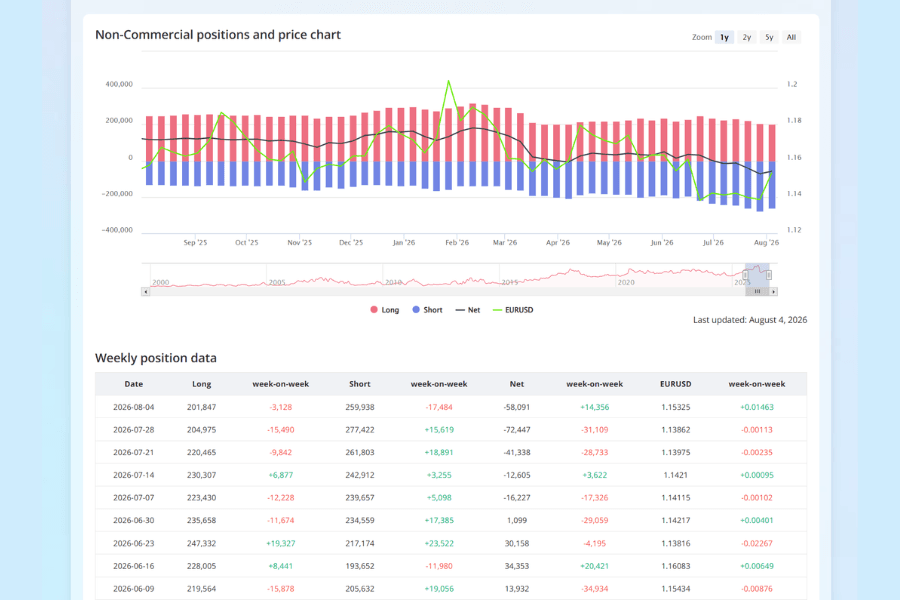
Two caveats: COT covers large-trader positions in CME futures, not the whole (mostly OTC) forex market; and it is a once-a-week delayed snapshot — suited to medium-term directional context, not same-day entry signals.
6. Strengths and Limitations
From a retail investor's viewpoint, each product has a clear home turf.
Strengths of FX futures:
-
Central clearing, low counterparty risk: the exchange clearinghouse stands behind every trade, so default risk is absorbed by the system.
-
Transparent prices and positioning: one traded price, published volume and open interest — the market's structure is open to inspection.
-
Clear-cut costs: commissions are charged per contract, and quotes do not widen the way OTC spreads can when liquidity providers adjust; a centralized market still has bid-ask spreads and slippage, though, and they too widen in extreme conditions.
Limitations of FX futures:
-
High capital threshold: standard contracts run six-figure notionals; even micros exceed spot micro lots, so capital flexibility is inferior.
-
Expiry management is mandatory: quarterly rollovers are unavoidable homework, adding operational and cost complexity.
-
Liquidity concentrates in one session: Globex is open nearly all day, but depth clusters in US hours; Asian-session depth is thin compared with spot's Tokyo session.
-
Account and data costs: a futures account, exchange data subscriptions, and platform fees make the entry bar higher than opening one spot account.
In short, the two products' typical users split like this:
-
FX futures suit: corporates and institutions hedging currency risk, larger traders who prize central clearing and positioning transparency, and anyone researching COT and volume data in depth.
-
Spot margin/CFD trading suits: everyday retail investors who value capital flexibility (from 0.01 lots), adjustable leverage, and 24-hour continuous trading.
Whichever you trade, the futures market's public data belongs in your analytical toolbox.
Trade Forex CFDs with Titan FX
Titan FX offers 50+ currency pair CFDs on MT4/MT5 with up to 1,000:1 leverage on major pairs, tight spreads, and the flexibility to go long or short. Micro accounts can reach up to 2,000:1 leverage when eligible.
7. FAQ
Q1: Can I trade FX futures with Titan FX?
Titan FX offers CFDs on spot forex rates across roughly 60 currency pairs — not exchange-listed futures. The futures market's positioning data is free to use, though: our CFTC large-trader positioning page updates the charted COT report weekly (see Section 5).
Q2: Why do yen futures move opposite to USD/JPY?
Because the quoting direction is inverted. CME yen futures (6J) quote "dollars per yen," while spot convention is "yen per dollar." When the yen strengthens, 6J rises and USD/JPY falls — mirror images. When you consult futures charts for spot trading, translate the direction first.
Q3: Futures or spot — where should a beginner start?
Most beginners are better served starting with spot margin trading: the capital threshold is low (from 0.01 lots), there is no expiry, and the market runs 24 hours, so the learning curve is gentler. Futures contract sizes and rollover management demand more capital and experience. Either way, practice on a demo account before committing real funds.
Q4: Do FX futures charge daily swap?
No. Futures have no daily swap debits or credits — the rate differential is priced into the basis between futures and spot all at once, converging as expiry approaches, with the carrying cost realized at rollover. Spot margin trading splits the same differential into daily swap payments. You pay the same thing either way; only the form differs (see Section 4).
Q5: What is a rollover?
Futures contracts expire. To keep a position, you close the expiring near-month contract before its last trading day and simultaneously open the next month's contract. That operation is the rollover. It costs the price gap between months (reflecting the remaining rate differential) plus transaction fees — unavoidable maintenance for long-term futures positions.
Q6: Where can I read the COT report, and how often is it updated?
The CFTC publishes every Friday (US time), with data compiled as of that Tuesday. The raw report lives on the CFTC website in table form and takes effort to parse; the Titan FX large-trader positioning page charts the major currencies' non-commercial longs, shorts, and net positions against the exchange rate for a much quicker read.
8. Conclusion
FX futures are standardized, exchange-listed currency contracts: fixed specifications, quarterly expiries, central clearing, published positioning. Born at CME in 1972, they remain the institutional tool of choice for managing currency risk and expressing directional views. They trade the same exchange rates as spot FX while living in a different world of contract flexibility, leverage, holding mechanics, and costs — futures price the rate differential into the basis and settle it at rollover; spot splits it into daily swap; futures demand expiry management; spot can be held indefinitely.
For retail investors, the rational conclusion is rarely "switch to futures." It is trade spot, read futures: keep the capital and leverage flexibility of margin trading, while folding the futures market's COT positioning and open-interest data into your framework — letting institutions' public footprints serve as one more check on your directional views.
Further Reading
- Forex Market Hours: Global Sessions and Active Windows
- What Is a Lot? Calculating Position Sizes in Forex and CFDs
- Pending Orders Explained: MT5/MT4 Order Types and Usage
- Margin Closeouts: Impact and Countermeasures
- Forex Glossary: Terms Every Trader Should Know
Titan FX Trading Strategy Lab. We produce investor-education content covering forex, commodities (crude oil, precious metals, agricultural goods), stock indices, US equities, and digital assets.
Primary Sources (by Category)
- Exchange and contract specifications: CME Group currency futures contract specs (Euro FX, Japanese Yen, etc.) and IMM historical materials
- Positioning data: US Commodity Futures Trading Commission (CFTC) Commitments of Traders (COT) weekly reports
- FX market statistics: BIS Triennial Central Bank Survey 2022 (OTC vs exchange-traded FX structure)