

Real Interest Rate
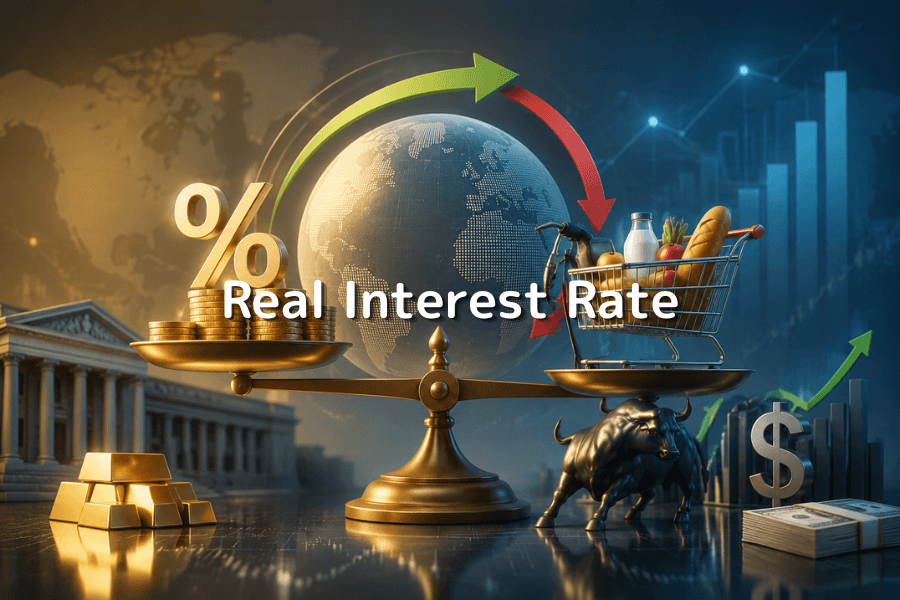
The same 3% deposit rate means something entirely different under 1% inflation than under 5% inflation: in the first case purchasing power is still growing, in the second it is quietly shrinking. The difference is the sign of the real interest rate. It is the same for an investor — whether an asset's return genuinely beats inflation and delivers a positive real return comes down to this figure.
This guide covers what the real interest rate is and how to calculate it, the Fisher equation, the difference between ex-ante and ex-post, what a negative real rate means, how it becomes the pricing anchor for gold, stocks and currencies, and how an individual investor can track it using central bank policy and inflation data.
- Real interest rate ≈ nominal interest rate − inflation rate: it measures the true change in the purchasing power of money, net of rising prices.
- The Fisher equation splits the nominal rate into "real rate + inflation expectations," the core framework for understanding rates and asset prices.
- The ex-ante real rate uses expected inflation and drives today's decisions; the ex-post real rate uses actual inflation and determines the final real return.
- When the nominal rate falls below inflation the real rate is negative: cash loses purchasing power, and money tends to move toward gold, hard assets and risk assets.
- The real rate is the pricing anchor for non-yielding and long-duration assets: a headwind for gold and growth stocks when it rises, a tailwind when it falls.
1. What Is the Real Interest Rate?
The real interest rate is what remains of the nominal rate once the effect of inflation has been subtracted. The question it answers is not "how much interest do I receive," but "how much purchasing power does this money have after prices move."
To follow it, keep two rates apart:
- Nominal interest rate: the rate as contracted on paper — the figure quoted by a bank or printed on a bond's face.
- Real interest rate: the nominal rate net of inflation, representing the actual change in purchasing power.
Take an example. You deposit 100 for a year at a nominal rate of 3% and get back 103. But if prices rose 5% over that year, what used to cost 100 now costs 105. Your 103 cannot buy back the purchasing power that 100 had a year earlier — the number grew, yet what it buys has shrunk. The real interest rate here is negative, about −2%.
Put another way, the nominal rate is the change in the quantity of money; the real rate is the change in its purchasing power. For savers, borrowers and investors alike, it is the latter that actually decides whether wealth rises or falls.
2. Calculation and the Fisher Equation
Before the formulas, one intuition: the nominal rate you demand is really made of two parts. One compensates for the purchasing power lost to inflation; the other is what genuinely adds to your money. The real rate is that second part.
The approximation
The most common way to estimate the real rate is simple:
At a 4% nominal rate and 3% inflation, the real rate is about 1%. This subtraction is accurate enough when inflation is low, and it is the version used most often in practice.
The Fisher equation (exact form)
Strictly, the relationship between the nominal rate, the real rate and inflation is described by the Fisher equation, named after the economist Irving Fisher:
Solving it for the real rate gives the exact version. At a 10% nominal rate and 6% inflation, the approximation gives 4% while the exact form is (1.10 ÷ 1.06) − 1 ≈ 3.77%. The gap is small when both rate and inflation are low, but it widens noticeably under high inflation — at which point subtraction alone is not enough.
The more important use of the Fisher equation is the reverse: breaking the nominal rate into two pieces.
This decomposition is central to understanding rates and asset prices. The nominal rate observed in the market contains two layers at once: the true cost of money (the real rate) and the expectation for future prices (inflation expectations). When Treasury yields rise, the real question is which one is moving — the real rate, or inflation expectations. The two carry completely different meanings for asset prices.
3. Ex-ante and Ex-post: Two Real Rates
The real rate has an easily overlooked detail: which inflation figure goes into the calculation. That gives rise to two different real rates.
A fixed-income purchase makes it concrete. At the moment you place the order you can only estimate the real return using expected inflation; only once the holding period ends and actual inflation is known can the true result be calculated. That before-and-after is exactly the two real rates.
Ex-ante real rate
Calculated with expected inflation. At the point of decision the coming year's actual inflation has not happened yet, so an expected value is all you have. The ex-ante real rate governs the action taken now — whether to save, to borrow, to buy a bond or gold.
Ex-post real rate
Calculated with the inflation that actually occurred. Only after the year has passed and the data is in can the true real rate for that period be worked out. The ex-post real rate determines the final result — whether purchasing power grew or shrank.
The gap between the two comes from the error in inflation expectations. If actual inflation runs well above what was expected, the ex-post real rate ends up far below the ex-ante rate, and borrowers gain at savers' expense. This is why unexpected inflation redistributes wealth between creditors and debtors, a point that matters especially to anyone holding a lot of fixed-rate assets.
4. What a Negative Real Rate Means
When the nominal rate falls below the inflation rate, the real rate is negative. This is not a rare anomaly; it appears whenever inflation runs hot or a central bank deliberately holds rates down. Between 2021 and 2022, major economies saw nominal rates fall well below inflation, pushing real rates clearly negative.
The core meaning of a negative real rate is that cash and deposits steadily lose purchasing power. Leave money still, and the number on paper is unchanged while what it buys shrinks year after year. This reshapes market behavior:
- Cash and deposits lose their appeal: with a negative real return, simply holding money becomes a slow loss.
- Money tends to move out of cash: gold, real estate and equities are seen as ways to resist the erosion of purchasing power, and demand can rise — though where the money actually goes still depends on growth, risk appetite and the liquidity environment at the time.
- Borrowing costs turn negative in real terms: a borrower repays a fixed sum in a depreciating currency, so the real burden eases, which encourages borrowing and investment.
A negative real rate is therefore often read as an easy financial environment, and it offers a gauge of how loose or tight monetary policy is — one distinct from simply raising or cutting rates. And because that looseness feeds straight through to asset prices, investors watch the real rate closely — which is the subject of the next section.
5. How the Real Rate Affects Different Assets
The real rate is watched so closely because it is the pricing anchor for many assets. The same nominal rate means different things against different inflation backdrops, and the real rate folds that backdrop in.
Gold and non-yielding assets
Gold pays no interest, so the cost of holding it is the opportunity cost of not putting that money to work earning interest. When the real rate rises, that opportunity cost climbs and gold looks relatively unattractive; when the real rate falls or turns negative, holding gold costs almost nothing and demand rises.
This is why the real rate is listed as a core variable among the factors that influence gold prices, with gold and the real rate showing a clear inverse relationship over the long run. That said, it is a long-term statistical tendency; in the short run the gold price is also pulled by the dollar, safe-haven demand and market sentiment, and cannot be reduced to "the real rate falls, so gold must rise."
Growth stocks and long-duration assets
Much of a growth stock's value comes from profits in the distant future, and those future profits are discounted back to the present using an interest rate. When the real rate rises, the discount rate climbs, the present value of far-off profits shrinks, and growth stocks and other long-duration assets (such as long-dated bonds) come under pressure; when the real rate falls, the reverse holds. This is why a low-real-rate environment tends to accompany high growth-stock valuations.
The dollar and exchange rates
The real rate also affects the international movement of capital. When one country's real rate is high relative to other major economies, assets denominated in its currency earn a higher real return, capital tends to flow in, and the currency is pushed up. This is one of the logics behind the carry trade, and the mechanism by which real-rate differentials drive exchange rates. What matters is the relative gap with other countries, not the absolute level.
| Situation | Gold | Growth stocks | The currency |
|---|---|---|---|
| Real rate rises | Headwind | Valuation falls | Supported |
| Real rate falls | Tailwind | Valuation improves | Pressured |
6. How to Track the Real Rate Yourself
There is no single official figure for the real rate, but it is built from two public, trackable variables: the nominal rate and inflation. Get a handle on those two and you can estimate it yourself.
Tracking the nominal rate: central bank policy
The nominal rate is anchored to the central bank's policy interest rate. When a central bank raises or cuts rates, it moves the market's nominal rate directly. The first step in judging the direction of the real rate is to stay on top of the major central banks' policy moves and the outlook for the next meeting.

Tracking inflation: price data
The other half of the real rate is inflation, most commonly measured by the Consumer Price Index (CPI). Track the release of CPI and other price data regularly, subtract it from the nominal rate, and you have a rough picture of the current real rate. The release times for this data can be checked in advance on the economic indicators page.

The market-implied real rate
Besides subtracting it yourself, the market also offers a ready-made reference for the real rate: the yield on Treasury Inflation-Protected Securities (TIPS). Issued by the U.S. Treasury, TIPS adjust their principal with inflation, so their yield directly reflects the real rate the market is pricing, and the 10-year TIPS yield is the reference the market most often uses for the long-term real rate.
The difference between a conventional Treasury yield and the TIPS yield of the same maturity is the market-implied "breakeven inflation rate," the market's expectation for future inflation.
7. Real Interest Rate FAQ
Q1: Which matters more, the real rate or the nominal rate?
It depends on the purpose. The nominal rate determines the amount you receive or pay on paper; the real rate determines whether your purchasing power rises or falls. For day-to-day interest calculations the nominal rate is enough, but as soon as you are comparing wealth across time — whether saving pays off, whether borrowing is light, whether an investment truly profits — you have to look at the real rate.
Q2: Can the real rate be negative?
Yes. When the nominal rate falls below the inflation rate, the real rate is negative. That means holding money in savings or cash steadily loses purchasing power. Negative real rates are not unusual in periods of high inflation or when a central bank deliberately holds rates down.
Q3: Why does a rising real rate hurt gold?
Because gold produces no interest. When the real rate rises, the real return on yield-bearing assets such as bonds improves, so holding non-yielding gold means giving up more opportunity cost, and its appeal falls. Conversely, when the real rate falls or turns negative, holding gold costs almost nothing and demand rises.
Q4: What is the difference between the ex-ante and ex-post real rate?
Which inflation figure is used. Ex-ante uses "expected" inflation and is the value you can calculate at the moment of an investment decision; ex-post uses "actual" inflation and can only be worked out after the period ends and the data is published. The gap between them comes from the error in inflation expectations, and that error redistributes wealth between borrowers and savers.
Q5: Where can an individual investor see the real rate?
There is no single official figure, but you can assemble one. Take a policy rate or a bond yield as the nominal rate, subtract the year-on-year CPI, and you have an approximate real rate. For the market-priced version, the yield on Treasury Inflation-Protected Securities (TIPS) directly reflects the real rate the market is pricing in.
Q6: Are the real interest rate and the real yield the same thing?
The concept is the same, with a slight difference in use. "Real interest rate" is the general term for any rate net of inflation; "real yield" usually refers specifically to a bond's yield net of inflation, especially government bonds or TIPS. In asset-allocation discussions, the market often takes the 10-year TIPS yield as the representative measure of the "real yield."
8. Conclusion
The real interest rate returns a rate to its true meaning: the focus is not how much the number on paper grew, but whether purchasing power actually thickened or thinned. Through the Fisher equation, it splits the nominal rate into a "true cost" and "inflation expectations," making visible what is really moving behind a change in market rates.
For an investor, the real rate is a pricing anchor that runs through many assets: the opportunity cost of gold, the discount rate on growth stocks and the relative appeal of a currency all point back to the same variable. It has no single official reading, but by tracking central banks' nominal rates and CPI inflation data, you can gauge its direction yourself — and from there, understand why gold, equities and exchange rates move.
Further Reading
Titan FX Trading Strategy Lab. We produce educational content for investors covering FX, commodities (crude oil, precious metals, agricultural products), stock indices, U.S. equities, and cryptocurrencies.
Primary Sources (by category)
- Academic and theory: Irving Fisher's theory of interest (the Fisher equation); the definitions of nominal and real interest rates in major economics textbooks
- Official data and statistics: U.S. Treasury Inflation-Protected Securities (TIPS) and breakeven inflation rate; consumer price indices (CPI) from national statistical agencies
- Research and reference: general treatments of the real interest rate and asset pricing in major investment education resources (Investopedia, the Federal Reserve's FRED economic data)