

Purchasing Power Parity (PPP)
Purchasing power parity (PPP) is an economic theory used to compare what different currencies can actually buy. It holds that, under ideal conditions, the same goods or services should cost roughly the same once converted at the exchange rate. Because PPP reflects a currency's long-run value, it is also one of the standard tools for analysing exchange rates.
In economics, PPP is widely used to compare price levels, living costs, and the size of economies. The World Bank and the International Monetary Fund (IMF) both use it to calculate GDP and income per capita. In financial markets, it serves as a reference point for analysing currencies, comparing their value, and reading the global economy.
This article covers what purchasing power parity is, the principle behind it, how it is calculated, how the Big Mac Index applies it, and how PPP differs from the market exchange rate — along with its strengths, its limits, and how investors can use it.
- PPP compares the real purchasing power of currencies, on the premise that identical goods should cost about the same once converted at the exchange rate.
- It rests on the law of one price, and splits into absolute PPP, which infers a rate from prices, and relative PPP, which infers rate changes from inflation differentials.
- The Big Mac Index is the best-known application of PPP — useful for grasping the concept, but not a sound basis on its own for judging whether a rate is fair.
- Market rates are driven in the short run by supply and demand, interest rates, and capital flows, so extended departures from PPP are normal rather than exceptional.
- PPP suits long-run currency valuation and cross-country comparison; it is not a short-term forecasting tool.
- 1. What Is Purchasing Power Parity? A Beginner's Introduction to PPP
- 2. How Is PPP Calculated? Theory, Formulas, and the Big Mac Index
- 3. How Does PPP Differ From the Market Exchange Rate?
- 4. What Does PPP Mean for Investors?
- 5. The Strengths and Limits of PPP
- 6. Purchasing Power Parity FAQ
- 7. Summary
1. What Is Purchasing Power Parity? A Beginner's Introduction to PPP
Definition: What PPP Means
Purchasing power parity (PPP) is an economic theory for comparing how much different currencies can actually buy, and one of the core concepts in international economics for measuring a currency's long-run value.
Put simply, if the same item costs roughly the same in two countries once converted at the exchange rate, the two currencies are close to parity in purchasing power. PPP is therefore not only a way to compare price levels — it is also used to assess whether an exchange rate has drifted away from a reasonable value.
Why PPP Matters
Prices, wages, and living costs differ from country to country, so comparing economies purely at market exchange rates can misrepresent what people can actually afford.
That is why the World Bank, the International Monetary Fund (IMF), and the OECD all use purchasing power parity when comparing GDP, income levels, and living costs — it makes economic data comparable across borders.
For investors, PPP is also a tool for analysing the currency market. It helps show whether a currency may be overvalued or undervalued, and serves as a reference when assessing long-run exchange rate trends.
2. How Is PPP Calculated? Theory, Formulas, and the Big Mac Index
The theory rests on the law of one price, and takes two forms: absolute purchasing power parity and relative purchasing power parity.
The first infers a fair exchange rate from prices; the second reads the long-run direction of a rate from differences in inflation.
The Principle: The Law of One Price
The law of one price says that, absent transport costs, tariffs, and other trading frictions, the same good should cost the same in every country once converted at the exchange rate.
PPP takes this as its starting point and works from there to estimate a fair value between two currencies.
Type 1: Absolute PPP
Absolute PPP holds that identical goods should end up at the same price across countries once converted, which means prices can be used to estimate a fair exchange rate.
The formula:
PPP rate = domestic price ÷ foreign priceSay a coffee costs 5 dollars in the US and 4 euros in the eurozone. Absolute PPP then gives:
5 dollars ÷ 4 euros = roughly 1.25 dollars per euro (EUR/USD around 1.25)If the market rate sits well away from that level, one of the two currencies may be relatively overvalued or undervalued.
Type 2: Relative PPP
Relative PPP holds that exchange rates adjust gradually in line with the difference in inflation between two countries.
If one country's inflation runs persistently higher than another's, its currency loses purchasing power over time, and the exchange rate tends to depreciate to reflect the divergence in prices.
The formula:
Change in exchange rate ≈ domestic inflation − foreign inflationThis is why, when analysing long-run currency trends, markets watch CPI and other inflation data alongside interest rate policy.
The Application: How the Big Mac Index Reflects PPP
The Big Mac Index, created by the British magazine The Economist, is the most recognisable application of purchasing power parity. Because the Big Mac sold in McDonald's outlets worldwide is a fairly consistent product, it is often used to compare the purchasing power of different currencies.
If a Big Mac costs 6 dollars in the US and the equivalent of only 4 dollars elsewhere, that country's currency may be relatively undervalued. If it costs more than in the US, the currency may be on the expensive side.
That said, Big Mac prices also reflect rent, labour costs, taxes, and input prices. The index is best treated as a way to understand the concept of PPP, not as a standalone verdict on whether an exchange rate is fair.
3. How Does PPP Differ From the Market Exchange Rate?
Both relate to the value of a currency, but they mean different things. PPP assesses long-run purchasing power; the market exchange rate is the live price formed by daily trading in the currency market.
PPP vs the Market Exchange Rate
| Purchasing power parity (PPP) | Market exchange rate | |
|---|---|---|
| How it is set | Estimated from price levels in two countries | Determined by market supply and demand |
| Main drivers | Goods prices, purchasing power | Interest rates, capital flows, policy, sentiment |
| Time horizon | Long-run analysis | The current market price |
| Main use | Judging whether a currency is over- or undervalued | International transactions and currency trading |
Because the market rate also responds to interest rate policy, cross-border capital flows, trade costs, and sentiment, gaps against the PPP estimate are common over shorter horizons.
The Gap Is Normal, Not an Anomaly
One idea worth internalising: a market rate sitting well away from PPP for a long stretch is the normal state of affairs, not a malfunction.
The general view is that it takes years for an exchange rate to converge toward its PPP level. In other words, even when a currency looks relatively undervalued, that gap can persist for a very long time.
For investors, PPP is the better lens on a currency's long-run value, while the market rate more faithfully reflects current supply, demand, and trading conditions.
4. What Does PPP Mean for Investors?
PPP cannot forecast short-term currency moves with any precision, but it remains an important reference for assessing long-run value in currency markets and macroeconomic analysis. Research houses, investment banks, and market analysts routinely fold it into their currency valuation work.
Use 1: Assessing Whether a Currency Is Over- or Undervalued
When the market rate and the PPP estimate diverge substantially, the currency may have moved away from its long-run fair value.
If the market rate sits clearly above the PPP estimate, the currency may be overvalued; if it stays below it for an extended period, it may be undervalued. This does not mean the rate will snap back to fair value — it points to a direction for observing long-run value, nothing more.
Use 2: Reading Long-Run Rates Alongside Fundamentals
PPP is frequently analysed together with GDP, CPI, inflation, and growth data, which helps show whether a currency's purchasing power is shifting.
The World Bank, the IMF, and similar institutions also publish PPP-adjusted GDP, making the size of economies and standards of living easier to compare across countries.
Tools: Tracking Economic Indicators
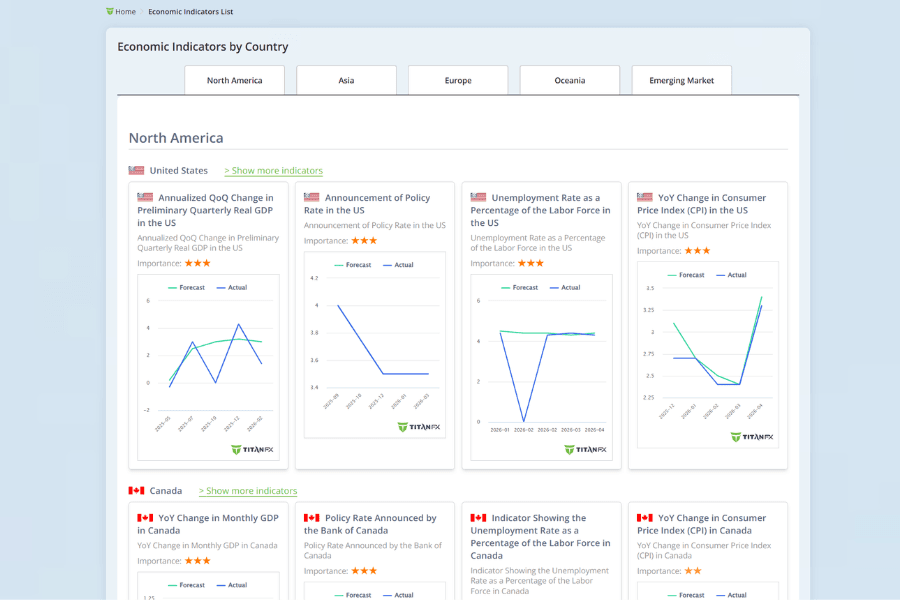
Because PPP is a long-run tool, it pays to follow GDP, CPI, PMI, unemployment, and other key data alongside the market rate, so you can see whether a country's fundamentals are shifting.
To look up key indicators quickly, Titan FX's global economic indicators tool lets you track GDP, CPI, PMI and more. Pairing that with purchasing power parity gives you a fuller reference point for the global economy and the currency market.
5. The Strengths and Limits of PPP
Purchasing power parity is a standard analytical tool in international economics and currency analysis, useful for comparing currency values and price levels across countries. But it is a long-run model, and applying it well means understanding both where it works and where it does not.
Strength 1: A Common Yardstick for Currency Value
Prices, wages, and living costs vary widely between countries, and comparing them at market rates alone leaves you exposed to short-term swings.
PPP builds a common yardstick out of what a currency can actually buy, which makes currency values and economic data easier to compare. That is why the World Bank, the IMF, and others rely on it.
Strength 2: A Lens on Long-Run Trends
Market rates move daily on policy, capital flows, and sentiment. PPP places its weight on a currency's long-run fair value instead.
For currency analysts and long-horizon investors, it offers a way to see whether a rate has drifted from fundamentals — not a way to predict the next move.
Limit 1: It Assumes Ideal Market Conditions
PPP assumes goods move freely and that transport costs, tariffs, and other frictions do not exist. Real markets do not work that way.
Logistics costs, tax regimes, and regulation all differ by country and feed into prices, so actual price levels need not match what the theory implies.
Limit 2: Most Services Cannot Be Arbitraged Across Borders
The logic of PPP rests on price gaps being closed by arbitrage — but that only applies to tradable goods.
A haircut, rent, or a sit-down meal cannot be shipped abroad, so those price gaps simply persist. This is one of the structural reasons why prices in lower-income countries sit below those in developed economies, and why such currencies often look "cheap" under a PPP comparison.
Limit 3: It Cannot Explain Short-Term Moves
Currency markets respond to far more than prices: interest rate policy, cross-border capital flows, geopolitics, and sentiment all feed in.
Market rates can therefore stay away from the PPP estimate for long periods, and short-term trading should not rest on purchasing power parity alone.
On balance, PPP is well suited to analysing a currency's long-run value and comparing economies. To assess actual market direction, pair it with macroeconomic data, central bank policy, and other analytical tools.
6. Purchasing Power Parity FAQ
Q1: What is the difference between PPP and the market exchange rate?
PPP estimates a currency's long-run fair value from price levels in each country — it is a theoretical figure. The market exchange rate is the live price set by daily trading in the currency market. Because market rates swing on interest rates, capital flows, and sentiment, short-term divergence from the PPP estimate is entirely normal.
Q2: Is the Big Mac Index the same thing as PPP?
No. The Big Mac Index is an indicator built on PPP theory, using a globally consistent product to compare the purchasing power of different currencies. It is one application of PPP, not the theory itself.
Q3: Can PPP predict exchange rates?
PPP works well for observing a currency's long-run value but not for predicting short-term moves. Short-run rates still respond to central bank policy, interest rate changes, cross-border capital flows, and sentiment, so PPP is generally used as a long-horizon analytical tool.
Q4: Why do prices in some countries stay below the PPP estimate for years?
Mainly because services cannot be arbitraged across borders. Haircuts, rent, and sit-down meals cannot be exported and sold elsewhere, so those price gaps never close. As a result, lower-income countries tend to have lower overall price levels. This is a structural difference, not necessarily evidence that a currency is mispriced.
Q5: Is PPP useful for ordinary investors?
Yes. Even without an economics background, PPP gives you a way to see whether a currency has drifted from its long-run fair value. Combined with economic data and macro analysis, it helps build a more complete picture of the market.
Q6: Does PPP only apply to currency markets?
No. Beyond currency analysis, purchasing power parity is used in international GDP comparisons, cost-of-living assessments, multinational pricing, market research, and economic policy work. It is one of the foundational theories in international economics.
7. Summary
Purchasing power parity is an important theory for measuring what different currencies can actually buy, and a standard tool for analysing long-run exchange rates and comparing economies.
Market rates respond to interest rates, capital flows, and policy, so they often will not match PPP over short horizons — but viewed over the long run, the reference value is considerable.
For investors, reading purchasing power parity alongside macroeconomic data gives a fuller understanding of currency value and market trends, and sharpens long-horizon judgement.
Further Reading
- What Is Inflation?
- What Is the Effective Exchange Rate?
- What Is Monetary Policy?
- EUR/USD Live Rate
- Forex Trading Basics
Titan FX Trading Strategy Lab. We produce investor-education content covering forex, commodities (crude oil, precious metals, agricultural goods), stock indices, US equities, and digital assets.
Primary Sources (by category)
- International institutions and statistics: World Bank International Comparison Program — PPP conversion factors and price levels; International Monetary Fund World Economic Outlook — GDP on a PPP basis; OECD — purchasing power parity statistics
- Index and media: The Economist Big Mac Index — the applied indicator built on purchasing power parity
- Theoretical background: the law of one price and absolute/relative purchasing power parity; the Balassa–Samuelson effect — structural price differences arising from non-tradable services