

BOC (Bank of Canada)
The Bank of Canada announces its policy interest rate on eight fixed dates a year, with the goal of keeping inflation around 2%. Its rate decisions move the Canadian dollar (CAD) directly, making them one of the most important events for anyone trading USD/CAD or other CAD pairs.
This guide explains what the Bank of Canada does, how the policy rate is set, its recent rate hikes and cuts, its main publications, how rate decisions affect the Canadian dollar, and how to trade CAD with Titan FX.
- The Bank of Canada was created by legislation in 1934, opened in 1935 and is headquartered in Ottawa
- The policy rate is the target for the overnight rate, announced on eight fixed dates a year
- The inflation target is 2% within a 1% to 3% range, and the framework has been renewed through 2031
- On October 28, 2026, the Bank raised its policy rate by 25 basis points, from 2.25% to 2.50%
- BoC decisions, the U.S.-Canada interest rate gap and oil prices are the main drivers of the Canadian dollar
1. What Is the Bank of Canada?
The Bank of Canada was established under the Bank of Canada Act, which received royal assent on July 3, 1934. The Bank opened in March 1935 and became publicly owned in 1938.
Its head office is in Ottawa, and its current Governor is Tiff Macklem. Like other central banks, it does not offer deposit accounts or loans to the public.
The Bank sets the policy rate on its own, while the inflation target is agreed jointly by the Government of Canada and the Bank and is reviewed and renewed every five years.
2. What Does the Bank of Canada Do?
-
Monetary policy: Sets the policy rate to keep inflation close to target
-
Financial system: Promotes financial stability and provides liquidity when needed
-
Currency: Designs and issues Canadian bank notes and keeps them hard to counterfeit
-
Funds management: Manages government debt issuance and foreign exchange reserves for the Government of Canada
-
Payments oversight: Oversees major payment systems and financial market infrastructures. Since September 8, 2025, it has also supervised payment service providers under the Retail Payment Activities Act
3. The Policy Rate and the Inflation Target
The Policy Rate
The Bank of Canada's policy interest rate is the target for the overnight rate, the level the Bank wants overnight borrowing between financial institutions to trade at. Changing the target shifts banks' short-term funding costs, which then flow through to mortgage, business loan and deposit rates.
The Bank also sets the Bank Rate and the deposit rate to keep the market overnight rate close to target. After the October 2026 decision, the policy rate was 2.50%, the Bank Rate 2.75% and the deposit rate 2.45%.
The policy rate is announced on eight fixed dates each year. Since 2021, changes take effect the day after the announcement.
The Inflation Target
Canada has used inflation targeting since the early 1990s. On November 5, 2026, the Government of Canada and the Bank announced the renewal of the framework for January 2027 to December 2031:
| Item | Details |
|---|---|
| Inflation target | 2% |
| Control range | 1% to 3% |
| Measure | 12-month CPI change |
| Approach | Symmetric |
The official target is measured by the 12-month change in the consumer price index (CPI). Because temporary factors such as energy prices can make total CPI swing sharply, the Bank also watches core inflation measures such as CPI-trim and CPI-median to judge whether price pressure is persistent.
When inflation stays above target and core inflation is also elevated, the Bank may raise rates to cool demand; when inflation is low and the economy is weak, it may cut rates to support growth.
4. Bank of Canada Rate History
Based on Bank of Canada announcements:
| Date | Policy rate | Context |
|---|---|---|
| Mar 27, 2020 | 0.25% | Cut to the floor during COVID-19 |
| Mar 2, 2022 | 0.50% | Hiking cycle begins |
| Jul 12, 2023 | 5.00% | Peak of the hiking cycle |
| Jun 5, 2024 | 4.75% | Easing cycle begins |
| Oct 29, 2025 | 2.25% | Low of the easing cycle |
| Oct 28, 2026 | 2.50% | Hikes resume |
As global inflation surged from 2022, the Bank raised rates from 0.25% to 5.00%. Once inflation eased, it began cutting in June 2024, made a series of further cuts and reached 2.25% in October 2025, where the rate stayed for almost a year.
On October 28, 2026, the Bank raised the policy rate by 25 basis points to 2.50%, its first hike since July 2023. According to the Bank's statement, the conflict in the Middle East had kept energy prices high, rising business costs were expected to be passed on to consumers, and Canadian growth had been stronger than expected. The hike was meant to reduce the risk that high energy prices would spread broadly to the prices of other goods and services.
The Monetary Policy Report released the same day projected inflation to stay around 3% through much of 2027 and return close to 2% by the middle of 2028.
5. Key Announcements and Release Times
| Publication | Frequency | Content |
|---|---|---|
| Rate announcement | 8 times a year | Policy rate and rationale |
| Monetary Policy Report (MPR) | 4 times a year | Economic and inflation outlook |
| Summary of deliberations | After each decision | Governing Council discussion |
| Financial Stability Report | Periodic | Risks to the financial system |
Rate announcements are released at 9:45 a.m. ET. The January, April, July and October decisions come with a Monetary Policy Report, and the Governor and Senior Deputy Governor hold a press conference at about 10:30 a.m. ET.
The last decision of 2026 is on December 9. As of November 2026, the Bank's published 2027 decision dates are January 27, March 3, April 28, June 2, July 21, September 8, October 27 and December 8.
6. How Rate Decisions Affect the Canadian Dollar
Rates and Market Expectations
When the Bank of Canada raises rates or sends hawkish signals, expectations for Canadian interest rates rise, CAD assets become more attractive and the Canadian dollar usually finds support. Rate cuts or dovish signals usually weigh on the currency.
Exchange rates react to the gap between the decision and what the market expected. If a hike is already priced in, CAD may not rise after the announcement, and the Bank's guidance on future rates can matter more than the decision itself.
The U.S.-Canada Rate Gap
Canada and the United States are closely linked, and USD/CAD is the most heavily traded CAD pair. Whether the gap between Bank of Canada and Federal Reserve rates widens or narrows affects the direction of USD/CAD:
| Scenario | CAD | USD/CAD |
|---|---|---|
| BoC hawkish | Supported | Tends to fall |
| BoC dovish | Weaker | Tends to rise |
| U.S. rate outlook rises | Under pressure | Tends to rise |
| U.S. rate outlook falls | Supported | Tends to fall |
These are typical reactions with everything else unchanged; actual moves also depend on economic data and risk sentiment.
Oil Prices
Canada is a major oil exporter, so higher oil prices usually boost export revenue and support the Canadian dollar. But CAD also responds to the U.S. dollar, the U.S.-Canada rate gap and global risk appetite, so higher oil does not always mean a lower USD/CAD.
Oil also feeds into Canadian inflation through gasoline and other energy prices, which can shape the Bank's rate decisions; the October 2026 hike is one example.
Jobs and GDP
Canadian employment reports and GDP data also shift rate expectations. Strong hiring and fast wage growth can add to inflation pressure, while rising unemployment or a slowing economy can raise expectations of rate cuts.
For more on the currency itself, see CAD (Canadian Dollar).
7. How to Trade CAD with Titan FX
Titan FX offers several Canadian dollar pairs on MT4 and MT5:
| Pair | Description |
|---|---|
| USD/CAD | U.S. dollar vs. Canadian dollar |
| EUR/CAD | Euro vs. Canadian dollar |
| GBP/CAD | British pound vs. Canadian dollar |
| AUD/CAD | Australian dollar vs. Canadian dollar |
| CAD/JPY | Canadian dollar vs. Japanese yen |
USD/CAD is the most direct way to follow the Canadian dollar: when CAD strengthens, USD/CAD usually falls, and when CAD weakens, it usually rises.
How to Prepare for a Decision
-
① Check the date: Use the Economic Calendar to find the next Bank of Canada decision and the release times for CPI and jobs data
-
② Compare the result with expectations: After the release, check whether the rate matched expectations, then read the Bank's assessment of inflation and growth and watch how expectations for future moves change
-
③ Manage risk: Spreads can widen and prices can gap around the announcement, so use a stop loss and keep position size under control
Track the Bank of Canada Rate on Titan FX
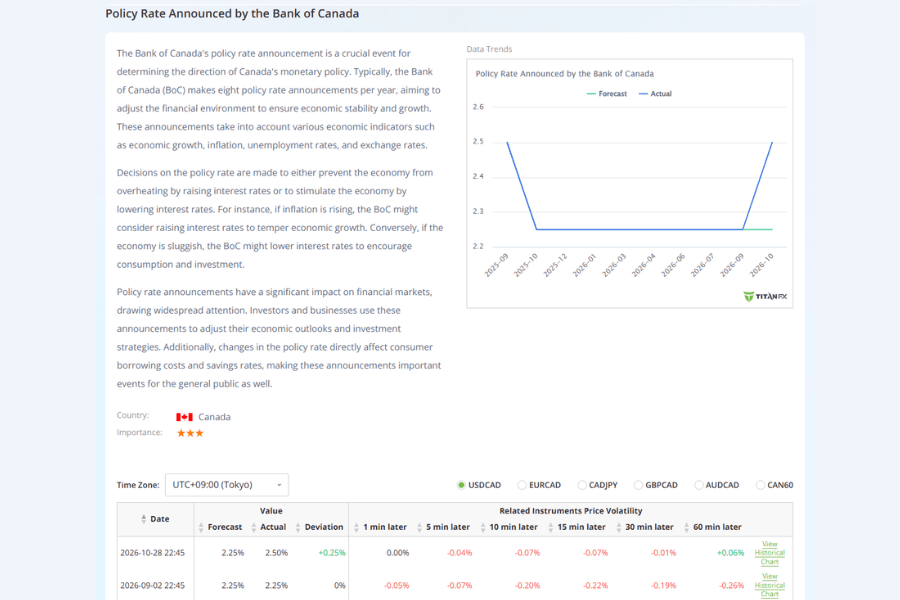
The Titan FX Policy Rate Announced by the Bank of Canada page shows the forecast, actual result and history of each decision, along with how USD/CAD, CAD/JPY and other pairs moved in the 1 to 60 minutes after the announcement.
View the Bank of Canada Policy RateCanadian CPI, unemployment, employment change and GDP are listed in Canada's Economic Indicators List, all data the Bank weighs when setting rates.
To compare the latest decisions from other major central banks, see Titan FX Central Bank Watch.
8. FAQ
Q1. Is BoC the same as BOC?
Yes. Both abbreviations refer to the Bank of Canada. BoC is common in English-language media, while BOC is also widely used.
Q2. How many times a year does the Bank of Canada set rates?
Eight times a year, on fixed dates. Decisions are released at 9:45 a.m. ET, and rate changes take effect the next day.
Q3. What is the Bank of Canada's inflation target?
The target is 2% within a 1% to 3% control range, measured by the 12-month change in CPI. The framework was renewed in November 2026 and runs through the end of 2031.
Q4. Does a Bank of Canada rate hike always lift the Canadian dollar?
No. Exchange rates respond to the gap between the decision and expectations, so if a hike is fully priced in, the reaction may be limited. U.S. interest rates, oil prices and global risk sentiment also move USD/CAD.
Q5. Which currency pairs do Bank of Canada decisions affect?
USD/CAD reacts most, but EUR/CAD, CAD/JPY and other CAD pairs move too. Volatility is usually higher around the announcement, so watch for wider spreads and price gaps.
9. Conclusion
The Bank of Canada (BoC) is Canada's central bank. It conducts monetary policy through the target for the overnight rate, aiming to keep inflation at 2%, and announces rate decisions on eight fixed dates a year. In October 2026, it raised the policy rate from 2.25% to 2.50%.
Rate decisions, the U.S.-Canada rate gap and oil prices all affect the Canadian dollar. Before trading CAD pairs, check the decision date, compare the result with expectations and keep an eye on U.S. data and oil prices.
Further Reading
Titan FX Trading Strategy Lab. We produce educational content for investors covering FX, commodities (crude oil, precious metals, agricultural products), stock indices, U.S. equities, and cryptocurrencies.
Primary Sources
- Bank of Canada: "History"; "Policy interest rate" (2026 and 2027 schedules); rate announcement press releases (March 27, 2020; March 2, 2022; July 12, 2023; June 5, 2024; October 29, 2025; October 28, 2026); Monetary Policy Report (October 2026); "Bank of Canada begins supervising payment service providers" (September 8, 2025); Price indexes (core inflation measures)
- Inflation target: Joint Statement of the Government of Canada and the Bank of Canada on the Renewal of the Monetary Policy Framework (November 5, 2026)