

SNB (Swiss National Bank)
The SNB normally reviews monetary policy once a quarter and announces its policy rate, and when necessary it intervenes directly in the foreign exchange market to influence the Swiss franc (CHF). Because the franc is widely seen as a safe-haven currency, SNB decisions are among the most important events for anyone trading USD/CHF, EUR/CHF or other franc pairs.
This guide covers what the SNB does, how its monetary policy works, its recent rate history, its most important past decisions, its announcement schedule, how its decisions affect the franc, and how to trade CHF with Titan FX.
- The SNB opened in 1907 and has two head offices, in Bern and Zurich
- It defines price stability as Swiss CPI inflation of less than 2% a year; deflation also breaches price stability
- It normally assesses monetary policy in March, June, September and December, publishing its policy rate and a conditional inflation forecast
- The SNB policy rate was cut to 0% in June 2025 and has stayed there through September 2026
- Besides the policy rate, the SNB intervenes in the foreign exchange market when necessary
- 1. What Is the Swiss National Bank?
- 2. What Does the SNB Do?
- 3. SNB Monetary Policy: Policy Rate, Price Stability and FX Intervention
- 4. SNB Interest Rate History
- 5. Major SNB Policy Decisions
- 6. Announcements and Release Times
- 7. How SNB Decisions Affect the Swiss Franc
- 8. How to Trade CHF with Titan FX
- 9. FAQ
- 10. Conclusion
1. What Is the Swiss National Bank?
The Swiss National Bank began operating in 1907 and is the only institution allowed to issue Swiss franc bank notes. It has two head offices, in the capital Bern and in Zurich, the country's financial center, plus a branch office in Singapore.
Monetary policy decisions are made by the Governing Board, currently chaired by Martin Schlegel. The SNB sets monetary policy independently by law and does not take instructions from the government. Like other central banks, it does not offer deposit accounts or loans to the public.
2. What Does the SNB Do?
-
Monetary policy: Sets the policy rate and, when necessary, intervenes in the FX market to keep prices stable
-
Cash supply: Issues Swiss franc bank notes and makes sure enough cash is available
-
Payments: Operates SIC, Switzerland's interbank payment system, to keep cashless payments running smoothly
-
Reserve management: Manages Switzerland's currency reserves and gold
-
Financial stability: Monitors systemic risks in the financial system. Individual banks are supervised by the Swiss Financial Market Supervisory Authority (FINMA)
3. SNB Monetary Policy: Policy Rate, Price Stability and FX Intervention
The SNB's monetary policy strategy has three elements: a definition of price stability, a medium-term conditional inflation forecast and the SNB policy rate. When needed, the SNB also uses other tools such as foreign exchange intervention.
Definition of Price Stability
The SNB's mandate is to ensure price stability while taking due account of economic developments. It defines price stability as a rise in the Swiss consumer price index (CPI) of less than 2% per year. A sustained fall in prices, or deflation, also breaches price stability.
Unlike central banks with a 2% inflation target, the SNB sets a ceiling. It does not aim for a single 2% figure or require inflation to stay at any particular number.
Conditional Inflation Forecast
At every assessment, the SNB publishes a conditional inflation forecast: its view of inflation over roughly the next three years, assuming the policy rate stays unchanged. The SNB relies on this forecast to judge whether prices are likely to move away from stability, so a single month's CPI rise does not by itself trigger a rate change.
The SNB Policy Rate
The SNB implements monetary policy by setting the SNB policy rate and aims to keep short-term Swiss franc money market rates close to it.
Banks' sight deposits at the SNB earn the policy rate up to a certain threshold; deposits above the threshold earn 0.25 percentage points less. This tiered system adjusts the cost of holding liquidity and keeps short-term rates close to the policy rate.
The SNB policy rate was introduced in June 2019. Before that, the SNB steered rates through a target range for the three-month Swiss franc Libor and the interest rate on sight deposits.
FX Intervention
The SNB states that it is willing to be active in the foreign exchange market as necessary, buying or selling foreign currency to influence the franc. Intervention can go either way:
| SNB action | Franc | Typical aim |
|---|---|---|
| Buy FX, sell CHF | Weakens | Curb rapid appreciation |
| Sell FX, buy CHF | Strengthens | Lower import prices |
When the franc faced strong upward pressure, the SNB mainly bought foreign currency. After inflation rose in 2022, it reversed course: in its 2023 statements, the SNB said that the focus had been on selling foreign currency for several quarters.
This is the biggest difference between the SNB and most major central banks. For the basics, see FX Intervention.
4. SNB Interest Rate History
The table below is based on the official interest rates published on the SNB data portal. The SNB policy rate did not exist in 2015, so the 2015 row shows the sight deposit rate; at the time, the target range for the three-month Swiss franc Libor was −1.25% to −0.25%.
| Effective month | Rate | Context |
|---|---|---|
| Jan 2015 | Sight deposits −0.75% | Minimum exchange rate dropped |
| Jun 2019 | −0.75% | SNB policy rate introduced |
| Jun 2022 | −0.25% | Hiking begins |
| Sep 2022 | 0.50% | Negative rates end |
| Jun 2023 | 1.75% | Peak of the hiking cycle |
| Mar 2024 | 1.50% | Cutting begins |
| Jun 2024 | 1.25% | Cut |
| Sep 2024 | 1.00% | Cut |
| Dec 2024 | 0.50% | Cut |
| Mar 2025 | 0.25% | Cut |
| Jun 2025 | 0% | Cut to zero |
The SNB applied a −0.75% negative rate from January 2015 until June 2022. As global inflation picked up, it ended negative rates in September 2022 and raised the policy rate to 1.75% in June 2023.
Once inflation eased, the SNB began cutting in March 2024 and lowered the rate to 0% on June 19, 2025. It has left the rate at 0% at every assessment since, through September 24, 2026.
According to the September 2026 statement, Swiss inflation edged up from 0.6% in May to 0.8% in August, mainly because of higher energy prices. The SNB expects inflation to rise somewhat further in the fourth quarter before falling back over the course of 2027. It judged that medium-term inflationary pressure had increased only slightly and kept the rate at 0%, a reminder that the SNB looks at its medium-term forecast rather than a single month's data.
5. Major SNB Policy Decisions
| Date | Decision |
|---|---|
| Sep 6, 2011 | EUR/CHF minimum rate set at 1.20 |
| Jan 15, 2015 | Minimum rate dropped; rate cut to −0.75% |
| Sep 22, 2022 | Negative rates end; rate raised to 0.50% |
| From 2022 | FX operations shift to selling foreign currency |
In September 2011, as the franc surged during the euro-area debt crisis, the SNB set a minimum exchange rate of 1.20 francs per euro and said it was prepared to buy foreign currency in unlimited quantities to defend it.
On January 15, 2015, the SNB unexpectedly abandoned the minimum rate and cut its rate to −0.75%. The franc jumped sharply within a short time, and the episode is often cited as an example of how a sudden central bank shift can trigger extreme currency moves.
When inflation rose in 2022, the SNB not only raised rates but also switched to selling foreign currency and buying francs, letting the franc strengthen to hold down import prices. That was the opposite of what it did while defending the minimum rate from 2011 to 2015.
6. Announcements and Release Times
| Publication | Frequency | Content |
|---|---|---|
| Monetary policy assessment | 4 times a year | Policy rate and rationale |
| Conditional inflation forecast | 4 times a year | Medium-term inflation path |
| News conference | After each assessment | Governing Board explains policy |
| Summary of discussion | 4 weeks after | Governing Board discussion |
| Monetary policy report | Quarterly | Economic and inflation analysis |
The SNB assesses monetary policy every March, June, September and December. Each assessment brings a policy rate decision, a conditional inflation forecast and a news conference the same day. Since September 2025, the SNB has also published a summary of the discussion four weeks after each decision, and its detailed analysis appears in the monetary policy report in the Quarterly Bulletin.
The press release is published at 9:30 a.m. Swiss time, followed by the news conference at 10:00. That is 3:30 a.m. and 4:00 a.m. ET for most of the year, but the gap can shrink by an hour in the weeks when U.S. and European daylight saving time changes do not line up.
The last assessment of 2026 is on December 10. As of November 2026, the SNB's 2027 assessment dates are March 18, June 24, September 23 and December 16. In exceptional circumstances, the SNB can change policy outside the scheduled dates; the 2015 decision to drop the minimum rate was announced outside a regular assessment.
7. How SNB Decisions Affect the Swiss Franc
Rates and Market Expectations
When the SNB raises rates or signals that it may do so, the franc usually finds support; rate cuts or hints at a return to negative rates usually weigh on it. As with other central banks, exchange rates react to the gap between the decision and market expectations.
FX Intervention
When the SNB signals that it is ready to intervene, markets expect it to sell francs if the currency rises further, which can cap the franc's gains. The SNB's published data on its foreign exchange transactions also show whether it has actually intervened.
Safe-Haven Demand and the Euro-Area Rate Gap
The franc is often treated as a safe-haven currency. When global stocks slump, geopolitical tensions rise or financial risks flare up in Europe, money tends to flow into the franc. The U.S. dollar is also a safe haven, though, so the reaction depends on the event; see Risk-on and Risk-off.
Switzerland and the euro area are closely linked, so EUR/CHF is another key franc pair. The rate gap between the SNB and the European Central Bank (ECB) affects its direction: when SNB policy is looser than the ECB's, the franc tends to weaken against the euro and EUR/CHF tends to rise, and vice versa.
| Scenario | Franc | USD/CHF |
|---|---|---|
| SNB leans toward hikes | Supported | Tends to fall |
| SNB cuts | Weaker | Tends to rise |
| SNB sells CHF, buys FX | Weaker | Tends to rise |
| Global risk aversion rises | Usually supported | Tends to fall |
| U.S. rate outlook rises | Under pressure | Tends to rise |
These are typical reactions with everything else unchanged; actual moves also depend on economic data and sentiment. For more on the currency, see CHF (Swiss Franc).
8. How to Trade CHF with Titan FX
Titan FX offers several Swiss franc pairs on MT4 and MT5:
| Pair | Description |
|---|---|
| USD/CHF | U.S. dollar vs. Swiss franc |
| EUR/CHF | Euro vs. Swiss franc |
| GBP/CHF | British pound vs. Swiss franc |
| AUD/CHF | Australian dollar vs. Swiss franc |
| CHF/JPY | Swiss franc vs. Japanese yen |
USD/CHF shows how many francs one U.S. dollar buys, so it usually falls when the franc strengthens and rises when the franc weakens.
How to Prepare for an SNB Decision
-
① Check the date: Use the Economic Calendar to find the next SNB assessment and the release time of Swiss CPI
-
② Compare the result with expectations: After the release, check whether the rate matched expectations, then look at the inflation forecast and any change in the SNB's wording on FX intervention
-
③ Manage risk: Spreads can widen and prices can gap around the announcement, so use a stop loss and keep position size under control. The news conference starts 30 minutes after the press release, and the Q&A can move the market again
Track the SNB Policy Rate on Titan FX
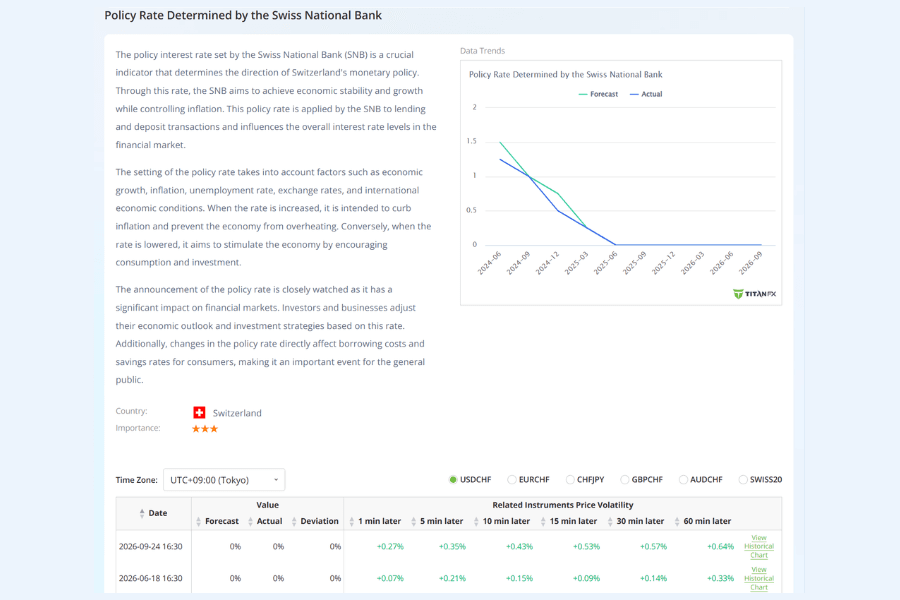
The Titan FX Policy Rate Determined by the Swiss National Bank page shows the forecast, actual result and history of each decision, along with how franc pairs moved in the 1 to 60 minutes after the announcement.
View the SNB Policy RateSwiss CPI, unemployment and GDP are listed in Switzerland's Economic Indicators List.
9. FAQ
Q1. Is the SNB the same as the Swiss central bank?
Yes. The Swiss National Bank is Switzerland's central bank and is usually abbreviated as SNB.
Q2. How often does the SNB set interest rates?
Normally four times a year, at its March, June, September and December assessments. The press release comes out at 9:30 a.m. Swiss time, with a news conference at 10:00.
Q3. What is the SNB's inflation target?
The SNB does not set a single target figure. It defines price stability as Swiss CPI inflation of less than 2% a year and regards deflation as a breach of price stability as well.
Q4. Why does the SNB intervene in the FX market?
Switzerland is a small, open economy, so the exchange rate has a large effect on prices. A rapid rise in the franc pushes down import prices and can lead to deflation, which is why the SNB uses FX intervention as one of its monetary policy tools.
Q5. Can the SNB change rates between scheduled assessments?
Yes. The SNB normally assesses policy in March, June, September and December, but it can act outside those dates if economic or financial conditions change sharply, as it did when it dropped the minimum exchange rate in January 2015.
Q6. Which currency pairs do SNB decisions affect?
USD/CHF and EUR/CHF react most, but GBP/CHF, CHF/JPY and other franc pairs move too. Volatility is usually higher around assessments, so watch for wider spreads and price gaps.
10. Conclusion
The Swiss National Bank (SNB) is Switzerland's central bank and defines price stability as CPI inflation of less than 2%. It normally reviews policy once a quarter, cut its policy rate to 0% in June 2025 and intervenes in the FX market when necessary.
Rate decisions, FX intervention, safe-haven demand and the rate gap with the euro area all affect the franc. Before trading franc pairs, check the assessment date, compare the result with expectations and watch what the SNB says about FX intervention.
Further Reading
Titan FX Trading Strategy Lab. We produce educational content for investors covering FX, commodities (crude oil, precious metals, agricultural products), stock indices, U.S. equities, and cryptocurrencies.
Primary Sources
- Swiss National Bank: "Monetary policy strategy"; "Monetary policy decisions"; "The SNB as an organisation"; "History"; SNB data portal, "Official interest rates"; monetary policy assessment press releases (June 13, 2019; September 22, 2022; March 23, 2023; June 22, 2023; June 19, 2025; September 24, 2026); press releases of September 6, 2011 and January 15, 2015; event schedule (2026 and 2027 assessment dates)