

What Is a Zero-Sum Game? Why Forex Is the Textbook Example
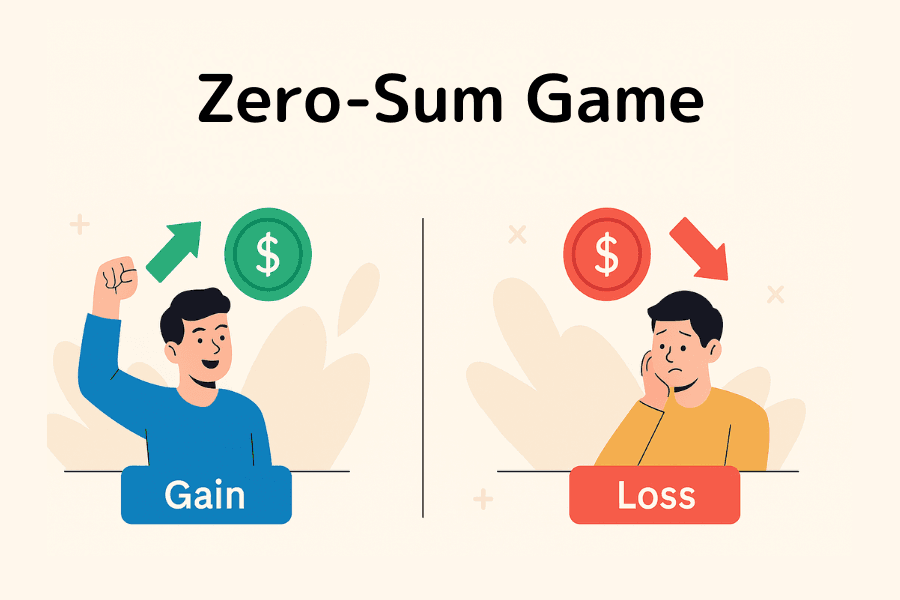
A zero-sum game is a structure where all participants' gains and losses sum exactly to zero — one side's profit must equal another side's loss. Forex and futures trading are textbook examples, fundamentally different from positive-sum markets like equities where everyone can win as the economy grows.
"For one person to win, another must lose" — in markets like forex and futures that often holds, yet for stocks or the wider economy it doesn't. Knowing where that line falls helps you read the true nature and risk of each market.
Forex trading is often described as a textbook zero-sum game for exactly this reason: when one trader profits from a price move, an equivalent counterparty position is taking the corresponding loss. Understanding the structure helps you read forex, futures, and options markets more accurately than treating them as growth-style asset classes.
This article walks through the definition, concrete examples, the contrast with non-zero-sum games, and the most common questions traders ask about zero-sum dynamics.
- A zero-sum game is a strictly adversarial structure where total participant P&L sums to zero — one side's win is another side's loss.
- Forex, futures, options, and head-to-head poker are textbook zero-sum environments because every long position is matched by an equivalent short.
- Once you add spreads and commissions, the practical reality of forex trading is closer to a negative-sum game — the broker takes a slice of every round trip.
- Stocks, bonds, and real estate are non-zero-sum (positive-sum) because the underlying economy grows the pie over time and all holders can win together.
- There is no guaranteed winning formula in zero-sum markets, but disciplined volatility management, technicals, and macro analysis can raise the long-run win rate.
1. What Is a Zero-Sum Game?
A zero-sum game (sometimes called a zero-sum situation or zero-sum interaction) is the canonical example of a strictly competitive structure in game theory. The defining feature is simple: when you add up every participant's gains and losses, the total is exactly zero.
In other words, any value one player wins must come directly from another player's loss. Resources are not created or destroyed inside the game — they are only redistributed. That is why zero-sum games are described as having a "your win is my loss" structure.
In investing, forex trading (FX) is the most often-cited example. When the price of a currency pair moves, the trader on the right side captures a profit and the trader on the wrong side absorbs an equivalent loss — the market as a whole produces no new value from that exchange.
What Is a Non-Zero-Sum Game?
The opposite of a zero-sum game is a non-zero-sum game (Non-zero-sum Game), in which the total payoff to participants does not have to sum to zero. Outcomes can be win-win, lose-lose, or a mix.
Non-zero-sum games typically come in two flavors
| Type | Total payoff | Possible outcome | Example |
|---|---|---|---|
| Positive-sum game | Positive | Every participant can win | Cooperative trade expansion, joint R&D |
| Negative-sum game | Negative | Every participant can lose | Cutthroat price wars, resource depletion |
Who Proposed the Zero-Sum and Positive-Sum Concepts?
The basic idea of a zero-sum interaction had been used informally in military and economic writing well before the 20th century, but it was made mathematically rigorous in 1944. American mathematician John von Neumann and economist Oskar Morgenstern jointly published Theory of Games and Economic Behavior, which formalized the zero-sum game and is widely considered the founding text of modern game theory.
The term "positive-sum game" was not coined by von Neumann himself. It came out of later economic writing as a way to classify the many real-world situations that did not fit the strict zero-sum frame.
In short, zero-sum game theory traces back to von Neumann, while the positive-sum classification was introduced later as the literature grew. Both concepts now show up not only in economics but also in political science, negotiation theory, decision science, and psychology, where they remain core tools for thinking about competition and cooperation.
2. Concrete Examples of Zero-Sum Games
The defining test of a zero-sum game is straightforward: one side's profit must come directly from another side's loss, and the totals across all players sum to zero. Here are several common examples.
2.1 The Forex Market
In the foreign exchange (FX) market, every currency move creates symmetric outcomes. If one trader is long USD/JPY expecting the dollar to rise, there is an equivalent short position somewhere in the system — typically split across many counterparties. When the rate moves, the long-side mark-to-market gain matches the short-side mark-to-market loss exactly.
Because of that symmetry, FX is a textbook zero-sum game from a pure P&L perspective.
That said, once you fold in spreads, swaps, and commissions, the structure shifts toward a negative-sum game. Brokers and intermediaries take a slice on every round trip, so the sum of net P&L across retail participants slowly drains over time.
Related: Introduction to Forex Trading.
2.2 Chess, Go, and Other Head-to-Head Board Games
Chess, Go, and Western checkers are the purest examples of zero-sum games. One side's victory is the other side's defeat, and unless the rules allow draws, the outcome is always a perfect mirror — totals sum to zero.
2.3 Poker and Head-to-Head Casino Games
Texas hold 'em and similar head-to-head card games are zero-sum at the table level: chips one player wins are chips another player lost. When the house extracts a rake or commission, the structure becomes zero-sum plus a fee — a small negative-sum tilt for the participants.
2.4 Futures and Options Markets
Futures and options are by design zero-sum derivatives. Every contract has a long and a short counterparty bound to the same underlying. If one side gains from a price move, the other side absorbs the identical loss — that is the entire mechanical purpose of the contract.
3. Concrete Examples of Non-Zero-Sum Games
In a non-zero-sum game, totals are not constrained to zero. Outcomes can be net positive, net negative, or mixed — and across an entire population of participants, the aggregate can move with the underlying economy. The two main flavors are positive-sum and negative-sum.
Positive-Sum Examples
Equities, bonds, and real estate are usually treated as positive-sum systems for long-term holders.
When the broader economy expands and corporate earnings grow, equity holders' net worth can rise together — everyone holding the index benefits without taking the gain from a specific loser. Bonds pay a contractual coupon that accrues to all holders as long as the issuer remains solvent. Real estate combines potential price appreciation with rental cash flow, both of which can build value across all owners.
Even a low-yield savings account is a slow positive-sum vehicle: it offers a small but contractually positive return on idle cash. These are the "we all win together" structures of finance.
Negative-Sum Examples
In contrast, lotteries, horse racing, slot machines, and similar gambling formats are negative-sum from the player's perspective.
The operator takes a meaningful cut up front in the form of takeout, vigorish, or house edge. Players then compete over a reduced pool, and even when a single jackpot winner emerges, the aggregate participant payout is structurally less than the aggregate participant stake.
A few players may walk away ahead. The system as a whole, by design, transfers value out of the participant pool.
4. Frequently Asked Questions About Zero-Sum Games
Q1. Is forex a zero-sum game?
Yes — at the P&L level. Every long position is matched by an equivalent short, so a move that rewards one side produces an equivalent loss on the other. Once you account for spreads, swaps, and commissions, however, the practical reality becomes closer to a negative-sum game, because brokers and venues extract value on every round trip. That is why disciplined cost management is just as important as direction in long-run forex performance.
Q2. Is the stock market also a zero-sum game?
Over long horizons, the stock market is not a zero-sum game. As corporate earnings and the broader economy grow, total shareholder value can rise together — everyone holding a diversified index can be better off without taking value from a specific loser. Short-term trading behaves differently. In intraday or high-frequency day trading windows, one trader's quick profit often comes directly from a counterparty's quick loss, which can look zero-sum within that narrow time slice.
Q3. Is there a winning formula for zero-sum games?
No, there is no guaranteed winner. There are, however, repeatable disciplines that improve win rate over many trades:
- Build an information edge with technical and fundamental analysis.
- Understand the structural drivers of the asset, including policy rates and macro positioning.
- Apply strict position sizing, stop placement, and volatility management.
- Minimize unnecessary trading cost — every spread and commission drags expected value below zero.
In zero-sum environments, the trader who consistently combines edge, discipline, and cost control is the trader who survives.
5. Summary
A zero-sum game is a strictly adversarial structure in which total participant payoffs add up to exactly zero — one side's win is by definition another side's loss. Forex, futures, options, chess, and head-to-head poker all fit this frame. They are redistribution machines, not value-creation machines.
By contrast, the broad equity, bond, and real-estate markets behave as positive-sum systems over the long run because the underlying economy grows the pie and all holders can benefit together.
Forex trading is risky, but it is not random. Disciplined use of technical and fundamental analysis, careful cost management, and an understanding of the zero-sum framework let traders push their long-run expected value into positive territory — and read price action with sharper intuition.
Further Reading
- How the Forex Market Is Structured
- Introduction to Forex Trading
- What Is Volatility?
- What Is a CFD?
- What Is Day Trading?
The Titan FX financial markets research team produces educational content for investors across foreign exchange (FX), commodities (crude oil, precious metals, agriculturals), equity indices, US stocks, and digital assets.
Primary Sources (by Category)
- Game-theory foundation: John von Neumann & Oskar Morgenstern, Theory of Games and Economic Behavior (Princeton University Press, 1944)
- Market structure data: BIS Triennial Central Bank Survey
- Glossary references: Volatility, CFD, Day Trading, Financing Cost
- Forex fundamentals: How the FX market works, Forex trading basics