

What Is Palladium vs US Dollar (XPDUSD)? A Trader's Guide
- Palladium vs US Dollar (XPDUSD) quotes the price of one troy ounce of palladium in US dollars; the market is smaller and thinner than gold, silver, or platinum
- Mined supply is concentrated in just two countries — Russia and South Africa — so geopolitics and supply events feed straight into price
- Demand is heavily concentrated in autocatalysts, making auto sales and emissions rules the key demand-side variables
- Liquidity can run thin in some sessions, and the price history features multi-year surges followed by deep retreats — volatility management comes first
- The palladium-platinum ratio and COT futures positioning are the standard gauges of substitution pressure and market sentiment
- 1. What Is Palladium vs US Dollar (XPDUSD)?
- 2. Why do traders follow Palladium vs US Dollar?
- 3. What market characteristics define Palladium vs US Dollar?
- 4. What moves the price of Palladium vs US Dollar?
- 5. How can traders access Palladium vs US Dollar? Common methods compared
- 6. What risks and market signals matter when trading Palladium vs US Dollar?
- 7. FAQ: Common questions about Palladium vs US Dollar
- 8. Conclusion: Understand Palladium vs US Dollar before building a trading plan
1. What Is Palladium vs US Dollar (XPDUSD)?
Palladium vs US Dollar (XPDUSD) quotes the market price of one troy ounce of palladium in US dollars. Palladium belongs to the platinum group metals (PGMs) alongside platinum, with a silvery-white appearance and a lower density than its sibling. Compared with gold, silver, and platinum, its market is smaller and its trading depth thinner. Demand is heavily concentrated: catalytic converters — mostly in gasoline vehicles — take the bulk of it, while chemical, electronics, dental, jewelry, and investment uses share the modest remainder. That makes the palladium price especially sensitive to the auto cycle and emissions rules, with a weaker financial and safe-haven role than gold.
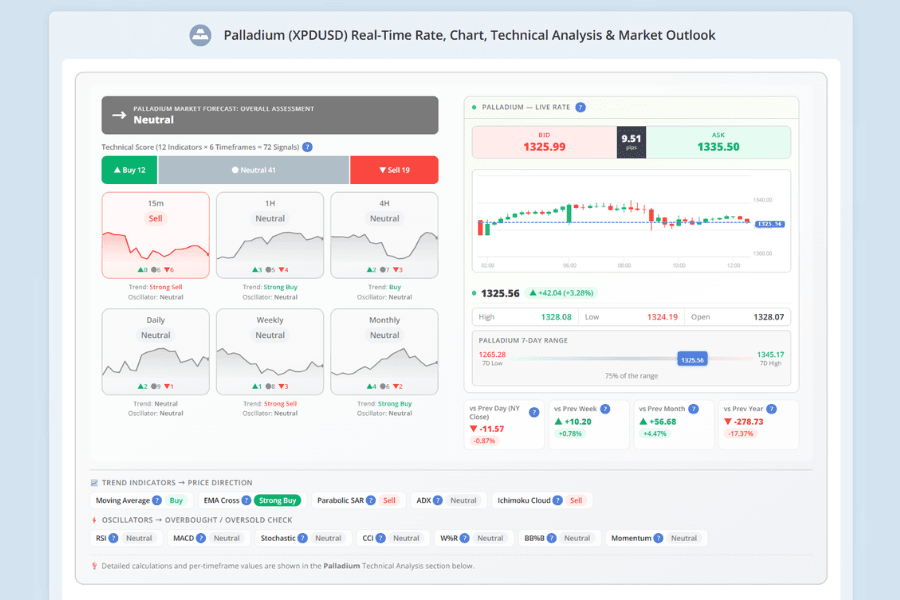
Through XPDUSD, traders can participate directly in palladium's rises and falls. For a live chart and technical analysis, see the palladium price tool page.
2. Why do traders follow Palladium vs US Dollar?
Palladium runs on one of the most extreme supply-and-demand scripts in precious metals. Supply is heavily concentrated in Russia and South Africa, which together have accounted for roughly 70-80% of mined output in recent years — Russian export policy or South African power and mining disruptions can each rewrite global supply expectations on their own. Demand is just as concentrated: auto demand built around gasoline-vehicle catalytic converters takes the bulk, so vehicle production, the drivetrain mix, and emissions rules are the demand side's most important variables.
With both sides of the market this narrow, the price history swings hard: palladium worked through a multi-year bull run, briefly ranked as the priciest major precious metal, then fell steeply from its highs. Notably, the structure itself has been shifting in recent years: after a long stretch of deficits, slowing gasoline-vehicle demand, substitution toward platinum, and rising recycled supply have been steering the market toward balance — possibly even surplus. That shift is a key piece of the fundamental backdrop behind the retreat from record highs.
For traders, this "structure decides the price" character makes palladium a stage for event-driven and trend strategies while demanding a high standard of risk control. Like the other precious metals it is priced in dollars, so the US Dollar Index and US real yields form the shared macro backdrop.
3. What market characteristics define Palladium vs US Dollar?
| Characteristic | What it means |
|---|---|
| Highly concentrated supply | Russia and South Africa account for the bulk of mined supply, and palladium is often a byproduct of nickel and platinum mining, so supply responds slowly to price |
| Highly concentrated demand | Autocatalysts take roughly three quarters of demand; auto-sales data and emissions rules are the core demand-side variables |
| Relatively small market | Trading depth is shallower than in gold or silver; liquidity can thin out in some sessions, making gaps, wider spreads, and slippage more visible |
| Palladium-platinum ratio | The two are partly interchangeable in catalysts; a persistently rich ratio strengthens automakers' incentive to switch to platinum, though reformulation lags behind certification |
| High recycled-supply share | Scrapped autocatalysts are a major supply source, with volumes tracking prices and the scrappage cycle |
When analyzing palladium, traders typically watch platinum and the gold price alongside it, reading relative strength and substitution pressure within the PGM family.
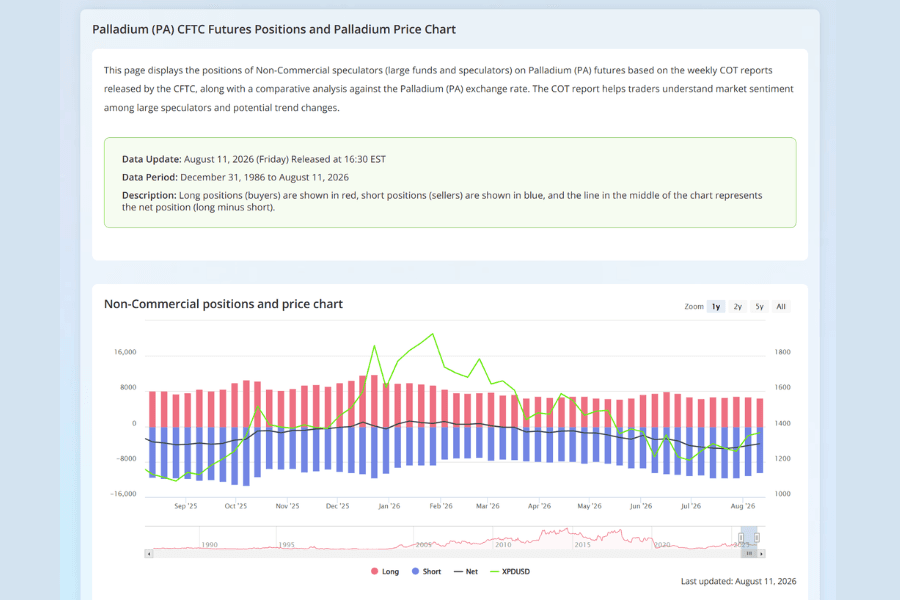
Futures positioning offers another sentiment window: the CFTC's COT report shows the rise and fall of speculative positions in palladium futures (NYMEX: PA). It reflects the structure of the futures market — not the money flow of the global palladium market — and since the palladium futures market is comparatively small, treat positioning changes as a supplementary read on crowding rather than a direct predictor of price direction. Titan FX's palladium COT page tracks it:
4. What moves the price of Palladium vs US Dollar?
- ① Russian and South African supply: export policy, sanctions and logistics, power supply, and mining costs — any disruption in either country feeds straight into price.
- ② Gasoline-vehicle sales and emissions rules: catalytic converters are palladium's dominant demand block, so auto-sales data and emissions standards around the world serve as the demand-side barometer.
- ③ The EV transition: battery EVs (BEVs) need no catalytic converter, so rising penetration is a structural headwind for palladium demand; hybrids still use catalysts, so the decline is unlikely to run in a straight line — the pace depends on how the BEV-hybrid-combustion fleet mix evolves.
- ④ Substitution toward platinum: when palladium stays expensive relative to platinum, automakers gradually switch loadings; but substitution runs through R&D, testing, and vehicle certification, so the response lags visibly — a price gap usually has to persist before new-model formulations change.
- ⑤ The dollar and real yields: the dollar and US rate environment affect palladium's dollar price and investment demand, but macro financial forces steer palladium less than they steer gold — supply-demand events usually carry more weight.
- ⑥ Recycled supply: scrapped autocatalysts are palladium's key secondary supply source, with volumes driven by prices, scrappage numbers, and the recovery chain. Growth in recycling is also one of the variables deciding whether the market moves from years of deficit toward balance or surplus.
5. How can traders access Palladium vs US Dollar? Common methods compared
| Method | Features and caveats |
|---|---|
| Physical palladium (bars) | Direct ownership with no leverage or expiry, but a small retail market with wide dealing spreads and storage costs |
| Futures (NYMEX: PA) | Standardized contracts with fixed sizes and expiry months; requires managing margin, expiries, and rollovers, with thinner liquidity than other metal futures |
| ETF | Price exposure through a fund, traded like a stock; tracking depends on fund structure and fees |
| CFD | Margin-based long and short access suited to swing and event-driven trading; watch spreads and slippage closely |
Most individual traders access palladium through CFDs with international brokers: being able to trade both directions is particularly practical in a market that moves violently both ways. For longer-horizon exposure, palladium ETFs are an option; physical investment, with its small market and wide spreads, is rarely the mainstream route for individuals.
6. What risks and market signals matter when trading Palladium vs US Dollar?
Palladium demands a high standard of risk management: the market is small, liquidity thins out in some sessions, supply headlines often open gaps directly, and slippage is visible. Actual CFD spreads depend on the broker and market conditions and can widen in volatile hours. Size positions more conservatively than in gold or silver, set the stop loss before entry, and accept that a stop order may fill away from its trigger price.
Three signal groups are worth a routine check: Russian and South African supply news plus auto sales and emissions-policy developments in major markets (fundamentals), the palladium-platinum ratio (substitution pressure), and crowding in COT positioning (sentiment). Around major economic data releases and supply events, lighter positioning or standing aside is often the better choice.
Start Trading Palladium vs US Dollar
Trade XPDUSD CFDs with Titan FX and access flexible leverage, competitive spreads, and opportunities in both rising and falling markets.
7. FAQ: Common questions about Palladium vs US Dollar
Q1. How do palladium and platinum differ?
Both are PGMs, but their market roles differ. Palladium's demand is heavily concentrated in autocatalysts, mostly for gasoline vehicles; platinum's demand is spread across diesel catalysts, gasoline-vehicle substitution, jewelry, and the hydrogen theme. Because the two are partly interchangeable in catalysts, their price ratio works as a thermometer of substitution pressure: when one side turns clearly expensive, automakers gradually shift toward the other, though vehicle certification means the switch takes time to reach demand.
Q2. Why did palladium surge and then fall so far?
Over roughly the past decade and a half, tightening gasoline-vehicle emissions standards lifted catalyst loadings, and with supply already tight, palladium ran a multi-year bull market and briefly became the priciest major precious metal. Then slowing gasoline-vehicle demand, rising EV penetration, substitution toward platinum, and recovering recycled supply moved the market from years of deficit toward balance, and the price fell steeply from its peak. It is a textbook case of a single-demand market's two faces: powerful while the story holds, unforgiving once it loosens.
Q3. Which countries dominate palladium supply?
Mined supply is concentrated in Russia and South Africa, together roughly 70-80% in recent years (the share varies with annual estimates). Palladium is also largely a byproduct of nickel and platinum mining, so output is slow to respond to price. A sizable share of supply additionally comes from recycling scrapped autocatalysts, with volumes tracking prices and the scrappage cycle.
Q4. How does EV adoption affect palladium demand?
Battery EVs use no catalytic converter, so rising penetration is palladium's most significant structural headwind. Two buffers slow the decline: hybrids still need catalysts, and the replacement cycle of the existing combustion fleet stretches over many years. The impact arrives as a gradual slope, with the pace set by each market's transition speed.
Q5. What should I check before trading palladium CFDs?
Treat it as a precious metal with an especially forceful volatility profile: liquidity thins out in some sessions, gaps are common, and spreads can widen markedly in volatile hours. Beyond keeping leverage and position sizes more conservative than in gold or silver, confirm XPDUSD's contract size, minimum trade size, leverage, overnight financing, and trading hours — broker product specifications that can change. Avoid heavy exposure around supply headlines and major data releases, and budget for stop orders filling away from their trigger prices.
Q6. Will platinum fully replace palladium?
A full replacement is not on the near-term horizon. The two are interchangeable only in part of the catalyst space, and formulations remain bound by catalytic efficiency, emissions standards, cost, and vehicle certification. When palladium turns clearly expensive against platinum, the incentive to substitute rises, but feeding through to actual demand usually takes multi-year product cycles. For traders, the practical takeaway is to watch the palladium-platinum ratio as a thermometer of substitution pressure — the substitution itself is a slow variable measured in years.
8. Conclusion: Understand Palladium vs US Dollar before building a trading plan
Palladium is a market with both sides concentrated and a comparatively small footprint: Russia and South Africa steer the supply, autocatalysts steer the demand, the EV transition draws the long-term slope, and substitution and recycling keep rewriting the script along the way. The wide swings are an opportunity for event-driven traders and a stress test of risk management at the same time.
In practice, put supply headlines, auto-sales data, the palladium-platinum ratio, and COT positioning on a routine checklist; when trading through CFDs, keep leverage and positions more conservative than in gold or silver, and use a demo account to get used to a volatility rhythm of its own. Read the market sentiment and accept the market's ferocity first — then decide how deep to wade in.
Further Reading
- What Is Platinum vs US Dollar (XPTUSD)? A Trader's Guide
- Introduction to Precious Metals Trading: Types, Applications, Price Drivers, and Trading Methods
- What is Gold CFD Trading? Exploring its Benefits, Risks, Costs, and Trading Methods
- What Is Silver vs US Dollar (XAGUSD)? A Trader's Guide
The financial markets research team at Titan FX. We produce educational content for investors across a wide range of instruments, including forex, commodities (oil, precious metals, agriculture), stock indices, US equities, and crypto assets.
Primary Sources (by Category)
- Market and industry bodies: London Platinum and Palladium Market (LPPM), Johnson Matthey PGM market reports
- Market data: CME Group (NYMEX), CFTC Commitments of Traders (COT) reports