

What Is Platinum vs US Dollar (XPTUSD)? A Trader's Guide
- Platinum vs US Dollar (XPTUSD) quotes the price of one troy ounce of platinum in US dollars; platinum is among the scarcest of the major precious metals
- In recent years roughly 70% of mined supply has come from South Africa, so supply-side news draws more attention than in the gold or silver market
- Autocatalysts are the largest single source of demand: alongside the traditional diesel use, platinum increasingly substitutes for palladium in gasoline vehicles
- Compared with gold and silver, the market is smaller and thinner, so price gaps and slippage are more visible in some sessions
- The platinum-gold ratio and COT futures positioning are the standard gauges of relative position and market sentiment
- 1. What Is Platinum vs US Dollar (XPTUSD)?
- 2. Why do traders follow Platinum vs US Dollar?
- 3. What market characteristics define Platinum vs US Dollar?
- 4. What moves the price of Platinum vs US Dollar?
- 5. How can traders access Platinum vs US Dollar? Common methods compared
- 6. What risks and market signals matter when trading Platinum vs US Dollar?
- 7. FAQ: Common questions about Platinum vs US Dollar
- 8. Conclusion: Understand Platinum vs US Dollar before building a trading plan
1. What Is Platinum vs US Dollar (XPTUSD)?
Platinum vs US Dollar (XPTUSD) quotes the market price of one troy ounce of platinum in US dollars. Platinum is the flagship of the platinum group metals (PGMs); its annual mine output is far below that of gold or silver, making it one of the scarcest major precious metals. Demand is dominated by industrial uses — the largest block being the catalytic converters that clean vehicle exhaust — with jewelry and investment demand next in line. Its price behaves less like a smaller gold and more like an industrial metal wearing a precious-metal badge.
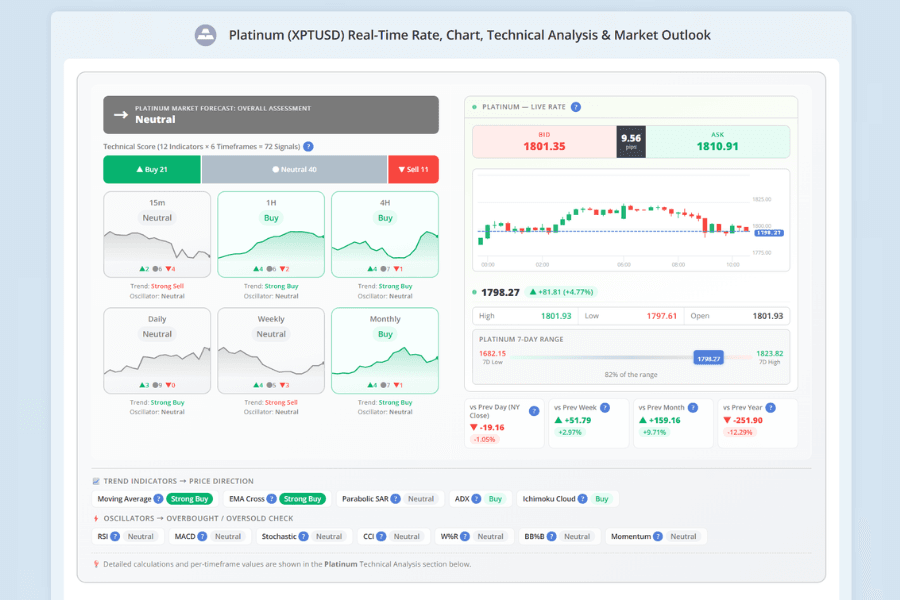
Through XPTUSD, traders can participate directly in platinum's rises and falls. For a live chart and technical analysis, see the platinum price tool page.
2. Why do traders follow Platinum vs US Dollar?
Platinum's appeal comes from an unusually narrow supply-and-demand structure. Supply is extremely concentrated — in recent years roughly 70% of mined output has come from South Africa, so power shortages, strikes, or mine restructuring there can visibly shift global supply expectations. Demand is tied to the auto cycle and emissions rules: diesel catalysts have traditionally been platinum's stronghold, and in recent years automakers have also substituted platinum for palladium in gasoline-vehicle catalysts as the price gap widened — the composition of auto demand is changing. With both sides of the market this narrow, platinum often trades to a script of its own rather than gold's.
The other draw is relative price. Platinum traded above gold in plenty of past periods but has spent most recent years below it, making the platinum-gold ratio a standard yardstick for its relative position. Beyond autos, jewelry, chemical and glass industry uses, and investment demand through ETFs and bars all matter at the margin across cycles; hydrogen (PEM fuel cells and electrolyzers) is the long-term demand theme — still a small share of total demand today. Like gold and silver, platinum is priced in dollars, so the US Dollar Index and US real yields move it too.
3. What market characteristics define Platinum vs US Dollar?
| Characteristic | What it means |
|---|---|
| Extreme supply concentration | Roughly 70% of recent mined supply is South African; power, labor, and mine-operation news hits supply expectations directly |
| Industrial demand dominates | Autocatalysts are the largest single demand block; price tracks the auto cycle, emissions rules, and Pt-Pd substitution |
| Relatively small market | Smaller and thinner than gold or silver; liquidity can run shallow in some sessions, with sharper price jumps |
| Platinum-gold ratio | Platinum price ÷ gold price — the standard gauge of platinum's relative position and strength versus gold |
| Substitution with palladium | Fellow PGMs, partly interchangeable in catalysts; the price gap steers automakers' loadings over time |
When analyzing platinum, traders typically watch the gold price and palladium alongside it, reading the relative strength across the three.
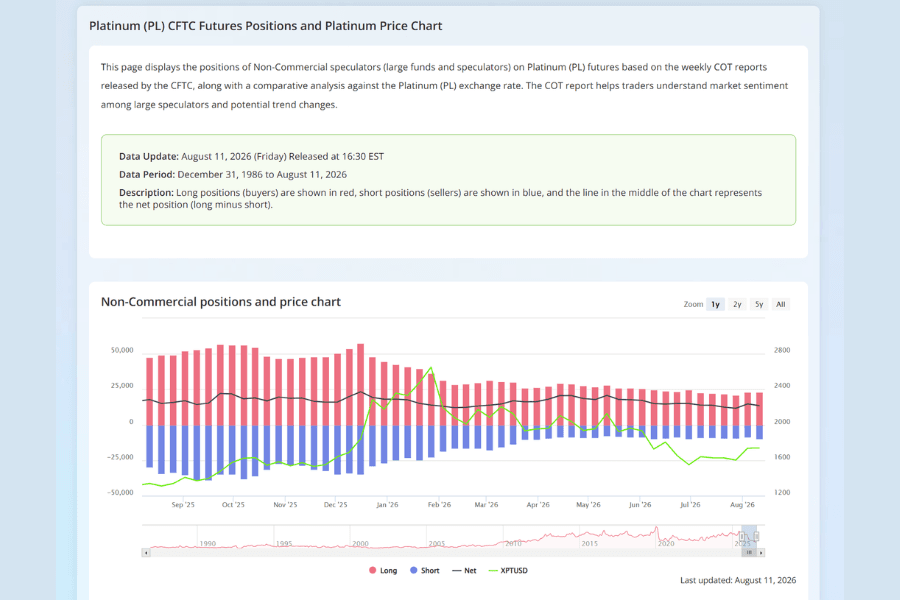
Futures positioning offers another sentiment window: the CFTC's COT report shows speculative positioning and crowding in platinum futures (NYMEX: PL). It reflects the structure of the futures market — not the money flow of the global platinum market — so treat it as a sentiment and positioning reference. Titan FX's platinum COT page tracks indexed positioning against price:
4. What moves the price of Platinum vs US Dollar?
- ① South African mine supply and recycling: unstable power, strikes, and cost pressure can tighten mine output; recycled supply — mainly from scrapped autocatalysts — is another key leg of total supply, ebbing with prices and the scrappage cycle.
- ② Autocatalyst demand and emissions rules: vehicle sales, the mix of combustion and hybrid drivetrains, and the strictness of emissions standards jointly set platinum loadings — the watchlist is broader than diesel sales.
- ③ Platinum-palladium substitution: the two are partly interchangeable in catalysts, but switching requires R&D, testing, and vehicle certification, so the response lags visibly — a price gap usually has to persist before new-model loadings change.
- ④ Jewelry, industrial, and investment demand: jewelry, chemical, and glass uses plus ETF and bar investment take turns as the marginal variable across cycles.
- ⑤ The dollar and real yields: dollar-priced platinum responds to dollar strength and US real rates, but with its heavy industrial weighting the reaction does not always track gold or silver.
- ⑥ The hydrogen long game: PEM fuel cells and some PEM electrolyzers use platinum as a key catalyst. Hydrogen remains a small slice of total demand today — a long-term incremental story and a source of theme-driven volatility.
One more nuance: safe-haven flows help platinum far less than gold. In a panic, money runs to gold first, while platinum can fall on recession fears as industrial demand gets marked down — the two do not have to move together.
5. How can traders access Platinum vs US Dollar? Common methods compared
| Method | Features and caveats |
|---|---|
| Physical platinum (bars) | Direct ownership with no leverage or expiry, but wide dealing spreads plus storage and liquidity costs |
| Futures (NYMEX: PL) | Standardized contracts with fixed sizes and expiry months; requires managing margin, expiries, and rollovers |
| ETF | Price exposure through a fund, traded like a stock; tracking depends on fund structure and fees |
| CFD | Margin-based long and short access with flexible sizing; watch spreads and leverage risk |
Most individual traders access platinum through CFDs with international brokers: the entry bar is low and both directions are tradable, which suits swing and event-driven approaches. XPTUSD is quoted as dollars per troy ounce; the actual contract size, leverage, and trading hours are broker product specifications — check the latest details on the platform. For physical or long-horizon exposure, platinum ETFs or bars are options, at the cost of wider spreads and storage.
6. What risks and market signals matter when trading Platinum vs US Dollar?
Platinum's core risk is being a relatively small market: liquidity can run thinner than gold or silver in some sessions, and surprise headlines bring sharper jumps and slippage. Actual CFD spreads depend on the broker, account type, and market conditions, and can widen in volatile hours. Position sizing and leverage deserve more conservatism than in gold or silver, and a stop loss belongs in place before entry.
Three signal groups are worth a routine check: South African supply news and auto-industry data (fundamentals), the dollar index and real yields (macro pricing), and COT positioning plus the platinum-gold ratio (sentiment and relative position). Around major economic data releases, wider swings are the norm — lighter positioning handles them better.
Start Trading Platinum vs US Dollar
Trade XPTUSD CFDs with Titan FX and access flexible leverage, competitive spreads, and opportunities in both rising and falling markets.
7. FAQ: Common questions about Platinum vs US Dollar
Q1. How is platinum different from gold?
The supply-demand structures differ substantially. Gold has a deep above-ground stock and trades mainly on financial and safe-haven demand; platinum is scarce in output and trades mainly on industrial demand, especially autocatalysts. On the chart, gold follows macro and haven sentiment, while platinum answers to the industrial cycle and supply events — in some risk-off or recession phases the two can move in different directions.
Q2. Why does platinum often trade below gold?
Their demand structures differ, so there is no fixed "fair spread" between them. In recent years platinum has been shaped by structural change in auto demand, while gold has been supported by central bank buying and investment and haven flows, leaving platinum below gold for long stretches. The ratio is useful for reading relative position — but "platinum used to cost more" is not, by itself, evidence that it must be undervalued.
Q3. Why is platinum supply concentrated in South Africa, and what does it mean?
The economically minable PGM deposits are heavily concentrated in South Africa's Bushveld Complex. That concentration means South African power shortages, strikes, or mine closures can visibly shift global supply expectations — a price catalyst peculiar to platinum.
Q4. Is hydrogen bullish for platinum?
It is a long-term theme worth tracking, but still a small share today — hydrogen-related applications remain a low percentage of total platinum demand, and near-term price action is driven by auto demand and South African supply. What deserves monitoring is the actual pace of PEM fuel cell and PEM electrolyzer deployment and commercialization; that is the signal of the theme paying off.
Q5. What should I check before trading platinum CFDs?
Beyond volatility, spreads, and slippage: confirm XPTUSD's contract size, minimum trade size, leverage, overnight financing, and trading hours — broker product specifications that vary by account type and market conditions. Operationally, keep leverage and positions moderate, avoid heavy entries and exits in the thinnest hours, and raise alert levels around supply headlines and major data releases.
Q6. How do platinum and palladium differ?
Both are PGMs used heavily in autocatalysts, but their home turf differs: platinum has traditionally anchored diesel catalyst systems, while palladium dominates gasoline vehicles — and in recent years the price gap has pushed some gasoline catalysts to substitute platinum for palladium. The substitution link is real, but it runs through vehicle certification and product cycles, so it takes time to show up in demand.
8. Conclusion: Understand Platinum vs US Dollar before building a trading plan
Platinum is a small precious-metals market with narrow supply and narrow demand: South Africa sets the supply, the auto industry sets the demand, hydrogen supplies the long-term imagination, and the dollar and real yields lay the macro ground. It is not a miniature gold — the haven role is weaker and the industrial role stronger — which is exactly why it walks its own path, and why the opportunity and the risk share one source.
In practice, put COT positioning, the platinum-gold ratio, and supply-demand headlines on a routine checklist; keep leverage in check when trading through CFDs or other flexible instruments; and use a demo account to get used to a volatility rhythm that differs from gold and silver. Read the market sentiment and your own risk tolerance first — then decide how deep to wade in.
Further Reading
- Introduction to Precious Metals Trading: Types, Applications, Price Drivers, and Trading Methods
- What is Gold CFD Trading? Exploring its Benefits, Risks, Costs, and Trading Methods
- What Is Silver vs US Dollar (XAGUSD)? A Trader's Guide
- How to Read the Silver Price: Live Quotes, Drivers, and Ways to Invest
The financial markets research team at Titan FX. We produce educational content for investors across a wide range of instruments, including forex, commodities (oil, precious metals, agriculture), stock indices, US equities, and crypto assets.
Primary Sources (by Category)
- Market and industry bodies: London Platinum and Palladium Market (LPPM), World Platinum Investment Council (WPIC)
- Market data: CME Group (NYMEX), CFTC Commitments of Traders (COT) reports