

What Are Defense Stocks? Largest US Defense Stocks, Price Drivers and How to Invest
The United States has the world's largest defense budget, so US defense contractors sit at the center of the sector. Their main customer is the government, and much of their work comes through multi-year contracts. As a result, their earnings usually depend less on the business cycle than those of consumer companies.
Defense stocks still have their own drivers. Congress has to approve the defense budget, and geopolitical events and the progress of large contracts also move share prices.
This guide covers what defense stocks are and the main types, the largest US defense stocks, what moves their prices, their strengths and risks, and how to get exposure through individual shares, ETFs and CFDs. It looks at the sector from an industry point of view and does not take a position on any political stance or military action.
- Defense stocks are companies that earn most of their revenue from government defense contracts. The largest US contractors include Lockheed Martin, RTX, Northrop Grumman and General Dynamics
- The sector splits into prime contractors, component suppliers, and defense technology and services firms, and each group depends on the defense budget to a different degree
- The US fiscal 2027 defense budget request is about $1.5 trillion, and NATO members have set a target of 5% of GDP for defense-related spending by 2035
- Strengths include a stable customer and good order visibility. Risks include budget politics, contract losses and easing geopolitical tension
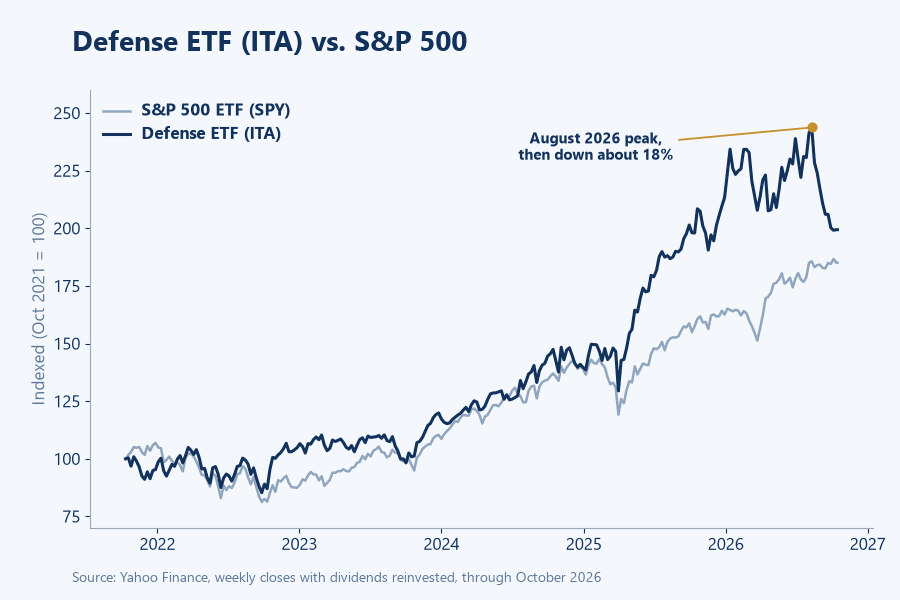
- The iShares defense ETF (ITA) beat the S&P 500 by a wide margin in 2025 but has fallen about 18% from its August 2026 peak
1. What Are Defense Stocks?
Defense companies make everything from fighter jets, missiles, warships and tanks to radar, satellites, and communications and information systems. The US Department of Defense is the world's largest buyer of defense equipment, so when markets talk about defense stocks, they usually mean US defense contractors.
Outside the United States, well-known listed defense companies include BAE Systems in the UK, Rheinmetall in Germany, Thales in France, Mitsubishi Heavy Industries in Japan and Hanwha Aerospace in South Korea.
By their place in the supply chain, defense stocks fall into three broad groups:
-
Prime contractors: Companies that sign contracts directly with the government and deliver complete weapons systems, such as Lockheed Martin, maker of the F-35 fighter jet. This group depends most on the defense budget
-
Component and subsystem suppliers: Companies that supply engines, electronics and structural parts to the primes. Many also serve commercial aviation, such as HEICO and Howmet Aerospace
-
Defense technology and services firms: Companies that provide information systems, cybersecurity and systems integration, such as Leidos
Many companies run both defense and commercial aerospace businesses, so defense stocks are often grouped with aerospace stocks. The two respond differently to the economy, though. Commercial aerospace follows air travel demand, while defense work depends mainly on government budgets.
2. List of the Largest US Defense Stocks
The table below lists US defense and aerospace stocks with live prices on Titan FX.
| Company (ticker) | Main defense business | Other main business |
|---|---|---|
| Lockheed Martin (LMT) | F-35 fighter jet, missiles and air defense, space systems | Mostly defense |
| RTX (RTX) | Raytheon missiles and the Patriot air defense system | Pratt & Whitney engines, Collins Aerospace and other commercial aerospace |
| Northrop Grumman (NOC) | B-21 bomber, intercontinental ballistic missiles, space systems | Mostly defense |
| General Dynamics (GD) | Nuclear submarines, Abrams tanks | Gulfstream business jets |
| Huntington Ingalls Industries (HII) | Aircraft carriers, submarines and other warships | Mostly defense |
| Leidos Holdings (LDOS) | Defense information systems, systems integration | Government IT and health services |
| Textron (TXT) | Bell military helicopters | Cessna commercial aircraft |
| Boeing (BA) | Tankers, fighter jets, space and security | Mostly commercial airliners |
| HEICO (HEI) | Defense electronics | Replacement parts for commercial aircraft |
| Howmet Aerospace (HWM) | Military engine parts | Commercial engine parts, fasteners |
The first four are the largest US defense contractors and earn the highest share of their revenue from defense. Boeing, HEICO and Howmet Aerospace earn most of their revenue from commercial aviation, so their share prices also react strongly to airliner demand.
3. What Moves Defense Stocks?
Defense stocks depend on how much governments spend, where that money goes, and whether companies can turn the contracts they win into profit. These are the four factors investors watch most often.
Defense budgets
The defense budget is the most basic driver of defense stocks. The US fiscal 2027 defense budget request, released in April 2026, is about $1.5 trillion, roughly 44% more than about $1.01 trillion in fiscal 2026. About $350 billion of it is planned to come through a separate reconciliation bill.
Congress still has to review the request, so the final amount and timing may differ from what was requested.
Allied defense spending
Defense spending is rising outside the United States too. At the 2025 Hague summit, NATO members agreed to raise defense-related spending to 5% of GDP by 2035: 3.5% for core defense and 1.5% for related areas such as infrastructure and cybersecurity. When European countries buy US weapons systems, those purchases also become orders for US defense companies.
Geopolitics
Wars and regional conflicts raise demand for weapons and ammunition, and investors often buy defense stocks when tensions rise. However, the effect of geopolitical risk on share prices is usually short-lived.
Winning and delivering contracts
A defense company's results depend on winning large contracts and delivering them on time and on budget. Fixed-price contracts are a common source of risk: if costs run over, the company absorbs the difference. Boeing has booked large losses on several fixed-price defense contracts in recent years.
4. Defense Stocks: Strengths and Risks
With those drivers in mind, here is what sets defense stocks apart. They are often seen as steady performers because of their unusual customer base and order structure, but the same structure brings risks that other sectors do not face.
Strengths of defense stocks
-
A stable customer: The main customer is the government, which reliably pays its bills, and demand has little to do with consumer spending
-
Good order visibility: Large weapons programs can run for more than a decade, and contractors carry large backlogs of unfilled orders. Lockheed Martin's backlog, for example, was about $230 billion at the end of June 2026, close to three times its full-year sales forecast
-
Dividends: Many large defense stocks pay steady dividends. General Dynamics has raised its dividend for more than 30 consecutive years and is a member of the Dividend Aristocrats
The chart below compares the defense ETF ITA with the S&P 500 ETF SPY over the past five years, using weekly closes with dividends reinvested. Defense stocks outperformed the broad market by a wide margin in 2025. After peaking in August 2026, ITA had fallen about 18% by mid-October, while SPY kept rising over the same period.
Risks of defense stocks
-
Budget politics: Congress must approve the defense budget. Budget delays, government shutdowns or shifting spending priorities can slow new contract awards
-
Contract losses and delays: Large programs often run into technical problems and cost overruns, and losses on fixed-price contracts hit earnings directly
-
Easing tensions: News of a ceasefire or peace talks can trigger sharp pullbacks in defense stocks that rose on the conflict
-
High valuations: When the market has already priced in good budget and order news, share prices become more sensitive to bad news
5. How to Invest in Defense Stocks: Shares, ETFs and CFDs
There are three main ways to invest in defense stocks:
| Method | Features | Best suited for |
|---|---|---|
| Buying shares | You own the stock directly and receive dividends | A view on a specific company's orders and products |
| Defense ETFs | One fund holds many defense and aerospace companies, which spreads single-company risk | Exposure to the whole sector |
| CFDs | You do not own the shares; profit or loss is settled on price changes, and you can go long or short | Short- to medium-term trading, or selling short in a decline |
Popular defense ETFs include the iShares U.S. Aerospace & Defense ETF (ITA), the SPDR S&P Aerospace & Defense ETF (XAR) and the Invesco Aerospace & Defense ETF (PPA). ITA is weighted by market cap, so its holdings are concentrated in the largest defense stocks. XAR uses a modified equal-weight method, which gives small and mid-sized companies a larger share.
Titan FX offers CFDs on the defense and aerospace stocks listed above. Each instrument page brings together the live price, chart, technical analysis and an overall signal for each timeframe. Here is the Lockheed Martin page as an example:
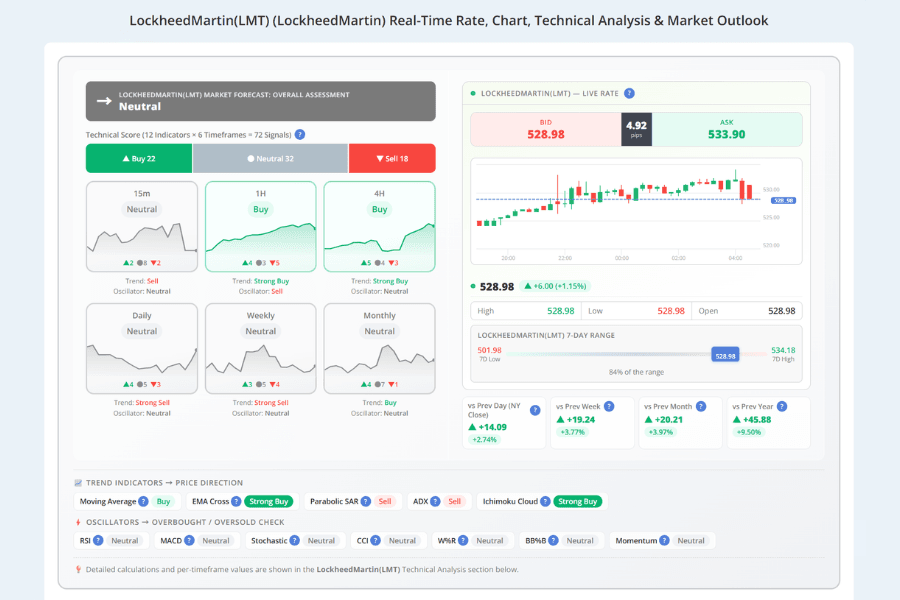
Available leverage for share CFDs varies by instrument and account type. Before you trade, you can check the required margin with the Margin Calculator.
6. Defense Stocks FAQ
Q1. Who are the Big Five defense contractors?
The "Big Five" usually means Lockheed Martin, RTX, Northrop Grumman, General Dynamics and Boeing. They are the largest prime contractors to the US Department of Defense. Boeing earns most of its revenue from commercial airliners, so its share price behaves differently from the other four.
Q2. Do defense stocks always rise when the defense budget grows?
Not necessarily. Once a budget passes, the money still has to go through bidding and contract awards before it becomes a company's orders, and orders only become revenue when products are delivered. If a fixed-price contract runs over budget, more orders can even mean lower profits. Besides the budget figure, look at each company's backlog, margins and delivery progress.
Q3. Do defense stocks go up during a war?
Not always. Defense stocks often draw buyers in the short term when a conflict escalates, but gains are hard to sustain unless budgets and orders actually increase. If share prices have already priced in the conflict, the orders that follow may fall short of what the market expected.
Q4. Do defense stocks pay dividends?
Most large defense stocks pay dividends, including Lockheed Martin, General Dynamics, Northrop Grumman and RTX. If you hold a CFD position, a dividend adjustment is applied on the ex-dividend date, and whether it is credited or charged depends on the direction of your position.
7. Conclusion
Defense stocks are companies that earn most of their revenue from government defense contracts. The main US prime contractors include Lockheed Martin, RTX, Northrop Grumman and General Dynamics. Defense budgets, allied spending, geopolitics and contract delivery are the four main factors that move these stocks.
Defense stocks have a stable customer and good order visibility, but they also face budget politics, contract losses and the risk that tensions ease. Choose shares, ETFs or CFDs to match your goal, and keep an eye on budget debates and major contract news.
Further Reading
Titan FX Trading Strategy Lab. We produce investor-education content covering forex, commodities (crude oil, precious metals, agricultural goods), stock indices, US equities, and digital assets.
Primary Sources (by Category)
- Government and international bodies: US Department of Defense fiscal 2027 budget request; NATO 2025 Hague Summit Declaration
- Market data: Yahoo Finance (ITA and SPY weekly closes); iShares, SPDR and Invesco defense ETF fact sheets
- Research and news: CSIS and other analyses of the fiscal 2027 defense budget; company investor relations materials