

What Are Blue-Chip Stocks? US Blue Chips, Traits, Risks, and How to Invest

A blue-chip stock is the stock of a large, financially sound company that leads its industry and has a long operating record behind it. The label describes a company's scale and reliability, and it carries an implied expectation that the business will not fall over suddenly.
There is no official definition of a blue chip and no institution publishes a certified list. In the US market the 30 components of the Dow Jones Industrial Average are the group most often treated as blue chips, though "Dow component" and "blue chip" are not the same thing. Other markets have their own working proxies.
This article covers the definition and the origin of the name, the five things to check before calling a stock a blue chip, the US companies usually cited as blue chips, how the label relates to growth, value, and small-cap stocks, and the risks that come with owning them.
- A blue-chip stock is a large, financially sound, industry-leading company with a long and stable operating record
- Blue chip is a market convention rather than an official category: no certified list, no agreed size threshold. The Dow 30 is the usual US proxy; Hong Kong applies the term to Hang Seng Index members
- Five things to check: market cap, industry position, earnings and cash-flow stability, dividend record, and survival through a full economic cycle
- Blue chip, growth, value, and small-cap sit on different classification axes, so one stock can be a blue chip and a value stock at the same time
- Blue-chip status can be lost. General Electric and Kodak were both Dow components; a reputation for stability is not protection against loss
- 1. What is a blue-chip stock?
- 2. What defines a blue chip? Five things to check
- 3. Which US stocks are blue chips? The Dow 30 and its sectors
- 4. Blue chip vs growth, value, and small-cap
- 5. Advantages and risks of blue-chip stocks
- 6. How to invest in blue chips: stocks, ETFs, and index CFDs
- 7. FAQ: Common questions about blue-chip stocks
- 8. Conclusion: Put blue chips in the right place
1. What is a blue-chip stock?
A blue-chip stock is the stock of a large, financially sound listed company that leads its industry and has an operating record long enough to be tested. These businesses have usually passed their rapid-expansion phase and settled into maturity, so the market expects steadiness from them rather than surprises.
The name is generally traced to poker, where the blue chip carries the highest value. US financial writers began borrowing the phrase in the 1920s for the heavyweight, high-priced shares of large corporations, and the usage stuck.
Because there is no official standard, the market borrows representative large-cap indices as working lists — the 30 components of the Dow Jones Industrial Average (US30) in the US, or the members of the Hang Seng Index (HK50) in Hong Kong. Lists compiled from different sources rarely match.
Deciding whether a company is a blue chip therefore takes more than market cap or index membership. Industry position, financial record, and the stability of the business all belong in the judgment.
2. What defines a blue chip? Five things to check
-
① Market capitalization: Blue chips are large caps or mega caps. There is no agreed minimum — figures quoted by different sources range from a few billion to well over a hundred billion dollars — so a company's relative size within its market and sector is the more practical test. The market cap ranking gives you that comparison.
-
② Industry position: Ranked at or near the top of its main market, with a durable edge in brand, distribution, scale, or technology that a new entrant cannot take away quickly.
-
③ Stable earnings and cash flow: Revenue and profit swing within a moderate range, and the business keeps producing free cash flow. You can verify this directly from the cash flow statement — operating cash flow less capital expenditure.
-
④ Dividend record: Most blue chips maintain a steady cash dividend policy, and some have raised the payout for decades. Dividends are a common trait, not a requirement — several of the largest technology companies paid nothing for years, or started only recently.
-
⑤ Survival through a full cycle: At least one complete recession and recovery, with no serious damage to the balance sheet along the way. This is the hardest item to acquire quickly, and it is the main gap between "a large company that recently listed" and "a blue chip".
Not every item has to be satisfied. In practice the term is applied on an overall impression: big enough, dominant enough, clean financials, around long enough.
3. Which US stocks are blue chips? The Dow 30 and its sectors
There is no official US blue-chip list, and the closest substitute is the 30 components of the Dow Jones Industrial Average. Those 30 companies are picked by a committee weighing reputation, sustained growth, investor interest, and sector representation, and they have long served as the core sample of US blue chips.
By sector, the Dow components fall roughly into the following groups. The table lists representative members only; the index is adjusted over time, so the current roster should be taken from the index provider.
| Sector | Representative companies |
|---|---|
| Consumer staples | Coca-Cola, Procter & Gamble |
| Health care | Johnson & Johnson, Merck |
| Financials | JPMorgan Chase, American Express |
| Industrials | Caterpillar, Honeywell |
| Information technology | Microsoft, Apple, IBM |
| Energy | Chevron |
One caveat is worth stating. The Dow is price-weighted and its members are chosen by a committee rather than screened mechanically on market cap or financial criteria. It is a representative list, not a certification standard for blue chips.
Widen the frame and most of the largest, consistently profitable companies in the S&P 500 (US500) also fit the general description.
The Magnificent 7 clear any traditional blue-chip bar on size and industry position. Their growth rates and volatility, however, run well above those of a mature blue chip, and filing them in the same drawer as Coca-Cola glosses over a real difference in risk profile.
4. Blue chip vs growth, value, and small-cap
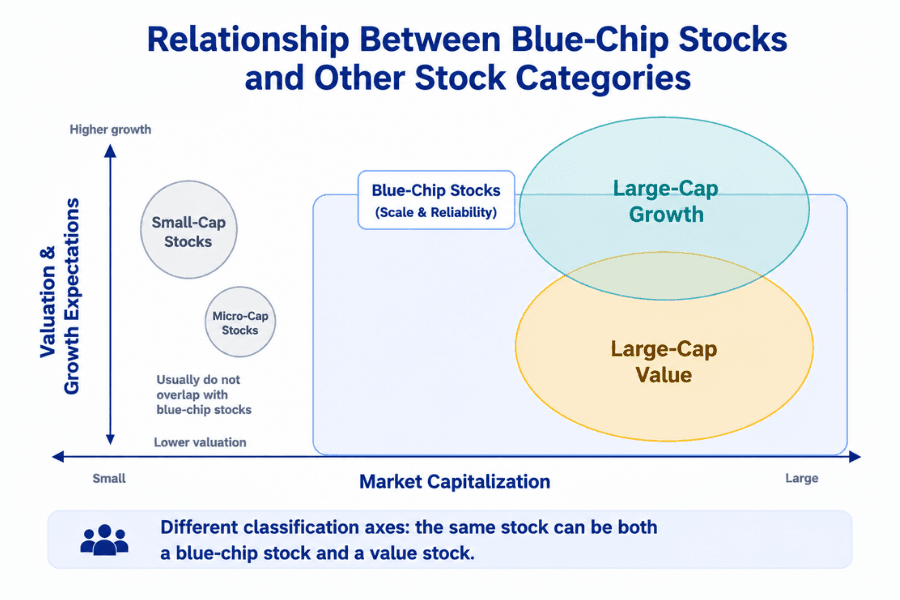
These four labels get compared side by side, but they are built on different axes:
- Blue chip answers a question about scale and reliability
- Growth and value answer a question about valuation and growth expectations
- Small-cap versus large-cap answers a question about size bracket
| Category | Basis | Typical traits | Relation to blue chips |
|---|---|---|---|
| Blue chip | Scale and reliability | Large cap, industry leader, sound financials | — |
| Growth stock | Growth expectations | Fast revenue and earnings growth, higher valuation, little or no dividend | Can overlap (large-cap growth) |
| Value stock | Valuation level | Lower P/E and price-to-book, higher payout | Substantial overlap |
| Small-cap | Size bracket | Small, volatile, thinly covered | Usually no overlap |
| Micro-cap | Size bracket | Smaller still, with clear liquidity risk | Usually no overlap |
Because the axes differ, one stock can carry several labels at once. An established manufacturer with a huge market cap, a low P/E ratio, and a steady dividend is both a blue chip and a value stock. A company of similar size still growing revenue at a double-digit rate on a rich multiple sits in the overlap between blue chip and growth.
5. Advantages and risks of blue-chip stocks
Advantages
-
Moderate volatility: Trading volume and research coverage are heavy, so prices are less easily pushed around by a single headline than small-cap prices are.
-
Information is available: Institutional research, analyst estimates, and media coverage are dense, which keeps the cost of finding and checking information low.
-
Steadier dividend income: Many mature blue chips have long payout records, so cash comes back to you while you hold. Dividends are not a requirement of the label, and they do not guarantee support if the share price falls.
-
Ample liquidity: Spreads are usually narrow, and larger orders have limited impact on the fill.
Risks
-
A ceiling on growth: Mature companies tend to grow revenue and earnings more slowly than the high-growth cohort. When the market is chasing growth stories, mature blue chips can lag them — how far depends on sector mix, valuation, and where the cycle sits.
-
Disruption: Scale is not a moat. When the technology or the business model shifts, a large organization and an entrenched revenue base slow the response down.
-
Blue-chip status expires: General Electric spent more than a century in the Dow and was treated for decades as a US blue chip. It cut its dividend sharply twice, in 2017 and 2018, and was removed from the index in June 2018. Kodak was also a Dow component, dropped in 2004 and filing for Chapter 11 reorganization in 2012.
-
Valuations get stretched too: Sound and cheap are separate questions. When money crowds into large caps, blue chips can just as easily be bought at an expensive price.
-
Systematic risk still applies: In a broad market drawdown blue chips may fall less than small caps, but they are not immune. If the shock lands in their own sector, size offers no protection.
6. How to invest in blue chips: stocks, ETFs, and index CFDs
-
Buying the shares directly: Your return depends entirely on that one company. The upside is that you can concentrate on businesses you genuinely understand; the cost is that company-specific operating and reporting risk cannot be diversified away. For how prices behave around results, see earnings season.
-
Through index products: An ETF or index fund tracking a large-cap index holds a basket of blue chips in one position. Diversification is good, but the weighting scheme determines the concentration you actually carry — a cap-weighted index with a few dominant names is less diversified than it looks.
-
Index CFDs: Contracts for difference let you trade the price of indices such as US30 and US500, in both directions and with efficient use of capital. A CFD does not hold the shares, so there are no shareholder rights, and leverage and overnight financing costs need watching.
The two indices are not interchangeable here. US30 is 30 mature large caps and sits close to the traditional blue-chip idea; US500 covers a far wider range of US large caps, including many high-growth and mid-size companies, and should not be read as a blue-chip index.
If income is the goal, judging whether a dividend yield is sustainable matters more than chasing a high number. A rising yield is sometimes just the result of a falling share price, so check whether the payout itself has changed.
Trade US Stock CFDs with Titan FX
Titan FX offers 100+ US stock CFDs on MT4/MT5 with up to 20:1 leverage, tight spreads, and full long/short flexibility.
7. FAQ: Common questions about blue-chip stocks
Q1: What is the difference between blue chips and red chips?
The two are classified on different bases. Blue chip describes a company's scale and reliability. Red chip is a Hong Kong market term for a company incorporated outside mainland China — usually in Hong Kong, Bermuda, or the Cayman Islands — whose main business is on the mainland and which is substantially controlled by mainland interests. H shares, by contrast, are incorporated on the mainland and listed in Hong Kong. A red chip large enough to join the Hang Seng Index would also be called a blue chip.
Q2: Is there an official US blue-chip list?
No. Every "blue-chip list" in circulation has been compiled by a media outlet or research firm against its own criteria. The most frequently used stand-in is the 30 components of the Dow Jones Industrial Average, followed by the largest and most profitable members of the S&P 500.
Q3: Do blue chips always pay dividends?
Not always. A steady payout is a common trait, not an entry ticket. Some very large, entrenched companies pay no cash dividend for long stretches, directing the money into reinvestment or share buybacks instead. Dividends are one dimension of the judgment, not the whole of it.
Q4: Are blue chips suitable for beginners?
On volatility and on how easy the information is to obtain, blue chips are friendlier than small caps. Suitable for beginners does not mean free of loss, though: blue chips fall in market drawdowns like everything else, and buying one at too high a price can leave you waiting for years. Position sizing and entry discipline apply here as much as anywhere.
Q5: Are blue chips and Dividend Aristocrats the same thing?
No. Blue chip is a descriptive market term with no quantitative threshold. Dividend Aristocrats is an index built by S&P Dow Jones Indices whose members must belong to the S&P 500 and must have raised the dividend per share every year for at least 25 consecutive years. Most Dividend Aristocrats fit the general description of a blue chip, but the two definitions rest on completely different foundations.
Q6: Do blue chips really hold up better when the market falls?
Large caps are statistically less volatile than small caps, but holding up better is a relative claim. During the 2008 financial crisis several large financial institutions fell far more than the market average. When the shock originates in a blue chip's own sector, size provides no shelter.
Q7: Are there blue-chip ETFs?
There is no standardized "blue-chip ETF" category. The usual route is an ETF tracking the Dow Jones Industrial Average, a broad large-cap index, or a large-cap value index, which gives you comparable exposure. What matters when choosing is the index it tracks, the expense ratio, the concentration of its holdings, and its distribution policy — the words "blue chip" in a fund's name tell you nothing about what it actually holds.
8. Conclusion: Put blue chips in the right place
Blue chip is a label about scale and reliability. It tells you the company is financially sound, well documented, and liquid. It says nothing about whether the valuation is reasonable, whether growth is still there, or whether the industry is changing underneath it.
In practice, treating blue chips as ballast for a portfolio gets closer to their real role than treating them as a safe. They lower the overall volatility of the mix, and they do not excuse you from the work of selection and timing. General Electric and Kodak make the same point: blue-chip status is a record, and it only holds as long as the company keeps earning it.
Further Reading
- Value investing: core principles, common metrics, and pitfalls
- Preferred stock vs common stock: definition, benefits, and risks
- What is a stock index? Types, calculation methods, and how to trade one
- What is the Russell 2000 (US2000)? A trading guide
- How to read financial statements: the three core reports explained
Titan FX Trading Strategy Lab. We produce investor-education content covering forex, commodities (crude oil, precious metals, agricultural goods), stock indices, US equities, and digital assets.
Primary Sources (by Category)
- Index construction: S&P Dow Jones Indices public materials on component selection for the Dow Jones Industrial Average and the S&P 500
- Market conventions: General descriptions by major exchanges and financial media of the terms blue chip, red chip, and H share
- Corporate events: Public records of General Electric's and Kodak's dividend decisions and of Dow Jones Industrial Average component changes
- Investor education: Regulator materials on stock classification, diversification, and risk awareness