

What Are Dividend Aristocrats? Criteria, the List, ETFs, and Risks
The Dividend Aristocrats are S&P 500 companies that have raised their dividend per share every year for at least 25 consecutive years. The name also belongs to a formal index built by S&P Dow Jones Indices — the S&P 500 Dividend Aristocrats, launched in May 2005.
Unlike a descriptive market term such as blue chip, this one comes with written, quantitative thresholds: S&P 500 membership, a 25-year streak of increases, and minimum size and liquidity. The number of companies that clear all of them is small — about 69 in 2026, and the count moves after every annual review.
This article covers the eligibility criteria, how the index is weighted and reviewed, its sector mix and best-known members, how Aristocrats differ from Dividend Kings and Dividend Achievers, the strengths and blind spots of the screen, and what to check before investing.
- Dividend Aristocrats are S&P 500 members that have raised the dividend per share every year for 25 consecutive years or more, compiled by S&P Dow Jones Indices into a formal index
- Four thresholds apply: S&P 500 membership, the 25-year streak, a float-adjusted market cap of roughly USD 3 billion, and average daily value traded of roughly USD 5 million over the prior three months
- The index is equal weighted, re-weighted quarterly, reviewed once a year in January, capped at 30% per sector, and kept at a minimum of 40 constituents
- Companies with 50+ year streaks are informally called Dividend Kings — not an S&P index; 10+ years makes a Dividend Achiever
- The streak is evidence of financial discipline, not a promise of returns: AT&T cut its dividend in 2022, broke its record, and was dropped from the list
- 1. What are Dividend Aristocrats?
- 2. Eligibility: the four thresholds
- 3. How the index works: equal weight, annual review, and sector mix
- 4. Aristocrats, Kings, and Achievers: how the tiers differ
- 5. Strengths and blind spots
- 6. How to invest: stocks, ETFs, and what to check
- 7. FAQ: Common questions about Dividend Aristocrats
- 8. Conclusion: Treat the streak as a lead, not a guarantee
1. What are Dividend Aristocrats?
The Dividend Aristocrats are S&P 500 companies that have raised the dividend per share every year for at least 25 consecutive years. S&P Dow Jones Indices packaged the qualifying companies into the S&P 500 Dividend Aristocrats index in May 2005, which is when the title acquired a definite owner and a definite rulebook.
What makes the 25-year bar meaningful is the span of time it covers. Holding an unbroken run of increases for 25 years means passing through the 2000 dot-com bust, the 2008 financial crisis, and the 2020 pandemic shock — each of which pushed large numbers of companies to freeze or cut their payouts to preserve cash. Continuing to raise the dividend through all of them says the earnings and the cash flow held up.
One distinction matters up front: the screen is about the continuity of increases, not about the current dividend yield. A company yielding 1% qualifies as long as it lifts the per-share cash dividend every year and meets the other conditions.
2. Eligibility: the four thresholds
-
① S&P 500 membership: The company must be a current constituent of the S&P 500 (US500). Leaving the S&P 500 voids the status at the same time.
-
② 25 or more consecutive years of increases: Measured on dividend per share, every year must exceed the one before. Holding the payout flat does not count — a single year of no change or a cut resets the record to zero.
-
③ Size threshold: A float-adjusted market capitalization of roughly USD 3 billion or more as of the rebalancing reference date.
-
④ Liquidity threshold: Average daily value traded of roughly USD 5 million or more over the three months before the review.
All four are checked together. A company with a 40-year streak that shrinks out of the S&P 500 in a given year leaves the Aristocrats list as well — a second route out that has nothing to do with the record itself.
The dollar figures can be revised as S&P Dow Jones Indices updates its methodology, so the current conditions should be taken from the official documentation.
3. How the index works: equal weight, annual review, and sector mix
Understanding the rules is more useful than memorizing the roster.
| Mechanism | Detail |
|---|---|
| Weighting | Equal weight — every constituent carries the same weight |
| Re-weighting | Reset to equal weight after the close of the last trading day of January, April, July, and October |
| Constituent review | Once a year in January, checking each company against the four thresholds |
| Sector cap | Maximum 30% weight for any single GICS sector |
| Minimum count | At least 40 constituents after each rebalance; the streak requirement relaxes to 20+ years if that is not met |
Three of these are worth a second look.
-
Equal weight: A company worth USD 300 billion and one worth USD 30 billion carry the same weight in the index. Performance is therefore not dictated by a handful of giants, at the cost of carrying more mid-cap exposure.
-
The 30% sector cap: This keeps the index from concentrating too heavily in consumer staples, industrials, and the other traditional high-payout sectors.
-
The 40-constituent minimum: When fewer than 40 companies clear the 25-year bar, the rules allow companies with 20+ year streaks to fill the gap and keep the index diversified enough to be investable. This is an exception mechanism that fires only on a shortfall — it does not mean a 20-year streak is a normal route in.
Which companies are Dividend Aristocrats? Sector mix and examples
The 30% cap shows up in the actual composition. Taking the 2026 list, the constituents cluster in a few traditional steady-payout sectors:
| Sector (GICS) | Approx. count | Representative companies |
|---|---|---|
| Consumer staples | about 15 | Coca-Cola, Procter & Gamble, Colgate-Palmolive |
| Industrials | about 13 | Caterpillar, Emerson Electric |
| Health care | about 9 | Johnson & Johnson, AbbVie |
| Financials | about 8 | Aflac, Chubb |
Those four sectors alone account for more than half the index, while information technology is clearly under-represented — a 25-year streak of increases is inherently hostile to younger companies that ploughed their early cash back into the business. That structure also explains why the index tends to lag during technology-led rallies (see section 5).
The table is there to show the sector mix. The roster is adjusted at every January review, so the current list should be taken from S&P Dow Jones Indices.
4. Aristocrats, Kings, and Achievers: how the tiers differ
Several titles describe consecutive dividend increases, and they differ in both threshold and source:
| Title | Core threshold | Formal index? | Approx. count |
|---|---|---|---|
| Dividend Achievers | 10+ consecutive years of increases | A Nasdaq index series | Several hundred |
| Dividend Aristocrats | S&P 500 membership + 25+ years + size and liquidity thresholds | S&P 500 Dividend Aristocrats | About 69 (2026) |
| High Yield Dividend Aristocrats | S&P Composite 1500 membership + 20+ years | S&P High Yield Dividend Aristocrats | Over a hundred |
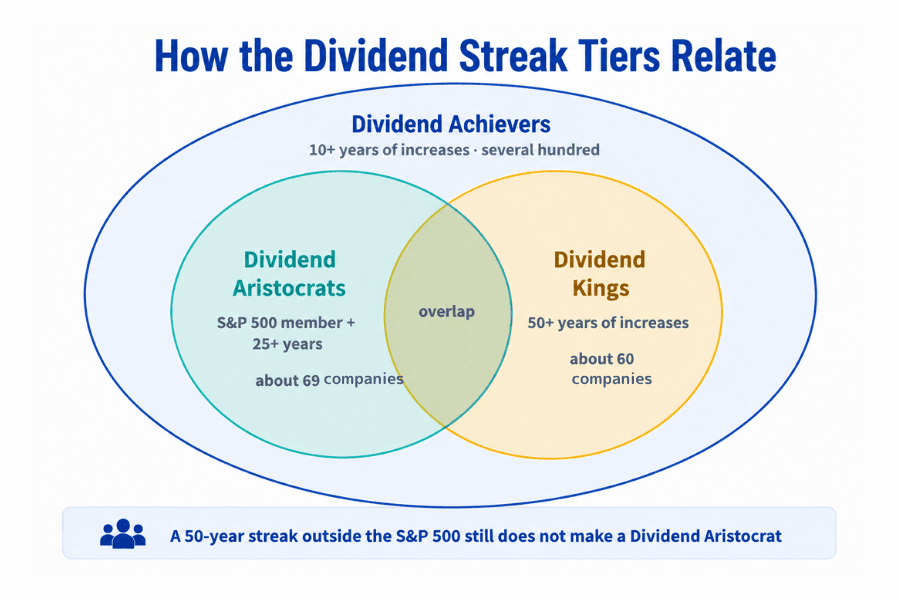
| Dividend Kings | 50+ consecutive years of increases | Market convention, no matching S&P index | About 60 |
Note that Kings and Aristocrats are not in a parent-child relationship. The two lists overlap heavily, but the screens are different. A Dividend King is defined purely by the 50-year record — no index membership required, no size threshold — so the list includes smaller mid-cap names. Conversely, a company with a 60-year streak that is not in the S&P 500 will not appear among the Aristocrats.
5. Strengths and blind spots
Strengths
-
Long-run evidence of discipline: A 25-year streak cannot be manufactured over a few quarters. It reflects earnings and cash flow that survived multiple economic cycles.
-
Predictable cash flow: The payout rises year after year, so a long-term holder's yield on original cost climbs over time.
-
Sector diversification: The 30% cap and the equal-weight scheme spread the index across sectors more evenly than a cap-weighted benchmark.
-
The increase is itself a signal: Raising the dividend is a public commitment to future cash outflows, and management usually makes it only when confident about earnings — which is why the market tends to read a continued increase as confidence in cash flow. It is a signal, not a guarantee.
-
Lower volatility, usually: The constituents are mature businesses, and the index has historically been less volatile than the S&P 500 — though it still falls with the market in a sharp correction.
Blind spots
-
The status can be lost: AT&T spun off its media business and cut the dividend in 2022, ending the streak, and was removed from the list at the subsequent review. One cut is enough to reset decades of record.
-
A streak says nothing about the size of the raise: The rule only asks for "higher than last year". A 0.5% increase counts, and an increase that small may not keep pace with inflation.
-
Sector tilt drags in growth markets: Consumer staples, industrials, and materials are heavily represented; information technology is not. When technology growth stocks lead, the index tends to lag the broad market.
-
Raising the dividend to keep the title: Management knows that removal triggers selling, so a weakening business may keep pushing through token increases. That is when to go back to the payout ratio and check whether free cash flow still covers it, using the cash flow statement.
-
Inclusion itself lifts the price: New constituents often attract buying after the announcement, so chasing the move means paying for that rally.
-
Mature does not mean cheap: Dividend Aristocrats overlap heavily with value stocks, but overlap is not a discount. When money rotates into defensive sectors, these valuations get pushed up too.
6. How to invest: stocks, ETFs, and what to check
-
Holding the shares directly: Pick from the list the companies you actually understand. Beyond the streak, the payout ratio and how well free cash flow covers it deserve more attention — a company with a persistently high payout ratio has little room left to keep raising.
-
Through an ETF: An ETF tracking the S&P 500 Dividend Aristocrats holds every constituent and applies the equal-weight and annual-review rules for you, which saves tracking the roster changes yourself. The cost is the expense ratio, and the fact that you cannot exclude the constituents you dislike. Diversifying away single-company risk still leaves you carrying the volatility of the equity market as a whole; this kind of ETF is not a capital-protected product.
-
Reinvesting the dividends: Putting the cash back into the same stock or ETF lets compounding build in share count. This is the main difference between a dividend-growth strategy and simply collecting the income.
Three things to confirm before you start:
-
The payment calendar: To receive a given dividend you must buy and hold before the ex-dividend date, while the shareholder register is fixed on the record date.
-
Dividend tax: Non-US residents receiving US cash dividends normally have tax withheld, at a rate that depends on where they live and on the applicable tax treaty. Build that layer into any calculation of the return you actually keep.
-
CFDs carry no shareholder rights: Trading the price of a share or index through a contract for difference means you do not hold the shares and have no voting rights; a position held across the ex-dividend date normally receives a dividend adjustment from the broker instead.
Trade US Stock CFDs with Titan FX
Titan FX offers 100+ US stock CFDs on MT4/MT5 with up to 20:1 leverage, tight spreads, and full long/short flexibility.
7. FAQ: Common questions about Dividend Aristocrats
Q1: How many Dividend Aristocrats are there?
About 69 in 2026. The number moves after each January review: companies drop out for cutting the dividend, leaving the S&P 500, or missing the size and liquidity thresholds, while others join as their streak reaches 25 years.
Q2: What is the difference between Dividend Aristocrats and Dividend Kings?
The threshold and the source. Aristocrats require S&P 500 membership, a 25-year-plus streak, and size and liquidity minimums, and the group is a formal index run by S&P Dow Jones Indices. Kings are defined only by a 50-year-plus streak, with no index membership or size requirement, and the title is a market convention. The lists overlap, but neither contains the other.
Q3: What happens when the streak breaks?
The record resets to zero and the company is removed at the next constituent review. Regaining the status means accumulating another 25 years from the new starting point. That is why many companies prefer a token increase over a freeze even in difficult periods.
Q4: Do Dividend Aristocrats have high yields? How do they differ from high-dividend stocks?
Not necessarily high. The Aristocrats screen looks at the record of consecutive increases and is indifferent to the current yield — the list contains companies yielding under 2% as well as companies well above the market average.
High-dividend stocks are screened on something else entirely: the absolute level of the current yield. The logic differs. A high yield can come from a falling share price or a one-off payment and says nothing about a company's ability to keep raising; a serial raiser can carry a low yield simply because the stock has run up. If the goal is current income, look at the yield. If the goal is income that grows, look at the size and the sustainability of the increases.
Q5: Are Dividend Aristocrats suitable for long-term holding?
The screen is built for the long run: what the constituents have in common is the ability to keep earning and paying through repeated downturns. Holding long term does mean accepting the character of the group, though — it lags growth stocks in bull markets, and it is not immune in a correction. Treating it as the part of a portfolio that lowers volatility fits better than treating it as the return engine.
Q6: Do non-US residents pay tax on US dividends?
Tax is normally withheld, at a rate that depends on where the investor is resident and on the tax treaty between that jurisdiction and the United States; the rules differ from place to place. Because this directly reduces the yield you actually receive, confirm the rate that applies to you before building a dividend strategy.
Q7: Are Dividend Aristocrats and blue chips the same group of companies?
They overlap heavily, but the definitions rest on different foundations. Blue chip is a market term describing scale and reliability, with no quantitative threshold; Dividend Aristocrats are the constituents of an index with written rules. Most Aristocrats fit the general description of a blue chip, but the largest technology companies usually do not appear among them, because their dividend histories are not long enough.
8. Conclusion: Treat the streak as a lead, not a guarantee
What the Dividend Aristocrats offer is a verifiable screen: S&P 500 membership, 25 consecutive years of increases, and enough size and liquidity. Companies that pass it have produced a quarter of a century of evidence about their financial discipline.
That evidence describes the past. AT&T's removal shows that decades of record can be voided by a single cut, and the equal weight and sector cap explain why the index lags in a technology-led market. Using the streak as the starting point for research — then going back to the payout ratio, free cash flow, and valuation — stays closer to what the index was designed to do than buying the list outright.
Further Reading
- What are growth stocks? Valuation, risks, and US examples
- What are stock dividends? How US companies issue them and how to calculate
- Preferred stock vs common stock: definition, benefits, and risks
- What is market cap ranking? Calculation, US rankings, and how to use it
- Value investing: core principles, common metrics, and pitfalls
Titan FX Trading Strategy Lab. We produce investor-education content covering forex, commodities (crude oil, precious metals, agricultural goods), stock indices, US equities, and digital assets.
Primary Sources (by Category)
- Index rules: S&P Dow Jones Indices, S&P Dividend Aristocrats Indices Methodology — eligibility, equal weighting, review frequency, and sector caps
- Index data: Official descriptions and constituent summaries for the S&P 500 Dividend Aristocrats
- Corporate events: Public records of AT&T's 2022 business separation and dividend policy change
- Investor education: Regulator materials on dividend investing, payout sustainability, and tax awareness