

What Is Earnings Season? US Reporting Calendar and Trading Guide
Earnings season is the period when US-listed companies report quarterly results in concentrated waves: each season kicks off about two weeks after a fiscal quarter ends, runs at full intensity for several weeks, and comes around four times a year. From the big banks that open it to the major retailers that close it out, thousands of scorecards land within these few weeks.
Earnings season is also the US market's four-times-a-year, calendar-predictable volatility peak: a single report can send a stock sharply higher or lower, and a heavyweight's numbers can swing an entire index in the short run. For investors it is the routine checkpoint on fundamentals; for traders it is a dense event window that rewards preparation.
This guide covers the four-round US reporting calendar and its conventions, why releases cluster in pre-market and after-hours sessions, how to read EPS, revenue, and guidance, the market reactions that repeat every season, and how to manage gap and volatility risk.
- Earnings season is the concentrated reporting period for US-listed companies — four rounds a year, each running at full intensity for several weeks
- The rounds land roughly in mid-January to late February, mid-April to May, mid-July to August, and mid-October to November, with the big banks usually first
- Most releases come in pre-market or after-hours, so the first price reaction often happens in thin extended-hours trading
- What matters is the gap between results and expectations, the guidance that often steers the price, and whether GAAP or adjusted figures are being compared
- "Beat the estimate, stock falls anyway" is routine; managing gaps and volatility is the trader's core skill for the season
- 1. What is earnings season?
- 2. Which months? The four-round US reporting calendar
- 3. Why do releases cluster in pre-market and after-hours?
- 4. How to read a US earnings report: EPS, revenue, guidance, and key metrics
- 5. Market reactions that repeat every earnings season
- 6. How should traders handle earnings season?
- 7. FAQ: Common questions about earnings season
- 8. Conclusion: Turn earnings season into a prepared trade
1. What is earnings season?
Earnings season exists by institutional design. US securities law requires listed companies to disclose results on a schedule: quarterly reports (Form 10-Q) are due within 40 or 45 days of quarter-end and annual reports (Form 10-K) within roughly 60 to 90 days, with deadlines varying by filer category (company size). Because most companies' fiscal quarters align with the calendar and their deadlines sit close together, results cluster into fixed windows — hence "earnings season."
One distinction is worth pinning down early: what the market calls "reporting earnings" usually means the earnings release. Companies first publish headline numbers and management commentary through a press release, their investor relations (IR) site, and a Form 8-K filed with the SEC; the fuller 10-Q or 10-K follows within the statutory deadline. The price action of earnings season keys mainly off those releases.
Understanding the season's rhythm and reaction patterns is basic equipment for trading US stocks. If you want to firm up financial-statement reading first, see how to read financial statements.
2. Which months? The four-round US reporting calendar
| Round | Approximate window | What is reported |
|---|---|---|
| First | Mid-January to late February | Prior-year Q4 and full-year results |
| Second | Mid-April to late May | Q1 results |
| Third | Mid-July to late August | Q2 results |
| Fourth | Mid-October to late November | Q3 results |
Each round follows a familiar order. JPMorgan and the other big banks report about two weeks after quarter-end, and the market habitually reads bank results as the signal that the season has entered full swing; the tech giants cluster in the middle and back half of each round; and some large retailers (Walmart among them) close their fiscal year at the end of January, reporting about a month later than calendar-year companies and often serving as each round's finale.
Remember that this order is market convention, not regulation. Exact dates move every quarter, so confirm each company's reporting date on its investor relations page.
3. Why do releases cluster in pre-market and after-hours?
By convention, US companies avoid publishing results during regular trading hours, releasing instead before the open or after the close. Doing so makes it easier to schedule the earnings call and brief investors, and it lets major information reach the market outside regular hours. The direct consequence: the first wave of earnings price action tends to occur in pre-market trading and after-hours trading.
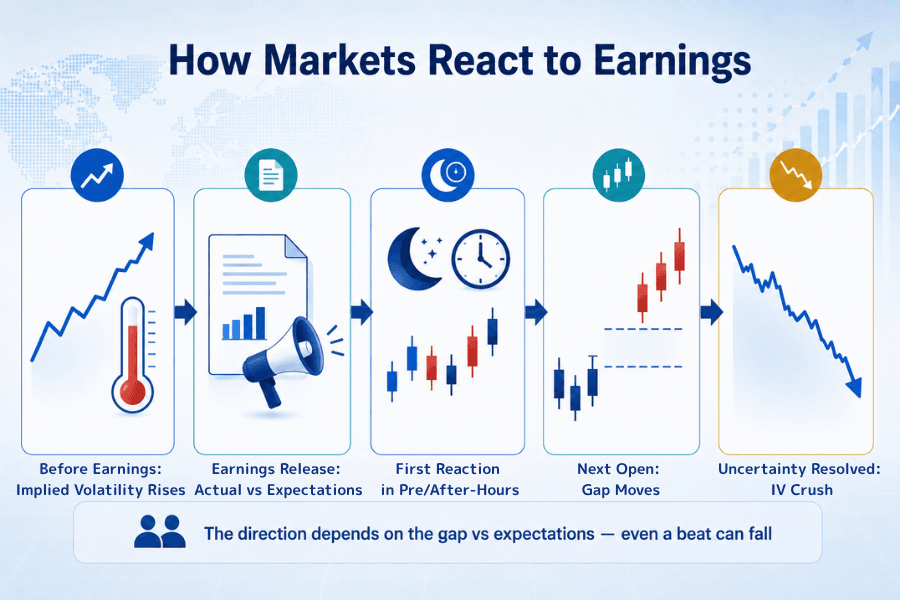
Extended hours have fewer participants and thinner liquidity, so prices jump harder: a stock can move violently within minutes of an after-hours release, and the next day's open frequently arrives as an outright gap. For session times and rules, see the full guide to US market trading hours.
4. How to read a US earnings report: EPS, revenue, guidance, and key metrics
Dozens of companies report daily during the season; catching the essentials beats reading everything:
-
① EPS and revenue vs expectations: prices react to the gap against expectations — a beat or a miss matters more than the absolute number. "Expectations" usually means the analyst consensus, and different data providers compile it on slightly different bases. For the calculation itself, see EPS (earnings per share).
-
② Guidance: management's outlook for the next quarter and full year. For companies priced on future growth, guidance often steers the stock more than the reported quarter — hitting the quarter but cutting the outlook usually still sends the price lower. Its weight varies by industry and company.
-
③ Margins and business mix: the direction of gross and operating margins, and which segments drive growth, reveal the quality of the earnings. Pair this with the income statement for detail.
-
④ GAAP versus adjusted figures: companies typically publish both official GAAP numbers and adjusted (non-GAAP) metrics that strip out one-off items — and the analyst consensus is usually quoted against adjusted EPS. Confirm the basis before calling a beat or a miss; most "the news says beat but the report disagrees" confusion starts here.
-
⑤ The earnings call: management's wording and the Q&A often add what the press release leaves out, and can power a second wave of after-hours movement.
Beyond the universal metrics, each industry has its own core KPIs: net interest income for banks, ARR for cloud software, data-center revenue for chipmakers, same-store sales for retailers — one template does not read every report.
5. Market reactions that repeat every earnings season
Beat the estimate, fall anyway
The season's most confusing sight for newcomers. Three causes dominate: the rally happened in advance and the print triggers profit-taking; the quarter was fine but guidance disappointed — the market trades expectations of the future; or the beat was smaller than the market's implied bar, because prices often carry expectations above the published consensus.
Volatility expectations rise, then collapse
Ahead of a report, implied volatility on short-dated options spanning the event tends to climb; once the numbers are out, the uncertainty is resolved and it deflates quickly — the "IV crush" of market slang. The practical read for traders is simple: price behavior and spreads around earnings are not what they are in normal weeks.
Heavyweight reports move the index
Magnificent 7 stocks carry outsized weights in the S&P 500 (US500) and the Nasdaq 100 (NAS100), so a heavyweight's report can visibly steer an index's short-term direction — especially in weeks when several report together. That is why earnings season matters to index traders as much as stock pickers.
Sympathy moves across the sector
A leader's report gets read as a verdict on its whole industry: a chip giant's order outlook moves the semiconductor complex, big-bank credit data moves financials. If you hold a peer stock, someone else's earnings date can become your volatility day.
6. How should traders handle earnings season?
-
Know the dates: put reporting dates for holdings and watchlist names on the calendar in advance — earnings risk control starts there
-
Respect gap risk: earnings gaps can jump straight over a stop level, and a stop order's fill is not guaranteed at its trigger price; run smaller size and lower leverage around report dates
-
Mind the extended-hours environment: liquidity is thin and spreads can widen, so chasing the first violent move costs more and risks more
-
Use the index level to diversify: index CFDs spread single-company earnings risk and trade in both directions — but no heavyweight-concentrated index fully insulates you from the season, and the index itself can swing around a giant's report
-
Stack the macro calendar: earnings season interleaves with rate decisions and jobs and inflation data; plan alongside the economic calendar so multiple events never sit on one oversized position
Trade US Stock CFDs with Titan FX
Titan FX offers 100+ US stock CFDs on MT4/MT5 with up to 20:1 leverage, tight spreads, and full long/short flexibility.
7. FAQ: Common questions about earnings season
Q1: Which months does US earnings season fall in?
Four rounds: roughly mid-January to late February (prior-year Q4 and full year), mid-April to May, mid-July to August, and mid-October to November. Big banks usually open the season and large retailers close it, but exact dates should be confirmed against each company's announcements.
Q2: Why are most reports released pre-market or after-hours?
It is convention, not a hard rule. Most companies avoid regular hours because it simplifies scheduling the earnings call and investor communication, and it reduces violent intraday swings. The side effect is that the first price reaction concentrates in thin extended-hours sessions, where jumps and spreads run wider than usual.
Q3: EPS beat expectations — why did the stock still fall?
Three usual suspects: the move happened in advance, so the print becomes a sell-the-news moment; guidance fell short — the market buys the future, and no quarter is good enough to offset a cut outlook; or the beat missed the market's implied bar, which often sits above the published consensus. Weighting guidance and the expectation gap over the headline number gets you closer to how the market actually reacts.
Q4: How does earnings season affect stock indexes?
The index answer depends on the heavyweights: reports from high-weight names like the Magnificent 7 can clearly steer US500 and NAS100 in the short run. When most companies beat or miss together, the season shapes how the market prices corporate earnings power and can set the index's phase direction. For traders who would rather not pick stocks, the index is the alternative route into earnings-season action.
Q5: Where do I check reporting dates?
Company IR pages and the SEC's filing system are the authoritative sources; major financial sites also compile earnings calendars. Note that site calendars mostly show estimated dates and companies do reschedule — for meaningful positions, trust the company's own announcement.
Q6: Is earnings season suitable for beginners?
The season is fast and volatile, so treat your first round as an observation exercise: follow a handful of companies through the full arc of expectations, release, and reaction until the "gap versus expectations decides the move" logic feels familiar, then step in with light size or at the index level. Understand gap risk and the limits of stop orders before entering.
Q7: Are the earnings release and the 10-Q or 10-K the same document?
They are different. Companies usually publish an earnings release first — headline numbers plus management commentary — and file it with the SEC on Form 8-K; the 10-Q (quarterly) and 10-K (annual) are the fuller statutory reports filed within their legal deadlines. The two overlap heavily but differ in purpose and depth of disclosure — which is why the news can be full of a company's earnings while the 10-Q has yet to appear in the filing system.
8. Conclusion: Turn earnings season into a prepared trade
Earnings season is the US market's quarterly exam: the schedule is predictable, the release conventions are stable, and the reactions follow patterns. Master the two cores — the gap versus expectations and the guidance — plus the extended-hours release mechanics and gap risk, and the season turns from a stream of surprises into an event you prepare for.
In practice, three habits carry most of the weight: put your holdings' reporting dates on the calendar, tighten leverage around report days, and express views at the index level when single-name risk is unwelcome. Markets will always spring surprises, but a prepared trader loses a position's worth of risk — an unprepared one loses the rhythm of the whole account.
Further Reading
- US overnight trading: sessions, ATS mechanics, advantages, and risks
- What is a balance sheet? Structure and how to read it
- What is a cash flow statement? Where the money comes from and goes
- What is quadruple witching? Mechanics and market impact
- NYSE vs NASDAQ vs AMEX: how the three US exchanges differ
Titan FX Trading Strategy Lab. We produce investor-education content covering forex, commodities (crude oil, precious metals, agricultural goods), stock indices, US equities, and digital assets.
Primary Sources (by Category)
- Reporting rules: General SEC requirements for 10-Q and 10-K filing deadlines and periodic disclosure
- Market conventions: General descriptions by major exchanges and financial media of season timing and extended-hours release practice
- Investor education: Regulator materials on reading earnings reports and managing event risk