

What Is Eli Lilly (LLY)? Mounjaro, Zepbound, Earnings, Dividend and Stock Price
Demand for obesity drugs has driven rapid revenue growth. In the third quarter of 2026, revenue reached $24.4 billion, up 39% from a year earlier, and Mounjaro and Zepbound together brought in about $16.1 billion. In November 2025, Lilly's market value passed $1 trillion for the first time.
This guide explains what Lilly does, its business areas and key products, its competition with Novo Nordisk in obesity drugs, its latest earnings, its dividend, how the stock has moved and what drives it, and how to invest in Eli Lilly stock.
- Lilly was founded in 1876 and began selling insulin in 1923. David A. Ricks is chair and CEO
- Its largest products are Mounjaro (type 2 diabetes) and Zepbound (obesity), both based on tirzepatide, which made up about two-thirds of revenue in Q3 2026
- The oral obesity drug Foundayo won FDA approval in April 2026. Lilly's main rival is Denmark's Novo Nordisk
- Q3 2026 revenue was $24.4 billion, up 39%, including about $900 million of favorable items. Full-year revenue guidance was raised to $91 billion to $92 billion
- The quarterly dividend in 2026 is $1.73 per share. The stock closed at a record of about $1,418 on October 30, 2026
1. What Does Eli Lilly Do?
Eli Lilly is a large pharmaceutical company that researches, makes and sells prescription medicines. Its products focus on four areas: cardiometabolic health (diabetes and obesity), oncology, immunology and neuroscience. Lilly is listed on the New York Stock Exchange and is a member of the S&P 500 (US500).
Full-year 2025 revenue was $65.2 billion, up 45%. Obesity drugs lifted the share price, and in November 2025 Lilly's market value passed $1 trillion for the first time.
Eli Lilly's history
-
1876, founding: Colonel Eli Lilly started the company in Indianapolis, and it still carries his name
-
1923, insulin: Lilly launched an insulin product under the name Iletin, becoming one of the first companies to mass-produce and sell insulin and building its position in diabetes care
-
2022, Mounjaro: the type 2 diabetes drug Mounjaro was approved in the U.S., followed in 2023 by Zepbound, the same medicine for obesity
-
2026, an oral obesity drug: Foundayo, a once-daily pill, won FDA approval in April 2026
2. Eli Lilly's Business Areas and Key Products
Lilly reports revenue in four business areas. Here is revenue by area for Q3 2026 (July to September):
| Business area | Key products | Q3 2026 revenue | Change |
|---|---|---|---|
| Cardiometabolic health | Mounjaro, Zepbound, Jardiance, Trulicity | $19.76 billion | +50% |
| Oncology | Verzenio, Jaypirca | $2.60 billion | +8% |
| Immunology | Taltz, Ebglyss, Omvoh | $1.44 billion | +5% |
| Neuroscience | Kisunla | $0.44 billion | +41% |
Cardiometabolic health makes up about 81% of total revenue. Revenue for the main products:
| Product | Ingredient and action | Use | Q3 2026 revenue | Change |
|---|---|---|---|---|
| Mounjaro | Tirzepatide, a weekly injection acting on both GIP and GLP-1 receptors | Type 2 diabetes | $10.72 billion | +65% |
| Zepbound | Same ingredient as Mounjaro | Obesity | $5.35 billion | +49% |
| Verzenio | Abemaciclib | Breast cancer | $1.51 billion | +3% |
| Jaypirca | Pirtobrutinib | Blood cancers such as chronic lymphocytic leukemia | $0.23 billion | +59% |
| Kisunla | Donanemab | Early Alzheimer's disease | $0.19 billion | +175% |
| Foundayo | Orforglipron, a once-daily oral GLP-1 receptor agonist | Obesity | $0.18 billion | Launched April 2026 |
Mounjaro and Zepbound together accounted for about 66% of Q3 revenue. The Zepbound name is used only in the U.S., Canada and Japan; elsewhere, Mounjaro is also sold for weight management, which is why Mounjaro's sales outside the U.S. have grown especially fast.
3. The Obesity Drug Market: Lilly vs. Novo Nordisk
GLP-1 receptor agonists were first used mainly to treat type 2 diabetes. Because they also produce large weight loss, they have become the core of obesity treatment. Two companies lead the market:
| Eli Lilly (U.S.) | Novo Nordisk (Denmark) | |
|---|---|---|
| Injectable drugs | Mounjaro (diabetes), Zepbound (obesity) | Ozempic (diabetes), Wegovy (obesity) |
| Main ingredient | Tirzepatide | Semaglutide |
| How it works | Acts on GIP and GLP-1 receptors | Acts on GLP-1 receptors |
| Oral obesity drug | Foundayo (FDA approval April 2026) | Wegovy pill (FDA approval December 2025) |
Foundayo, the oral obesity drug
Foundayo's active ingredient is orforglipron, taken once a day as a pill instead of an injection. The FDA approved it for adults with obesity, or overweight with weight-related medical problems, alongside a reduced-calorie diet and more physical activity.
In the Phase 3 trial Lilly reported, people on the highest dose who stayed on treatment lost an average of 12.4% of their body weight. Clinical trials differ in their participants, duration and statistical methods, so weight loss figures from different drugs cannot be compared directly. When the results came out on August 7, 2025, the weight loss fell short of what the market expected, and Lilly's stock closed down about 14% that day.
Foundayo brought in $184 million in Q3 2026. In Europe, the EMA's medicines committee recommended approval on October 15, 2026; the European Commission makes the final authorization decision.
Drug prices and insurance coverage
In November 2025, Lilly and Novo Nordisk each reached agreements with the U.S. government to lower obesity drug prices in Medicare, Medicaid and cash-pay channels and to widen coverage. Lower prices reduce revenue per dose, but they also let more people use the drugs.
In research, retatrutide, which acts on three receptors, is in late-stage clinical trials and is not yet approved. It is the leading candidate for Lilly's next-generation obesity drug.
4. Eli Lilly's Latest Earnings
Lilly reported third-quarter results on October 29, 2026:
| Item | Q3 2026 | Change |
|---|---|---|
| Revenue | $24.4 billion | +39% |
| U.S. revenue | $15.1 billion | +34% |
| Revenue outside the U.S. | $9.3 billion | +47% |
| Non-GAAP gross margin | 84.4% | +0.8 points |
| Non-GAAP earnings per share (EPS) | $7.48 | +7% |
Part of the 39% revenue growth came from one-time items. Q3 revenue included about $900 million of favorable items, mainly $410 million of milestone payments for Jardiance, the diabetes drug Lilly sells with Boehringer Ingelheim, and favorable adjustments to rebate and discount estimates.
Split into volume and price, worldwide volume rose 53% while realized prices fell 15%, mainly because of Zepbound. Growth is coming from more patients, while pricing and coverage policy affect revenue per unit.
EPS included $4.57 per share of acquired in-process R&D charges, so it grew more slowly than revenue. Lilly raised its full-year 2026 revenue guidance from $85 billion to $87 billion to $91 billion to $92 billion, with non-GAAP EPS of $35 to $36. The stock rose about 6.6% on the day of the report.
5. Eli Lilly's Dividend
Lilly pays a quarterly cash dividend. The quarterly dividend for 2026 is $1.73 per share, up about 15% from $1.50 in 2025, or $6.92 for the year. The first-quarter 2026 dividend was declared in December 2025.
Based on the closing price of about $1,418 on October 30, 2026, the dividend yield is about 0.5%. The investment case for Lilly rests on revenue and earnings growth from obesity drugs; its dividend is modest, and it is not a high-yield pharma stock.
6. Eli Lilly Stock Price History and Drivers
The chart below shows Lilly's daily closing price over the past five years.
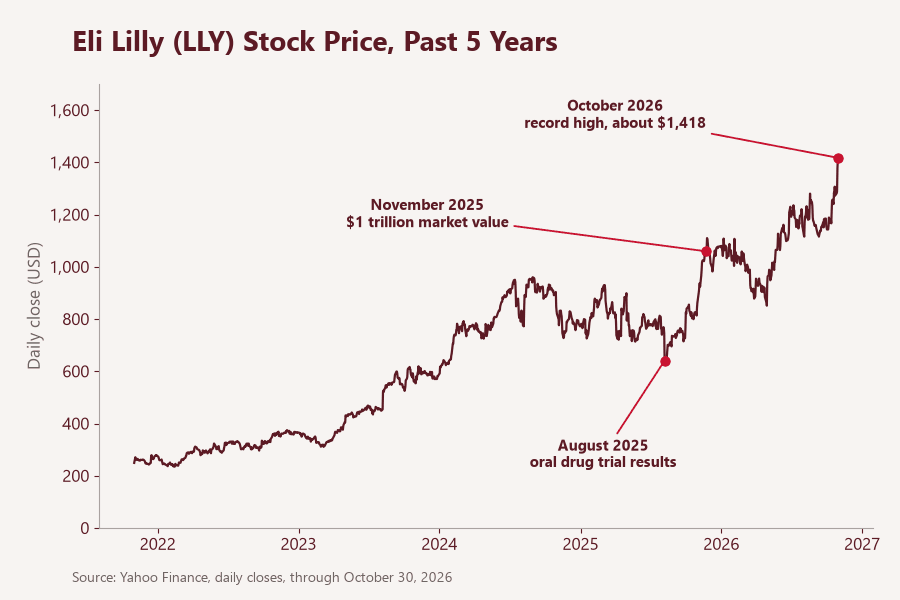
Lilly's stock was about $276 at the end of 2021 and about $1,075 at the end of 2025, roughly four times higher. In 2026 it fell to about $851 on April 29, then recovered to close at a record of about $1,418 on October 30.
The main drivers of Lilly's share price:
-
Mounjaro and Zepbound sales growth: the two products make up about two-thirds of revenue, so quarterly sales are the biggest source of stock moves
-
Foundayo and the pipeline: sales of the oral drug and trial results and regulatory progress for new drugs such as retatrutide
-
Drug pricing, coverage and policy: U.S. drug pricing policy and whether insurers cover obesity drugs affect both price and the number of patients
-
Manufacturing capacity: production of injection pens and active ingredients determines whether supply can meet demand, and Lilly keeps adding plants in the U.S. and abroad
-
Earnings, guidance and valuation: the stock already prices in high expectations for long-term obesity drug growth. With a high P/E ratio, the stock can fall even when revenue and earnings grow, if results miss expectations
7. How to Invest in Eli Lilly Stock
There are three main ways to get exposure to Lilly's share price:
| Method | Features | Best for |
|---|---|---|
| Buying shares | You own the stock and receive dividends | Long-term holding |
| CFDs | You trade price changes without owning shares, and can go long or short | Short- to medium-term trading, or selling short in a downturn |
| Stock index (e.g., US500) | Exposure to large U.S. stocks including Lilly through an index | Following the broader market and spreading single-company risk |
Titan FX offers Eli Lilly as a CFD. The instrument page brings together the live price, chart, technical analysis and an overall reading across timeframes:
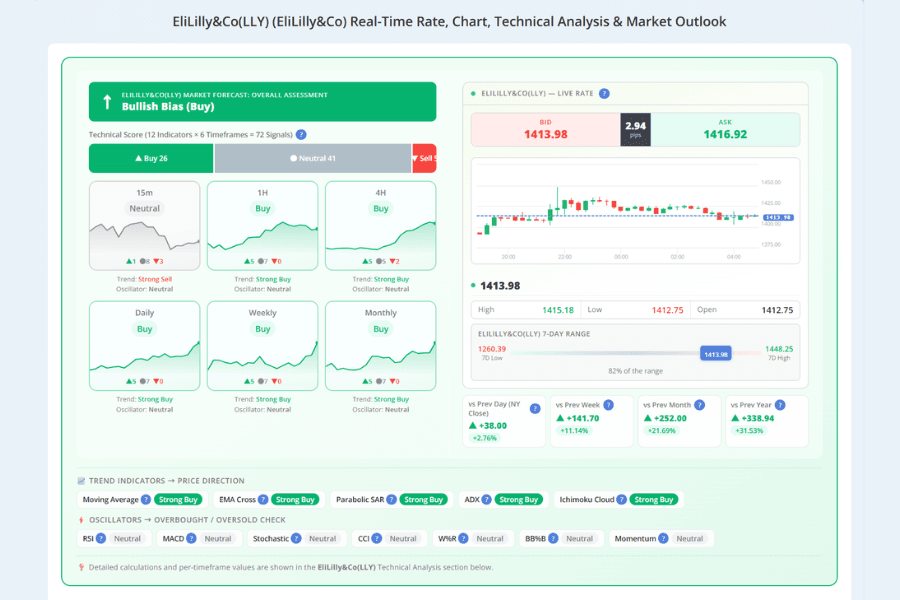
If you hold a CFD position over the ex-dividend date, a dividend adjustment applies, depending on the direction of your position. You can check the required margin with the margin calculator before trading.
8. Eli Lilly FAQ
Q1. Is Eli Lilly part of the Magnificent 7?
No. The Magnificent 7 are Apple, Microsoft, Alphabet, Amazon, Meta, Nvidia and Tesla.
Q2. What is the difference between Mounjaro and Zepbound?
They contain the same ingredient, tirzepatide. In the U.S., Mounjaro is approved for type 2 diabetes and Zepbound for obesity and related conditions. The Zepbound name is used only in the U.S., Canada and Japan; in other markets, Mounjaro is also sold for weight management.
Q3. How is Eli Lilly different from Novo Nordisk?
Both are leading obesity drug makers. Lilly's core ingredient is tirzepatide, while Novo Nordisk's is semaglutide (Ozempic, Wegovy). Lilly is a U.S. company listed on the NYSE; Novo Nordisk is based in Denmark and listed in Copenhagen and on the NYSE.
Q4. When does Eli Lilly report earnings?
Lilly's fiscal year matches the calendar year. It usually reports fourth-quarter and full-year results in February, and other quarters within about a month after the quarter ends. For what to watch around reporting periods, see our guide to earnings season.
9. Conclusion
Eli Lilly is a large drugmaker whose growth comes mainly from diabetes and obesity drugs. Mounjaro and Zepbound have driven rapid revenue growth, the oral drug Foundayo launched in 2026, and the company's market value passed $1 trillion in 2025.
The stock is highly sensitive to obesity drug news. Sales growth, pipeline progress, pricing and coverage, manufacturing capacity, and whether results meet expectations are the key things to watch. The next major event is the fourth-quarter and full-year report in early 2027.
Further Reading
Titan FX Trading Strategy Lab. We produce investor-education content covering forex, commodities (crude oil, precious metals, agricultural goods), stock indices, US equities, and digital assets.
Primary Sources (by Category)
- Company materials: Eli Lilly Q3 2026 earnings release and Form 10-Q, Q4 2025 earnings release (SEC); Foundayo approval and Q1 2026 dividend announcements
- Regulators: EMA Committee for Medicinal Products for Human Use opinion on Foundayo (October 2026)
- Market data: Yahoo Finance (LLY daily closes, dividend history)