
 Home
Home- Investment Guide: Strategies for Stocks, Forex, and Metals
- Pyramid Trading: How to Scale Into Trends With Risk Control
Pyramid Trading: A Complete Guide to Position Adding and Trend-Following Strategies

In financial trading, expanding upside while keeping risk under control is what every serious trader is trying to do. Pyramid trading is one of the most well-known position-adding strategies designed for exactly that goal.
This guide explains the core mechanics of pyramid trading, the four main pyramiding styles, how to apply it in forex and CFD markets, and the practical risks you should manage when using it.
- Pyramid trading = add with the trend in shrinking sizes
- Upright pyramid (smaller adds) controls risk; inverted (larger adds) is high-risk
- Four add styles: fixed-ratio, breakout, trailing-stop, tier-target
- Best in clearly trending markets; avoid range-bound conditions
- Requires strict money management and stops, or exposure balloons
1. What Is Pyramid Trading?
Pyramid trading (also called pyramiding) is a position-management strategy that adds size to a winning position as the trend develops, with each addition smaller than the one before it.
The core idea comes from the structure of a pyramid: the base is widest and most stable, and each layer above it is smaller. After establishing the initial position, traders add only when the market continues in the expected direction, and they keep each new tranche smaller than the last.
This approach lets traders expand profits when a strong trend develops, while keeping total risk bounded — because the diminishing add sizes mean even a sharp reversal does not produce catastrophic loss across the full position stack.
2. The Mechanics of Pyramiding
The two-line summary of pyramiding is "trade with the trend; add in shrinking sizes." Unlike a single oversized entry, this approach builds the full position gradually as the trend confirms itself.
| Step | Description |
|---|---|
| Base position | When the trend is initially confirmed, take a relatively larger base position as the foundation of the structure. |
| Sequential adds | Add new positions as price continues in the favorable direction. Each add is executed only while the trend is still extending. |
| Diminishing rule | Each subsequent add is smaller than the previous one, forming a top-heavy-narrow structure. This expands profit while keeping reversal-risk contained. |
Example
Plan to deploy 10 units total: place 4 units as the base, then add 3, 2, and 1 unit as the trend extends. That is the canonical pyramid structure.
3. Common Pyramiding Strategies
In live trading, traders choose among several pyramiding styles depending on market structure and personal trading style.
| Strategy | How It Works | Characteristics |
|---|---|---|
| Fixed-Ratio Pyramiding | Add at a pre-defined ratio or fixed amount (e.g., each add is half the previous one). | Simple and easy to execute, but inflexible. |
| Breakout-Confirmed Pyramiding | Add when price breaks through a key technical level (prior high/low, support/resistance). | Rides market momentum, but vulnerable to false breakouts. |
| Trailing-Stop Pyramiding | Move stops up as the trend extends, and add within each new range while the previous trail-stop locks in gains. | Combines pyramiding with risk management; protects unrealized profit dynamically. |
| Tier-Target Pyramiding | Add at pre-planned price tiers or target zones laid out in advance. | Highly disciplined; may not fully execute if the move is too rapid. |
4. Pros and Risks of Pyramid Trading
Pyramiding offers a structured way to scale into winners, but it is not risk-free.
Pros
The biggest advantage is gradual entry with built-in risk control. The trader tests the trend with the base position; once the trend confirms, they add. This avoids the psychological pressure (and concentrated risk) of a single oversized entry. As price continues to extend in the trend direction, sequential adds materially increase per-trade profit. Because each add is smaller than the previous one, even a sharp reversal keeps the total loss within a controlled band.
Risks
Pyramiding still carries real risks. If the initial trend judgment is wrong, position-size discipline alone will not prevent loss. If the trader adds too aggressively, exposure can grow before the trend is fully confirmed — leaving the account vulnerable. Pyramiding also requires strict money management and entry-ratio design; without those, a poorly structured stack can pressure account capital quickly.
5. Applying Pyramid Trading in Forex and CFD Markets
Pyramiding is a natural fit for trend-following strategies and is best deployed in directional moves within forex and CFD markets.
For example, when a major pair such as EUR/USD or USD/JPY breaks a key technical level and develops strong directional momentum, a trader can use the upright pyramid approach to scale in and expand profits. The opposite inverted pyramid approach builds size faster but magnifies reversal risk dramatically.
Important caveat: pyramid trading is not suited to range-bound or choppy markets. Without clear direction, additional adds simply increase the number of stop-outs.
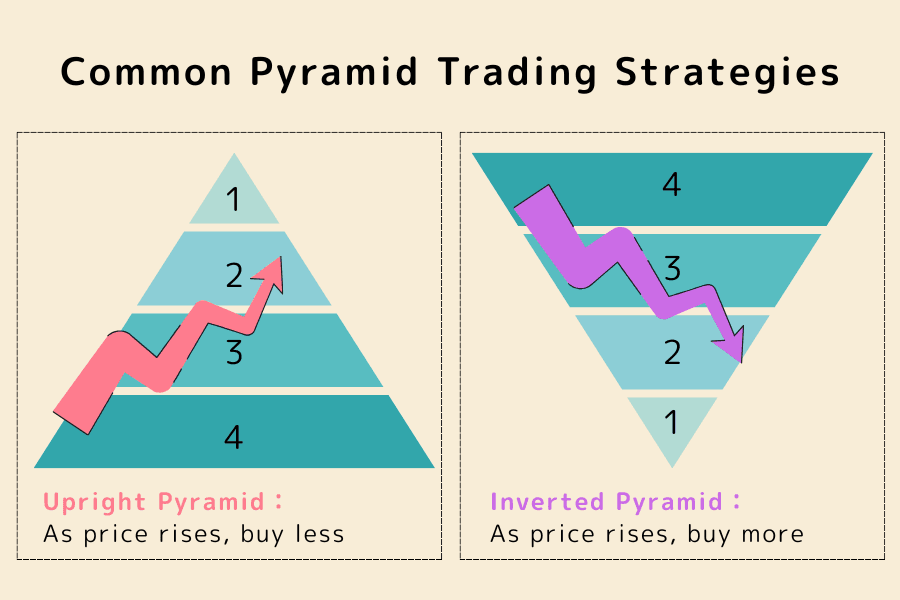
The illustration above contrasts the upright pyramid (smaller adds as price rises) with the inverted pyramid (larger adds as price rises), making the structural difference visible at a glance.
6. FAQ: Common Questions
Q1. Is pyramid trading suitable for every trader?
Not necessarily. Pyramid trading rewards traders who can patiently wait for clear trends. Scalpers and range traders typically find it less productive because the strategy depends on extended directional moves to monetize the diminishing add structure.
Q2. How is pyramiding different from regular position adding?
Regular adding is often equal-sized or ad hoc. Pyramiding requires each subsequent add to be smaller than the previous one, forming a wide-base, narrow-top structure. This structural rule is what lets it expand profit while keeping reversal risk capped.
Q3. How should I size the adds?
A common framework is to split total capital into segments — for example 40%, 30%, 20%, 10% — and deploy them sequentially as the trend extends. The principle is that the final add must always be the smallest.
Q4. Can pyramid trading be used on its own?
It is more effective in combination with technical-analysis and risk-management tools — moving averages, Bollinger Bands, and stop-loss orders. Together they sharpen trend judgment and tighten risk control.
7. Conclusion
Pyramid trading is a position-management strategy built on the principle of "trading with the trend and scaling in with diminishing size."
It enables traders to expand profits during strong trends while controlling reversal risk through the diminishing-add structure.
For forex and CFD traders, pyramid trading is a strategy worth learning and applying carefully. It is not, however, universally applicable: it requires strict discipline, well-defined risk control, and combination with other technical tools to deliver its real edge.
Further Reading
- Forex Trading Strategy: A Complete Guide for Beginners
- Why most traders cap position risk at 2%
- Five common stop-loss strategies compared
- Forex Margin Trading Basics
- Top 10 Mistakes New Forex Traders Make
Titan FX Research and Review Team — covering forex (FX), commodities (oil, precious metals, agricultural products), stock indices, US equities, and crypto assets, producing educational content for retail and institutional investors.
Primary Sources by Category
- Academic and historical references: Edwin Lefèvre, "Reminiscences of a Stock Operator" (1923, classic account of Jesse Livermore's pyramiding practice); Andrew W. Lo, "The Adaptive Markets Hypothesis" (Journal of Portfolio Management, 2004); Daniel Kahneman & Amos Tversky, "Prospect Theory" (1979) on loss aversion and money management.
- Money management frameworks: Ralph Vince, "The Mathematics of Money Management" (fixed-ratio and optimal f); Van K. Tharp, "Trade Your Way to Financial Freedom" (R-multiple framework and position sizing); John L. Kelly Jr., "A New Interpretation of Information Rate" (1956, the Kelly Criterion).
- Industry and third-party references: Investopedia (Pyramid Trading entries), Bloomberg Markets, Reuters, Titan FX product specifications and risk-disclosure documentation.