

Banxico (Bank of Mexico)
Banxico runs monetary policy through its policy rate and targets 3% inflation. Mexico's policy rate has long been higher than those of major economies such as the United States and Japan, so the Mexican peso (MXN) is a popular carry-trade currency, and Banxico's rate decisions are among the most important events for anyone trading USD/MXN or MXN/JPY.
This article explains what Banxico does, how its monetary policy works, its recent rate history, Mexico's exchange rate policy, when decisions are announced, and how they affect the peso.
- Banxico was founded in 1925 and has had constitutional autonomy since April 1994
- Its inflation target is 3%, with a tolerance range of plus or minus 1 percentage point
- Its policy instrument is the target for the overnight interbank interest rate, commonly called the policy rate
- It usually announces eight rate decisions a year and publishes the minutes two weeks after each decision
- The peso floats freely, and exchange rate policy is set by the Foreign Exchange Commission, made up of officials from the Ministry of Finance and Banxico
- 1. What Is Banxico (Bank of Mexico)?
- 2. Banxico's Main Functions
- 3. Banxico's Monetary Policy: Inflation Target and Policy Rate
- 4. Banxico Interest Rate History
- 5. Mexico's Exchange Rate Policy
- 6. Banxico Decision Times and Meeting Minutes
- 7. How Banxico Decisions Affect the Mexican Peso (MXN)
- 8. How to Trade the Mexican Peso with Titan FX
- 9. FAQ
- 10. Conclusion
1. What Is Banxico (Bank of Mexico)?
Banxico is Mexico's central bank. Its official name is Banco de México (Bank of Mexico), and it was founded in 1925.
| Item | Details |
|---|---|
| Founded | 1925 |
| Autonomy | Since April 1994 |
| Primary mandate | Peso purchasing power |
| Decision body | 5-member Board |
| Governor | Victoria Rodríguez Ceja |
Its mandate is written into the Constitution: Banxico's primary objective is to preserve the purchasing power of the Mexican peso, in other words to keep inflation low and stable. The law also gives it two further tasks: promoting the sound development of the financial system and ensuring that payment systems run smoothly.
It is independent of the government: On April 1, 1994, the amended Article 28 of the Mexican Constitution took effect, giving Banxico constitutionally guaranteed autonomy to set monetary policy on its own. The Constitution also states that no authority may order Banxico to grant financing, so the government cannot make the central bank print money to pay for public spending.
Rates are set by the Board of Governors: Banxico's Board of Governors (Junta de Gobierno) has five members: the Governor and four Deputy Governors. Members are nominated by the President and confirmed by the Senate, and their terms are staggered so that no single administration can replace the whole Board at once. The current Governor is Victoria Rodríguez Ceja.
2. Banxico's Main Functions
-
Monetary policy: sets the policy rate to keep inflation near its target
-
Currency issuance: issues Mexican peso banknotes and coins
-
Financial system: promotes the sound development of the financial system
-
Payment systems: operates and oversees payment systems so that funds move smoothly
-
Foreign reserves: manages Mexico's international reserves
3. Banxico's Monetary Policy: Inflation Target and Policy Rate
Banxico uses an inflation-targeting framework: it announces the inflation rate it aims for and uses the policy rate to steer inflation toward that target.
Inflation Target: 3% ± 1 Percentage Point
Banxico formally adopted inflation targeting in 2001. Since 2003, its permanent inflation target has been 3%, with a tolerance range of plus or minus 1 percentage point to absorb short-term price swings.
The range does not mean Banxico stays on hold as long as inflation sits between 2% and 4%. It also looks at core inflation, how persistent inflation is, and where expectations are heading before deciding whether to change rates.
According to data published on Banxico's website, Mexico's annual inflation rate was 3.75% in October 2026 and core inflation was 3.80%, both still above the 3% target.
Policy Rate: The Overnight Interbank Rate Target
Banxico's policy instrument is the target for the overnight interbank interest rate (tasa objetivo), the rate at which banks lend to each other overnight. Banxico has used this rate as its operational target since January 2008 and uses open market operations to keep market rates close to it.
4. Banxico Interest Rate History
The table below is based on Banxico's published monetary policy decisions.
| Date | Policy rate | Context |
|---|---|---|
| Jun 2021 | 4.25% | Hiking begins |
| Mar 2023 | 11.25% | Cycle peak |
| Mar 2024 | 11.00% | Cutting begins |
| Dec 2024 | 10.00% | Cut |
| Jun 2025 | 8.00% | Fourth straight 50 bp cut |
| Dec 2025 | 7.00% | Year-end level |
| Feb 2026 | 7.00% | Pause |
| Mar 2026 | 6.75% | Cuts resume |
| May 2026 | 6.50% | Cut |
| Sep 2026 | 6.50% | Third straight hold |
| Nov 2026 | 6.25% | Cut |
As global inflation picked up, Banxico began raising rates in June 2021 and lifted them by a total of 7.25 percentage points through March 2023, taking the policy rate from 4.00% to 11.25%. It then held at 11.25% for almost a year before starting to cut in March 2024.
In the first half of 2025, Banxico cut by 0.5 percentage point at four straight meetings, then slowed to 0.25-point cuts in the second half, ending the year at 7.00%. After pausing in February 2026, it cut by 0.25 point in March and again in May to 6.50%, held for three meetings, and then cut to 6.25% on November 5.
5. Mexico's Exchange Rate Policy
Since December 22, 1994, Mexico has let the market set the peso's exchange rate under a free-floating regime.
Under a free float, the peso's price is set mainly by supply and demand, and the government does not hold the dollar-peso rate at a fixed level.
Mexico separates two kinds of policy. Monetary policy belongs to Banxico, which controls inflation through the policy rate. Exchange rate policy belongs to the Foreign Exchange Commission (Comisión de Cambios), made up of officials from the Ministry of Finance (SHCP) and Banxico.
The Commission does not set a target level for the exchange rate. It announces measures such as FX intervention only when needed, for example auctions of currency hedging instruments through Banxico to keep the foreign exchange market functioning smoothly.
6. Banxico Decision Times and Meeting Minutes
| Release | Frequency | Content |
|---|---|---|
| Rate decision | Usually 8 a year | Policy rate and rationale |
| Minutes | 2 weeks later | Each member's vote and views |
| Quarterly Report | Every quarter | Inflation and growth outlook |
Banxico announces its decisions according to a calendar published in advance, and there were eight decisions in both 2024 and 2025. Announcements are usually made at 1:00 p.m. Mexico City time (UTC-6). You can find the exact dates on Banxico's calendar or in an economic calendar.
The Board's minutes are released two weeks after each decision. For example, the minutes of the November 5, 2026 decision were published on November 19. They show how each member voted and explain any dissent, which helps you gauge where the Board is leaning on its next move.
7. How Banxico Decisions Affect the Mexican Peso (MXN)
Three main forces drive the Mexican peso: Banxico's rate decisions, the interest rate gap between the United States and Mexico, and global investors' appetite for risk. Banxico controls only the first, and the other two often matter more.
Rates and Market Expectations
When Banxico raises rates or signals a hawkish bias, the peso tends to find support. When it cuts or hints at further cuts, the peso tends to weaken. As with any central bank, the exchange rate reacts to the gap between the actual decision and what the market expected.
On November 5, 2026, for example, the market expected Banxico to hold at 6.50%, but it cut to 6.25%. According to the Titan FX economic indicators list, USD/MXN rose 1.06% in the first minute after the announcement.
The Carry Trade
Because Mexico's policy rate is higher than rates in countries such as the United States and Japan, investors often borrow a low-yielding currency and buy the peso to earn the rate difference. This is the carry trade.
The carry trade is not a reliable source of profit. You may earn the rate difference every day, but if the peso falls sharply while you hold the position, the currency loss can far exceed the interest income. When global risk aversion rises, investors tend to sell the peso and unwind carry positions at the same time, and the peso can drop sharply in a short period.
US Economy and Policy
Mexico trades heavily with the United States, so US interest rates, economic data and trade policy all affect the peso. If Banxico cuts while US rates stay unchanged, for instance, the US-Mexico rate gap narrows, holding pesos becomes less attractive, and USD/MXN tends to rise.
| Scenario | Mexican peso | USD/MXN |
|---|---|---|
| Banxico leans hawkish | Supported | Tends to fall |
| Banxico cuts | Weaker | Tends to rise |
| Global risk-off | Under pressure | Tends to rise |
| US rates rise relatively | Under pressure | Tends to rise |
These are typical reactions with everything else held equal. Actual moves also depend on economic data and market sentiment.
8. How to Trade the Mexican Peso with Titan FX
Titan FX offers the following Mexican peso pairs on MT4 and MT5:
| Pair | Description |
|---|---|
| USD/MXN | US dollar vs Mexican peso |
| MXN/JPY | Mexican peso vs Japanese yen |
USD/MXN shows how many Mexican pesos one US dollar buys. When the peso strengthens, USD/MXN usually falls, and when it weakens, USD/MXN usually rises.
Trading Steps
-
① Check the release time: look up Banxico rate decisions and Mexican CPI releases on the Economic Calendar
-
② Compare the result with expectations: after the release, first check whether the rate matched the forecast, then see whether the statement changed its wording on inflation or the next move
-
③ Check your trading costs: check the current spread on the instrument page, and use the Swap Point Calendar to see the daily swap on an open position
-
④ Manage your risk: the peso is an emerging-market currency with a shallower market than majors such as the euro or the yen, so spreads can widen sharply and prices can gap around decisions. Use a stop-loss and keep your position size under control
Track Banxico's Rate Record in the Economic Indicators List
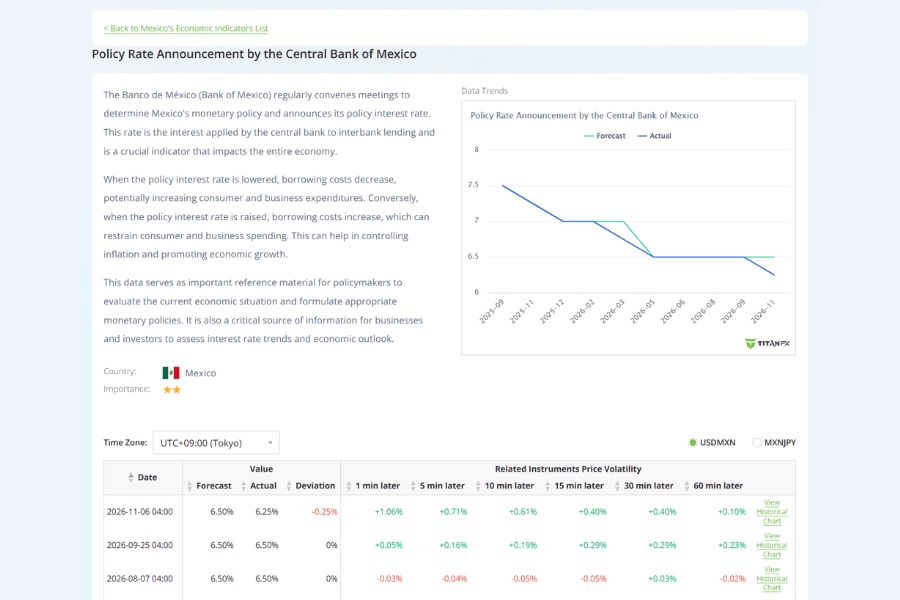
Titan FX's economic indicators list has a "Policy Rate Announcement by the Central Bank of Mexico" page that shows the forecast, actual value and history for each decision, along with how USD/MXN and MXN/JPY moved over the 1 to 60 minutes after the release.
Open the Banxico Policy Rate Indicator PageFor Mexican inflation data, see the Mexico CPI (YoY) page.
9. FAQ
Q1. Is Banxico the same as the Bank of Mexico?
Yes. Its official name is Banco de México (Bank of Mexico), and it is commonly known as Banxico.
Q2. What is Banxico's inflation target?
3%, with a tolerance range of plus or minus 1 percentage point. This permanent target has been in place since 2003.
Q3. How many times a year does Banxico decide on rates?
Usually eight times a year, on a calendar published in advance. Decisions are usually announced at 1:00 p.m. Mexico City time, and the minutes follow two weeks later.
Q4. Why is the Mexican peso popular for carry trades?
Mexico's policy rate is higher than rates in countries such as the United States and Japan, so borrowing a low-yielding currency to buy pesos earns the rate difference. When risk aversion rises, however, the peso can fall sharply as carry positions are unwound.
Q5. Who decides Mexico's exchange rate policy?
The Foreign Exchange Commission, made up of officials from the Ministry of Finance and Banxico. Mexico has had a free-floating exchange rate since December 1994, and the Commission sets no exchange rate target, announcing measures only when needed.
Q6. Which currency pairs do Banxico decisions affect?
USD/MXN is affected most, and other peso pairs such as MXN/JPY also move. Volatility is usually higher around decisions, so watch for wider spreads and price gaps.
10. Conclusion
Banxico is Mexico's central bank. Its primary mandate is to preserve the peso's purchasing power, and it targets inflation of 3% ± 1 percentage point. It runs monetary policy through a target for the overnight interbank rate, usually announces eight decisions a year, and cut the policy rate to 6.25% in November 2026.
The peso is driven by Banxico's decisions, the US-Mexico rate gap, global risk sentiment and US economic policy. Before trading USD/MXN, check the decision date and compare the actual outcome with market expectations. High rates alone do not tell you which way the peso will go, because a rush to unwind carry trades can send it lower quickly.
Further Reading
- What Is the MAS (Monetary Authority of Singapore)?
- What Is the SNB (Swiss National Bank)?
- What Is a Policy Interest Rate?
Titan FX Trading Strategy Lab. We produce educational content for investors covering FX, commodities (crude oil, precious metals, agricultural products), stock indices, U.S. equities, and cryptocurrencies.
Primary Sources
- Banco de México sources: Banco de México, "Misión y visión," "Autonomía," "Miembros de la Junta de Gobierno," "Anuncios de las decisiones de política monetaria," "Operaciones del Banco de México y objetivos operacionales," "Calendario," inflation and policy rate data on the homepage (November 2026), and Foreign Exchange Commission announcements