

Liquidity Trap

The concept comes from Keynesian economics and explains why, in certain conditions, conventional rate cuts stop working. When markets are deeply pessimistic about the outlook and expect prices to fall, people would rather hold cash and wait; the liquidity a central bank injects becomes "trapped" inside the banking system and is slow to reach the real economy.
This article covers what a liquidity trap is, its features and causes, the classic case of Japan, how central banks respond, and what it means in practice for FX traders — especially for the Japanese yen.
- A liquidity trap is a state where rates are near zero and monetary policy stops working; money is hoarded as cash and struggles to reach the economy.
- Three features: very low nominal rates, expectations of deflation, and a market that barely responds to further easing.
- The classic case is Japan's "lost decades"; after the 2008 financial crisis, the U.S. and Europe fell into a similar situation.
- Central-bank responses are mostly unconventional tools: quantitative easing, forward guidance, negative rates, and yield curve control.
- For traders, prolonged low rates strip a currency of its yield appeal, while also making it a funding or safe-haven currency.
1. What Is a Liquidity Trap?
A liquidity trap is a macroeconomic concept traced to the economist John Maynard Keynes. It describes a situation where, once interest rates are already near zero, monetary policy loses its power to stimulate the economy.
Under normal conditions, a central bank's rate cut lowers borrowing costs, encourages investment and spending, and lifts activity. But once rates are pinned against the zero lower bound, there is little room left to cut. In this state the preference for cash becomes extreme — however much money the central bank adds, it is held as cash and struggles to reach investment or spending. In the language of economics, money demand becomes almost insensitive to interest rates, and the extra liquidity is "absorbed" without moving the economy.
The key to understanding a liquidity trap is to see it as a state where monetary policy has "lost transmission": the central bank's tap is open, yet the water pools without flowing out.
2. Features and Causes of a Liquidity Trap
A liquidity trap usually comes with three mutually reinforcing features.
Feature 1: Rates Near Zero
Nominal rates having fallen as far as they can go is the precondition. Once the policy rate approaches zero, conventional rate cuts are nearly exhausted, and the central bank loses its main lever.
Feature 2: Expectations of Deflation
When markets expect prices to fall, simply holding cash raises purchasing power on its own. This deflationary mindset encourages hoarding cash and delaying spending and investment. Worse, even with a zero nominal rate, if prices are falling the real cost of borrowing (the real interest rate) is actually positive, which further chills the appetite to borrow.
Feature 3: No Response to Easing
Under the first two conditions, additional money supply from the central bank does little to spur spending. With confidence weak and firms and households busy deleveraging and repaying debt, the new money stays inside the banking system and struggles to turn into real investment or consumption.
As for causes, a liquidity trap tends to appear after an asset-bubble burst or a severe financial crisis: the private sector carries heavy debt and rushes to repair its balance sheet, unwilling to borrow even at rock-bottom cost. This "balance-sheet recession" is the environment in which a liquidity trap takes root.
3. The Classic Case: Japan and Post-2008 West
The most representative case of a liquidity trap is Japan. After its asset bubble burst in the early 1990s, the economy fell into prolonged stagnation — the so-called "lost decades." The Bank of Japan (BOJ) cut its policy rate to near zero from 1999 and, in 2001, became the first to launch quantitative easing. Deflation and weak growth nonetheless lingered, making Japan a textbook example of a liquidity trap.
After the 2008 Lehman Brothers Crisis, the U.S. and Europe fell into a similar situation. The Federal Reserve and the European Central Bank cut rates to the zero lower bound, found that rate cuts alone could not revive demand, and turned to large-scale quantitative easing and forward guidance and other unconventional tools. That experience turned the "zero lower bound" and the liquidity trap from a textbook concept into a real policy problem for major central banks.
4. How Central Banks Respond to a Liquidity Trap
Once conventional rate cuts are exhausted, central banks turn to a set of unconventional monetary policy tools to work around the liquidity trap.
- Quantitative easing (QE): the central bank buys large amounts of government bonds and other assets, injecting money directly into the market and pushing down long-term rates to force funds out of the banking system.
- Forward guidance: the central bank promises to keep rates low for a long time, managing the market's rate expectations to shape borrowing and investment decisions today.
- Negative rates: the policy rate is pushed below zero, charging a fee on funds parked at the central bank to prod banks into lending.
- Yield curve control (YCC): the central bank sets and pins a target for the yield on a particular maturity of government bonds; the Bank of Japan is its best-known practitioner.
All of these tools tackle the same problem: how to keep influencing financing conditions and inflation expectations when there is no room left to cut rates. Beyond that, many economists argue that when monetary policy stalls, fiscal policy (expanded government spending) often needs to take over as the main driver of demand.
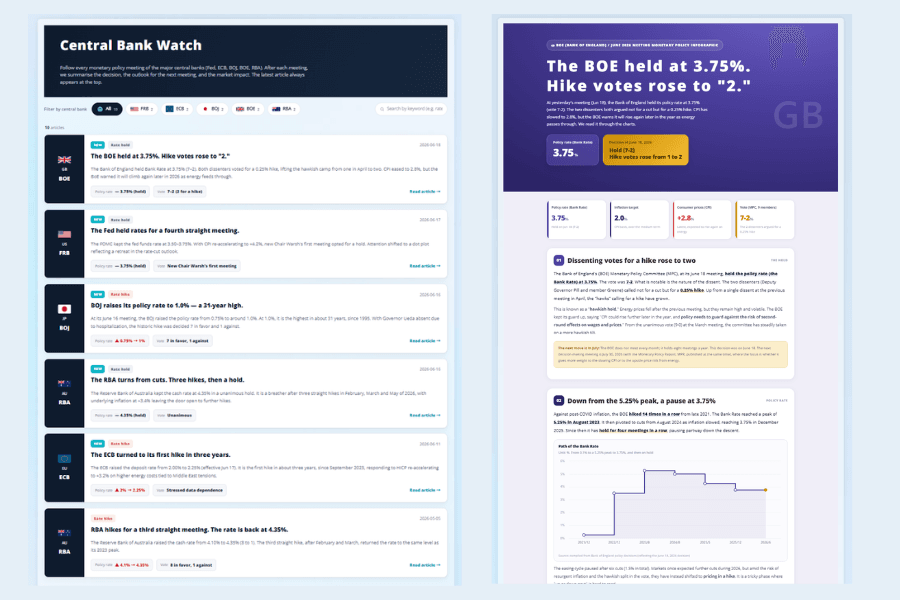
Because the central bank's policy direction and inflation expectations are the key variables in a liquidity trap, tracking what major central banks are doing is an important first step in reading the situation.
5. The Liquidity Trap and FX Traders
For FX traders, the significance of a liquidity trap shows up mainly in the relationship between rates and currencies.
When a country falls into a liquidity trap, its interest rates stay pinned near zero for a long time — a condition that reaches the currency market through several channels:
- The rate gap disappears: FX markets care a great deal about the interest-rate differences between countries. When a country's rates are held near zero for years, its currency loses its yield appeal, and capital tends to flow toward higher-yielding currencies.
- Funding and safe-haven currency: prolonged low rates also make such a currency a common funding leg for the carry trade — borrowing the low-yield currency to buy higher-yielding assets. The Japanese yen is the classic example; when markets turn turbulent, those positions are unwound, which paradoxically gives the yen a safe-haven character.
- Flattened yields: under policies like yield curve control, the country's bond yields are held artificially low with muted volatility, which carries over to currency pairs closely tied to rates.
Take USD/JPY: for years its path has depended heavily on the U.S.-Japan rate gap. When U.S. rates sit well above a Japan near zero, that gap becomes a powerful driver of the exchange rate. Understanding the liquidity trap adds one more framework for reading how low-rate currencies behave.
6. Liquidity Trap FAQ
Q1: How is a liquidity trap different from ordinary low rates?
The difference is whether policy still works. With ordinary low rates, cutting further can still stimulate the economy. A liquidity trap is the state where rates are already near zero and no amount of easing lifts demand. In other words, it is low rates taken to the extreme, where monetary policy has lost its transmission.
Q2: Why does printing more money not work in a liquidity trap?
Because the new money is hoarded as cash and struggles to reach investment and spending. When markets are pessimistic and expect prices to fall, people prefer to hold cash and wait, while firms and households focus on repaying debt. The liquidity the central bank injects stays inside the banking system and is slow to become real spending.
Q3: Does a liquidity trap always come with deflation?
The two are closely related but not identical. Deflation expectations are an important factor that reinforces a liquidity trap — falling prices raise the real interest rate and encourage hoarding cash. The core definition of a liquidity trap, however, is that monetary policy stops working near zero rates; deflation is often its cause or a co-occurring symptom.
Q4: How do central banks escape a liquidity trap?
Mainly through unconventional tools plus fiscal support. On the monetary side, they use quantitative easing, forward guidance, negative rates, and yield curve control to push down long-term rates and lift inflation expectations. Many economists also stress that when monetary policy stalls, fiscal policy (expanded government spending) needs to take over in lifting demand.
Q5: How does a liquidity trap affect FX traders?
The most direct effect is the rate gap. When a country's rates are held near zero for a long time, its currency loses its yield appeal and often becomes a funding leg for the carry trade — the yen being the classic case. When trading a low-rate currency, watching its rate difference with other economies and when the central bank might turn often matters more than looking at that country alone.
Q6: Why is the yen so often used as the example of a liquidity trap?
Because Japan was the earliest and longest-running major economy to fall into low rates and deflation. The BOJ cut rates to near zero from the late 1990s and pioneered quantitative easing, negative rates, and yield curve control. That decades-long experience makes Japan and the yen the most frequently cited case in any discussion of the liquidity trap.
7. Summary
A liquidity trap is an economic state where interest rates fall to near zero and monetary policy loses its effect. Its three features — very low rates, deflation expectations, and no response to easing — reinforce one another and blunt the central bank's conventional tools. Japan's "lost decades" is its most classic case, and the post-2008 West lived through it too.
Facing a liquidity trap, central banks often turn to quantitative easing, forward guidance, negative rates, and yield curve control, and usually need fiscal policy alongside. For FX traders, the value of understanding a liquidity trap is in reading how low-rate currencies behave: why the rate gap disappears, and why the yen so often carries both a funding and a safe-haven character. Treat it as one key to the relationship between rates and exchange rates, and you can read the market more calmly in a low-rate environment.
Further Reading
- What Are the FED, FRB, and FOMC?
- What Is the Real Interest Rate?
- What Is Inflation?
- What Are Global Central Banks?
- Forex Trading Basics
The financial markets research team at Titan FX. We produce educational content for investors across a broad range of instruments, including forex (FX), commodities (crude oil, precious metals, agricultural products), equity indices, U.S. stocks, and crypto assets.
Primary Sources (by category)
- Theory and academia: John Maynard Keynes, "The General Theory of Employment, Interest and Money" (1936), on liquidity preference and the liquidity trap; the definition of the zero lower bound in major economics textbooks
- Policy and central banks: Bank of Japan policy documents on zero rates, quantitative easing, negative rates, and yield curve control; Federal Reserve and ECB material on unconventional monetary policy after 2008
- Research and reference: general treatments of the liquidity trap, balance-sheet recession, and unconventional monetary policy in major investment education resources (Investopedia and others)