

What Is Bitcoin Halving? The Schedule, Past Halvings, and the Effect on Price

Bitcoin halving is the rule that cuts the block reward paid to miners in half every 210,000 blocks, which works out to roughly once every four years. It is an issuance rule written into the Bitcoin code — no institution decides it, and it cannot be changed on a whim.
The purpose is to slow the supply of new coins over time so that the total converges on 21 million. That makes Bitcoin one of the few assets with a clear, verifiable issuance ceiling, and it is why the comparison with gold keeps coming up.
This article covers how halving works, the full record of the four halvings so far and the estimate for the next one, what it actually does to mining economics, the evidence and the limits behind the "four-year cycle" claim, and the other cryptocurrencies that use the same mechanism.
- Bitcoin halving is the issuance rule that cuts the miner's block reward in half every 210,000 blocks, written into the protocol and not changeable at will
- Halving is triggered by block count, not by time; what actually locks the interval near four years is difficulty adjustment, which pulls block times back to 10 minutes regardless of how much hashrate joins
- Four have happened: 2012 50→25, 2016 25→12.5, 2020 12.5→6.25, April 2024 6.25→3.125 BTC; the next is expected around April 2028 at 1.5625 BTC
- Halving cuts miner revenue overnight; less efficient miners shut down, hashrate falls, and difficulty adjustment restores the balance
- "Halving drives the price up" rests on four observations, and because the schedule is public and predictable it is hard to separate from macro liquidity conditions
- 1. What is Bitcoin halving?
- 2. How halving works: 210,000 blocks and difficulty adjustment
- 3. The Bitcoin halving schedule: past halvings and 2028
- 4. What halving does to miners
- 5. Will Bitcoin rise after a halving? The four-year cycle, and its limits
- 6. Other cryptocurrencies with a halving
- 7. FAQ: Common questions about Bitcoin halving
- 8. Conclusion: Treat halving as a supply rule, not a price signal
1. What is Bitcoin halving?
Bitcoin halving means that every 210,000 blocks, the new-coin reward a miner receives for producing a block is automatically cut in half. At Bitcoin's current block pace that works out to roughly once every four years — as for why it stays so reliably at four years, that involves a second mechanism, which the next section unpacks.
The design comes from Satoshi Nakamoto's original whitepaper: the rate of new issuance has to fall over time so that total supply converges on a ceiling of 21 million coins. Unlike a fiat currency, where a central bank decides the money supply, Bitcoin's monetary policy is fixed in the protocol in advance and anyone can verify what will be issued in any future year.
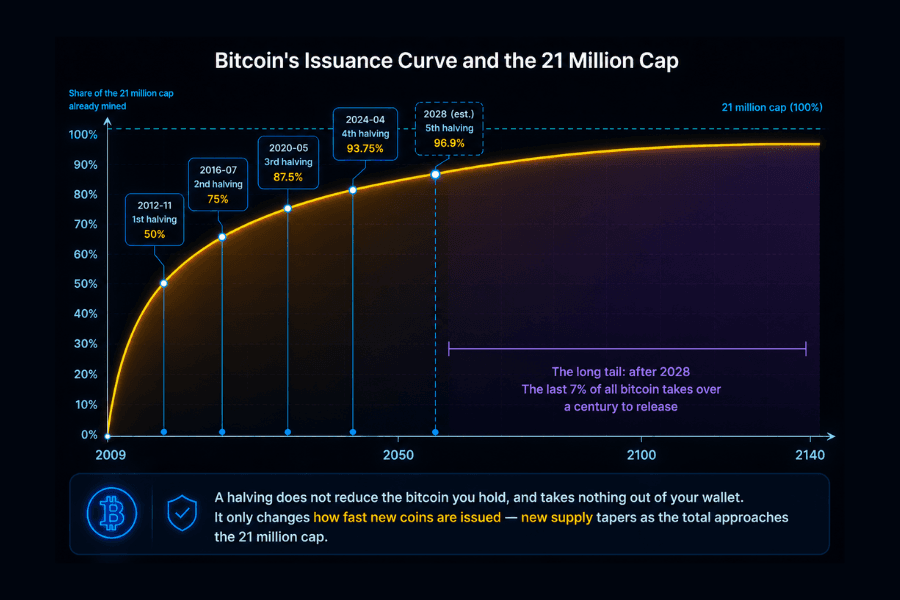
The genesis block was mined in January 2009, when each block paid 50 BTC. After four halvings the block reward now stands at 3.125 BTC. As of the fourth halving in 2024, more than 93% of all bitcoin had been mined, with the remainder due to be released slowly over more than a century.
One distinction is worth keeping: mined is not the same as circulating. Coins whose private keys were lost in the early years can never be moved, so the amount actually tradable is smaller than the headline figure.
For the broader basics first, see what cryptocurrency is.
2. How halving works: 210,000 blocks and difficulty adjustment
Halving needs no vote and no announcement. Every node runs the same rule: when blockchain height reaches a multiple of 210,000, the reward for new blocks automatically becomes half of the previous level. It takes effect across the whole network at once, with no transition period.
Why is it always about four years, and not eight or longer?
This is the most important point in understanding the mechanism, and the answer is difficulty adjustment.
Start with this: halving is triggered by block count, not by time. So how long 210,000 blocks take depends entirely on how quickly the network produces a block.
Bitcoin's total hashrate has grown by several orders of magnitude since 2009. If block production sped up along with hashrate, 210,000 blocks could be cleared in months; if miners left in large numbers, it could stretch to eight or ten years.
What locks the timing is difficulty adjustment: every 2,016 blocks — about two weeks — the network looks back at how long that batch actually took and raises or lowers mining difficulty so the next batch averages close to 10 minutes per block. Difficulty rises when hashrate floods in and falls when it leaves.
This is a negative feedback loop. No matter how many machines the world plugs in, block production gets pulled back to 10 minutes. Ten minutes × 210,000 blocks ≈ 3.99 years, and that is where the four-year rhythm comes from.
In practice the halvings have arrived about 3.6, 3.8 and 3.9 years apart — all slightly under four years. Hashrate has trended upward, so within each adjustment period blocks come in a little faster than 10 minutes, and a correction that runs only once every two weeks is always playing catch-up.
Will halvings continue forever?
Following the same rule, the block reward halves roughly 33 times until it falls below Bitcoin's smallest unit, one satoshi, at some point around the year 2140. After that, miner income comes entirely from transaction fees.
3. The Bitcoin halving schedule: past halvings and 2028
| Halving | Date | Block height | Block reward |
|---|---|---|---|
| First | November 28, 2012 | 210,000 | 50 → 25 BTC |
| Second | July 9, 2016 | 420,000 | 25 → 12.5 BTC |
| Third | May 11, 2020 | 630,000 | 12.5 → 6.25 BTC |
| Fourth | April 20, 2024 | 840,000 | 6.25 → 3.125 BTC |
| Fifth (estimated) | around April 2028 | 1,050,000 | 3.125 → 1.5625 BTC |
The block height is certain; the date is an estimate. Because block production drifts with total hashrate, the exact date of the fifth halving can only be pinned down as it approaches — it happens at the moment block 1,050,000 is produced. The halving countdown sites you see are all extrapolating from the current average block pace.
4. What halving does to miners
The impact on mining is immediate and direct: with the coin price and fees unchanged, a miner's block reward income falls by half overnight.
In practice a sequence follows:
-
① Marginal miners shut down: operations with higher electricity costs or less efficient machines become unprofitable first and switch off.
-
② Network hashrate falls: as that capacity accumulates, block production temporarily slows.
-
③ Difficulty adjusts downward: the next adjustment period lowers difficulty, the remaining miners win more blocks, and revenue per unit of hashrate partly recovers.
-
④ The industry gets leaner: over the long run each halving accelerates hardware replacement and pushes mining toward cheaper power.
There is also a structural change: fees rise as a share of miner income with every halving.
Once the block reward approaches zero, network security ultimately has to rest on transaction fees. This is one part of Bitcoin's long-run economic model that has not yet been fully tested.
On the day of the fourth halving in 2024, a new token protocol launched and congested the chain to the point where that block's fee income briefly exceeded the block reward itself — a short glimpse of what that future looks like.
That was a single-block event caused by specific circumstances, though, and it does not mean fees have taken over from the block reward. Most of the time, fees still make up a small share of miner income.
5. Will Bitcoin rise after a halving? The four-year cycle, and its limits
This is the most widely repeated claim about halving and the one that needs the most care.
The case for halving lifting the price
The logic itself is intuitive: halving cuts the growth rate of new supply, so if demand holds steady the price should rise. Historically, in the 12 to 18 months following each of the first three halvings, Bitcoin did post large gains — which is the main basis for the "four-year cycle" idea.
Why halving does not guarantee a rise
-
Only four observations: four data points cannot establish a statistical regularity. Any event recurring every four years over the same period would show a similar "correlation".
-
Halving is entirely predictable: the block heights have been in the code since day one and the whole world knows when they arrive. In an informationally efficient market, a known future event should already be reflected in the price rather than driving it when it occurs.
-
Hard to separate from macro: the first three halvings landed in very different global liquidity conditions. The 2020 one coincided with large-scale easing worldwide, when almost every risk asset was rising; crediting the subsequent gains entirely to halving ignores the other forces at work.
-
The demand structure has changed: US spot ETFs were approved in early 2024, bringing an entirely new channel and holder base. The fourth halving occurred after that shift, so the environment is no longer directly comparable to the first three.
-
New supply is a shrinking share: the bitcoin produced each day is now small relative to spot market turnover. Halving's effect on incremental selling pressure is far less decisive than it was in the early years.
The workable reading is this: halving genuinely changes the long-run supply curve, and that matters. But treating it as a short-term price signal, or expecting the historical rhythm to repeat on schedule, is not supported by the evidence. Prices can be watched directly on pages such as live BTC quotes, without leaning on the cycle narrative.
6. Other cryptocurrencies with a halving
Halving is not unique to Bitcoin, but it only appears in coins that use proof of work and have a fixed total supply.
-
Litecoin (LTC): halves every 840,000 blocks. With a block time of around 2.5 minutes the interval is likewise close to four years. The most recent was August 2023, taking the reward from 12.5 to 6.25 LTC.
-
Bitcoin Cash (BCH): a fork of Bitcoin that kept exactly the same 210,000-block schedule and 21 million ceiling, so its halvings land at almost the same time as Bitcoin's.
-
Ethereum (ETH): no scheduled halving. Block rewards were cut several times during the proof-of-work era, but those were governance decisions rather than a fixed schedule written into the code. Since the move to proof of stake, issuance floats with the total amount staked and a fee-burn mechanism applies, so supply changes continuously with no step changes.
Put differently, halving is a product of a particular issuance design. When a coin markets a halving story, it is worth checking first whether it really has a fixed supply and proof of work, or is simply borrowing the word.
Trade Crypto CFDs with Titan FX
Titan FX offers 20+ crypto CFDs including BTC and ETH with up to 100:1 leverage — go long or short with no wallet or private-key management.
7. FAQ: Common questions about Bitcoin halving
Q1: How often does Bitcoin halving happen?
Every 210,000 blocks. Since the average block time is around 10 minutes, that works out to roughly every four years, though the actual interval drifts by several weeks with network hashrate. Halving is measured in block height, not on the calendar.
Q2: When is the next Bitcoin halving?
It is expected around April 2028, when block height reaches 1,050,000, at which point the block reward falls from 3.125 BTC to 1.5625 BTC. The exact date can only be calculated precisely as it draws near.
Q3: Does Bitcoin always rise around a halving?
No mechanism guarantees it — that applies both to the run-up before a halving and to the aftermath. The first three halvings were indeed followed by large gains, but with only four samples and a different macro backdrop each time, no regularity can be built on that.
More to the point, the schedule is completely public: the block heights have been in the code since day one, giving the market years to price it in. An event everyone knows the timing of is unlikely to be a source of excess return. What halving actually changes is the pace of new supply; the direction of price is still set by demand, liquidity, and macro conditions together.
Q4: Could halving shut all the miners down and stop the network?
No. Difficulty adjustment exists precisely for this: after some miners leave, difficulty is revised downward in the next period, revenue for the remaining miners recovers, and block times return to around 10 minutes. All four halvings so far produced a short dip in hashrate followed by a recovery, and the network never stopped.
Q5: What happens once all bitcoin has been mined?
Around the year 2140 the block reward becomes too small to halve again, new issuance ends, and total supply settles near 21 million. From then on miner income comes entirely from transaction fees. Whether that model can sustain enough network security over the long run is still an open question.
Q6: Does an ordinary investor need to do anything for a halving?
Halving itself requires no action from a holder, and the bitcoin in your wallet does not change. What is worth watching is the rise in attention around the event, the potential for wider price swings, and the marketing that tends to attach itself to the word. Understanding halving as a long-term change on the supply side is more useful than chasing the event.
Q7: Is halving the same thing as a fork?
They are completely different. Halving is an issuance rule built into the protocol, executed automatically across the network, and it creates no new chain. A fork is a divergence in the rules that can split the chain in two and create a new coin — which is how Bitcoin Cash came about. Halving creates no new coins and changes nobody's holdings.
8. Conclusion: Treat halving as a supply rule, not a price signal
At its core, Bitcoin halving is an issuance rule: every 210,000 blocks the pace of new coins is cut in half, until total supply caps out at 21 million. That makes Bitcoin's monetary policy fully verifiable public information — a rare property among financial assets.
What it settles with certainty is only the supply side. The impact on mining economics can be derived, and the long-run test for network security is clear enough. Its effect on price, though, is tangled up with macro liquidity, shifting demand structure, and market expectations, and there is no clean causal chain to pull out.
The value in understanding halving lies in seeing Bitcoin's issuance logic and the constraints miners operate under — not in getting a signal for when to buy. The next halving is due around 2028, and the schedule has been public all along. That fact alone explains why it is hard to turn into excess return.
Further Reading
- What is a cold wallet? How it works and how to use it safely
- What is a mnemonic phrase? 12 vs 24 words and how to protect your seed
- Stablecoins complete guide: USDT vs USDC, peg mechanisms, regulation
- What is an oracle in crypto? Mechanism, use cases, and risks
- Understanding Dogecoin: features, volatility, and trading
Titan FX Trading Strategy Lab. We produce investor-education content covering forex, commodities (crude oil, precious metals, agricultural goods), stock indices, US equities, and digital assets.
Primary Sources (by Category)
- Protocol rules: The Bitcoin whitepaper and Bitcoin Core documentation on block rewards, the 210,000-block halving schedule, and difficulty adjustment
- On-chain data: General figures from public block explorers and network statistics services on block height, hashrate, and the fee share of miner revenue
- Market structure: General descriptions by major exchanges and research firms of how spot ETF listings changed Bitcoin demand
- Investor education: Regulator materials on crypto-asset volatility, event marketing, and risk awareness