

What Is a Smart Contract? How It Works, Gas Fees, Uses, and Security Risks
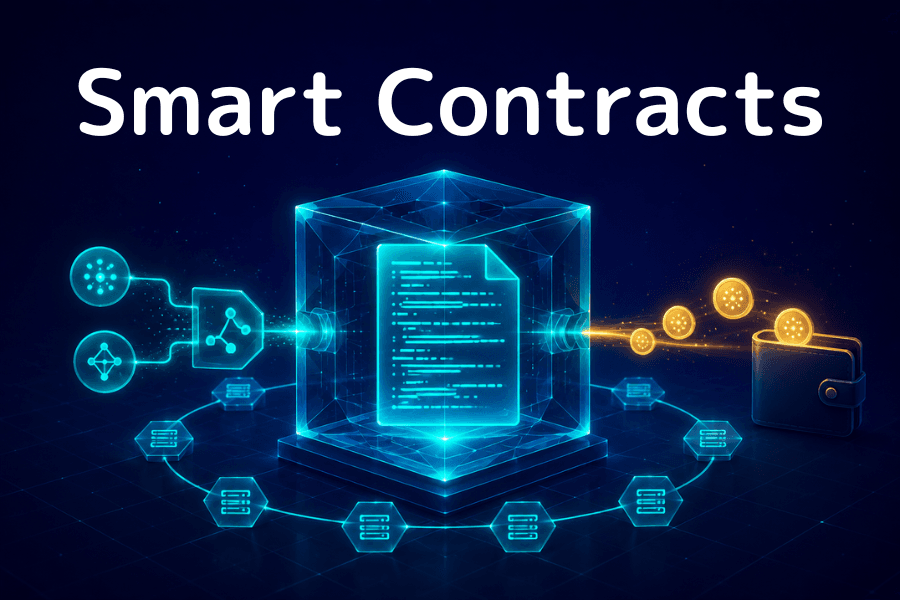
The usual comparison is a vending machine: put in enough money, press the button, and the machine hands over the product — no clerk decides whether you deserve it. A smart contract does the same thing, except the conditions and the outcome are both recorded on chain, so anyone can read the code beforehand and check the execution afterwards.
What this design solves is the problem of trusting the other side to follow through. What it introduces is a different set of risks: once deployed, code runs literally, and it runs just as faithfully when it is wrong. This guide covers the execution flow, gas fees, token standards, real applications, and the failures that have actually happened.
- A smart contract is code on a blockchain that runs automatically when its conditions are met, with the result re-computed and confirmed by every node
- Any call that changes on-chain state costs gas; read-only queries do not. Gas exists to stop infinite loops from stalling the network, and a failed transaction is still charged
- "Immutable once deployed" applies to the bytecode alone. Most projects keep an upgrade path through proxy contracts, which makes admin keys the real risk
- A contract cannot reach outside the chain on its own. Any external data — prices, weather, match results — has to be written on chain by an oracle first
- The largest losses have come from logic bugs, oracle manipulation, admin keys, and bridges. An audit lowers risk but is not a guarantee of safety
- 1. What is a smart contract?
- 2. How does a smart contract work?
- 3. How is a smart contract different from a traditional contract?
- 4. Which blockchains support smart contracts? EVM and non-EVM
- 5. What are smart contracts used for? Four main applications
- 6. Smart contract risks: five failures that have actually happened
- 7. FAQ: Common questions about smart contracts
- 8. Conclusion: It guarantees execution, not correctness
1. What is a smart contract?
A smart contract is a piece of code deployed on a blockchain, with a block of storage only it can write to. When someone sends a call that meets the conditions, it runs the logic it was written with, updates its own state, and the whole thing is recorded on chain.
The term predates the technology by two decades. In 1994 the legal scholar and cryptographer Nick Szabo proposed the idea of a smart contract, using a vending machine to explain performance enforced by mechanism rather than by trust. The infrastructure to carry it did not exist yet. It arrived in 2015, when Ethereum launched the first Turing-complete smart contract platform.
Two properties decide what a smart contract can and cannot do.
The first is determinism. The same code with the same input has to produce exactly the same result on every node, or the nodes will disagree about the ledger.
That rules out genuine randomness, and it rules out reaching onto the internet for data. Prices, exchange rates, temperatures — any off-chain information has to be written on chain by an oracle before a contract can read it. This is exactly why oracle manipulation became one of the most common attack paths in DeFi.
The second is transparency. The bytecode is always on chain, and most projects publish verified source alongside it. Users can inspect the logic before interacting; attackers can study it at leisure for holes.
If the underlying technology is new to you, what cryptocurrency is fills in the background.
2. How does a smart contract work?
A smart contract goes through a fixed set of stages between being written and being used.
From source code to on-chain: five stages
-
① Write: Solidity is the usual choice in the Ethereum ecosystem, with Vyper and others available. The code defines which functions exist, who may call them, and what data they change.
-
② Compile: the source is compiled into bytecode the EVM (Ethereum Virtual Machine) can run, along with an ABI — the instruction sheet other programs use to call the contract.
-
③ Deploy: the bytecode goes on chain inside a transaction. Once confirmed, the contract gets a fixed address and stays there. Deployment costs gas, and longer code costs more.
-
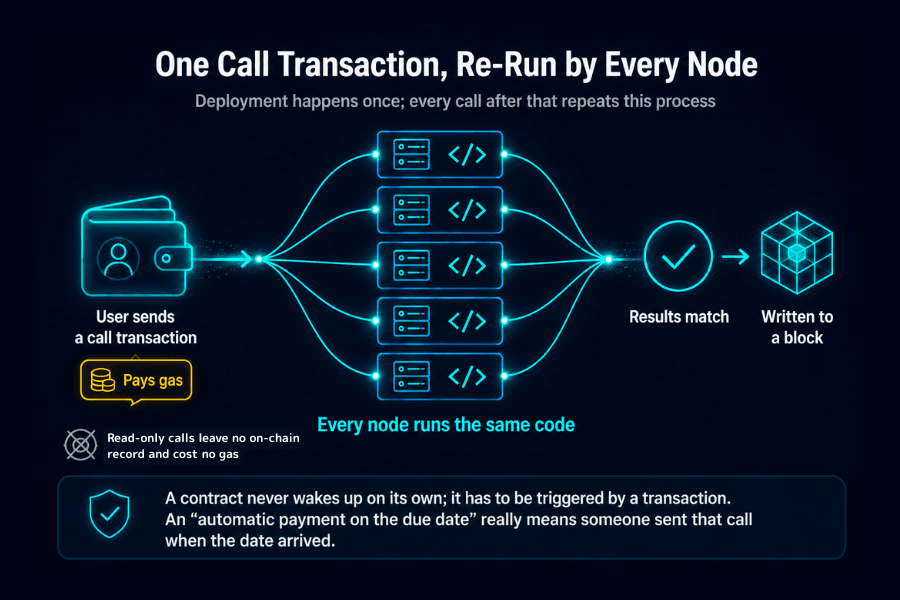
④ Call: anyone — a person or another contract — can send a transaction to that address to run a function. Queries that only read data are free; anything that changes state is a transaction.
-
⑤ Re-execute and record: every node runs the same code, compares results, and once consensus is reached the new state is written into a block. This is what "automatic execution" actually means: no scheduler is running in the background, every node simply computed it.
Worth noting: a contract does not wake up on its own. It has to be triggered by a transaction. A feature described as "automatic payment on the due date" really means someone — or some automated service — sends that call when the date arrives.
Gas: why running code costs money
The code is Turing-complete, which means it is possible to write a loop that never finishes. If execution were free, anyone could stall the network with one. Gas is the unit of account built to close that hole.
Every operation has a fixed gas cost — writing to storage is the most expensive, plain arithmetic the cheapest. Two things get set when you send a transaction:
-
Gas limit: the most gas you are willing to let the transaction burn. Set it too low and execution fails partway.
-
Price per unit of gas: since Ethereum's London upgrade in 2021 this is split into a base fee, which adjusts with congestion and is burned, and a tip that goes to the validator.
One thing that catches newcomers out: a failed transaction is still charged gas. If a contract halts partway because a condition is not met, state reverts to where it started, but the computation already spent is not refunded. Sending a transaction that will fail during congestion means paying a fee for nothing.
Costs vary enormously between chains: the same transfer might cost a few dollars on Ethereum mainnet and well under a cent on a scaling solution like Polygon.
Is "immutable once deployed" actually true?
Half true. The bytecode genuinely cannot be edited, but that does not mean the behavior is frozen.
The standard approach is a proxy contract: the address users interact with is only a forwarder, and the real logic sits in a separate, replaceable contract. To upgrade, the team points the forwarder at a new version — user addresses and balances are untouched.
This solves the problem of being unable to fix bugs, and it hands power back to the development team. Who can push an upgrade, who can pause the contract, who can withdraw from the treasury — those permissions usually sit with a set of admin keys or a multisig wallet.
So reading the code is only half the job when you assess a contract. Whether the upgrade key is a single private key, a multisig, or a multisig with a timelock matters more at this layer than the technical architecture does.
3. How is a smart contract different from a traditional contract?
The names are close; the mechanics are nearly opposite.
| Traditional contract | Smart contract | |
|---|---|---|
| Expressed in | Natural language, open to interpretation | Code, with one possible outcome |
| Performance | Relies on both sides, enforced by courts | Executes on condition, no room to default |
| Cost of enforcement | Slow and expensive after the fact | One gas fee, settled in seconds |
| When it goes wrong | Renegotiate, amend, or seek rescission | Runs literally, usually no way back |
| Scope | Anything that can be agreed in writing | Conditions must be decidable from on-chain data |
The difference comes down to ambiguity. A traditional contract can leave space — "within a reasonable period", "material adverse effect" — for a court to fill in later. A smart contract has no such space; every condition has to be quantified into something the code can evaluate.
That also draws the boundary of where it is useful. Escrowed payments, rule-based revenue splits, liquidation when collateral drops below a threshold — anything decidable from on-chain data, a smart contract does quickly and cheaply. The moment subjective judgement, interpretation of intent, or a party's legal capacity is involved, code has nothing to offer.
One point is widely misunderstood: in most jurisdictions a smart contract is not itself a legal contract. Whether agreement was formed and whether the subject matter is lawful are still decided under local law. In practice the common arrangement is a paper contract setting out rights and obligations, with a smart contract automating the payment leg.
4. Which blockchains support smart contracts? EVM and non-EVM
Not every chain can run smart contracts, and the ones that do split into two camps.
The EVM camp: write once, deploy across chains
Ethereum defined the EVM as an execution environment. BNB Chain, Polygon, Avalanche's C-Chain, and Layer 2s including Arbitrum, Optimism and Base all chose to stay compatible with it.
The benefit is concrete: the same Solidity code deploys to another chain with barely a change, and the tooling, wallets and explorers all carry over.
Token standards spread the same way — BNB Chain's BEP-20 is Ethereum's ERC-20 moved across.
The non-EVM camp: each on its own path
Solana is written in Rust, calls its contracts programs, and trades design complexity for throughput through parallel execution. Cardano uses Plutus; Aptos and Sui use Move.
Each makes its own trade-offs on performance and security, at the cost of ecosystems that do not interoperate and code that cannot simply be moved across.
Why Bitcoin is not on this list
Bitcoin's scripting language was deliberately designed not to be Turing-complete, supporting only limited functions such as multisig and timelocks. The 2021 Taproot upgrade widened what it can express, but it is still not a general-purpose smart contract platform.
That is a security trade-off rather than a technical shortfall. For the differences underneath, see what blockchain is.
5. What are smart contracts used for? Four main applications
Token issuance and token standards
A token on a chain is itself a smart contract: it records who holds how much and defines functions for transfer, approval and the rest. ERC-20 sets out which functions and events a fungible token should have, and the ERC-20 standard covers the full field list; ERC-721 covers NFTs, where every token is unique; ERC-1155 lets one contract manage several token types at once.
The value of these standards is a shared interface: wallets do not need bespoke support for each token, and exchanges do not rewrite their backend to list a new one.
Decentralized finance (DeFi)
This is where smart contracts are most mature.
-
Automated market makers replace the order book with a formula. Uniswap is the clearest example — liquidity providers deposit two tokens into a pool and traders deal directly with the pool.
-
Lending protocols such as Aave let users post collateral and borrow another asset, with rates set automatically by pool utilization and liquidation triggered when the collateral ratio breaks its threshold.
-
Overcollateralized stablecoins such as DAI are minted against locked collateral, with the whole issuance and liquidation ruleset written into the contracts.
DeFi's composability is often called "money legos": one contract can call another directly, chaining borrowing, swapping and staking into a single transaction. The efficiency is real, and so is the way risk travels along that same chain.
Staking and validator mechanics
On proof-of-stake chains, staking contracts handle lock-ups, reward distribution and penalties for misbehaving nodes. Liquid staking goes a step further, issuing a receipt token so the user still holds something tradable while the stake is locked.
NFTs and on-chain governance
An NFT contract records ownership and metadata location for each token, and can write in rules such as an automatic royalty on resale. A DAO turns the organization's charter into a contract: governance token holders vote, and approved proposals are executed by the contract itself, with no board signature involved.
6. Smart contract risks: five failures that have actually happened
This is the section worth the most time. Every category below has caused real losses, and all of them still recur.
Logic bugs: The DAO and reentrancy
The best-known case is The DAO in June 2016. An attacker called the withdrawal function repeatedly before the contract updated the balance, taking roughly 3.6 million ETH. The technique became known as a reentrancy attack, the most classic vulnerability class in smart contract security. The Ethereum community eventually rolled it back with a hard fork, which is where Ethereum Classic (ETC) came from. There is no support desk to appeal a contract logic error to — that is the lasting lesson.
Oracle manipulation: flash loan attacks
Lending and derivatives contracts depend on external prices. If the price source is a single exchange's live quote, an attacker can use a flash loan to push it up or down inside the same transaction, making the contract liquidate or lend at the wrong price. These attacks have recurred since 2020. The defense is time-weighted averages and multi-source aggregation, which is exactly what decentralized oracle networks such as Chainlink exist for.
Admin keys and exit scams
The upgrade permissions above are the risk most often overlooked. If a contract keeps functions for unlimited minting, pausing trading, or withdrawing the treasury outright, and those permissions sit with a single private key, no amount of elegant design stops the team from using them — or stops the key from being stolen. Read the permission list and timelock settings alongside the code.
Bridges: the largest losses of all
A bridge locks assets on chain A and mints a receipt on chain B, which usually involves both smart contracts and a set of off-chain validators. Between 2021 and 2022, bridge incidents at Poly Network, Wormhole and Ronin each ran into the hundreds of millions of dollars. Ronin's failure came from stolen validator keys rather than faulty contract code — which shows that "smart contract risk" is not only about the code, but about everything around it that is not on chain.
Approval risk on the user side
This is the category retail users meet most directly. To let a DEX or lending protocol move your tokens, you first have to send an approve transaction. Many interfaces request an unlimited allowance by default, and the approval stays live until you revoke it yourself. A standard phishing technique is to get you to sign an approval to a malicious contract, then move your tokens later, when you are no longer watching.
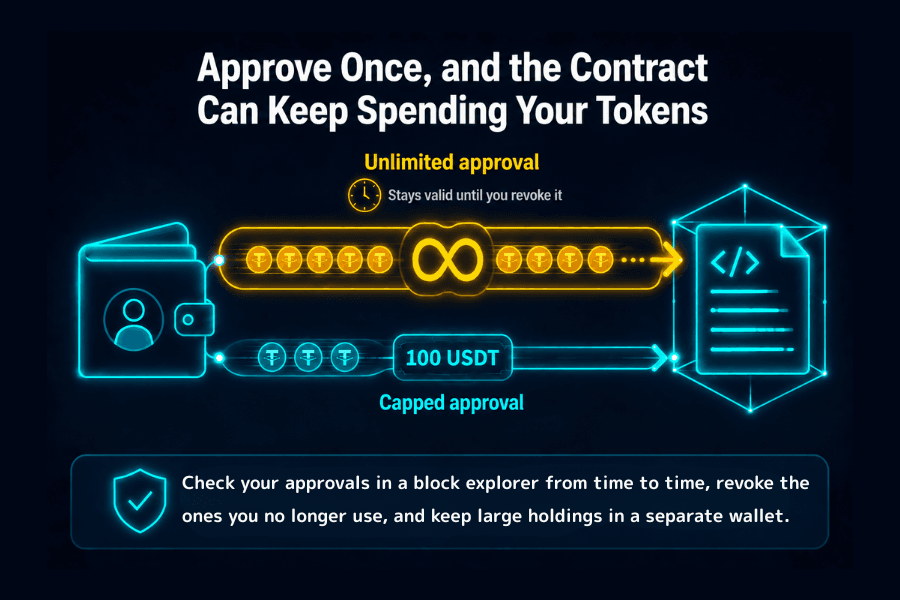
The workable habits are to set the allowance to the amount this transaction actually needs, to check and revoke approvals you no longer use with a block explorer or an approval manager, and to keep large holdings in a wallet separate from the one you interact with day to day — long-term positions can move to a cold wallet.
Trade Crypto CFDs with Titan FX
Titan FX offers 20+ crypto CFDs including BTC and ETH with up to 100:1 leverage — go long or short with no wallet or private-key management.
7. FAQ: Common questions about smart contracts
Q1: Can a smart contract really not be changed?
Deployed bytecode cannot be rewritten, but most projects use a proxy architecture that keeps the logic in a replaceable contract, so the functionality can still be upgraded. To judge whether a contract is genuinely immutable, look for a proxy layer, who holds the upgrade key, and whether there is a timelock.
Q2: Who receives the gas fee, and why is it sometimes so expensive?
Since Ethereum's London upgrade, gas is split into a base fee that adjusts with congestion and is burned, and a tip paid to the validator who includes the transaction. The level depends on how much computation your transaction requires and how many people are competing for block space at that moment.
Q3: If a transaction fails, is the gas refunded?
No. State reverts to where it started, but the computation already spent is not refunded; only the unused portion of your gas limit comes back. During congestion it is worth simulating a transaction to confirm it will go through before sending it.
Q4: Is a smart contract legally binding?
In most jurisdictions it does not automatically form a legally binding contract. Some jurisdictions now recognize electronic records and blockchain signatures as evidence, but that addresses form rather than treating code as the agreement itself.
Q5: Do ordinary investors need to be able to read the code?
Not line by line, but four habits are worth building: confirm the contract address came from an official channel; use a block explorer to check whether the source is verified, how long it has been deployed, and how many users have interacted with it; revoke token approvals you no longer need; and keep large holdings in a wallet separate from your day-to-day one. None of these needs a programming background, and together they block most common losses.
Q6: Is a smart contract the same thing as a DApp?
They sit at different layers. The smart contract is the on-chain backend logic; a DApp usually also includes a web frontend. The frontend can be updated, taken down, or even compromised and replaced with a malicious version while the contract keeps running unchanged on chain — which is why experienced users confirm the frontend is pointing at the right contract address.
Q7: Are smart contracts safe?
It has to be taken apart. Execution itself is verifiable: the code is public and every call leaves a record. But verifiable execution does not mean a safe outcome — of the five risk categories above, only the first sits in the contract code. The other four come from external data, permission design, surrounding infrastructure, and the user's own approval habits. An audit lowers risk, but it is a spot check on one specific version and does not constitute a guarantee.
8. Conclusion: It guarantees execution, not correctness
What a smart contract genuinely changes is one thing: it swaps the question "will the other side follow through?" for the question "is this code correct?" The first needs trust and courts; the second needs code review and permission design.
That is a real advance, and the price is just as clear. Code runs literally, and it runs when it is wrong. Assets that move cannot be recalled by a support desk. The largest losses in the history of this technology came from logic bugs, oracle manipulation, admin keys and bridges — not from broken cryptography.
The practical stance is to treat a smart contract as a verifiable execution mechanism: rules become public and transparent, execution becomes fast and cheap, but risk has not disappeared, only moved. Seeing where it moved to is what lets you ask the right questions. For live prices on the related assets, see the live ETH quotes page.
Further Reading
- What Is TRC-20? A Beginner Guide to USDT Transfers on TRON
- Stablecoins Complete Guide: USDT vs USDC, Peg Mechanisms, Regulation
- What Is a Mnemonic Phrase? 12 vs 24 Words and How to Protect Your Seed
- CBDC Complete Guide: Mechanics, Risks, and How It Differs From Cryptocurrency
- What Is Bitcoin Halving? The Schedule, Past Halvings, and the Effect on Price
Titan FX Trading Strategy Lab. We produce investor-education content covering forex, commodities (crude oil, precious metals, agricultural goods), stock indices, US equities, and digital assets.
Primary Sources (by Category)
- Protocol documentation: General descriptions of the EVM, gas metering and token standards from the Ethereum documentation and improvement proposals (EIPs)
- Security research: Public smart contract security research and incident compilations covering reentrancy, oracle manipulation and bridge exploits
- On-chain data: General figures from public block explorers on contract verification status, deployment age and interaction counts
- Investor education: Regulator materials on crypto-asset approval risk, phishing techniques and scam recognition