

Beige Book

Its formal title is the Summary of Commentary on Current Economic Conditions by Federal Reserve District. It comes out about two weeks before each Federal Open Market Committee (FOMC) meeting and describes, in words rather than numbers, how activity, employment and prices have changed around the country.
This guide explains what goes into the Beige Book and how it is put together, how it relates to the FOMC, when it is released, how to read it, and how it affects currencies and US stocks.
- The Beige Book compiles economic information gathered by the 12 regional Federal Reserve Banks and is published eight times a year
- It is mostly written description, organized around three topics: overall economic activity, employment and wages, and prices
- It is usually released on a Wednesday about two weeks before each FOMC meeting, at 2:00 p.m. Eastern Time
- It is one of the inputs the FOMC considers and is not a commentary on the views of Fed officials
- Market reactions are usually smaller than for payrolls or CPI, but a tone that differs sharply from expectations can still move the dollar and US stocks
1. What Is the Beige Book?
The Federal Reserve divides the United States into 12 Federal Reserve Districts, each served by its own Reserve Bank. The Beige Book combines the reports in which each of these 12 banks describes economic conditions in its District.
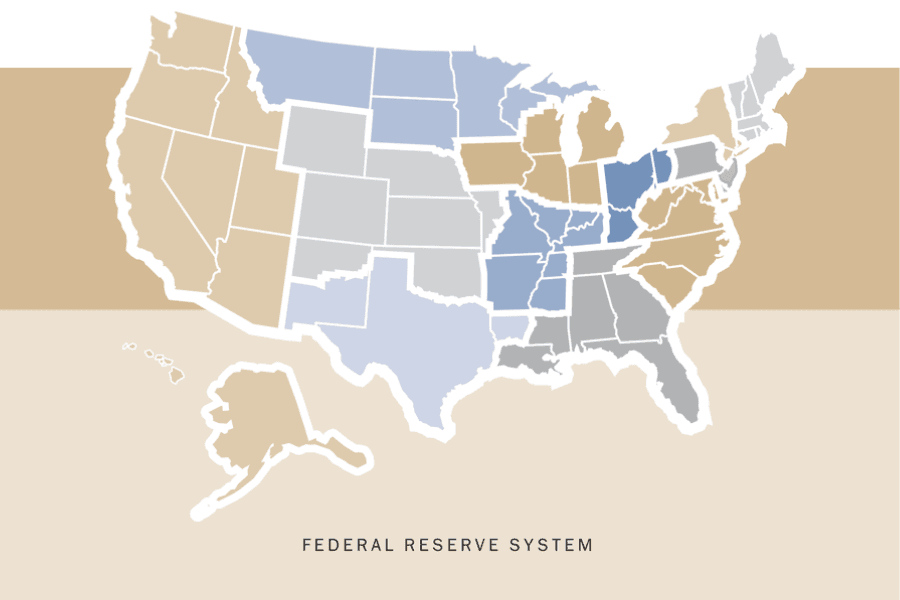
The information comes from conversations with businesses, economists and other contacts, so it is qualitative, unlike statistics such as GDP or the unemployment rate. Its purpose is to describe how economic conditions have changed since the previous report.
The Fed states that the Beige Book summarizes comments from contacts across the Districts and is not a commentary on the views of Federal Reserve officials.
2. What's in the Beige Book and How It Is Compiled
Every Beige Book goes through two stages: each of the 12 Reserve Banks first gathers information in its own District, and the results are then organized by set topics into District reports and a national summary.
Where the Information Comes From
Each Reserve Bank collects information on its local economy in several ways:
-
① Reports from directors: input from the directors of the Reserve Bank and its branches
-
② Interviews: in-person or phone conversations with businesses, economists, market experts and others
-
③ Online questionnaires: surveys completed by a regular group of contacts
Each Reserve Bank chooses its own contacts and aims to cover a wide range of industries and economic activities.
How the Report Is Structured
The Beige Book has two parts:
| Part | Content |
|---|---|
| National Summary | All 12 Districts combined |
| District reports | Each District's conditions |
The national summary is written by one of the 12 Reserve Banks on a rotating basis. Since January 2017, every District report has covered the same three core topics: overall economic activity, employment and wages, and prices.
3. The Beige Book and the FOMC
The FOMC is the Fed committee that sets interest rates, and it meets eight times a year. The Beige Book is generally released on the Wednesday about two weeks before each meeting, so it also comes out eight times a year.
Before each meeting, FOMC members look at statistics on GDP, jobs and prices, and the Beige Book is one more input. Official statistics often arrive with a lag, while the Beige Book covers the latest conditions around the country since the previous meeting, filling in what the data cannot yet show.
Examples include whether businesses are slowing their hiring, whether consumers are cutting back, or whether firms are planning to raise prices because of higher costs. Changes like these often show up in what businesses say before they appear in the data.
Still, the Beige Book is only one of the inputs the FOMC considers and does not set interest rates by itself. For the direction of rates, look to the FOMC statement and the dot plot.
4. When Is the Beige Book Released?
The Beige Book is released at 2:00 p.m. Eastern Time.
These are the 2026 Beige Book and FOMC dates published by the Fed:
| Beige Book | FOMC meeting |
|---|---|
| January 14 | January 27–28 |
| March 4 | March 17–18 |
| April 15 | April 28–29 |
| June 3 | June 16–17 |
| July 15 | July 28–29 |
| September 2 | September 15–16 |
| October 14 | October 27–28 |
| November 25 | December 8–9 |
The last Beige Book of 2026 is due on November 25. FOMC meeting dates are tentative until confirmed at the preceding meeting, so check the Fed's announcements for the final schedule.
5. How to Read the Beige Book
The full Beige Book runs to more than 50 pages, so most traders read only the national summary at the front. Go through it in the order of overall activity, employment and prices: first look at how the Districts are distributed, then check whether the wording has changed from the previous report.
Start with the National Summary
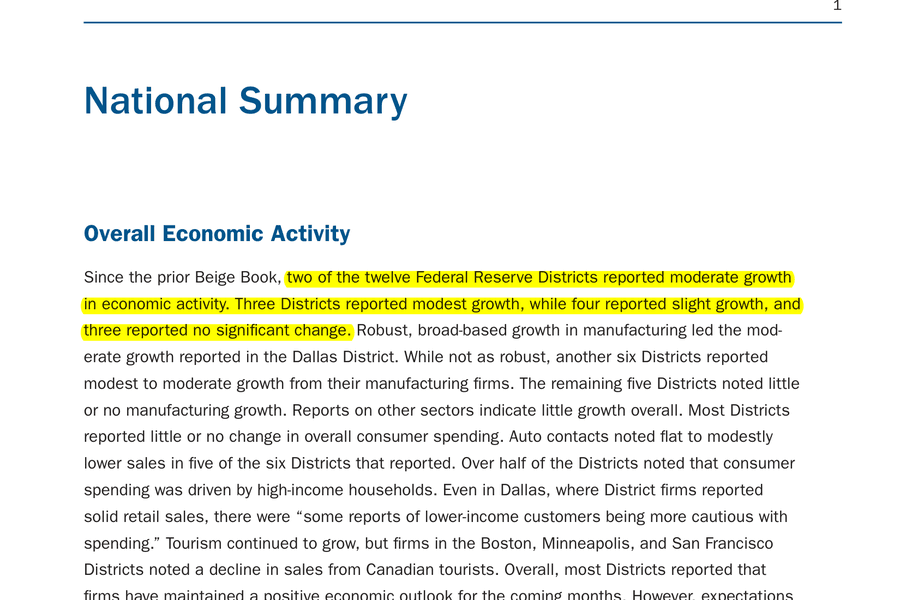
The first paragraph of the national summary says how many of the 12 Districts saw growth, how many were flat and how many saw declines. It is the fastest way to judge the overall direction of the economy.
Watch the Wording
The Beige Book describes the size of changes in words. Common terms, roughly from weakest to strongest, are:
| Term | Meaning |
|---|---|
| slight | Very small change |
| modest | Small change |
| moderate | Medium change |
| robust | Strong change |
These are common descriptive terms that make it easier to compare changes, but the Fed has not set a formal scale for them. Read them in context and compare them with the previous report. For example, if price growth goes from "modest" to "moderate," the Districts are reporting stronger price pressure.
Example: The October 2026 Beige Book
The Beige Book released on October 14, 2026, was prepared at the Federal Reserve Bank of Philadelphia and based on information collected on or before October 5:
-
Overall economic activity: of the 12 Districts, two reported moderate growth, three modest growth, four slight growth and three no significant change
-
Employment: three Districts reported modest increases, five slight increases and four no significant change, leaving conditions little changed overall
-
Prices: three Districts described price growth as robust, eight as moderate and one as modest, and four said the pace of price increases had picked up since the prior report
The report showed an economy that was still growing but without much momentum, with flat employment and building price pressure.
6. How the Beige Book Affects Currencies and US Stocks
The Beige Book does not change interest rates directly. It moves markets by changing what investors expect the Fed to do next. Because it has no consensus forecast to compare against, the market reaction is usually smaller than for data such as nonfarm payrolls or CPI.
Impact on the US Dollar
When the tone of the Beige Book differs sharply from expectations, it can still move the dollar:
| Beige Book content | Likely market reading | US dollar |
|---|---|---|
| Activity and jobs firm up | Fewer rate cuts | Supported |
| Price pressure builds | Tighter policy | Supported |
| Many Districts weaken | More rate cuts | Under pressure |
These are typical readings with all else equal; actual moves also depend on other news at the same time. A stance that leans toward tighter policy is called hawkish.
Impact on US Stocks
The stock market's reaction is more complicated than the dollar's, because the same report can affect both earnings and the outlook for rates:
-
Stronger activity: brighter sales prospects for companies, but a lower chance of rate cuts, which is not always good for highly valued growth stocks
-
Weaker activity: higher hopes for rate cuts, but if recession worries grow, earnings forecasts may be cut too
-
Building price pressure: concern that rates will stay high for longer, which can weigh on stock valuations
Check Post-Release Price Moves on the Titan FX Indicator Page
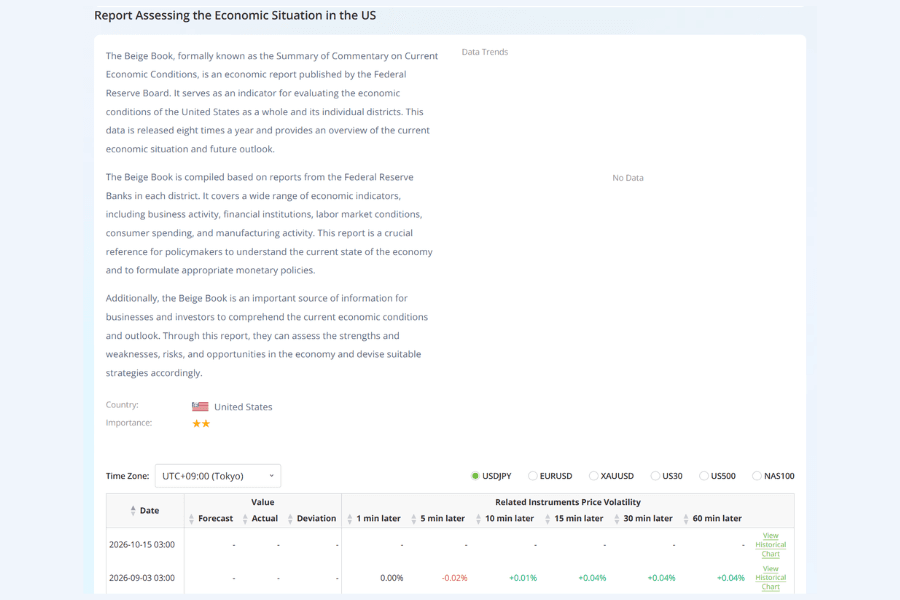
Titan FX's economic indicators list has a page for the Beige Book that shows each release time and how USD/JPY, EUR/USD, XAU/USD, US30, US500 and NAS100 moved over the 1 to 60 minutes after the release.
Open the Beige Book Indicator PageFor release times of other US economic data, check the Economic Calendar.
7. Limitations of the Beige Book
-
It is not statistical data: the Beige Book summarizes what contacts say and contains no hard numbers, so it cannot replace statistics such as GDP or employment
-
Contacts are not chosen at random: each District uses different contacts and questions, so descriptions across Districts are not always directly comparable
-
It does not represent the Fed's stance: it describes conditions around the country and does not reveal what Fed officials think about rates
-
It looks backward: each report has an information cutoff date and reflects only what was collected by then, so later developments are not included
8. FAQ
Q1. What is the official name of the Beige Book?
Its official name is the Summary of Commentary on Current Economic Conditions by Federal Reserve District, and it is commonly known as the Beige Book.
Q2. How often is the Beige Book published?
Eight times a year, usually on a Wednesday about two weeks before each FOMC meeting.
Q3. What time is the Beige Book released?
At 2:00 p.m. Eastern Time.
Q4. Does the Beige Book reflect the Fed's policy stance?
No. The Fed states that the Beige Book summarizes comments from businesses, economists and other contacts in each District and is not a commentary on the views of Fed officials.
Q5. How is the Beige Book different from the FOMC minutes?
The Beige Book comes out before an FOMC meeting and describes economic conditions around the country. The minutes come out after the meeting and record what FOMC members discussed and what views they expressed.
Q6. How should traders use the Beige Book?
Start with how many Districts in the national summary reported growth, no change or declines, then compare the wording on prices and employment with the previous report. Price moves after the release are usually smaller than after major data, so weigh it alongside the other data that comes out before the FOMC meeting.
9. Conclusion
The Beige Book is the Fed's eight-times-a-year report summarizing what businesses and experts in the 12 Federal Reserve Districts say about their local economies. It is usually released on a Wednesday about two weeks before each FOMC meeting, at 2:00 p.m. Eastern Time, and it is one of the inputs the FOMC considers.
When reading it, start with the District counts in the national summary and then track changes in the wording on prices and jobs. With no forecast to compare against, the market reaction is usually smaller than for major data, but a tone that differs sharply from expectations can still move the dollar and US stocks.
Further Reading
- What Is the Federal Funds Rate?
- What Is the PCE Price Index?
- What Is the Consumer Price Index (CPI)?
Titan FX Trading Strategy Lab. We produce educational content for investors covering FX, commodities (crude oil, precious metals, agricultural products), stock indices, U.S. equities, and cryptocurrencies.
Primary Sources
- Federal Reserve sources: Federal Reserve Board, "Beige Book," "Beige Book FAQs," the national summary of the October 2026 Beige Book, the November 30, 2016 announcement of the Beige Book format change, the November 2026 events calendar, and the FOMC meeting calendar
- Reserve Banks: Federal Reserve Bank of San Francisco, "What is the Beige Book, and what role does it play in setting interest rates for monetary policy?"