

What Is the AEX 25 Index (NETH25)? Components & Trading Guide
NETH25 is the core benchmark index tracking the performance of the Dutch stock market, compiled by Euronext Amsterdam. It comprises the 25 largest and most actively traded companies listed in the Netherlands. From semiconductor equipment giant ASML and global consumer goods leader Unilever to energy major Shell, these constituents represent the backbone of the Dutch economy.
For CFD traders, NETH25 is an important instrument for gaining exposure to both the Dutch and broader European markets. The index is driven by multiple factors including EU economic policy, European Central Bank (ECB) interest rate decisions, Dutch domestic economic data, and the global business performance of its constituent companies, providing abundant trading opportunities. This article provides a comprehensive analysis of NETH25's trading logic, covering the index definition, constituents, price drivers, and practical trading methods.
What Is the Netherlands AEX 25 Index (NETH25)?
The AEX Index (Amsterdam Exchange Index) is the most important stock market benchmark in the Netherlands, compiled and maintained by Euronext Amsterdam. In CFD trading, the AEX Index uses NETH25 as its trading symbol.
The index selects the 25 largest and most liquid companies listed on Euronext Amsterdam, serving as the core indicator for measuring the overall performance of the Dutch stock market. Launched in 1983, the AEX Index is calculated using a free-float market capitalization weighting methodology and covers diverse sectors including technology, financials, consumer goods, energy, and industrials.
| Item | Details |
|---|---|
| Official Name | AEX Index (Amsterdam Exchange Index) |
| Trading Symbol | NETH25 (CFD) |
| Launch Date | 1983 |
| Index Provider | Euronext Amsterdam |
| Weighting Method | Free-float market capitalization weighted |
| Number of Constituents | 25 |
| Denomination Currency | Euro (EUR) |
| Review Frequency | Annual review in March |
Although the AEX Index has only 25 constituents, it includes global corporations such as ASML, Unilever, and Shell. As a result, the index reflects not only domestic Dutch economic conditions but also moves in close correlation with the global semiconductor supply chain, commodity markets, and the broader European economy.
Compared to the EURO STOXX 50 Index (EUSTX50), which covers 50 major companies across 11 eurozone countries and provides broader eurozone market exposure, NETH25 focuses on the Dutch market with a significantly higher weighting toward the technology sector (particularly ASML).
Constituents and Sector Distribution
Constituent Selection Criteria
The AEX Index applies the following screening criteria for constituent selection:
| Criterion | Description |
|---|---|
| Listing Venue | Companies listed on Euronext Amsterdam |
| Free-Float Market Cap | Ranked by free-float market capitalization; top 25 selected |
| Liquidity Requirements | Must meet minimum trading volume and frequency thresholds |
| Annual Review | Constituent adjustments in March each year |
Representative Constituents by Sector
The AEX Index covers the core sectors of the Dutch economy. Below are representative companies by industry:
Technology
The technology sector carries the largest weighting in NETH25, with ASML alone accounting for a substantial proportion of the index:
| Company | Sub-Sector |
|---|---|
| ASML Holding NV | Semiconductor Equipment (global monopoly supplier of EUV lithography systems) |
| Wolters Kluwer NV | Professional Information and Software Solutions |
| RELX NV | Information Analytics and Data Services |
Consumer Goods
| Company | Sub-Sector |
|---|---|
| Unilever PLC | Global Food, Beverages, and Personal Care |
| Heineken NV | Global Beer Manufacturer |
Energy
| Company | Sub-Sector |
|---|---|
| Shell PLC | Global Integrated Energy Company |
Financials
| Company | Sub-Sector |
|---|---|
| ING Groep NV | Netherlands' Largest Bank and Financial Services Company |
| Aegon NV | Insurance and Pension Services |
Health Technology
| Company | Sub-Sector |
|---|---|
| Koninklijke Philips NV | Global Health Technology (Medical Devices, Digital Health) |
Sector Composition Characteristics
NETH25's sector composition differs significantly from other European indices. The technology sector's weighting far exceeds that of most European indices, primarily due to ASML's monopolistic position in the global semiconductor supply chain. Additionally, the consumer goods and energy sectors carry substantial weightings, meaning NETH25 is simultaneously influenced by technology industry cycles, global consumer demand, and international oil prices.
Key Price Drivers
1. EU Economy and Market Confidence
The overall economic performance of the European Union has a direct and profound impact on NETH25. When EU economic growth is robust, constituent companies' profitability generally improves, driving the index higher. Conversely, economic downturns put downward pressure on the index.
-
Eurozone GDP Growth Rate: Overall eurozone economic growth directly affects constituent companies' earnings expectations
-
Eurozone Consumer Confidence Index: Reflects consumer spending willingness, impacting consumer-related constituents such as Unilever and Heineken
-
Netherlands GDP Growth Rate: Dutch domestic economic fundamentals
2. ECB Monetary Policy
The European Central Bank's (ECB) interest rate decisions are critically important for NETH25:
-
A low interest rate environment facilitates corporate financing, reduces borrowing costs, and supports rising stock prices
-
Rate increases raise corporate borrowing costs, suppress investment and consumption, and create downward pressure on the index
-
ECB quantitative easing or tightening policies directly affect the eurozone liquidity environment
3. Semiconductor Industry and Technology Cycles
Given ASML's extremely high weighting in NETH25, the global semiconductor industry business cycle has a significant impact on the index:
-
Changes in global chip demand directly affect ASML's order volume and share price
-
Technology policies and export controls in major markets such as the US and China may impact ASML's business outlook
-
The rapid growth of the artificial intelligence (AI) industry is driving demand for advanced process equipment
4. Trade Policy and Exchange Rates
The Netherlands is a highly open trading economy, with many AEX constituents generating revenue from global markets:
-
EU trade policy and tariff changes affect the profitability of export-oriented companies
-
Euro exchange rate fluctuations impact the international competitiveness of euro-denominated constituent companies
Since most AEX constituents operate globally, the EUR/USD (Euro vs US Dollar) exchange rate is an important reference for gauging currency impacts on the index.
5. Regulatory Environment and Consumer Confidence
EU environmental regulations, labor laws, and data protection regulations affect constituent companies' operational costs and business models. Changes in eurozone consumer confidence also directly impact the performance of consumer and retail-related constituents.
Use Titan FX's Economic Calendar to track the release times and market expectations of these key data points in real time.
Index Comparison and Trading Strategies
NETH25 vs EUSTX50 vs GER40
| Item | NETH25 (AEX 25) | EUSTX50 (EURO STOXX 50) | GER40 (German DAX 40) |
|---|---|---|---|
| Constituent Scope | Top 25 Dutch listed companies | Top 50 companies across 11 eurozone countries | Top 40 German listed companies |
| Technology Weighting | High (ASML dominates) | Medium | Medium (SAP-led) |
| Sector Characteristics | Semiconductors, Consumer Goods, Energy | Financials, Industrials, Consumer -- diversified | Automotive, Industrials, Chemicals |
| Denomination Currency | Euro | Euro | Euro |
| Constituent Concentration | High (ASML weighting is prominent) | Medium | Medium |
| Volatility | Medium-High (ASML-influenced) | Medium | Medium |
| Titan FX Symbol | NETH25 | EUSTX50 | GER40 |
Key Trading Strategy Considerations
-
ASML dominance effect: Due to ASML's extremely high weighting in the index, changes in the global semiconductor industry cycle significantly affect NETH25's price action. Closely monitor ASML's quarterly earnings, order data, and global chip demand trends
-
ECB interest rate decisions: The ECB's monetary policy has a profound impact on all eurozone indices. Rate decisions are typically accompanied by increased volatility, creating important trading windows for short-term strategies
-
Global trade sensitivity: Constituents such as Shell and Unilever are highly dependent on international markets. International trade friction, geopolitical risks, and global supply chain disruptions can all affect index performance
-
Energy price correlation: As a major energy company, Shell's share price is directly influenced by international oil and natural gas price fluctuations, which in turn drive NETH25 movements
How to Trade NETH25 on Titan FX
On the Titan FX platform, the Netherlands AEX 25 Index is traded under the symbol NETH25, available on both MT4 and MT5 platforms via CFD (Contract for Difference) with leverage up to 500:1. You can also trade using WebTrader directly in your browser.
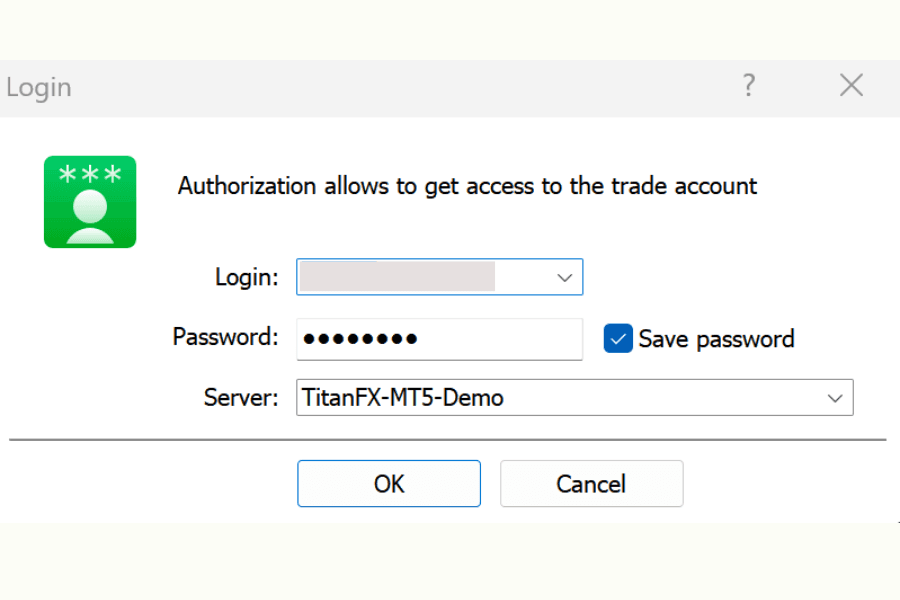
Step 1: Log In to Your Trading Account
Open a Titan FX trading account (Zero Standard or Zero Blade), complete your deposit, then download the MT4 or MT5 platform and log in with your credentials.
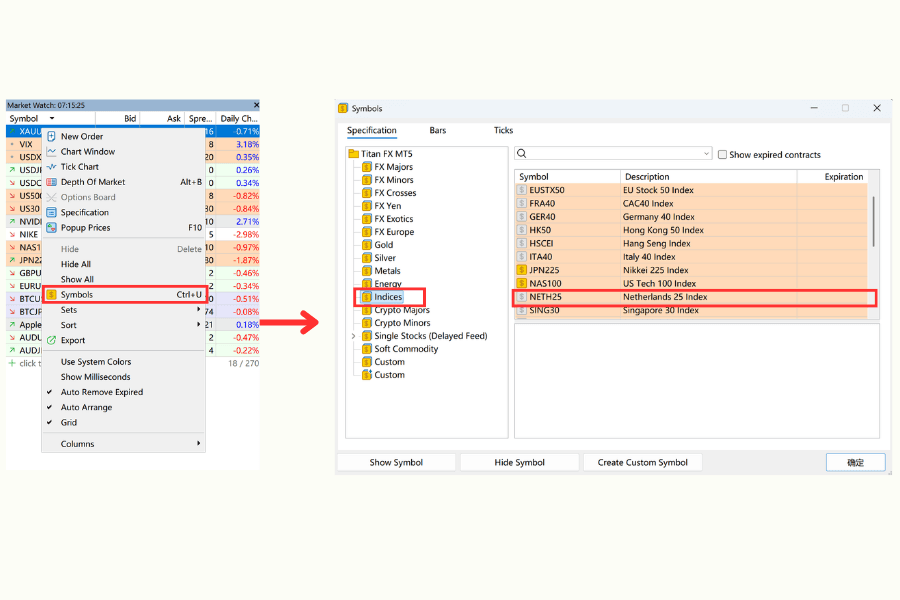
Step 2: Add NETH25 to Market Watch
Right-click in the Market Watch window, select "Symbols," expand the "Indices" category, find NETH25 (Netherlands 25 Index), and double-click to add it to your quote list.
Step 3: Place a Trade
Double-click the NETH25 quote or open a chart to access the order window. Enter your lot size (minimum 0.01 lots), select Buy or Sell, set your stop loss and take profit, and execute the trade.
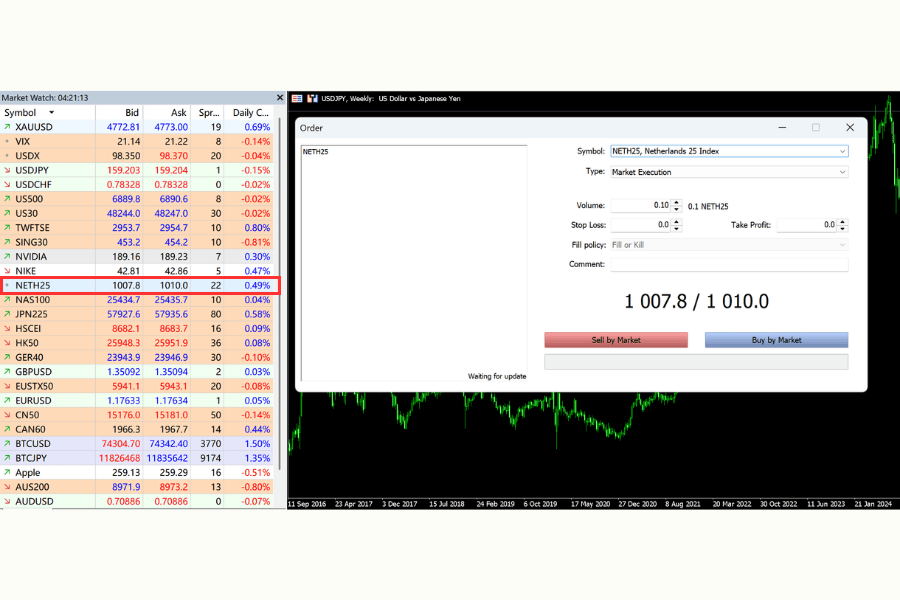
Titan FX offers a free demo account, allowing you to familiarize yourself with NETH25 trading procedures and platform operations in a risk-free environment.
Trading Hours
| Time Zone | Standard Time (GMT+2) | Daylight Saving Time (GMT+3) |
|---|---|---|
| MT4/MT5 Server | 09:00 - 23:00 | 09:00 - 23:00 |
| Eastern Time (ET) | 03:00 - 17:00 | 03:00 - 17:00 |
| Taiwan / Hong Kong / Beijing (GMT+8) | 15:00 - 05:00 next day | 14:00 - 04:00 next day |
| Japan (GMT+9) | 16:00 - 06:00 next day | 15:00 - 05:00 next day |
NETH25 trading hours cover the main European trading session, with the highest liquidity during Euronext Amsterdam's trading hours.
Titan FX Analysis Tools
Titan FX provides a range of analysis tools to help traders assess NETH25's technical outlook:
- Support and Resistance: Identify key NETH25 price levels to assess breakout or reversal potential
- Order Book (Position Information): Observe other traders' pending order distribution and long/short ratios
- Trend Analysis: Determine whether NETH25 is in an uptrend, downtrend, or consolidation phase
- RSI Analysis: Identify overbought or oversold conditions to support reversal timing decisions
- Volatility Heatmap: Understand NETH25's volatility patterns across different trading sessions
- Percentage Change Ranking: Compare NETH25's real-time performance against other indices
- Swap Calendar: Check NETH25 overnight financing rates
- Dividend Calendar: Track the impact of constituent ex-dividend dates on CFD accounts
- Margin Calculator: Calculate required margin and appropriate position sizing
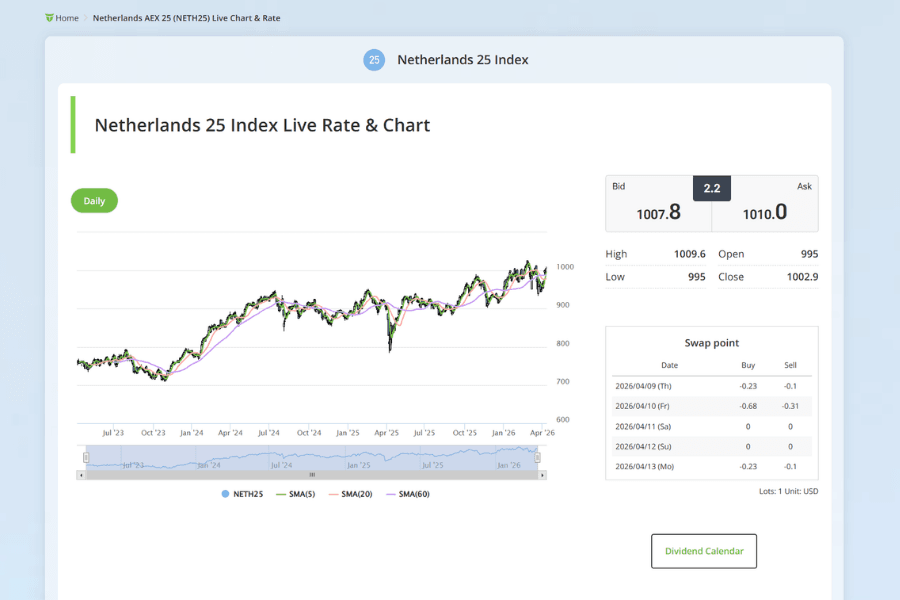
For the latest trading conditions and spreads, please refer to the official page.
For the latest trading conditions and live prices, see the NETH25 instrument page.
Start Trading the NETH25 Index
Trade NETH25 CFDs with Titan FX and enjoy up to 500:1 leverage, tight spreads, and the flexibility to go long or short. Both Zero Standard and Zero Blade accounts support index CFD trading (Zero Micro accounts do not support index CFDs).
FAQ
Is NETH25 better suited for short-term trading or long-term investing?
NETH25 is suitable for both short-term trading and long-term investing. For short-term trading, the index is driven by events such as ECB interest rate decisions, ASML earnings releases, and European economic data, offering moderate volatility that suits event-driven trading strategies. For long-term investing, AEX constituents include several global leaders (ASML, Shell, Unilever), and the index has a foundation for long-term growth as the European economy continues to develop and the technology sector expands. We recommend monitoring the Netherlands Economic Indicators to track fundamental changes.
What are the main risks of trading NETH25?
The main risks include: (1) Concentration risk -- ASML's extremely high weighting means that sharp movements in its share price can have an outsized impact on the overall index; (2) European economic risk -- eurozone recessions, debt crises, or geopolitical events can all put downward pressure on the index; (3) Currency risk -- a weakening euro may affect international investors' returns; (4) Leverage risk -- NETH25 supports up to 500:1 leverage, and high-leverage trading requires strict stop-loss discipline, keeping risk per trade within 1-2% of account equity.
How significant is ASML's influence on NETH25?
ASML is the world's only manufacturer of extreme ultraviolet (EUV) lithography systems and holds an extremely high weighting in the AEX Index. Due to its monopolistic position in the global semiconductor supply chain, ASML's share price movements have a far greater impact on NETH25 than any other constituent. Changes in global chip demand, AI industry development trends, and technology export control policies all indirectly affect NETH25's price action through ASML's stock price.
Summary
The Netherlands AEX 25 Index (NETH25) is the core benchmark for measuring Dutch stock market performance, bringing together global companies from the technology, energy, consumer goods, and financial sectors. ASML's high weighting makes NETH25 a unique window for tracking the global semiconductor industry cycle, while constituents such as Shell and Unilever provide the index with diversified sources of returns.
Monitoring ECB monetary policy closely, tracking the global semiconductor industry cycle, and applying technical analysis tools to time entries and exits form the fundamental framework for trading NETH25.
Use Titan FX's NETH25 live quotes and charts page to stay on top of market developments, and refer to the EURO STOXX 50 Index (EUSTX50) Trading Guide and the German DAX 40 Index (GER40) Trading Guide to learn more about trading strategies for European market indices.