

Margin Call
The name dates from the era when brokers telephoned clients to ask for additional funds. Notifications now arrive by email or as a platform message, but the term has stuck. In forex and CFD trading, the margin call sits between normal trading and forced liquidation: receiving one means the account is already carrying elevated risk, but there is still time to act on your own terms.
This guide covers what triggers a margin call, how margin level is calculated, the two thresholds Titan FX applies (90% for the notice, 20% for the liquidation), the three ways to respond, and how to keep the account far enough from the line that the question never arises.
- A margin call is a warning issued when margin level drops below the alert threshold — the last buffer before forced liquidation.
- Titan FX sets the alert at 90%. Below that a notice is sent; below 20% the system starts closing positions, beginning with the largest losing one.
- Margin level = equity ÷ used margin × 100%. The higher the effective leverage, the faster that figure falls.
- Three responses are available: deposit funds, close part of the exposure, or close out yourself. Delay only removes options.
- Unlike a stock margin call, an offshore CFD margin call is not a demand for payment. Titan FX applies a Zero Cut System, so losses stop at the funds in the account.
1. What Is a Margin Call?
A margin call is a warning mechanism specific to margin trading. Forex and CFDs run on leverage, so a trader deposits a fraction of a position's notional value and controls something many times larger. When price moves against the position and unrealized losses pull account equity down to the alert level, the broker sends a notice asking the trader to add funds or cut exposure.
It helps to think of the account as passing through three states:
- Normal: margin level has room to spare; positions can be opened and held freely.
- Margin call (alert): margin level has crossed below the alert threshold and a notice has been sent. This is the stage where the trader still decides.
- Forced liquidation (stop out): margin level falls further, past the liquidation threshold, and the system closes positions automatically. The decision is no longer the trader's.
Put another way, a margin call does not touch the position. It is the alarm that sounds before forced liquidation. For how margin itself is calculated, see Forex Margin Calculation.
2. What Triggers It: Margin Level and Two Thresholds
The margin level formula
Whether a margin call fires depends on one figure, the margin level:
The inputs are easy to mix up, so it is worth pinning down what each one means:
| Term | Also shown as | What it is |
|---|---|---|
| Balance | — | Account funds including realized profit and loss, before open positions are counted |
| Equity | Net asset value | Balance plus the unrealized profit and loss on every open position — the account's live value |
| Used margin | Required margin | The total margin locked up by the positions currently held |
| Free margin | Usable margin | Equity minus used margin: what remains to open new positions and absorb unrealized losses |
| Margin level | Margin maintenance ratio | Equity ÷ used margin × 100% |
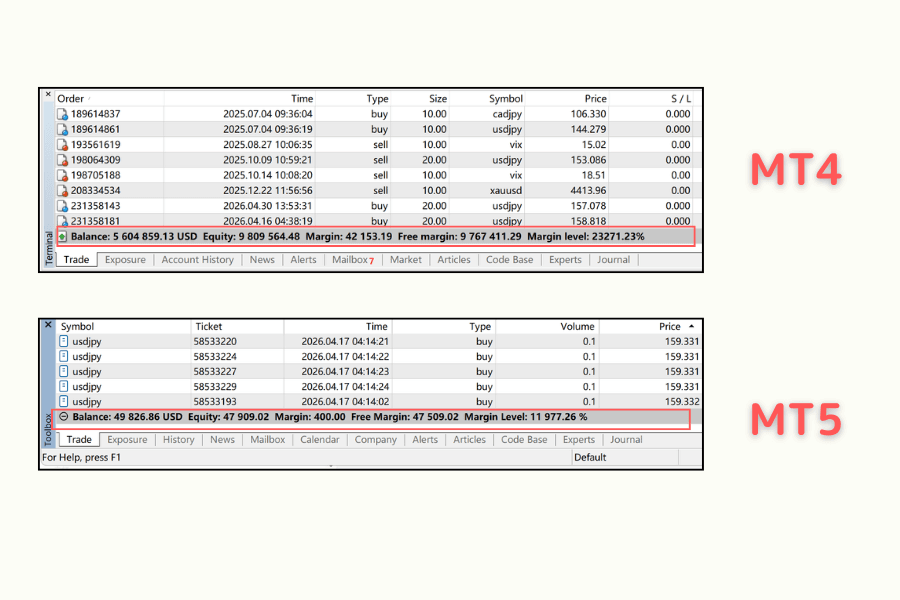
When a position moves into unrealized loss, used margin stays fixed while equity falls, so the margin level declines. All of these figures update in real time in the account information row of the Trade tab at the bottom of MT4 and MT5. The labels are identical on both platforms in English, so nothing needs to be relearned when switching between them.
Titan FX thresholds: 90% for the notice, 20% for liquidation
Titan FX applies two levels:
| Threshold | Level | What happens |
|---|---|---|
| Margin call (alert) | Margin level falls below 90% | The broker sends a notice prompting a deposit or a reduction in exposure |
| Forced liquidation (stop out) | Margin level falls below 20% | The system closes positions automatically, starting with the largest losing one |
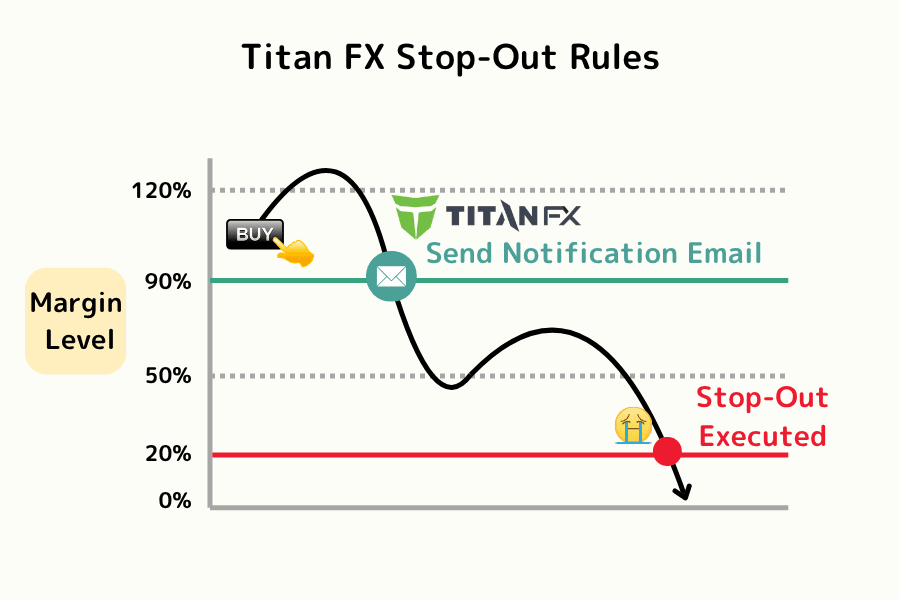
Positions survive a drop below 90%, but the notice is an unambiguous signal from the account. Below 20% the system closes them to stop losses widening further. The higher the leverage, the more a given price move moves the margin level — which is why leverage trading has to be paired with risk management.
3. A Worked Example: From Entry to Margin Call
Take a Titan FX Standard account with 1,000:1 leverage and a 1,000 USD deposit, buying 1 standard lot of USD/JPY at 160.00 — a notional value of 100,000 USD.
- Used margin = 100,000 ÷ 1,000 = 100 USD
- Margin level at entry = 1,000 ÷ 100 × 100 = 1,000%
- One standard lot of USD/JPY is worth roughly 6.25 USD per pip (0.01 yen) at 160
Now suppose price falls:
| Account state | Equity | Margin level | Approximate move |
|---|---|---|---|
| At entry | 1,000 USD | 1,000% | — |
| Margin call | 90 USD | 90% | 910 USD unrealized loss ≈ 146 pips (about 1.46 yen) |
| Forced liquidation | 20 USD | 20% | 980 USD unrealized loss ≈ 157 pips (about 1.57 yen) |
Two things in this table deserve attention. The first is the gap between the notice at 90% and liquidation at 20%: 70 USD, or roughly 11 pips. On a heavily leveraged position, that can amount to only a few minutes of price action.
The second concerns position size. Trading 0.1 lot on the same deposit puts the margin level at entry at 10,000%, and price would have to fall about 15.9 yen before the notice fires. That is not ten times 1.46 yen, because a smaller position also requires less margin — 10 USD instead of 100. The equity corresponding to the 90% line drops to 9 USD, so the tolerable unrealized loss actually grows, from 910 USD to 991 USD. Position size affects the safety margin far more than most newcomers expect.
4. Three Ways to Respond to a Margin Call
Three responses are available once the notice arrives, each suited to a different situation.
Response 1: Deposit funds
Adding money to the account raises equity and the margin level directly. This fits the case where the move looks temporary and the original reasoning still holds. Bear in mind that deposits take time to clear, so in a fast decline the funds may not arrive before liquidation.
Response 2: Close part of the exposure
Closing some positions releases used margin and lifts the margin level. It is the most direct option when no deposit is coming. Start with the largest losing position, or with the ones that move in step with the rest of the book.
Response 3: Close out yourself
If the market has clearly turned and the reason for the trade no longer stands, closing everything and taking the loss leaves more capital intact. Choosing the exit yourself is preferable to waiting for the system to choose it at 20%, at a worse price.
The option worth avoiding is doing nothing. If price keeps moving against the position after the 90% line is crossed, the system liquidates at 20%. At that point neither the timing nor the order of the closures is yours, and a fast market can add slippage on top. The mechanics and consequences are covered in Impact of Loss Cut.
5. How This Differs from a Stock Margin Call
The term "margin call" also appears in equity margin trading, where it works differently — which is a common source of confusion.
| Equity margin call | Offshore forex / CFD (Titan FX) | |
|---|---|---|
| Nature of the notice | An obligation to pay the shortfall within a set period | A warning; no obligation to deposit |
| If ignored | The broker liquidates the collateral; any remaining shortfall stays owed | The system liquidates the positions, and that settles it |
| Loss ceiling | Can exceed the principal and become a debt | Limited to the funds in the account where negative balance protection applies |
Under most equity margin regimes, a call has to be met within a deadline or the collateral is sold, and if the sale does not cover the shortfall the investor still owes the difference. An offshore CFD margin call is a risk warning rather than a demand for payment: ignoring it results in liquidation, not a debt.
Titan FX also operates a Zero Cut System. If a violent move drives the account negative before liquidation completes, the negative balance is reset to zero, so losses are capped at the funds deposited and no further payment is owed.
6. How to Keep Margin Calls Out of Reach
Margin calls are manageable at the source. The principle is to keep a meaningful buffer in the margin level at all times.
- Control effective leverage: account leverage is a ceiling, not a target. Even on a 1,000:1 account, the leverage actually in use — notional position divided by equity — is better kept well below that ceiling. See how to change leverage if the setting needs adjusting.
- Set a stop on every trade: cap the loss on any single position before the margin level has a chance to deteriorate. Limiting risk per trade to 1–2% of equity is a common approach.
- Watch total size and correlation: several positions pointing the same way deteriorate together, so the real exposure is larger than any one of them suggests.
- Monitor the margin level regularly: treat it as the account's dashboard and keep it in the hundreds of percent, rather than reacting once a notice arrives.
- Avoid heavy size around major events: spreads widen and price gaps around important releases, and the margin level can deteriorate in seconds.
Before entering a trade, you can use the Margin Calculator to estimate the required margin and position size and keep your risk within plan.
7. Margin Call FAQ
Q1: Does a margin call always lead to forced liquidation?
No. A margin call is a warning, and the positions remain open. If the market steadies, or a deposit or partial close brings the margin level back to a safe range, no liquidation occurs. The system only begins closing positions if the margin level falls further, below 20%.
Q2: What is the difference between a margin call and a stop out?
A margin call is a notice, issued when margin level falls below 90%, and the trader still decides what to do. A stop out is a system action at 20%, where positions are closed automatically starting with the largest loss. There is no choice involved at that stage.
Q3: Where can I check the margin level in MT4 or MT5?
In the account information row of the Trade tab at the bottom of the terminal, which shows balance, equity, margin, free margin and margin level in real time. Both platforms use the same English labels. Checking it regularly while positions are open is a habit worth building.
Q4: What happens if I ignore a margin call?
If price keeps moving against the position, the system liquidates once margin level falls below 20%. Timing and sequence are decided by the system, and in a fast market slippage can make the fills worse than expected. If price recovers and the margin level climbs back above 90%, the alert state clears on its own.
Q5: Can the account go negative and leave me owing money?
Not at Titan FX. If an extreme move drives the account negative before liquidation completes, the Zero Cut System resets the balance to zero. Losses are limited to the funds in the account and do not become a debt.
Q6: What reduces the chance of a margin call the most?
Lower effective leverage combined with a stop on every trade. Smaller positions leave a larger buffer in the margin level, and a reliable stop keeps any single loss from eating into the alert threshold. With both in place, margin calls rarely occur.
8. Conclusion
A margin call is the warning system of margin trading. When margin level falls below 90%, Titan FX sends a notice that the account is carrying elevated risk; below 20%, the system begins closing positions from the largest loss down. Depositing, closing part of the exposure, and closing out entirely are all workable responses to that notice. Ignoring it is the one that is not.
What matters more is the work done before the line is reached — keeping effective leverage modest, placing a stop on each trade, and watching total size alongside the margin level. Done consistently, a margin call stays something you know about rather than something you have been through.
Further Reading
Titan FX Trading Strategy Lab. We produce educational content for investors covering FX, commodities (crude oil, precious metals, agricultural products), stock indices, U.S. equities, and cryptocurrencies.
Primary Sources (by category)
- Official documentation and broker rules: Titan FX Calculate and Manage Margins guide; Titan FX account specifications and Zero Cut System policy
- Trading platform documentation: MetaQuotes MT4/MT5 user guides on the definition and display of equity, free margin and margin level
- Research and reference: general treatments of margin call and stop out mechanics in major trading education resources (Investopedia, BabyPips)