

What Is AMD? Business, Latest Earnings, Stock Price History and AMD vs. Nvidia
Demand for AI data centers has grown sharply since 2025, and AMD's data center business has grown with it. In the second quarter of 2026, data center sales made up 58% of AMD's revenue. Large partnerships with AI companies such as OpenAI and Anthropic have also made the stock much more volatile.
This guide explains what AMD does, its four businesses and latest earnings, how it differs from Nvidia and Intel, what moves the stock and the key risks, how the share price has moved, and how to invest in AMD through shares, CFDs and stock indices.
- AMD is a fabless chip designer: it designs its own chips and relies mainly on TSMC to make them. Lisa Su has been CEO since 2014
- Its products fall into four groups: data center, client (PC), gaming and embedded. Data center made up 58% of revenue in Q2 2026
- Q2 2026 revenue was $11.5 billion, up 50% from a year earlier. AMD expects Q3 revenue of about $13 billion and will report after the US market close on November 3, 2026
- AI accelerator shipments, progress on large customer deals and TSMC capacity are the main drivers of the stock
- The stock hit a record close in early October 2026, then fell about 19% in two weeks, making it far more volatile than the broad market
1. What Does AMD Do?
AMD is a semiconductor company that designs chips but does not manufacture them. It handles the architecture and design of its processors and AI accelerators and relies mainly on TSMC to make them. This model is called fabless.
AMD sells into two broad markets:
-
Data center: EPYC server processors and Instinct AI accelerators, sold to cloud providers, AI companies and enterprises
-
PC and gaming: Ryzen PC processors, Radeon graphics cards and custom chips for game consoles such as PlayStation and Xbox
AMD's main rival in CPUs is Intel, and its main rival in AI accelerators is Nvidia. The company is headquartered in Santa Clara, California, and listed on Nasdaq. It is a member of the Nasdaq-100 (NAS100) and the Philadelphia Semiconductor Index.
AMD's history
AMD was founded in 1969 and spent decades competing with Intel in PC processors. These milestones shaped the company it is today:
-
2009, manufacturing spun off: AMD spun off its factories as GlobalFoundries and became a fabless company
-
2014, Lisa Su becomes CEO: Under Su, AMD launched the Zen architecture, which helped Ryzen and EPYC processors win back the market
-
2022, Xilinx acquired: The deal brought FPGA and other programmable chip technology, which now forms the core of the embedded business
-
2025, ZT Systems acquired: AMD gained AI server rack design expertise. It kept the design team and sold the manufacturing business to Sanmina
2. AMD's Four Businesses and Main Products
AMD's products fall into four groups. The revenue figures below are for Q2 2026 (the quarter ended June 27, 2026):
| Business | Main products | Q2 2026 revenue | Change from a year earlier |
|---|---|---|---|
| Data center | EPYC server processors, Instinct AI accelerators, Helios rack-scale AI systems | $6.7 billion | +107% |
| Client (PC) | Ryzen desktop and laptop processors | $3.1 billion | +23% |
| Gaming | Radeon graphics cards, semi-custom chips for game consoles | $779 million | −31% |
| Embedded | FPGAs and embedded processors for industrial, automotive and communications uses | $977 million | +19% |
In its official reporting, AMD combines client and gaming into one segment, "Client and Gaming," but still discloses revenue for each. This guide lists them separately so they match the products.
Data center is now AMD's largest business. Its new generation of AI accelerators is the Instinct MI400 Series, which includes the MI450 named in the OpenAI and Anthropic deals. Helios combines AI accelerators, EPYC processors and networking chips in a single rack, which AMD supplies to cloud providers and AI companies.
Gaming revenue fell mainly because sales of semi-custom chips for game consoles declined.
3. AMD's Latest Earnings
AMD reported second-quarter results on August 4, 2026, with record quarterly revenue:
| Item | Q2 2026 | Change from a year earlier |
|---|---|---|
| Revenue | $11.5 billion | +50% |
| Data center revenue | $6.7 billion | +107% |
| Non-GAAP gross margin | 56% | +13 percentage points |
| Non-GAAP EPS | $1.66 | +246% |
Gross margin and earnings per share jumped partly because Q2 2025 included inventory-related charges for MI308 chips hit by US export controls, which lowered the comparison base. Revenue growth gives a cleaner read on how fast the business is growing.
For the third quarter, AMD guided to revenue of about $13 billion, plus or minus $300 million. At the midpoint, that is about 41% growth from a year earlier, with a non-GAAP gross margin of about 56%.
AMD will report Q3 results after the US market close on November 3, 2026, with the conference call at 5:00 p.m. ET. Most US companies report outside regular hours, so the first price reaction often comes in after-hours trading.
For full-year 2025, AMD reported record revenue of $34.6 billion, including $16.6 billion from data center, up 32%.
4. AMD vs. Nvidia vs. Intel
AMD's two main competitors are Nvidia and Intel. Each has different strengths and a different way of making chips:
| Item | AMD | Nvidia | Intel |
|---|---|---|---|
| Main strengths | Server and PC CPUs, AI accelerators | AI accelerators (GPUs) and the CUDA software ecosystem | PC and server CPUs |
| Manufacturing | Fabless, mainly TSMC | Fabless, mainly TSMC | Own factories, plus a foundry business for other companies |
| AI software platform | ROCm (open source) | CUDA | oneAPI |
Nvidia is the largest supplier of AI accelerators, and its CUDA software ecosystem is a major advantage. AMD's approach is to offer CPUs, GPUs and complete rack systems together, using its open ROCm software to win customers. Cloud providers also want a second supplier besides Nvidia.
In CPUs, AMD competes directly with Intel. Its next-generation EPYC server processor, code-named Venice, is made on TSMC's 2-nanometer process.
5. What Moves AMD Stock: Drivers and Risks
AMD's share price mostly reflects expectations for its data center business, so AI news has the biggest effect. These are the factors to watch:
-
Progress on large customer deals: AMD signed a partnership with OpenAI in October 2025. OpenAI plans to deploy 6 gigawatts (GW) of AMD GPUs in stages, starting with 1 GW of MI450 in the second half of 2026, and AMD granted OpenAI a warrant for up to 160 million AMD shares. In July 2026, Anthropic announced plans to deploy up to 2 GW of MI450 Series GPUs, with the first gigawatt starting in the first half of 2027, and AMD committed to a strategic equity investment of up to $5 billion in Anthropic. Both are staged plans with "up to" sizes, so how much is actually deployed, and when it becomes revenue, depends on the customers' funding, demand and delivery schedules
-
AI accelerator shipments: MI450 and Helios start ramping in the second half of 2026. Whether shipments keep to plan will show up directly in data center revenue
-
TSMC capacity: AMD's advanced chips depend on TSMC, and tight capacity could limit shipments
-
Export controls: The US restricts AI chip exports to China. In full-year 2025, AMD recorded about $440 million in MI308 inventory-related charges, and policy changes remain a risk
-
Valuation and volatility: After a large rally, the P/E ratio already prices in a lot of growth. When earnings or AI spending news falls short of expectations, the stock can drop sharply even if the results themselves are solid
-
PC and gaming demand: These two businesses make up about a third of revenue, so weaker consumer electronics demand drags on overall results
6. AMD Stock Price History
The chart below shows AMD's daily closing price over the past five years. During the 2022 semiconductor sell-off, the stock fell below $60 at one point. After the US announced reciprocal tariffs in April 2025, it dropped to a low of about $78.
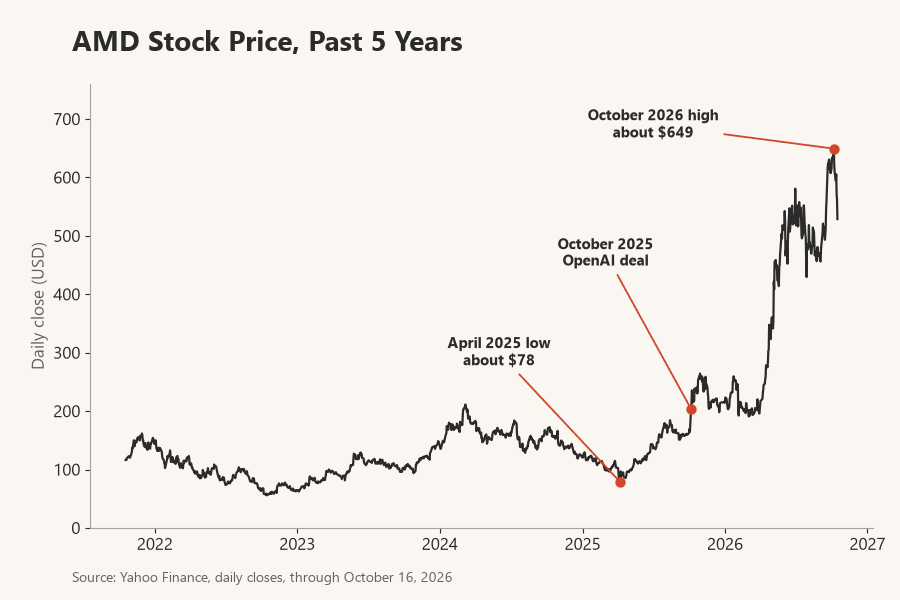
After the OpenAI partnership was announced in October 2025, AMD rose about 43% in three trading days, from about $165 to about $236.
On October 6, 2026, AMD closed at a record of about $649, roughly three times its 2025 year-end close of about $214. Semiconductor stocks then weakened across the board, and by October 16 AMD had closed at about $529, about 19% below the high. By then, the Philadelphia Semiconductor Index (SOX) was about 24% below its June high.
7. How to Invest in AMD Stock
There are three main ways to get exposure to AMD's share price:
| Method | Features | Best suited for |
|---|---|---|
| Buying shares | You own AMD stock directly, bought through a broker on Nasdaq | Long-term holding, a view on the company's growth |
| CFDs | You do not own the shares; profit or loss is settled on price changes, and you can go long or short | Short- to medium-term trading, or selling short in a decline |
| Stock indices (such as NAS100) | Exposure to large tech stocks including AMD; AMD is only a small part of the index (about 3.6% as of August 2026) | Exposure to the tech sector as a whole, less single-company risk |
Titan FX offers CFDs on AMD. The AMD instrument page brings together the live price, chart, technical analysis and an overall signal for each timeframe:
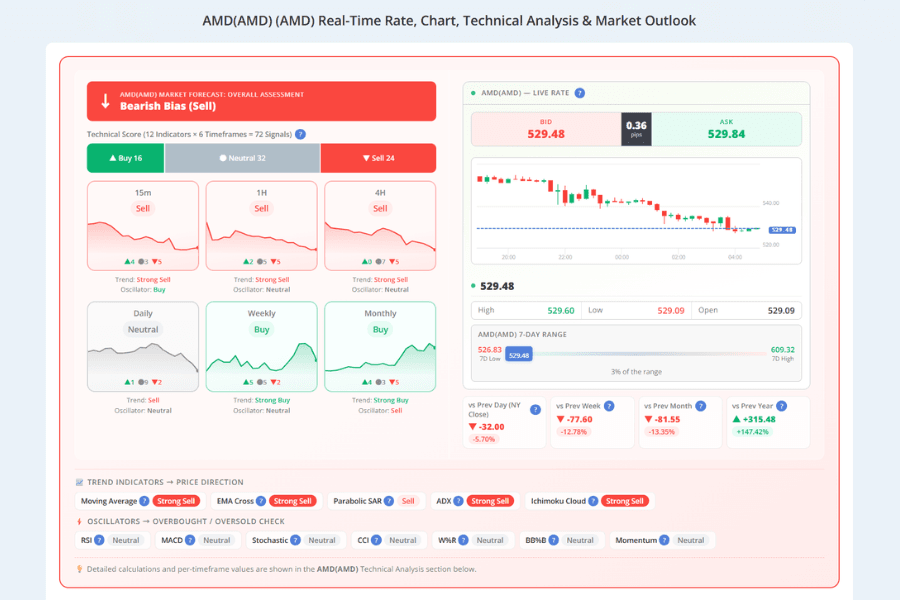
AMD can move more than 5% in a single day, and swings are larger around earnings. Before you trade, check the required margin with the Margin Calculator and size your position accordingly.
8. AMD FAQ
Q1. Who makes AMD's chips?
TSMC makes most of them. AMD has no factories of its own and outsources production of its main chips, including EPYC, Ryzen and Instinct, to TSMC. Its next-generation EPYC is made on TSMC's 2-nanometer process, so TSMC's capacity and pricing affect AMD's shipments and costs.
Q2. Does AMD pay a dividend?
No. AMD does not currently pay a cash dividend. It has mainly returned cash to shareholders through share buybacks. Investors who want dividend income need to look at other tech stocks that pay one.
Q3. When is AMD's next earnings date?
AMD reports every quarter, usually in late January to early February, late April to early May, late July to early August, and late October to early November. Q3 2026 results are scheduled for after the US market close on November 3. For how stocks tend to move around reporting dates, see What Is Earnings Season?
Q4. Is AMD bigger than Nvidia?
No. Nvidia is the larger company and the biggest supplier of AI accelerators. Both are fabless and rely on TSMC, but Nvidia focuses on AI GPUs and its CUDA software, while AMD sells both CPUs and AI accelerators and also supplies complete rack systems.
9. Conclusion
AMD is a fabless chip designer with four businesses, data center, client, gaming and embedded, and it relies mainly on TSMC for manufacturing. Data center is now its largest business, with Q2 2026 revenue up 107% from a year earlier and 58% of the total.
AMD stock is highly sensitive to AI news. AI accelerator shipments, progress on large customer deals, TSMC capacity and export controls are the main things to watch, and the next big event is Q3 earnings on November 3, 2026.
Further Reading
Titan FX Trading Strategy Lab. We produce investor-education content covering forex, commodities (crude oil, precious metals, agricultural goods), stock indices, US equities, and digital assets.
Primary Sources (by Category)
- Company materials: AMD Q2 2026 and Q4 2025 earnings releases and Q3 2026 earnings date announcement; AMD's partnership announcements with OpenAI and Anthropic; announcements on the Xilinx and ZT Systems acquisitions and the sale of ZT Systems' manufacturing business
- Market data: Yahoo Finance (AMD and Philadelphia Semiconductor Index daily closes); Nasdaq (Nasdaq-100 index weights)