

Stock Market Index
If you follow the stock market, you constantly hear that "the market rose" or "the market fell today." A stock market index is what condenses that whole-market movement into a single number.
This article explains the main types of indices, how they are calculated, and how you can invest using them.
- Definition: an index is a weighted statistic of representative stocks measuring the whole market
- Major indices: the three U.S. majors, Nikkei 225, Hang Seng, TAIEX, and CSI 300
- Calculation: price-weighted, market-cap-weighted, and equal-weighted, each with distortions
- Drivers: economic data, rate policy, earnings, geopolitics, and fund sentiment
- How to invest: ETFs, index funds, futures, options, and CFDs
1. What Is a Stock Market Index?
A stock market index is a statistical measure of the overall performance of a stock market.
It is not a tradable stock itself; it is built from a basket of representative listed companies and computed by a weighted average.
Its design goals are:
- Quickly reflect market moves: index swings instantly show investor confidence
- Provide an investment benchmark: funds and ETFs are often compared with it
- Act as an economic barometer: index trends are closely tied to the macroeconomy
Internationally, investors watch the S&P 500, the Dow Jones Industrial Average, and the Hang Seng Index as key references for global market dynamics. Each has a different construction and market representation, covered next.
2. Major Stock Market Indices
There is no single standard; each country or region selects representative companies based on its market. These indices reflect local moves and are also seen worldwide as a sense of investment direction.
| Country / Region | Index | Traits and representation |
|---|---|---|
| U.S. | Dow Jones Industrial Average (DJIA) | 30 large blue chips; the oldest, best-known U.S. gauge |
| U.S. | S&P 500 Index | 500 largest-cap firms; broadly represents U.S. equities |
| U.S. | NASDAQ Composite | Tech-heavy, innovation and high growth, higher volatility |
| Taiwan | TAIEX | All TWSE-listed stocks; Taiwan's core market gauge |
| Hong Kong | Hang Seng Index (HSI) | Tracks 50 large blue chips; represents Hong Kong's mainstream |
| Japan | Nikkei 225 | 225 major Japanese firms; frequent in global coverage |
| China | CSI 300 | 300 largest, most-liquid Shanghai and Shenzhen stocks |
Regionally, the three U.S. majors, the Nikkei 225, and the Hang Seng are the "market proxies" global investors track most. Their swings move not just local markets but global capital flows.
3. How Indices Are Calculated
Methods differ by provider, but all aim to measure overall market performance. The common methods are price-weighted, market-cap-weighted, and equal-weighted.
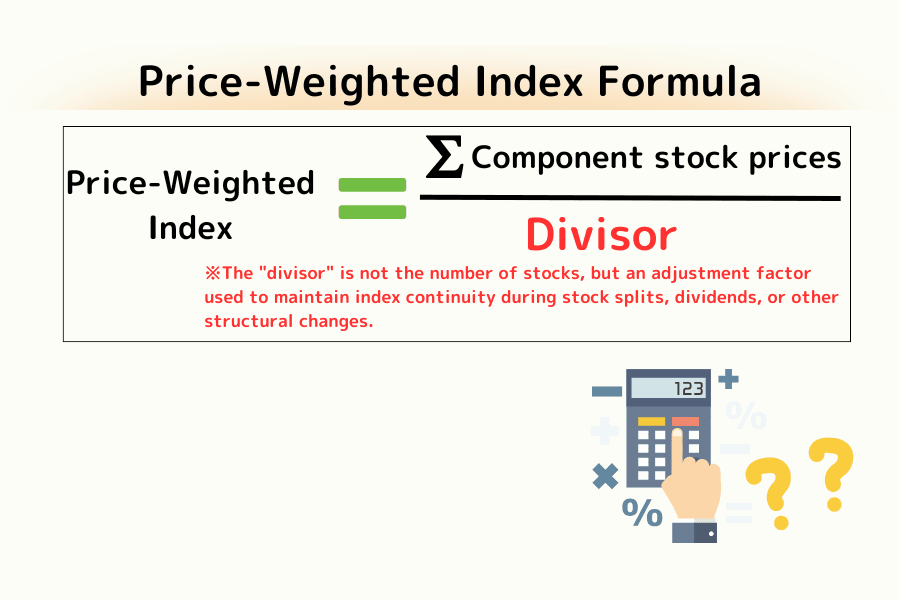
Type 1: Price-weighted index
- Examples: DJIA, Nikkei 225
- Method: sum component prices, divide by a "divisor" that changes with splits and composition
- Pros: simple, long history, quickly reflects high-priced stocks
- Cons: a few high-priced stocks can distort it; unrelated to market cap
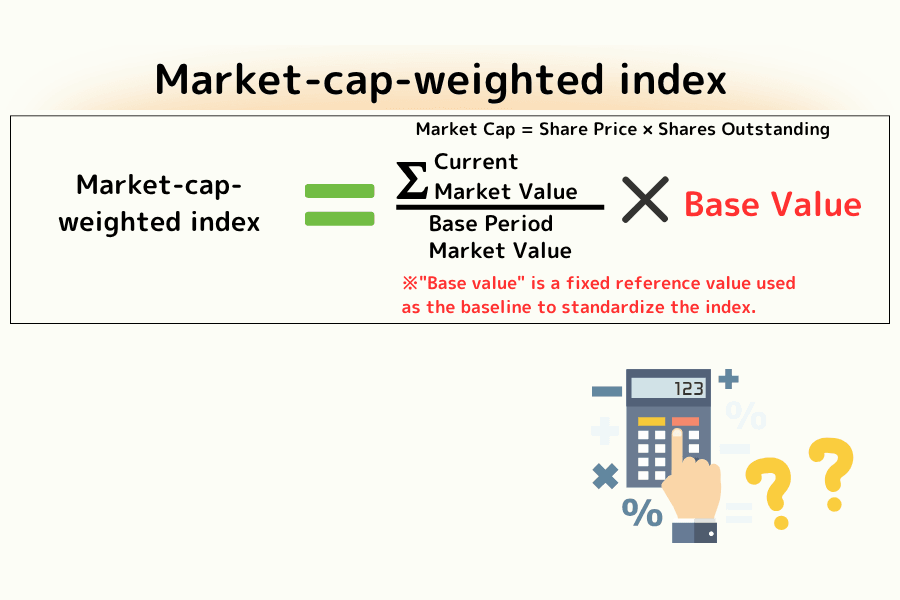
Type 2: Market-cap-weighted index
- Examples: S&P 500, TAIEX, CSI 300
- Method: weight by market cap; larger cap, higher weight
- Pros: faithfully reflects mainstream capital distribution; the most common method today
- Cons: a few mega-caps (Apple, TSMC) can dominate and distort
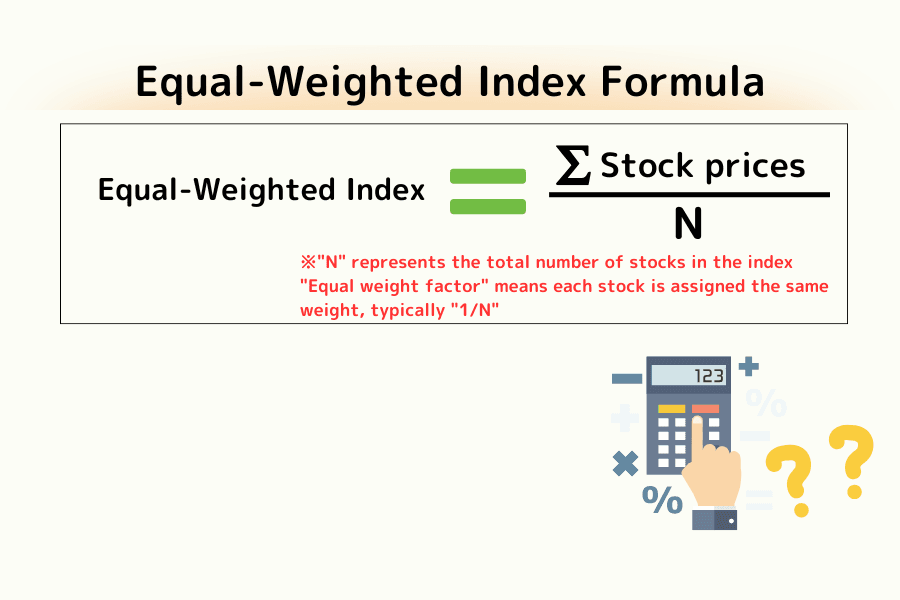
Type 3: Equal-weighted index
- Examples: S&P 500 Equal Weight Index
- Method: all components carry the same weight, regardless of cap
- Pros: avoids domination by a few large firms; reflects mid- and small-caps evenly
- Cons: needs periodic rebalancing and can diverge from real capital flows
4. What Moves a Stock Market Index
Index moves reflect not only trading results but several external forces.
Driver 1: Economic data
GDP, CPI, and unemployment shape expectations. Sustained GDP growth lifts confidence and the index; high inflation (rising CPI) can raise rate-hike fears and pressure prices.
Driver 2: Rates and monetary policy
Central-bank monetary policy directly affects funding costs. Hikes raise corporate financing costs and dampen investment, pressuring stocks; cuts add liquidity and the index tends to rise.
Driver 3: Earnings and industry dynamics
Indices are swayed by the largest-cap firms (Apple, Microsoft in the U.S.; TSMC in Taiwan). Beats lift related sectors and the index; misses drag the whole market.
Driver 4: International political and economic events
Geopolitical risk, trade friction, public-health events, and major policy shifts can trigger panic or optimism. In 2020, COVID drove major indices sharply lower, then stimulus sparked a fast rebound.
Driver 5: Capital flows and investor sentiment
Beyond fundamentals, capital flows and psychology matter. Heavy foreign buying supports the index; panic selling can accelerate short-term declines.
5. Uses and Significance
A stock market index is more than a news number; it plays a key role in investing and economic research.
Use 1: Market thermometer
Swings quickly reflect mood and flows. Up means stronger confidence; down may signal weaker economic or corporate prospects.
Use 2: Investment benchmark
Funds and ETFs often benchmark against an index — Taiwan funds against the TAIEX, U.S. funds against the S&P 500.
Use 3: Economic gauge
Long-term trends reflect economic health: sustained gains suggest improving profits and optimism; prolonged weakness can signal recession risk.
Use 4: Basis for product design
Many derivatives use an index as the underlying — ETFs, futures, and options. Taiwan's index futures are built on the TAIEX.
Use 5: Allocation reference
Investors judge entries, exits, and rebalancing by index trends; some scale in during large drops for long-term positioning.
6. Ways to Invest in an Index
You do not need to buy every component; you can join the market through different instruments.
| Type | ETF | Index fund | Futures | Options | CFD |
|---|---|---|---|---|---|
| Example | SPY (tracks S&P 500) | S&P 500 index fund | Index futures | S&P 500 index options | Index CFDs on broker platforms |
| Traits | Exchange-listed, low-cost tracking | Passive, fund creates/redeems | Leveraged, amplify or hedge | Right to buy or sell | Contract traded on price difference |
| Pros | High liquidity, diversified | Good for regular investing | Capital-efficient, long/short | Hedge, leverage small size | Leverage, two-way, low barrier |
| Risks | Still moves with the market | Higher fees, lower liquidity | High leverage risk | High premium, complex | Mind leverage; rules vary by region |
| Suited to | Long-term investors | Regular-saving investors | Experienced traders | Advanced traders | Short-term, flexible traders |
7. Frequently Asked Questions (FAQ)
Q1. If the market rises, does every stock rise?
Not necessarily. The index is the overall trend; individual stocks still depend on fundamentals. Indices have lower volatility through diversification, while single stocks move more on one company's earnings or news.
Q2. Does a falling index mean the economy is bad?
Not entirely. Short-term moves can come from sentiment or international events; judge alongside GDP, CPI, and unemployment.
Q3. Which index should a beginner watch?
Watch highly representative ones — the S&P 500 (U.S.), Nikkei 225, and Hang Seng — to grasp market direction quickly.
Q4. Is investing in an index ETF risky?
Yes. ETFs are diversified and less volatile than single stocks, but they still rise and fall with the market, so consider your own risk tolerance.
Q5. How do a stock market index and an index ETF relate?
The index is the calculation basis; an index ETF (e.g. SPY) tracks its performance, letting you join the whole market without buying every component. To participate with leverage or two-way, an index CFD is also an option. ETFs still have tracking error and fees, so they will not match the index exactly.
8. Stock Index Trading with Titan FX
Beyond traditional ETFs, funds, and futures, investors can also join the market through the various stock-index CFDs (contracts for difference) offered by Titan FX.
Titan FX offers major international indices including the three U.S. majors, the Nikkei 225, and the Hang Seng, with:
- High leverage: improves capital efficiency
- Two-way trading: find opportunities whether the market rises or falls
- Free tools and learning resources: research, indicators, and platform tutorials to support strategy and judgement
For investors who want flexible operation and to capture global equity-market opportunities, Titan FX is an effective choice for stock-index trading.
9. Conclusion
A stock market index is an indispensable basic tool in equity investing.
It quickly reflects the overall market trend, provides a benchmark for performance, and serves as an important gauge of economic conditions.
For beginners, understanding indices helps avoid fixating on single stocks while missing the bigger picture.
Investors can join market performance through ETFs, index funds, futures, options, and CFDs, choosing the right tool for their own risk tolerance.
Further Reading
- What Is a Price-Weighted Index?
- What Is a Market-Cap-Weighted Index?
- What Is an Equal-Weighted Index?
- What Is a CFD?
- What Is GDP?
Titan FX Research Hub — investor education across foreign exchange, commodities (oil, precious metals, agriculture), stock indices, U.S. equities, and crypto assets.
Primary Sources (by category)
- Index construction and methodology: public methodologies of index providers (general concepts for DJIA / S&P 500 / Nikkei 225 / TAIEX / HSI / CSI 300)
- Market and economic indicators: general public statistical concepts of GDP / CPI / unemployment
- Investment products: general public knowledge on ETFs, index futures, and CFDs; Titan FX platform public information