

BOE (Bank of England)

The Bank of England (BOE) is one of the most important price drivers for the British pound (GBP). Its rate decisions, policy tone, and economic forecasts often steer short-term swings and medium-term direction in the FX market. Whether you are starting out or already an advanced trader, if you touch any GBP-related product, understanding the BOE's policy framework and announcements is core to your strategy.
This article walks through, in plain language, what the BOE is, how its policy moves GBP, the announcements the market watches most, and how to trade GBP on Titan FX through a range of GBP-linked products.
- Position: The BOE is the UK's central bank (founded 1694), institutionally independent, focused on monetary policy and financial stability
- Four functions: setting monetary policy (2% inflation target), maintaining financial stability, managing payment systems, and issuing the pound while overseeing money supply
- Policy mechanism: the Monetary Policy Committee (MPC) — nine members voting roughly every six weeks on Bank Rate and the pace of QE / QT
- Three GBP drivers: rate direction, policy tone (hawkish / dovish), and CPI, wage, and labour data
- Key publications: rate decisions, the quarterly Monetary Policy Report, MPC minutes, and official speeches — each can move GBP
1. What Is the Bank of England (BOE)?
The Bank of England (BOE) is the UK's central bank, responsible for price stability, monetary policy, and oversight of the financial system. It is one of the most influential central banks in the world.
Because the UK financial market is large and London is a global financial hub, BOE policy affects not only the domestic economy but also international capital flows — and it shows up directly in the British pound (GBP).
The BOE is institutionally independent from the UK government: the government sets fiscal policy, while the BOE focuses on monetary policy and financial stability. This division supports a high level of credibility and transparency in policy decisions and helps shield rate decisions from political pressure, so that policy direction reflects economic fundamentals more cleanly.
For FX traders, the BOE matters in a special way. It is the core driver of pound moves over the short to medium term — rate moves, policy tone, and economic forecasts can each trigger large swings in GBP. Understanding the BOE's position and remit is essential before stepping into any GBP-related market.
2. The BOE's Main Functions
The BOE's core mandate looks similar to other major central banks, but the UK's outsized financial sector and tight linkage to global markets make its policy reach broader in practice. The BOE's functions can be grouped into four areas: setting monetary policy, maintaining financial stability, managing the currency and payment system, and issuing the pound and overseeing money supply. Each affects GBP directly or indirectly.
Function 1: Setting monetary policy
The BOE's primary mandate is to use monetary policy to keep inflation near 2%, supporting the UK economy on a sound footing.
If price pressure rises, the BOE may lean toward tightening; if the economy weakens or demand cools, policy may move toward easing.
GBP is highly sensitive to rate direction and policy tone, so each BOE decision — both the move and the wording — often becomes the starting point of a fresh move in GBP.
Function 2: Maintaining financial stability
As one of the world's leading financial centres, the UK has large institutions with deep international linkages, which makes the BOE's role in financial stability especially important.
The BOE monitors bank capital adequacy, assesses market stress, and provides liquidity when needed to avoid systemic risk. Financial-stability moves often show up quickly in market sentiment and GBP performance.
Function 3: Managing the currency and payment system
The BOE runs the UK's main payment and settlement systems, including CHAPS for high-value payments, letting funds flow smoothly between banks and institutions and maintaining the operational efficiency of financial markets.
The stability of the payment system is one of the pillars of London's status as a financial centre, and it underpins traders' ability to deal and settle in a low-risk environment.
Function 4: Issuing the pound and overseeing money supply
The BOE is the sole issuer of the British pound and manages money supply in line with the needs of the economy. As one of the world's main reserve and trading currencies, GBP's stability and international credibility owe much to the BOE's institutional design and long-term policy discipline.
Together, these four functions shape the BOE's influence in global markets and form the basic framework FX traders need when analysing GBP.
3. How the BOE Sets Policy and How Policy Moves GBP
The BOE's monetary policy is run by the Monetary Policy Committee (MPC), a nine-member body that votes on rates and policy direction.
Because every member's vote is published, the market can see the distribution of views clearly. As a result, GBP is particularly sensitive to MPC voting outcomes and tone shifts, and it often moves sharply right at the moment of the decision.
Mechanism: how the policy rate is set and transmitted
The MPC meets roughly every six weeks to discuss Bank Rate, the pace of QE or QT, and the inflation outlook. Once decisions are made, they affect the economy and GBP through a chain of transmission. The flow has three stages:
- ①Policy adjustment: based on the economy and inflation, the MPC decides whether to change Bank Rate or balance-sheet size, setting a new direction.
- ②Transmission through financial markets: the move affects bank funding costs and market rates, lifting or lowering corporate, mortgage, and consumer credit costs.
- ③Real-economy response: tighter or easier financial conditions gradually feed through to investment, consumption, and overall demand, eventually affecting inflation and growth.
The effect on the real economy takes time, but FX prices move in advance on expectations. So pound moves often start showing direction well before the rate decision itself.
Impact: how rate expectations move GBP
GBP is heavily influenced by policy expectations. When the market sees a BOE hike — or a longer high-rate environment — GBP tends to strengthen. When the market starts pricing in a slower pace of tightening or future cuts, GBP weakens.
Because the UK economy is closely linked to the U.S. and Europe, the policy direction of the Fed or the ECB can shift expectations for the BOE, and GBP often reacts in sympathy.
Data: indicators the BOE watches most closely
The BOE relies heavily on economic data and takes a "data-dependent" approach. The most influential indicators include:
Inflation (CPI)
The UK has long faced strong price pressure, so CPI is the BOE's most important reference point. Persistently high CPI generally argues for tighter policy; cooling prices give room to slow or pivot.
Wage growth
Wages are a key driver of inflation. When UK wage growth accelerates, the BOE tends to be more cautious about inflation re-acceleration, nudging policy tone hawkish.
Labour-market conditions
A rising unemployment rate or slower hiring signals cooling demand and can pull the BOE toward easier policy; strong employment leans the other way.
The BOE's policy judgment relies on multiple data sources, so traders watching GBP need to track the same data. Titan FX's global economic indicator calendar covers many countries and regions, with the major UK series (GDP, CPI, employment, central-bank-related data) all easy to look up — useful for tracking the key inputs that drive GBP.
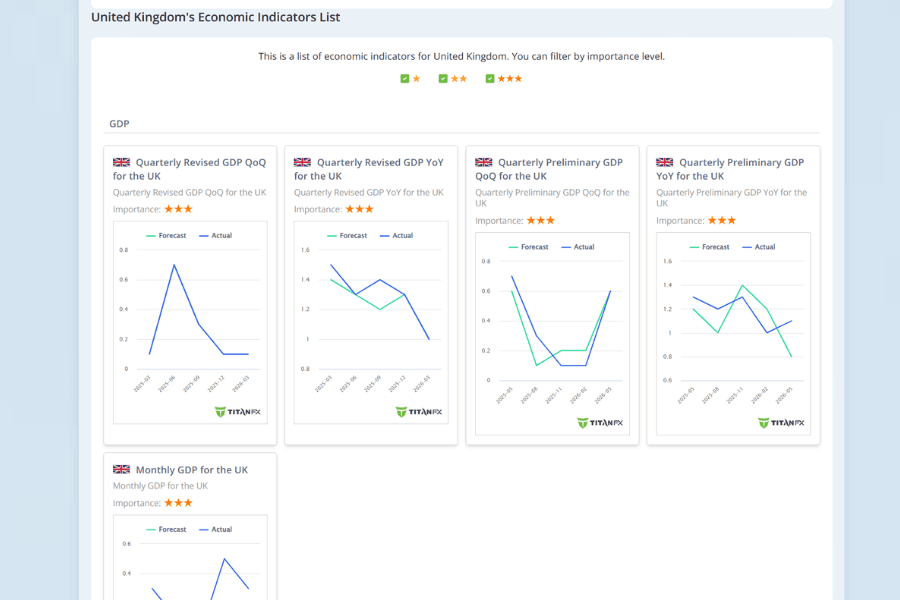
View the UK economic-indicator list
Market read: how policy tone moves GBP
Policy tone is often a defining factor in GBP's short-term moves.
Central banks signal stance through wording — "stronger action may be needed" is typically read as a hawkish hint, while "risks are tilted to the downside" is often read as dovish.
GBP reacts to these signals quickly, so when reading BOE announcements, traders should look not only at the result but also at whether the tone has pivoted.
By understanding how policy is made and how the market reads it, traders can more systematically grasp GBP's rhythm across the BOE policy cycle and translate that understanding into actual strategy.
4. Key BOE Publications and Meetings: Contents and Uses
The BOE communicates policy direction and economic views through several types of publication. These not only reveal the reasoning behind decisions but also act as the main triggers for GBP moves. Knowing the purpose of each helps traders read the market more effectively before and after events.
Rate decision (Monetary Policy Summary)
Every six weeks or so, the BOE publishes a rate decision covering Bank Rate, the vote breakdown, and the rationale, with a brief overview of inflation and the economy. Because the voting structure is disclosed, the market can immediately see how aligned (or split) members are, and GBP tends to move on both the result and the tone.
On Titan FX's economic-indicators page, traders can directly check the BOE's latest policy rate, forecast, and actual print, alongside history charts and reaction data — useful for reading GBP more fully.
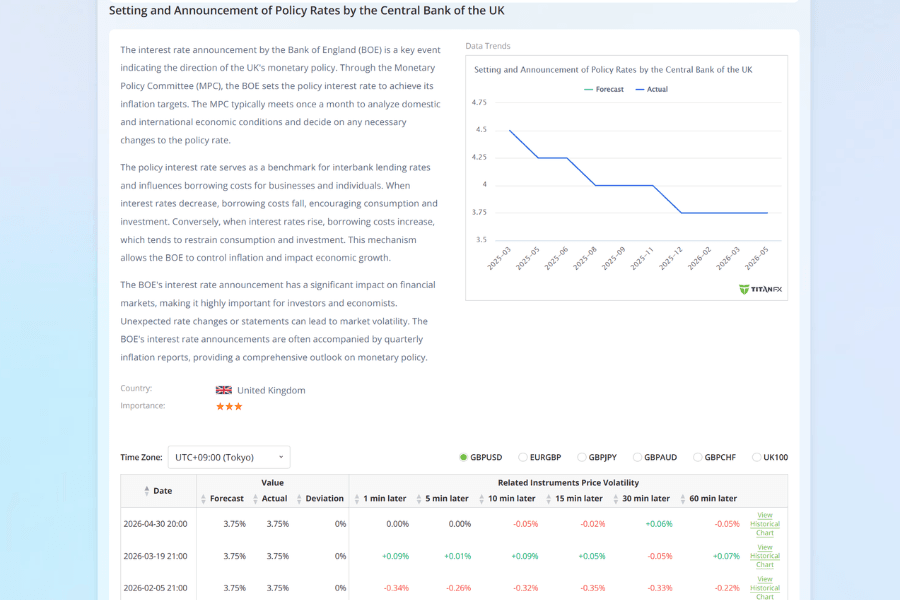
See the latest BOE policy rate
Monetary Policy Report (MPR)
The MPR is the BOE's flagship quarterly document, broader in scope than the rate decision: it covers the medium-term inflation forecast, growth outlook, and key risk scenarios. It is one of the market's main references for reading the future policy path; meaningful revisions tend to affect GBP's medium-term performance.
Minutes
The minutes are published with the rate decision and detail the discussion and individual views of MPC members. Widening voting splits or shifts in members' assessment of risk are often read as early signs of a policy pivot, and GBP can adjust further on changes in tone within the minutes.
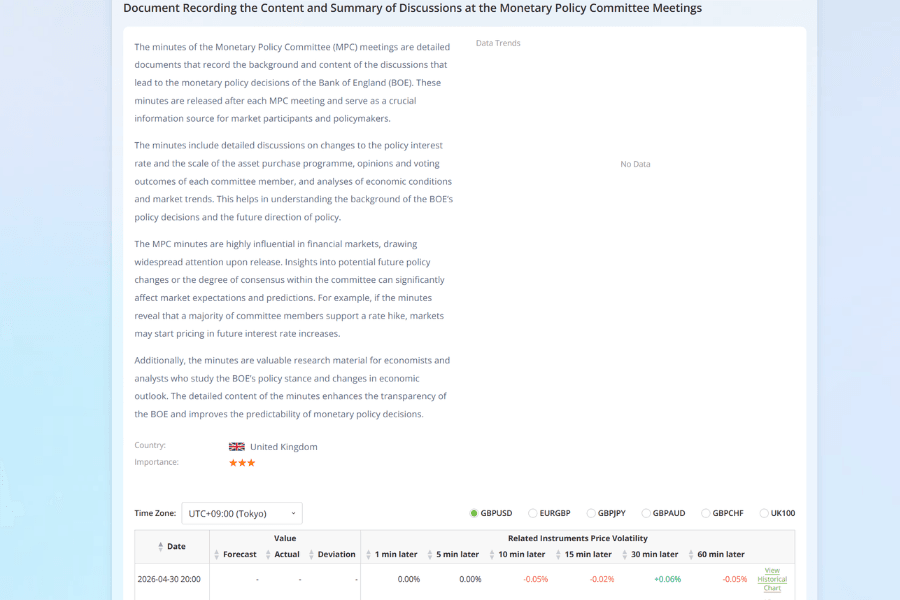
See the latest BOE MPC minutes
BOE speeches
Public speeches by the Governor and other MPC members do not follow a fixed schedule but are closely watched. References to the inflation outlook, the peak in rates, or financial risks are often treated as supplementary signals on policy direction. Because GBP is sensitive to tone, even a single phrase change can drive a short-term move.
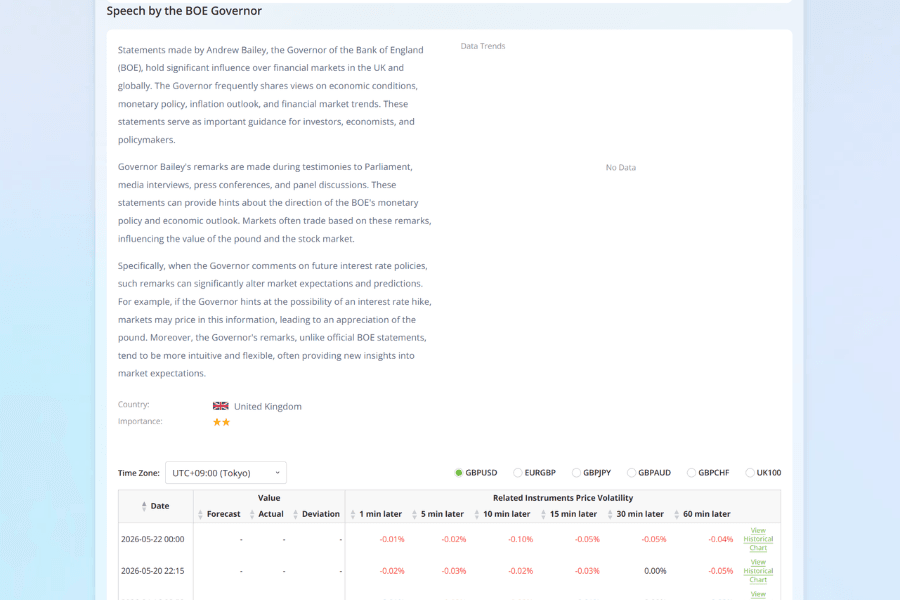
See the latest BOE Governor Bailey speeches
How to read BOE announcements
To make effective use of BOE announcements, several angles help:
① Judge whether the result matched expectations
Expectations are priced in ahead of time, so a meaningful miss in either direction typically drives a larger GBP move.
② Watch for shifts in tone and description
The BOE's wording often carries policy hints — a stronger or softer tone can outweigh the rate result itself.
③ Compare content with the previous release
Revisions to inflation, growth, or risk views suggest the policy direction may be turning.
④ Observe the first market reaction after the release
If GBP breaks key levels cleanly or reverses fast, that usually reflects a converging market interpretation.
⑤ Confirm with technical analysis
BOE releases give the fundamental direction; technical analysis helps with entry and risk levels, lending consistency and discipline to the strategy.
By understanding the purpose of each release and how the market reads it, traders can analyse GBP's behaviour across the policy cycle more systematically and trade events with more conviction.
5. Trading GBP on Titan FX: Products and Process
Products: GBP markets supported by Titan FX
The pound is one of the world's main traded currencies, with high liquidity and clear volatility — well-suited to a range of strategies. Titan FX offers a variety of GBP-related products, covering major pairs, crosses, and commodity-linked contracts so traders can choose the market direction that fits their strategy.
| Category | Products |
|---|---|
| Major GBP pairs | GBPUSD / GBPJPY / GBPAUD |
| Crosses | GBPCAD / GBPCHF / GBPNZD / GBPSGD / GBPTRY / GBPNOK / GBPSEK |
| Inverse GBP pair | EURGBP |
| Commodity-linked | XAUGBP (gold) |
▸View live quotes for all products
Process: how to start trading GBP on Titan FX
If you want to trade GBP on Titan FX, the following flow helps you complete onboarding, funding, and getting ready to trade.
| Stage | Description |
|---|---|
| Step 1: Open an account | Go to the Titan FX onboarding page, enter an email and password to register. After verification, your account is active. |
| Step 2: Fund your account | Log in to the client portal, choose a funding method (credit card, e-wallet, bank transfer, etc.), and follow the prompts. |
| Step 3: Download the platform | Titan FX offers MT4 and MT5, available on Windows, Mac, iOS, and Android. |
| Step 4: Place trades | Titan FX offers multiple GBP-related products; pick a symbol such as GBP/USD and go long or short. |
Strategy note: risk management around events
GBP often moves sharply around policy events, data prints, and official speeches, so adjusting size and leverage during these windows is key.
Before a rate decision, it is usually wise to reduce leverage and position size to avoid excessive exposure to sudden moves.
After a release, use technical charts to assess the initial direction before entering, rather than chasing the headline.
Sound risk management also includes setting clear stops, avoiding overtrading during high volatility, and watching for fake breakouts, gaps, and slippage. Event-driven moves in GBP tend to be fast, and discipline plus risk control are the core of consistency.
6. Frequently Asked Questions (FAQ)
Q1. How do BOE meetings differ from Fed and ECB meetings?
The three central banks differ mainly in three ways: (1) meeting frequency (BOE roughly every six weeks; Fed every six to eight weeks; ECB every six weeks); (2) vote disclosure (BOE and Fed publish individual votes, ECB tends to present a consensus); (3) inflation target (all three target 2%, though the framing differs in detail). For traders, the BOE's vote-by-vote disclosure lets the market parse member stance shifts more finely.
Q2. Is a BOE rate hike always positive for the pound?
Not always. In theory a rate hike attracts capital inflow and supports GBP, but if the BOE simultaneously cuts its growth forecast or signals that this is the "peak rate," the market may start pricing in a future cutting path. That can produce a "hike but fall" reaction in GBP. Read policy together with tone and the outlook.
Q3. Does the BOE's quantitative tightening (QT) matter much for GBP?
It does — but typically more mildly than rate decisions. QT tightens financial conditions by reducing the BOE's gilt holdings, lifting yields and potentially supporting GBP. But because the QT pace is announced in advance and phased, the market reaction is more diffused than for a rate decision. Notably, the BOE is one of the few central banks that explicitly conducts "active gilt sales," which carries a stronger tightening signal than the "let-mature, don't reinvest" approach used elsewhere.
Q4. Has Brexit changed BOE policy independence?
Institutionally, no. Since gaining operational independence over rates in 1997, the BOE has kept the same division of labour: the Treasury sets the inflation target, the BOE chooses how to deliver it. What Brexit changed is the economic environment the BOE faces (supply-chain frictions, labour-market structural shifts), not the policy framework itself.
Q5. How can I judge the BOE's next move ahead of an event?
Four signals are useful: (1) the vote distribution in the previous minutes (how many lean to hike or cut), (2) recent tone shifts in BOE speeches (especially senior members such as Bailey and Pill), (3) the rate path implied by UK OIS (Overnight Index Swap) markets, and (4) how far major data (CPI, wages, employment) is from the BOE's own forecasts. Combining the four usually gives a more accurate read than any single indicator.
7. Conclusion
Any change in the BOE's rates, policy tone, or forecasts can directly affect the direction of the British pound. Traders who understand the policy logic and track the core data tend to catch shifts in market sentiment faster than those who rely on price alone.
A practical workflow: mark the MPC meeting and Monetary Policy Report dates on your calendar, keep an eye on inflation, wages, and employment, and watch whether each announcement's tone pivots. After the release, use technical analysis to confirm entry and risk levels, and combine Titan FX's GBP products and multi-timeframe charts into a disciplined fundamental-plus-technical strategy.
With steady practice, you will read GBP's reaction in different policy phases more clearly and gradually build a GBP trading rhythm that fits you.
Further Reading
- Central Bank Overview
- What Is Monetary Policy?
- What Is the British Pound (GBP)?
- What Does Central-Bank Hawkish / Dovish Mean?
- What Is a CFD?
Titan FX Research Hub — investor education across foreign exchange (FX), commodities (oil, precious metals, agriculture), stock indices, U.S. equities, and crypto assets.
Primary Sources (by category)
- UK central-bank official sources: Bank of England, BOE — Monetary Policy, BOE — Statistics
- UK economic and inflation data: Office for National Statistics (ONS), HM Treasury
- Academic and central-bank basics: general public knowledge on inflation targeting and monetary-policy transmission