
 Home
Home- Investment Guide: Strategies for Stocks, Forex, and Metals
- Copy Trading: How It Works, Pros, Cons, and Risk Control
Copy Trading: How It Works, Pros & Cons, and Risk Management
Copy trading is a way of trading that links your account to a signal provider (a lead trader) and automatically mirrors their buys and sells, so without watching the charts yourself you enter and exit in proportion to their orders. It is often seen as a way for beginners to take part in the market, or a time-saver for busy investors.
The appeal of copy trading is swapping "making your own decisions" for "copying someone else's": you pick a provider whose past record looks good, and the system copies each of their entries and exits into your account at a set ratio. It sounds like outsourcing the trading — but the biggest misconception about copy trading is mistaking "saving time" for "lowering risk." What you save is screen time; you don't save the risk, and the provider's profits, losses, and weaknesses are still borne by you.
This article explains what copy trading is and its core idea, how it works, the differences between copy, mirror, and social trading, its advantages and the risks most often overlooked, and the practical steps for choosing a provider and managing your capital — so you can see both sides before you start.
- Copy trading links your account to a lead trader and copies their orders proportionally and automatically; the decisions are outsourced, but the risk is still yours.
- Common forms include copy trading, mirror trading, social trading, and manager-run MAM/PAMM accounts — the mechanics and where responsibility sits differ in each.
- Its strengths are saving time, a low barrier to entry, the chance to observe and learn, and easy diversification across providers; its risks are that past performance doesn't predict the future, hidden deep drawdowns, excessive leverage, and blind following.
- When picking a provider, look beyond the return — at the maximum drawdown, the length of the track record, and the trading style (avoid stop-less Martingale/add-to-loser types) — and only commit risk capital you can afford to lose.
- Copy trading saves you the screen time, not the judgment — understand what the provider is doing and keep capital and risk control in your own hands, and copying can be done safely.
1. What Is Copy Trading? The Core Idea
At its heart, copy trading ties your account to another trader (the signal provider, or lead trader): when they open or close a position, the system makes the same move in your account at a set ratio. You don't have to analyze the market or decide entries and exits yourself — your account moves along with the provider.
It is not quite the same as "handing your money to someone to manage": copy trading copies the provider's trade orders, and the funds mostly stay in your own account under your control — the provider can't withdraw your money; managed trading, by contrast, hands the capital to a manager to operate directly. The two differ in who controls the funds and where responsibility lies, but they share one thing — the final profit, loss, and blow-out risk are all borne by you.
One idea to fix in your mind: copy trading outsources the "operation," not the "risk." A provider making money in the past does not guarantee they will keep doing so; when you copy their strategy, you also copy every weakness that comes with it. Grasp this, and you'll view the advantages and risks below with the right mindset.

2. How Copy Trading Works
In practice, copy trading usually runs through a trading platform or a dedicated social-copy platform that turns "the provider's signals" into "orders in your account." For example, the built-in "Signals" feature in MT4/MT5, or various copy-trading apps, let you copy — as a Copier — the trades of a Mentor (the lead trader) into your own account. The flow looks roughly like this:
| Step | What happens |
|---|---|
| ① Choose a provider | Pick a signal provider from the platform's leaderboard, weighing their performance, drawdown, and trading style. |
| ② Set the copy ratio | Decide how much capital to allocate and whether to copy by fixed lots or by equity ratio — the higher the ratio, the bigger the swings and risk. |
| ③ Auto-sync orders | When the provider opens or closes, your account copies the same direction in real time, per your settings. |
| ④ Fees and profit share | Some services charge a subscription or take a share of profits; these costs eat into your real returns. |
Note that copying is never 100% identical: because entry timing, network latency, spread, slippage, market liquidity, and account size all differ, your fill price and actual P/L can drift from the provider's, and the gap widens as it accumulates over time.
3. Common Forms of Copy Trading
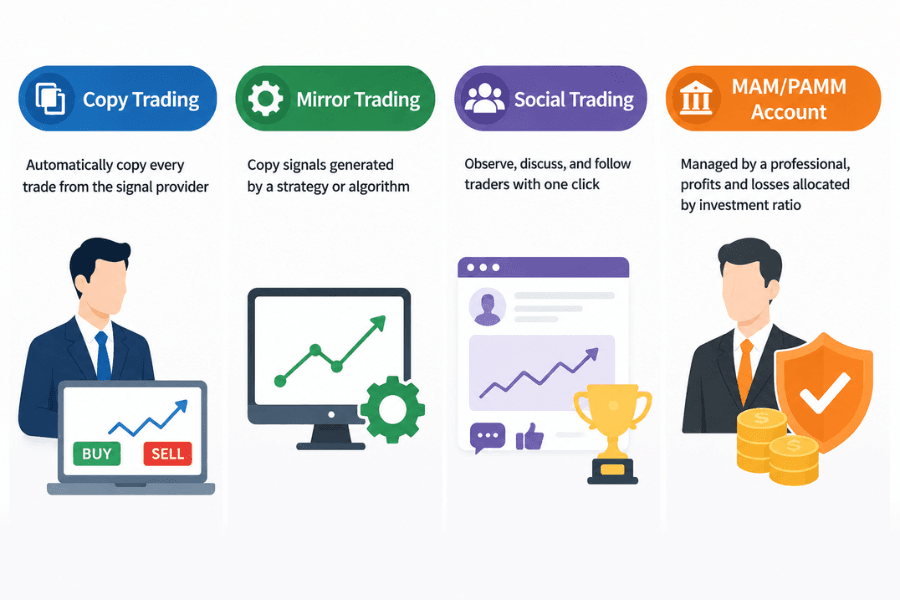
"Copy trading" is an umbrella term covering several mechanically different forms:
| Form | How it works | Key point |
|---|---|---|
| Copy Trading | Copies each of a provider's actual trades, proportionally | Most common; funds stay in your account, trades are mirrored |
| Mirror Trading | Copies signals sent by a strategy or algorithm | You follow the strategy itself, not a specific person |
| Social Trading | Observe, discuss, and follow others on a community platform | Adds community and leaderboards; still copying at its core |
| MAM/PAMM Account | A manager trades; investors share P/L by their contribution | Closer to managed accounts; the arrangement depends on the platform and contract |
The first three share a common trait: your funds mostly stay in your own name and you can stop copying at any time. MAM/PAMM, where a manager runs the trading and allocates results by each investor's contribution, differs in its funding arrangement and mechanics — check the platform's rules and the contract, since responsibility and control sit differently from the others.
4. The Advantages of Copy Trading
- Saves time, no screen-watching: hand the analysis and order entry to the provider — good for people without the time, or the skills yet, to take part in the market.
- Low barrier to entry: you don't need to master a whole toolkit of technical or fundamental analysis first; set it up and you can start copying.
- A chance to observe and learn: watching where the provider enters and exits and how they manage positions is one way for beginners to build a feel for the market — though understanding their trading logic is worth more than simply copying the outcome.
- Easy to diversify: you can follow several providers with different styles at once, spreading capital across strategies and reducing the risk of betting on one person.
These advantages assume you picked the right provider and set a risk cap. Otherwise "saving time" can easily become "skipping the judgment and doubling the losses."
5. The Risks of Copy Trading
Another common myth is treating "a pretty track record from the past" as "a guarantee for the future." The points below are the most common risks — and the easiest to hide behind a leaderboard's high headline returns:
- Past performance doesn't predict the future: a leaderboard shows returns that have already happened; the provider's strategy may just have caught a tailwind, and can fail once the market shifts.
- Hidden deep drawdowns: two accounts that both "doubled" can be worlds apart in risk — one with a 20% max drawdown, one that was once down 70%. Looking only at return and not maximum drawdown makes it easy to follow an account that could blow out at any time.
- Dangerous strategies dressed up as steady gains: some providers use Martingale, adding to losers, and no stops to "manufacture" a smooth run of gains — the curve looks stable until one move wipes the whole account out at once.
- Leverage and capital mismatch: if the provider uses small leverage but you copy at a high ratio, or your capital is too thin, a normal drawdown can hit your loss cut first.
- Black swans and blind following: in a black swan event, the copied positions take the same hit; and "blind copying" without understanding what the provider does leaves you unsure whether to cut when you should.
- Cost erosion: subscription fees, profit shares, spread, and slippage all pull your real return below the provider's headline number.
6. How to Choose a Provider and Manage Risk
Whether copying is safe comes down to two things: picking the right person and managing yourself. In practice, run through these checks:
- Look at drawdown, not just return: prioritize the ratio of maximum drawdown to return — an account with modest returns but a small drawdown is often more worth following than a flashy-return, deep-drawdown one.
- Insist on a long-enough track record: an account that has run for at least several months, ideally through a choppy or corrective stretch, shows more of its true ability; a few weeks of high returns is of limited value.
- Understand the trading style: know whether they mostly trade with the trend or ranges, and whether they use a stop loss — and avoid the type that props up returns by adding to losers.
- Start small and diversify: begin with risk capital you can afford, and follow several providers of different styles rather than putting everything on one person.
- Set your own risk cap: pair it with money management like the 2% rule and set an acceptable maximum loss for the whole account.
- Decide in advance when to stop copying: rather than reacting on the fly, set exit conditions ahead of time — for example, when the account's drawdown exceeds your limit, the provider's style clearly changes, or they start propping up returns with high-risk add-ons (averaging down, Martingale) — and stop copying decisively.
- Choose a safe trading environment: prefer a regulated platform with negative-balance protection (Zero Cut) and segregated client funds, so an extreme move at worst won't leave you owing money. Take Titan FX, for example: on top of those protections, it offers its own social copy-trading platform Titan FX Social (powered by Pelican Trading, binds directly to your Titan FX account, and lets you follow as a Copier or share as a Mentor), letting you copy-trade within a regulated environment.
7. Copy Trading FAQ
Q1: Is copy trading suitable for beginners?
To a degree, yes — but with the right expectations. It lets people who can't read charts take part and learn as they go, and the barrier really is low. But "low barrier" doesn't mean "low risk" — the mistake beginners make most is following purely on a leaderboard return, without checking the drawdown or understanding what the provider does. Treating it as a tool for learning and diversifying, and starting with small capital, is healthier than treating it as a sure-thing shortcut.
Q2: Can copy trading guarantee steady profits?
No. No copy service can guarantee gains; the high returns on a leaderboard are results that have already happened, not a promise for the future. A provider can draw down sharply because the market shifts, their strategy stops working, or a black swan hits, and your copied positions take the same damage. When you see "guaranteed profit" or "never loses" marketing, be more wary, not less.
Q3: When I copy, is my money handed to the provider?
Under most copy-trading and social-trading models, no — the funds stay in an account in your own name, and the provider only has their trades copied over; they can't withdraw your money. But MAM/PAMM, where a manager runs the trading and funds are often pooled, is different, with different responsibility and control — always check the contract and regulatory status before joining.
Q4: Is it OK to pick a provider on return alone?
Not advisable. Choosing on return alone makes it easiest to follow a "great return, extreme risk" account. What matters more is the maximum drawdown, how long the performance has lasted, and whether the provider's style uses a stop loss. Two accounts that both doubled — one with a 20% drawdown, one with 70% — are entirely different risk classes.
Q5: What fees does copy trading involve?
It depends on the service. Common ones are a subscription (a fixed monthly fee) and a profit share (a cut of gains), on top of the spread and slippage of the trades themselves. These costs pull your real return below the provider's headline number, so factor them in when you choose.
Q6: Can I follow many providers at once?
Yes — sensible diversification is actually a good way to lower risk: spreading capital across several providers of different styles avoids being badly hurt when one strategy fails. But don't over-diversify beyond what you can manage, and still review each provider's performance and drawdown regularly.
Q7: How much capital does copy trading need?
There's no fixed amount; what matters is the "risk ratio," not the absolute number. Three principles: only put in money you can afford to lose and that won't affect your life; keep enough buffer so a normal drawdown by the provider won't immediately trigger your loss cut; and set your copy ratio to your own capital rather than forcing yourself to follow a provider trading oversized lots. Rather than asking "how much do I need," first work out "how much can I afford to lose."
8. Summary
Copy trading swaps "making your own decisions" for "copying someone else's," letting people without the time or experience take part and observe as they learn — the low barrier and easy diversification are its real value. But what it outsources is the operation, not the risk — every weakness in the provider is copied straight into your account.
Using it well takes two layers. The first is picking the right person: look at maximum drawdown rather than return alone, insist on a long-enough track record, understand the trading style, and avoid accounts that prop up a pretty curve by adding to losers. The second is managing yourself: start with small capital and diversify, set a risk cap for the whole account, and choose a regulated environment with negative-balance protection and segregated funds.
Treat copy trading as a tool for "borrowing expertise and diversifying," not a "sure-thing shortcut," and you can enjoy the time it saves while keeping the risk in your own hands.
Further Reading
- Counter-Trend Trading: Strategies, Risks, and Forex Tips
- Averaging Down
- CFD (Contract for Difference)
- How to Set a Stop Loss? 5 Common Methods Compared
- Titan FX: Safety, Features, Leverage, Products, Platforms
Titan FX Trade Strategy Research Lab covers forex (FX), commodities (oil, precious metals, agricultural products), stock indices, U.S. equities, and crypto assets, producing educational content for retail investors across asset classes.
Primary Sources (by Category)
- Trading platform documentation: MetaQuotes MT4/MT5 user guides (how the Signals copy service works and how to subscribe)
- Educational resources: Investopedia, BabyPips (general definitions and risk notes for copy trading, social trading, and MAM/PAMM)