
 Home
Home- Investment Guide: Strategies for Stocks, Forex, and Metals
- Range Trading: Strategy, Indicators, and Risk Management
Range Trading: Strategy, Indicators, and Risk Management
Range trading is a strategy that, when price oscillates within a horizontal band, buys near the lower edge (support) and sells near the upper edge (resistance) to capture the back-and-forth swing again and again. It is built for a sideways, range-bound market — one that "can't push higher and won't fall lower" — rather than a clear up- or downtrend.
Markets spend a fair amount of time consolidating at different timeframes, though how much depends on the instrument, the timeframe, and the wider environment. Trend following enters in the direction of an existing trend, counter-trend fades the move at overheated extremes, and range trading works this horizontal chop — the three map onto different market states, each with its own time to shine.
This article covers what range trading is and its core idea, how it differs from trend following and counter-trend, its pros and cons, how to execute it step by step, the indicators it relies on, and the false-breakout and range-ending risks you most need to guard against.
- Range trading operates in a sideways market with no clear trend: buy the lower edge, sell the upper edge, and pocket the swing in between.
- The make-or-break step is confirming a range rather than a trend — it works best when ADX is low and price is shuttling between clear support and resistance.
- Common tools: support and resistance lines to draw the boundaries, plus Bollinger Bands and RSI/Stochastic (KD) to judge overbought/oversold at the edges.
- Enter near a boundary and place the stop just outside it; the biggest risks are false breakouts and a real breakout that ends the range as a trend begins.
- Range, trend following, and counter-trend suit different conditions — they are three tools to switch between as the market changes, with no absolute winner.
1. What Is Range Trading?
The Core Idea
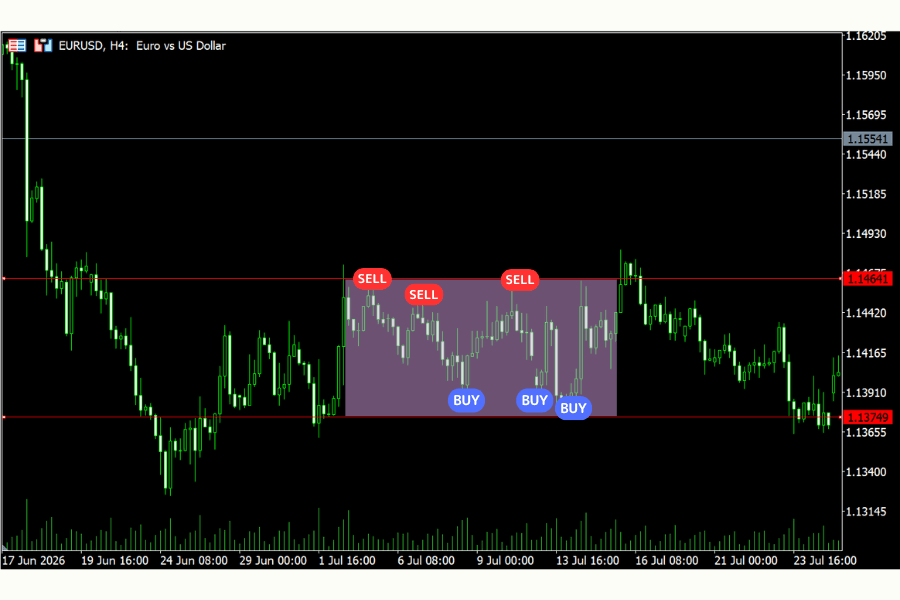
At its heart, range trading is about exploiting the fact that price moves back and forth within a horizontal band. When an instrument rises to a certain level and meets selling pressure, then falls to another level and finds buying support, price forms a range between the two: the upper edge is resistance, the lower edge is support.
What a range trader does is buy near the lower edge and sell near the upper edge, capturing the swing that spans the height of the range; if you are comfortable shorting, you can also short near the upper edge and cover near the lower one. Unlike the "buy and hold for a trend" mindset, the profit comes from the same range being traveled over and over.
So whether range trading is even possible depends on first having a clear enough range: the upper edge (resistance) and lower edge (support) each tested at least twice, boundaries well defined, and the range tall enough to cover the spread and trading costs so a round trip is worthwhile. If price wanders aimlessly or sits in a strong one-way trend, the conditions for range trading are not there.
2. Range Trading vs. Trend Following and Counter-Trend
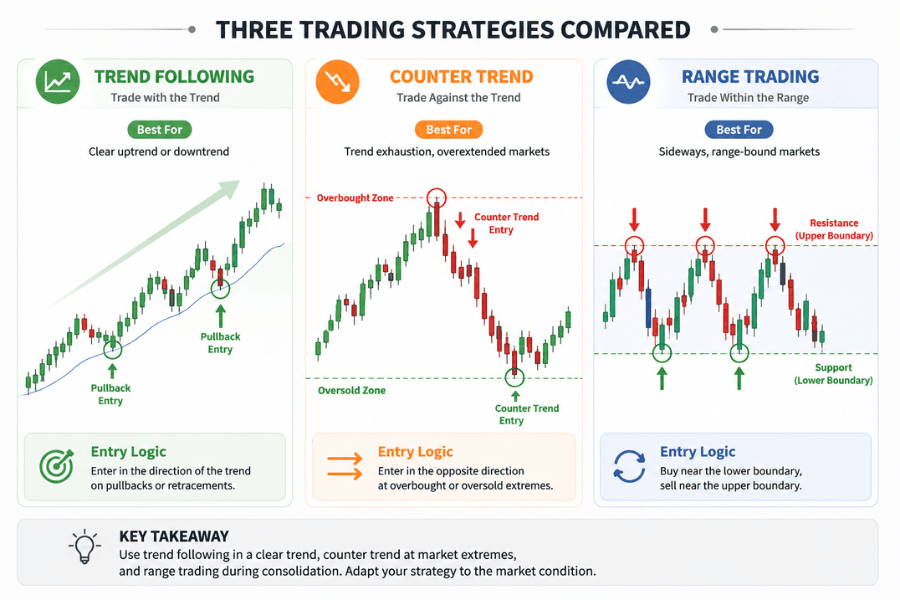
Depending on the market you face, strategies fall into roughly three types. Trend following enters in the direction of an existing trend and rides the bulk of its continuation; counter-trend trading positions against a move once it has run too far, betting on a reversal. Range trading handles the market with no clear direction, relying on price shuttling between fixed boundaries.
The biggest difference lies in the conditions each is built for and its entry logic:
| Strategy | Best for | Entry logic |
|---|---|---|
| Trend following | A clear up- or downtrend | Enter with the trend on pullbacks or rebounds |
| Counter-trend | Trend exhaustion, overextension | Fade the move at overbought/oversold extremes |
| Range trading | Sideways, no clear trend | Buy the lower edge, sell the upper edge |
Range trading and trend following are almost complementary: use trend following when the trend is clear, and switch to range trading when the market stalls into consolidation. The real difficulty is telling whether the current market is trending or ranging — which is exactly what Sections 5 and 6 deal with.
3. Pros and Cons of Range Trading
Advantages
| Advantage | Detail |
|---|---|
| Clear entries and exits | The boundaries (support and resistance) are natural entry and target levels, so you don't have to guess how far a trend will run. |
| Easy to size risk and reward | The range height is roughly your profit target, and with the stop just outside the boundary you can work out the reward-to-risk before you enter. |
| Frequent opportunities | Markets spend much of their time ranging, so as long as the range is clean you can trade it back and forth several times. |
Disadvantages
| Disadvantage | Detail |
|---|---|
| Frequent false breakouts | Price often pokes through a boundary and snaps back, stopping you out and racking up small losses. |
| Every range ends | Any range eventually ends in a real breakout and turns into a trend; being on the wrong side can wipe out several rounds of gains at once. |
| Limited profit per trade | Each trade is capped at the range height, so you miss the big move when a real trend finally develops. |
4. How to Execute a Range Trade
The process breaks down into a few steps, and the key is to confirm the range first, then think about entries:
| Step | What to do |
|---|---|
| ① Confirm it's a range | First check the market is sideways, not trending (see the ADX and price structure in the next section); don't range-trade inside a trend. |
| ② Draw the boundaries | Use support and resistance lines to mark the upper and lower edges; a boundary should have been tested at least two or three times to count. |
| ③ Enter near a boundary | Buy near the lower edge, sell (or short) near the upper edge. Avoid entering mid-range — it is far from both boundaries and the reward-to-risk is much worse. |
| ④ Target the opposite edge | Set the target at the other side of the range; conservative traders can scale out before it gets there. |
| ⑤ Stop just outside | Place the stop a little beyond the boundary — once it is truly broken, the range may be over and you should take the loss. |
The spirit of this flow is to swap an uncertain call about direction for a defined operation at the boundaries: while the range holds, buy low and sell high near the edges; once a boundary fails, the stop takes you out and keeps you from clinging to a losing position.
5. Recommended Indicators for Range Trading
ADX: first, confirm it's a range
The biggest danger in range trading is mistaking a trend for consolidation, so the first step is to check trend strength. ADX (see DMI/ADX) measures how strong a trend is: when ADX is below roughly 20–25, trend strength is usually weak and the market is leaning sideways, which can serve as one condition that favors range trading; a clearly rising ADX means a trend is forming and it's time to step back and switch to a trend approach. Think of it as a filter that keeps you out of the most dangerous setup — fading a low into a high inside a trend — rather than a hard rule that a low ADX guarantees a range; still read the price structure itself.
Bollinger Bands: read where price sits in the range
Once you've confirmed consolidation, use Bollinger Bands to see where price sits within the range. The bands consist of a middle line and two standard-deviation bands: in consolidation price mostly travels between the upper and lower bands, leaning toward resistance at the upper band and support at the lower one. When the bands clearly narrow (a "squeeze"), it often signals compressed volatility and that the range may be about to break — a cue to watch for a breakout.
RSI and Stochastic (KD): gauge the edges
Finally, use an oscillator to check the strength at the edges. RSI and the Stochastic (KD) work well inside a range: as price nears the upper edge it often turns overbought, and near the lower edge it turns oversold, giving you an "edge plus extreme" confirmation. Bear in mind that overbought or oversold does not mean price will reverse right away — in a stronger move RSI can stay overbought for a long time and the Stochastic can flatten out (blunt), so treat it as a supporting signal and read it together with the boundary and price action itself.
6. Risks and What to Watch For
Risk 1: False breakouts
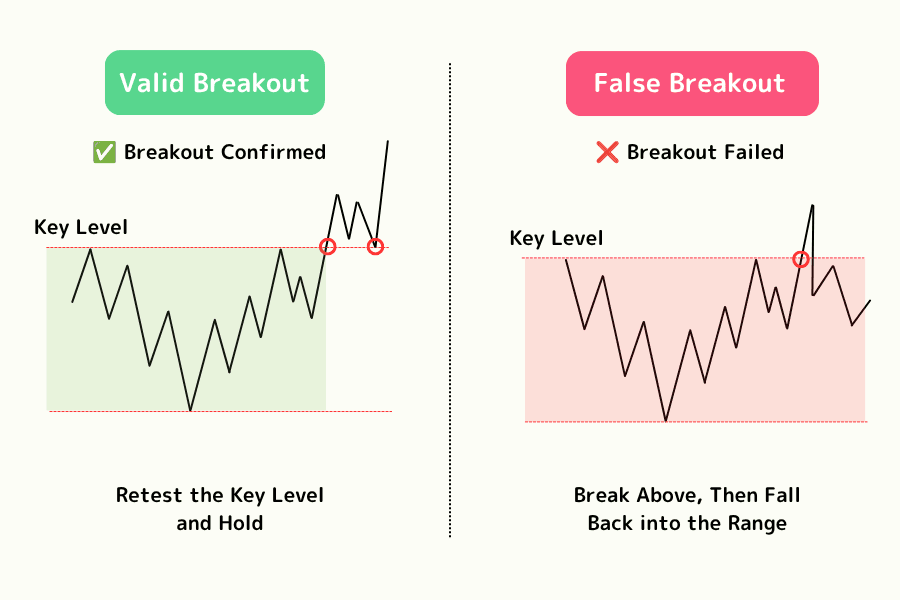
Price briefly pierces a boundary, triggers your stop, and then slips back into the range — the most common source of losses in range trading.
How to handle it: don't react the instant price touches a boundary. Wait for the candle to close to confirm it has truly held above or below, and judge it on your main trading timeframe — if you're trading a daily range, don't be spooked by a momentary 5-minute poke. You can also leave a small buffer beyond the boundary to avoid being shaken out by a quick wick.
Risk 2: A real breakout — the range ends and a trend begins
Every range ends eventually. When price breaks a boundary on rising volume and closes beyond it, that usually marks the end of consolidation and the start of a new trend; clinging to "buy low, sell high" here puts you against the trend, and it is range trading's biggest risk.
How to handle it: always set a stop loss in advance, take the loss immediately once the breakout is confirmed, don't average into the move against you — and if you're up to it, you can even flip to trade with the new trend, turning the range's end into a fresh opportunity.
Risk 3: Unclear boundaries
If support and resistance have been tested too few times or the edges are ragged, the "range" doesn't really exist.
How to handle it: if the boundaries aren't clear, don't trade — better to wait for a clean range that has been tested repeatedly than to force buy-low-sell-high against a fuzzy band of prices.
7. Range Trading FAQ
Q1: Is range trading suitable for beginners?
Relatively, yes. Compared with trend following, where you have to judge how far a trend will run, range trading gives you clear boundaries for entry, target, and stop, which makes discipline easier to follow. But beginners should practice two things: first confirm "this really is a range," and strictly honor the stop without averaging down when a breakout comes.
Q2: How do I tell whether to range-trade or follow the trend?
Look at two things. One is price structure — whether price is shuttling between clear horizontal support and resistance rather than making persistent higher highs or lower lows. The other is a trend-strength indicator: a low ADX (say, 20–25 or below) usually points to consolidation and favors range trading, while a rising ADX means a trend is forming and you should switch to trend following.
Q3: Which is better — range, trend following, or counter-trend?
There is no absolute winner; they suit different markets. Trend following has the edge when a trend is clear, range trading is more effective in consolidation, and counter-trend deals specifically with reversals at the end of a trend. Rather than sticking to one, decide first whether the market is trending or ranging, then pick the matching strategy.
Q4: Which indicators does range trading use?
The core one is support and resistance lines, used to draw the range boundaries; Bollinger Bands help you see where price sits in the band and spot squeezes; RSI and the Stochastic (KD) judge overbought/oversold at the edges; and ADX is used first to confirm whether the market is actually ranging. The usual combination is "support/resistance plus one oscillator."
Q5: What if the range breaks?
First tell a false break from a real one. If it's just a momentary wick that closes back inside the range, it's usually a false breakout and the original plan still stands; if price breaks a boundary on volume and closes beyond it, that generally means the range is over — take the loss on your stop right away, don't fight the breakout, and if appropriate you can flip to trade with the new trend.
Q6: How is range trading different from breakout trading?
Their assumptions are opposite. Range trading assumes the boundaries will hold, so it buys the lower edge and sells the upper edge for the swing inside the range; breakout trading specifically waits for price to break a boundary on volume, betting on a new trend unfolding. Facing the same range, a range trader enters near the boundary while a breakout trader enters when it is broken. In practice the two are complementary: trade the range while it holds, and once a real breakout is confirmed, switch to a breakout or trend approach.
8. Summary
Range trading is a strategy built for sideways markets: within a horizontal band where price oscillates, buy near the lower edge and sell near the upper edge to capture the swing. Its strengths are clear entries and exits, an easy-to-size reward-to-risk, and frequent opportunities; its difficulties are the many false breakouts and the fact that every range eventually ends and turns into a trend.
Using it well takes two layers. The first is picking the right market: use ADX and price structure to confirm the market is ranging, not trending, and don't range-trade inside a trend. The second is keeping discipline: draw the boundaries with support and resistance, judge overbought/oversold with Bollinger Bands and RSI/Stochastic (KD), place the stop outside the boundary, and when a real breakout hits, take the loss decisively — or even flip to trade with the trend.
Treat range trading, trend following, and counter-trend as three tools for different markets and switch between them as conditions change — that is how the strategy is really meant to be used.
Further Reading
- Stochastic Oscillator: Definition, Setup, and Trading Tips
- Oscillators
- How to Use Moving Averages (MA) in Trading
- Entry
- Forex Trading Hours & Time Zones: Global Markets and Best Times to Trade
Titan FX Trade Strategy Research Lab covers forex (FX), commodities (oil, precious metals, agricultural products), stock indices, U.S. equities, and crypto assets, producing educational content for retail investors across asset classes.
Primary Sources (by Category)
- Educational resources: Investopedia, BabyPips (general definitions and practice for range trading, support/resistance, and oscillators)
- Market analysis: Bloomberg, Reuters (forex and CFD market conditions and volatility context)