

What Is a Cross Currency Pair? Synthetic Rates, Major Crosses & Strategies
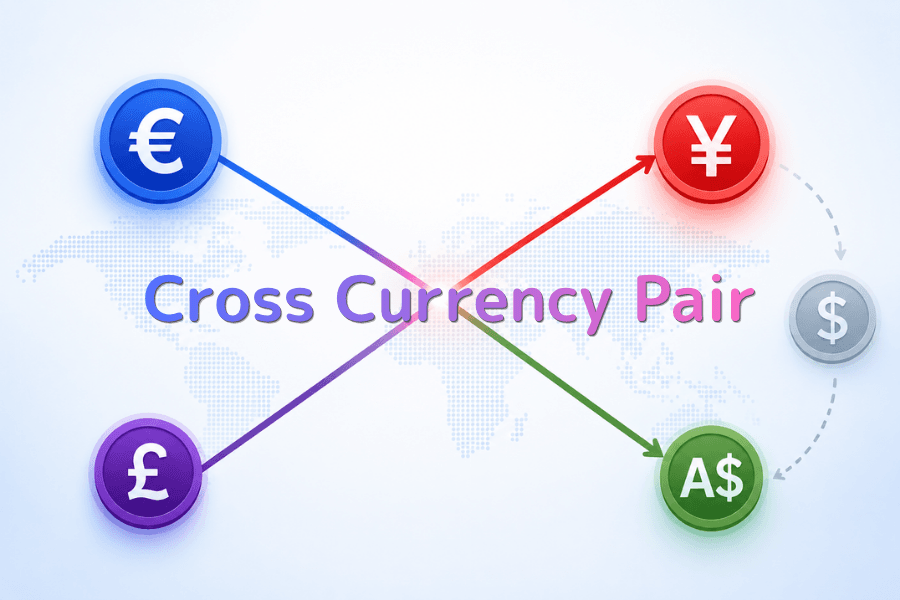
A cross currency pair (or simply a "cross") is a currency pair that does not include the US dollar — for example EUR/JPY, EUR/GBP, or AUD/NZD. The rate of a cross can be derived from two corresponding USD pairs (for example, EUR/JPY ≒ EUR/USD × USD/JPY), which lets traders trade the relative strength of two non-dollar currencies directly, without routing through the dollar.
The US dollar remains the center of the foreign exchange market: according to the BIS 2022 survey, the dollar is on one side of roughly 88.5% of global FX turnover. Everything that trades without the dollar — that is the world of crosses. For traders, crosses are far more than "extra symbols to trade": they reduce the direct impact of US dollar events, express the relative strength of two economies more cleanly, and open up a wider menu of carry and trend opportunities.
This guide covers what cross currency pairs are and how their rates are formed (synthetic rates), the four major cross families — yen, euro, pound, and commodity crosses — the practical differences between crosses and USD pairs in spreads, liquidity, and trending behavior, and how to pick crosses using currency strength, with the risk controls that go with them.
- A cross currency pair contains no US dollar (EUR/JPY, EUR/GBP, etc.), letting you trade the relative strength of two non-dollar currencies directly.
- A cross rate can be derived from two USD pairs; the principle is that the dollar cancels out between numerator and denominator (EUR/JPY ≒ EUR/USD × USD/JPY).
- Each of the four families has its own character: yen crosses track risk sentiment, euro crosses reflect intra-European strength, pound crosses are famously volatile, and commodity crosses move with raw materials.
- Compared with USD pairs, crosses have wider spreads and lower liquidity; when monetary policies clearly diverge, trends tend to persist, and direct exposure to US dollar events is reduced.
- The practical core is "pair the strongest against the weakest": use a currency strength meter to pick the combination, and keep spread costs, liquidity, and carry-unwind risk under control.
- 1. What Is a Cross Currency Pair?
- 2. How Cross Rates Are Formed: Synthetic Rates
- 3. The Major Crosses: Four Families
- 4. Crosses vs USD Pairs: Five Practical Differences
- 5. Three Reasons to Trade Crosses
- 6. Trading Strategy: Picking Crosses with Currency Strength
- 7. Risks and Caveats
- 8. FAQ
- 9. Conclusion
1. What Is a Cross Currency Pair?
A cross currency pair is a pair in which neither currency is the US dollar. By contrast, any pair with the dollar on one side — whether as the base or the quote currency — is a USD pair (also called a dollar pair or major). For the fundamentals of base and quote currencies and how pairs are classified, start with our currency pair guide.
| Category | Definition | Examples |
|---|---|---|
| USD pairs | Pairs that include the US dollar | EUR/USD, USD/JPY, GBP/USD |
| Crosses | Pairs that do not include the US dollar | EUR/JPY, EUR/GBP, AUD/NZD |
The name "cross" comes from FX market history. In the early interbank market, almost every currency conversion went through the dollar: to turn a European currency into yen, you first sold it for dollars, then sold the dollars for yen — "crossing over" the dollar in two legs. When direct quotes between major currencies emerged, these dollar-free combinations kept the name "crosses."
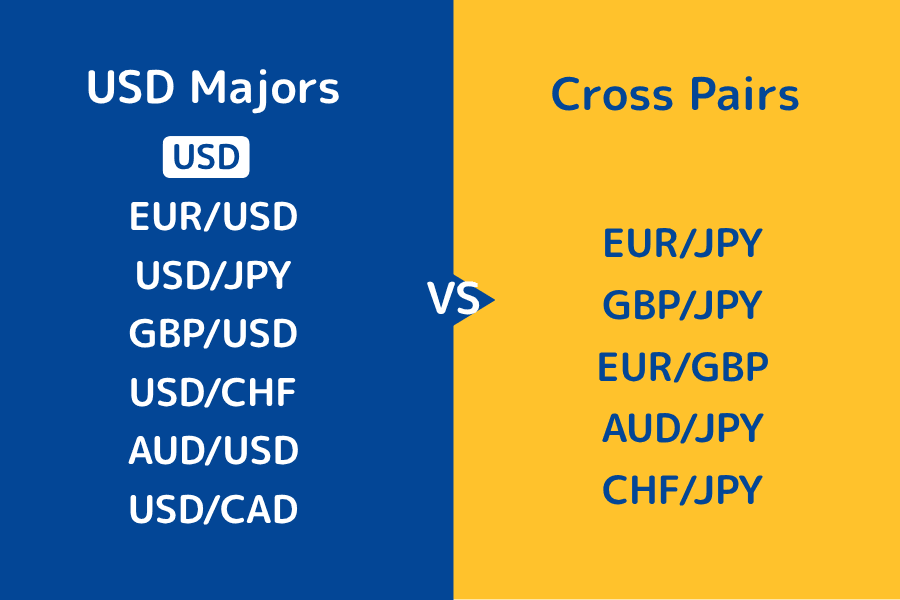
Today, major crosses such as EUR/JPY, GBP/JPY, and EUR/GBP have active direct markets of their own — no actual detour through the dollar is needed. But the relationship "two USD pairs can be converted into a cross rate" still holds, and it is the first key to understanding how crosses work.
2. How Cross Rates Are Formed: Synthetic Rates
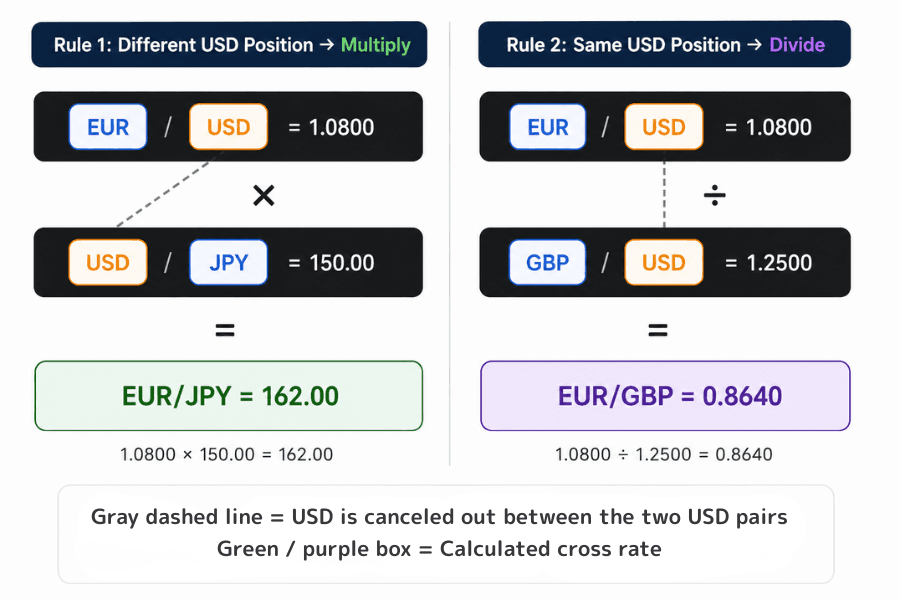
The theoretical rate of a cross can be derived from two corresponding USD pairs — the market calls this the synthetic rate. The underlying principle is to line up the two pairs by their units so that the dollar cancels out between numerator and denominator. In practice this reduces to two simple rules, depending on where the dollar sits in each pair:
Rule 1: Dollar on different sides → multiply
In EUR/USD the dollar is the quote currency; in USD/JPY it is the base currency. Multiply the two rates and the dollar cancels out:
- EUR/USD = 1.0800 (1 euro = 1.08 dollars)
- USD/JPY = 150.00 (1 dollar = 150 yen)
- EUR/JPY = 1.0800 × 150.00 = 162.00 (1 euro = 162 yen)
Rule 2: Dollar on the same side → divide
In EUR/USD and GBP/USD, the dollar is the quote currency in both. In that case, divide:
- EUR/USD = 1.0800
- GBP/USD = 1.2500
- EUR/GBP = 1.0800 ÷ 1.2500 = 0.8640 (1 euro = 0.864 pounds)
Market rates vs synthetic rates
Major crosses have their own order books and traded prices — not every trade is literally assembled from two USD pairs. But whenever the market price drifts visibly away from the synthetic value, banks and algorithmic traders arbitrage the gap (buy the cheap leg, sell the rich one) and it closes quickly. Under normal market conditions, cross rates therefore stay very close to the synthetic value of the two USD pairs (brief deviations can occur in extreme volatility or thin liquidity). Traders can use the relative movement of the two USD pairs as a real-time clue for the cross: if EUR/USD rallies while GBP/USD stalls, EUR/GBP will usually rise in step.
The same relationship shapes the cost structure of crosses. Volume and market depth in crosses are generally lower than in the major USD pairs, and liquidity providers often hedge cross positions through two USD pairs, carrying extra spread and inventory risk. As a result, cross spreads are generally wider than USD-pair spreads, and the more exotic the cross, the wider they get (see Section 4).
3. The Major Crosses: Four Families
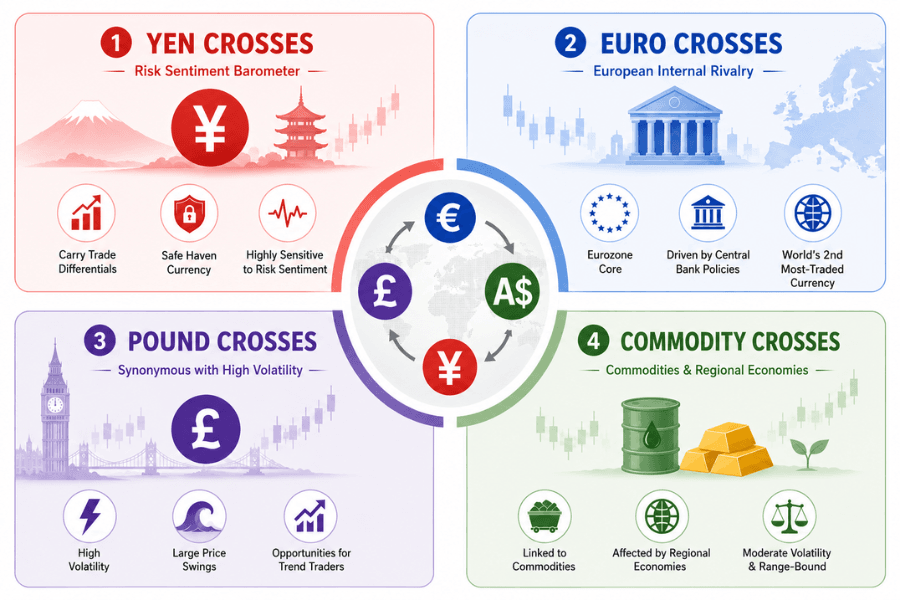
By the character of their component currencies, crosses fall into four broad families. Each family has its own drivers — and its own playbook.
Family 1: Yen crosses — the risk-sentiment barometer
The Japanese yen combines persistently low interest rates with traditional safe-haven status. Yen crosses therefore carry two personalities at once — carry trade and risk sentiment. When markets are optimistic, money borrows yen to buy higher-yielding currencies and yen crosses rise together; when panic hits, carry positions unwind en masse and yen crosses tend to drop in unison.
| Pair | Highlights |
|---|---|
| EUR/JPY | One of the most traded crosses; good liquidity, relatively tight spreads |
| GBP/JPY | Among the most volatile major crosses; famously aggressive moves |
| AUD/JPY | High-yield commodity currency × safe haven — a classic risk-sentiment gauge |
| NZD/JPY | Similar character to AUD/JPY with slightly larger swings |
| CAD/JPY | Notably correlated with crude oil prices |
| CHF/JPY | Two safe havens in one pair; long, persistent trends |
Emerging-market and Asian yen crosses — SGD/JPY, CNH/JPY, SEK/JPY, MXN/JPY, ZAR/JPY, THB/JPY — offer bigger rate differentials, but liquidity and information transparency drop off sharply. They are advanced instruments.
Family 2: Euro crosses — Europe's internal contest
The euro is the world's second most-traded currency. Euro crosses express "the eurozone versus another economy," and their trends are often driven by the relative pace of the two central banks.
| Pair | Highlights |
|---|---|
| EUR/GBP | The direct duel of Europe's two big economies; calm daily ranges, violent event moves |
| EUR/CHF | Heavily shaped by SNB policy; crashed in a single day in 2015 when the floor was scrapped |
| EUR/AUD | Europe × commodity currency; frequent trending phases |
| EUR/NZD | Bigger swings and wider spreads than EUR/AUD |
| EUR/CAD | Europe paired with an oil-exporting economy |
Euro crosses against Nordic and emerging-market currencies — EUR/SGD, EUR/SEK, EUR/NOK, EUR/PLN, EUR/TRY — offer larger volatility and carry opportunities, and demand correspondingly stricter risk control.
Family 3: Pound crosses — synonymous with high volatility
Sterling is a volatile currency in its own right. Paired with non-dollar currencies, spreads widen further and the price action gets rougher — a family for traders who can stomach larger swings and lean toward trend and swing styles.
| Pair | Highlights |
|---|---|
| GBP/AUD | Multi-hundred-pip days are not unusual |
| GBP/NZD | One of the widest-ranging major crosses |
| GBP/CAD | UK × oil exporter — reacts to both crude and UK data |
| GBP/CHF | High volatility × safe haven |
| GBP/SGD | A pound cross with relatively active Asian-session trade |
Family 4: Commodity crosses — raw materials and regional economies
The Australian, New Zealand, and Canadian dollars are all commodity currencies. Crosses among them usually move more calmly than the same currencies do against the US dollar, with rates set by fine differences in the two economies' fundamentals and commodity prices — a natural home for range and mean-reversion strategies.
| Pair | Highlights |
|---|---|
| AUD/NZD | Tightly linked economies; the textbook long-term range-trading pair |
| AUD/CAD | Iron ore vs crude oil — two commodity cycles pulling against each other |
| AUD/CHF | A risk-appetite gauge, similar in character to AUD/JPY |
| NZD/CAD | Dairy exporter vs oil exporter |
| NZD/CHF | High yield × safe haven; a clear carry profile |
| CAD/CHF | Oil prices versus risk aversion in one pair |
There are also Singapore dollar crosses such as AUD/SGD and CHF/SGD, suited to traders focused on Asian markets.
4. Crosses vs USD Pairs: Five Practical Differences
Once the classification is clear, the more important question is: how does trading a cross actually feel different from trading a USD pair?
| Comparison | USD pairs | Crosses |
|---|---|---|
| Spread cost | Tightest (often under 1 pip on EUR/USD) | Generally wider; exotic crosses several times wider |
| Liquidity | Best in the market | Adequate on major crosses, clearly thinner on exotic ones |
| Volatility | Comparatively contained | Generally higher (GBP/JPY and GBP/NZD especially) |
| Trending behavior | Buffeted by dollar factors; more frequent reversals | Trends persist more readily when policies clearly diverge |
| Most active hours | London and New York sessions | Depends on the components (yen crosses are active from Tokyo hours) |
Difference 1: Spreads and trading costs
As covered in Section 2, crosses trade on lower volume and often require two-leg hedging, so spreads run wider than on USD pairs. Trade a cross at the same frequency as a USD pair and the cost burden grows visibly — short-term, high-frequency strategies need to convert the per-trade spread into money terms first.
Difference 2: Clearly layered liquidity
EUR/JPY, EUR/GBP, and GBP/JPY have ample liquidity for normal position sizes. But the further you go toward exotic crosses (EUR/TRY, ZAR/JPY), the thinner the book: larger orders slip, and prices can gap outright around major events.
Difference 3: Higher volatility
A cross stacks the volatility of two non-dollar currencies on top of each other — without the dollar, the market's common anchor, as a buffer. Overall volatility therefore runs above USD pairs. To compare volatility across pairs and sessions quantitatively, use the Titan FX volatility heatmap.
Difference 4: Trends persist when policies diverge
A USD pair's chart always carries "the dollar's own story" — Fed policy, US data, global dollar liquidity. Strip the dollar out and a cross reflects the relative strength of two economies more directly. When the two central banks point in clearly opposite directions, crosses can print cleaner, longer one-way moves than USD pairs — a tendency that shows up when conditions align, not a universal law.
Difference 5: Different active hours
USD pairs do their heaviest business where the London session overlaps New York. Crosses follow their components: yen and Asia-linked crosses are already moving in the Tokyo session — a real advantage for traders in Asian time zones.
5. Three Reasons to Trade Crosses
Reason 1: Reduce the direct impact of US dollar events
When the FOMC decision or nonfarm payrolls hit, every USD pair convulses. If your position thesis has nothing to do with the dollar, switching to a cross (EUR/GBP, AUD/NZD) lowers the direct impact of dollar events on your pair — though note that major events still reach crosses indirectly through global risk sentiment and capital flows. Crosses reduce the exposure; they do not eliminate it.
Reason 2: Express a two-economy view directly
Say you are bullish on the eurozone and bearish on the UK. Long EUR/USD still needs the dollar to stay out of the way; short GBP/USD has the same problem. Long EUR/GBP expresses the view in its purest form. Crosses let you turn an "A strong, B weak" judgment into a position without detouring through the dollar.
Reason 3: A wider menu of carry and trend opportunities
Crosses offer rate-differential combinations that USD pairs simply do not have. The classic carry trade — borrowing low-yield yen or francs to buy higher-yielding currencies — has always lived in crosses like AUD/JPY, NZD/JPY, and NZD/CHF. Overnight financing depends on the pair and direction, so check the actual numbers in the swap history before entering.
6. Trading Strategy: Picking Crosses with Currency Strength
The core logic: pair the strongest against the weakest
The starting point of cross trading is intuitive: find the strongest and the weakest currency at the same moment, combine them into a "strong vs weak" cross, and trade with that flow. If the strength ranking shows the euro strongest and the yen weakest, a long in EUR/JPY carries a much simpler directional logic than wrestling with the dollar in a USD pair. Strength pairing clarifies the with-trend direction — but entries still need confirmation from price structure, session timing, and risk management.
In practice you do not need to compare eight currencies by hand. The Titan FX currency strength meter ranks the majors' relative strength in real time, showing at a glance which currency is strongest and which is weakest right now:
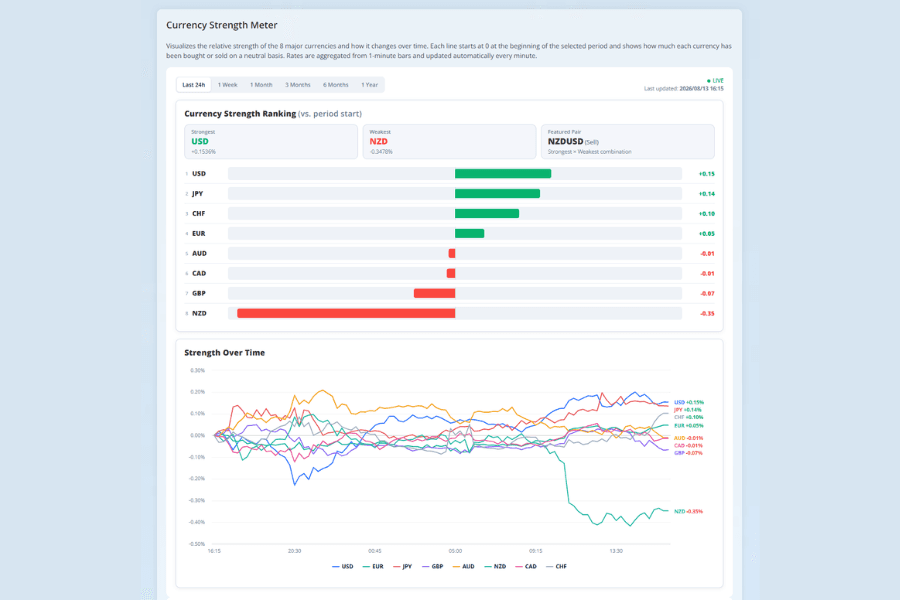
The workflow condenses into five steps: identify the strongest and weakest currencies with the strength meter → select the corresponding cross → confirm the trend structure and entry on the chart → check correlation against existing positions → set the stop and position size, then enter. The three techniques below deepen different steps of that flow.
Technique 1: Read the two USD pairs to anticipate the cross
The synthetic-rate relationship (Section 2) is a free leading indicator. When a major release sends EUR/USD sharply higher while GBP/USD barely moves, EUR/GBP has to rise; watching the relative reaction of the two USD pairs often flags the direction earlier than the cross's own chart.
Technique 2: Manage risk with correlations
Crosses within the same family move closely together (AUD/JPY and NZD/JPY, for instance). Longing both is taking the same risk twice. Before adding a position, check the correlation coefficients against your book in the correlation matrix, so you do not stack exposure by accident — the full playbook is in our currency correlation guide.
Technique 3: Ride policy divergence for the long trend
When the two central banks move in opposite directions — one hiking, one cutting — crosses can trend for months at a stretch. Track the majors' rate paths and meeting outcomes on the central bank watch page as a standing routine.
7. Risks and Caveats
-
Spread costs eat into returns: cross spreads run wider than USD pairs, and high-frequency strategies multiply that cost. Before trading actively, convert the per-trade spread into money and make sure your strategy's expectancy can carry it.
-
Liquidity and gap risk: exotic crosses trade on thin books; surprises bring slippage and outright gaps, and stop orders can fill well beyond their trigger levels. Size positions more conservatively than you would on USD pairs.
-
High volatility calls for lower leverage: several-hundred-pip days are routine on GBP/JPY and GBP/NZD. Using EUR/USD-sized leverage and lots on pound crosses multiplies the risk severalfold — and when the market turns against you, a margin closeout arrives faster than you expect.
-
Carry-unwind stampedes: when panic strikes, carry positions in yen and franc crosses unwind together, and longs absorb a sharp drop within hours. Whenever you hold a high-yield cross long, pre-plan the risk-off scenario and your exit.
-
Double the information load: trading EUR/GBP means following the ECB and the Bank of England, plus both economies' inflation and jobs data. Fundamentals are more scattered than for USD pairs — use the economic calendar to schedule both economies' key events in one place.
Trade Forex CFDs with Titan FX
Titan FX offers 50+ currency pair CFDs on MT4/MT5 with up to 1,000:1 leverage on major pairs, tight spreads, and the flexibility to go long or short. Micro accounts can reach up to 2,000:1 leverage when eligible.
8. FAQ
Q1: Should beginners start with crosses or USD pairs?
The usual advice is to start with the most liquid, tightest-spread USD pairs (EUR/USD, USD/JPY), get comfortable with orders, stops, and money management, and then add major crosses like EUR/JPY and EUR/GBP to your watchlist. Starting with exotic crosses means taking on wide spreads and high volatility at the same time — two handicaps at once.
Q2: Are crosses the same thing as minor pairs?
The two terms overlap but classify differently. USD pair vs cross is about whether the dollar is in the pair; major vs minor is about volume and liquidity. What the market calls "minor pairs" usually means the liquid crosses built from major non-dollar currencies (EUR/GBP, EUR/JPY). "Cross currency pair" is the broader definition — anything without the dollar qualifies, from the highly liquid EUR/JPY to thinly traded emerging-market combinations.
Q3: Who sets cross rates? Can they deviate from the synthetic value?
Major crosses have markets of their own, and rates are set by supply and demand. Arbitrage, however, keeps the market rate pinned to the synthetic value derived from the two USD pairs, and deviations usually vanish within moments. Under normal conditions, the gap a retail trader sees between a quoted cross rate and its synthetic value is negligible.
Q4: Which crosses have the best liquidity?
EUR/JPY, EUR/GBP, and GBP/JPY are generally regarded as the top tier, with spreads and depth closest to USD pairs; EUR/CHF, AUD/JPY, and EUR/AUD sit on the next rung. The further into emerging-market currencies you go, the thinner the liquidity and the tougher the trading conditions.
Q5: Why are cross spreads wider than USD-pair spreads?
Crosses trade on lower volume and thinner books than the major USD pairs, and market makers quoting them often hedge through two USD pairs — carrying two legs of spread and inventory risk. That cost is passed into the quote, and the less liquid the cross, the bigger the markup.
Q6: Why do yen crosses crash when markets panic?
The yen is a low-yielding safe-haven currency. In calm periods it is sold heavily as the funding leg of carry trades, and yen crosses grind higher. When a risk event hits, those carry positions unwind at once — yen gets bought back — and EUR/JPY, AUD/JPY, and their peers drop together. It is the classic "up the stairs, down the elevator" rhythm of yen crosses.
Q7: Which cross currency pairs can I trade with Titan FX?
Titan FX offers around 60 currency pairs as CFDs, spanning the major crosses of all four families plus a range of emerging-market crosses. Live prices, spreads, and swap rates for every pair are on the live rates page.
9. Conclusion
A cross currency pair is simply a pair without the US dollar. Arbitrage against its two USD pairs keeps every cross glued to its synthetic value, while the pair itself lets you trade the relative strength of two economies directly: yen crosses map risk sentiment, euro crosses stage Europe's internal contest, pound crosses supply the volatility, and commodity crosses ride raw-material cycles.
Against USD pairs, crosses cost more in spread and sit on clearly layered liquidity — but they trend more persistently when policies diverge, trade actively across more sessions, and offer a cleaner way to express two-economy views, sidestep direct dollar-event risk, and harvest carry. In practice: pick the "strong vs weak" combination with the currency strength meter, anticipate direction from the relative moves of the two USD pairs, control book-level exposure with the correlation matrix — and pair it all with reduced leverage and disciplined stops.
Start with the major crosses — EUR/JPY, EUR/GBP — fold each family's personality into your watchlist, and let the dollar-free tenth of the market become the next piece of your strategy.
Further Reading
- Forex Trading Basics: The Complete Beginner's Guide
- What Is Leverage? Calculation, Margin, and a Practical Guide
- Pips, Pip Value, and Spreads: Definitions and Calculations
- Fundamental Analysis in Forex: Key Indicators and Workflow
- Forex Glossary: Terms Every Trader Should Know
Titan FX Trading Strategy Lab. We produce investor-education content covering forex, commodities (crude oil, precious metals, agricultural goods), stock indices, US equities, and digital assets.
Primary Sources (by Category)
- FX market statistics: BIS Triennial Central Bank Survey 2022 (global FX turnover and currency shares)
- Central banks and monetary policy: public releases of the ECB, Bank of England, Bank of Japan, Reserve Bank of Australia, and Reserve Bank of New Zealand
- Live data and tools: Titan FX Live Rates, Currency Strength Meter, Correlation Matrix, Swap History