

Scalping

The name comes from the image of shaving off one thin layer: rather than taking a whole move, the scalper cuts out the thinnest slice of it. With a target of only a few pips per trade, results have to be accumulated through repetition. And precisely because the target is so small, the spread, commission and slippage that a longer-term trader can round away become the things that decide whether the strategy works at all.
This guide covers what scalping is and how it operates, where it sits relative to day trading and swing trading, why a few pips of spread and commission determine whether the style makes money, how execution quality and account conditions affect the outcome, which sessions suit it and which to avoid, and the risk controls that make it sustainable.
- Scalping completes a trade in seconds to minutes with a target of only a few pips, accumulating results through repetition.
- A round-turn cost of 1 pip is 20% of a 5-pip target but only 0.5% of a 200-pip target — the same expense carrying 40 times the weight.
- At a 1:1 target and stop, that 1 pip lifts the break-even win rate from 50.25% (200-pip target) to 60% (5-pip target).
- Commission has to be converted into pips before it can be compared with spread — and the conversion differs by instrument: the same $7 round turn is 0.70 pip on EUR/USD but about 1.05 pip on USD/JPY.
- Slippage and network latency scale the same way, which makes execution quality and session choice matter at least as much as the entry signal.
1. What Is Scalping?
Scalping is the trading style with the shortest holding period. A trade runs from entry to exit in seconds or minutes, and the target is a stretch of the chart too small to call a trend.
Direction still has to be judged; the time frame over which it is judged is simply compressed. Over the next few tens of seconds to a few minutes: does the momentum continue, does the break hold, does an overextended quote come back. That is the whole question.
The style rests on three conditions:
- Frequency: with a tiny gain per trade, results have to come from volume. Some traders take dozens of trades a day, though the actual rate depends on the strategy, market conditions and personal habits.
- Short exposure: positions are held in seconds and minutes, so there is no overnight risk and almost no directional shock from a single event.
- Strict discipline: entry and exit rules have to be fixed and executable quickly. Hesitation alone eats into the target.
Common entry premises include deviation from a short-period moving average, repeated tests of a level where resting orders cluster, and the return move once price settles after a data release. In scalping, though, the choice of signal is not necessarily the decisive variable — a point the following sections build up to.
2. How Scalping Sits Against Day and Swing Trading
The three styles are usually compared side by side, but the real dividing line is not how long a position is held. It is the ratio between the target per trade and the cost.
| Scalping | Day trading | Swing trading | |
|---|---|---|---|
| Holding period | Seconds to minutes | Minutes to hours | Days to weeks |
| Target per trade (indicative) | A few pips | Tens of pips | Hundreds of pips |
| Trades per day (indicative) | Several to dozens | A few | One every few days |
| Main costs | Spread, commission, slippage | Spread, commission | Swap, gaps |
| Screen time | Constant focus | Needs monitoring | A daily check is enough |
| Biggest variable | Execution conditions | Entry and exit timing | Directional judgment |
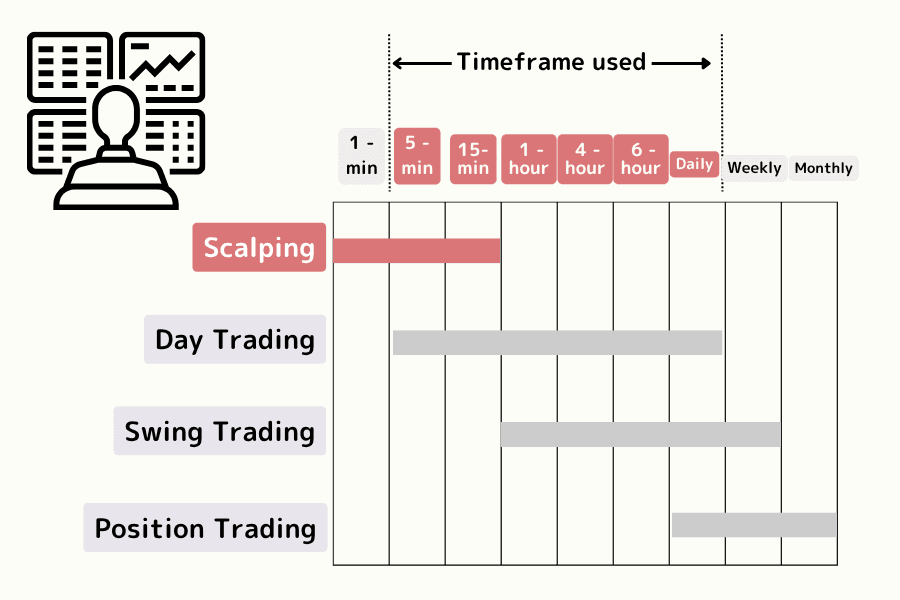
The difference also shows up directly in which chart is used. Scalping works mainly on the 1-minute to 15-minute chart, day trading extends to around the hourly, swing trading centers on the 4-hour and daily, and beyond that sits position trading held for months.
Getting that pairing wrong does not work. Hunt for a scalping entry on the daily chart and the few pips of room are long gone by the time the signal confirms. Judge swing direction on the 1-minute chart and most of what appears is noise that never forms into anything.
Back to the table: the last row is the point. Swing trading succeeds or fails mainly on directional judgment, and day trading on entry and exit timing.
Scalping, by contrast, is most likely to fail on the trading conditions themselves. The same rules can be positive expectancy in one cost and execution environment and a steady loss in another.
3. Why Cost Decides the Outcome
Put simply, the difficulty in scalping is that every single trade pays its cost up front. Getting the direction right is one thing; what is left after the cost is another. Two sets of numbers make the size of this clear.
Relative cost: the same expense, 40 times the weight
Assume a round-turn trading cost of 1 pip and place it against different target sizes. The targets below are the orders of magnitude each style typically works at — matching the holding periods and timeframes in the previous section — and are there to show the ratio. The actual figures vary by trader, so watch the right-hand column.
| Trading style | Target per trade (indicative) | 1 pip round turn as a share of target |
|---|---|---|
| Scalping | 5 pips | 20% |
| Day trading | 30 pips | 3.3% |
| Swing trading | 200 pips | 0.5% |
Substitute your own target and the arithmetic is identical: cost ÷ target. The cost does not change; what changes is how much of the result it accounts for.
To a swing trader, 1 pip is a rounding error. To a scalper, it is a fifth of the trade, handed over before anything else happens.
Break-even win rate: how cost moves the bar
Push this a step further and a more direct number appears. Assume the target and the stop are the same distance (a 1:1 risk-reward) and the round-turn cost is 1 pip:
| Target / stop | Win | Loss | Break-even win rate |
|---|---|---|---|
| 5 pips | +4 | −6 | 60.0% |
| 10 pips | +9 | −11 | 55.0% |
| 30 pips | +29 | −31 | 51.7% |
| 200 pips | +199 | −201 | 50.25% |
On the same 1:1 setup, a swing trader breaks even a little above a coin flip, while a scalper needs 60%.
Those ten percentage points have nothing to do with the quality of the strategy. They are what cost looks like when it is magnified against a small target. Which means that in scalping, lowering the cost by one notch is the same thing as lowering the win-rate bar by one notch — and the second is usually much harder to do.
Converting commission into pips
Comparing cost structures means putting two different quotations into the same unit. Spread is already expressed in pips; commission is a cash amount, so it has to be converted using the pip value.
- One standard lot of EUR/USD (100,000 units) is worth $10.00 per pip
- A commission of $3.50 per side is $7.00 round turn
- $7.00 ÷ $10.00 = 0.70 pip
The important caveat is that 0.70 pip is a EUR/USD figure. Yen crosses have a different pip value. One standard lot of USD/JPY is worth ¥1,000 per pip, which at 150 is about $6.67 — so the same $7.00 round turn converts to $7.00 ÷ $6.67 = about 1.05 pip, roughly one and a half times the EUR/USD figure.
Applying that to the average spreads published on this site, the answer changes with the instrument:
| Currency pair | Standard | Blade + converted commission | Total difference |
|---|---|---|---|
| EUR/USD | 1.20 | 0.20 + 0.70 = 0.90 | Blade cheaper by 0.30 pip |
| GBP/USD | 1.57 | 0.57 + 0.70 = 1.27 | Blade cheaper by 0.30 pip |
| USD/JPY | 1.33 | 0.33 + 1.05 = 1.38 | Roughly level; Standard marginally cheaper |
The rule itself is simple: a commission account is cheaper when its spread advantage exceeds the commission expressed in pips. But because that converted figure differs by instrument, treating "the commission account is cheaper" as a blanket statement can lead to the wrong conclusion on yen crosses. The full conditions for each account are set out in Comparison of Titan FX Account Types.
Note also that the figures above are averages. Real spreads move with the session and the instrument, so what actually matters is the quote during the hours you personally trade.
4. Execution Quality: Slippage, Order Type and Latency
Calculating the cost precisely still assumes the order fills as expected. At the scale scalping works on, "as expected" is harder than it sounds. Each of the three factors below can leave a meaningful gap on a target of a few pips.
Slippage
Slippage is the difference between the price submitted and the price filled.
Half a pip of slippage is almost meaningless against a 200-pip swing target; against a 5-pip scalping target it is a full 10%. And slippage widens when price is moving quickly — exactly the moments a scalper most wants to enter.
Choosing between market and limit orders
A market order guarantees the fill but not the price; a limit order guarantees the price but not the fill. Scalping leaves no clean way out of that trade-off.
Use market orders and every trade absorbs slippage. Use limit orders and the ones that miss tend to be precisely the trades that would have run — the fills you fail to get are disproportionately the profitable ones.
In practice many traders enter on a limit and exit their stop on a market order, giving the "must get out" priority to the risk side.
Execution model
The route an order takes to market affects the result too. Among the forex execution models, ECN is a no-dealing-desk structure in which orders are passed directly to liquidity providers, making the source of quotes and the matching process relatively transparent.
Actual fill quality, however, still depends on the depth of liquidity at that moment, market conditions and the platform's execution capacity. Using ECN does not automatically make costs lower or fills more stable. The mechanics of filling and the circumstances in which an order is rejected are covered in Order Execution.
Network latency
When the target is only a few pips, the time between pressing the button and the server receiving the instruction shows up in the fill price as well. Some traders running expert advisors or trading at high frequency place their programs on a VPS close to the trading server to reduce the gap latency introduces.
This is not a requirement for a manual trader operating at moderate frequency. It does illustrate the same point, though: a considerable share of what determines scalping results sits outside the entry signal.
5. When to Trade: Sessions, Instruments and What to Avoid
Scalping needs two conditions at once: enough volatility and enough liquidity.
Neither works without the other. Without movement there is no spread to cut out of the market; without liquidity the spread widens and slippage increases, taking back whatever was captured.
Choosing the session
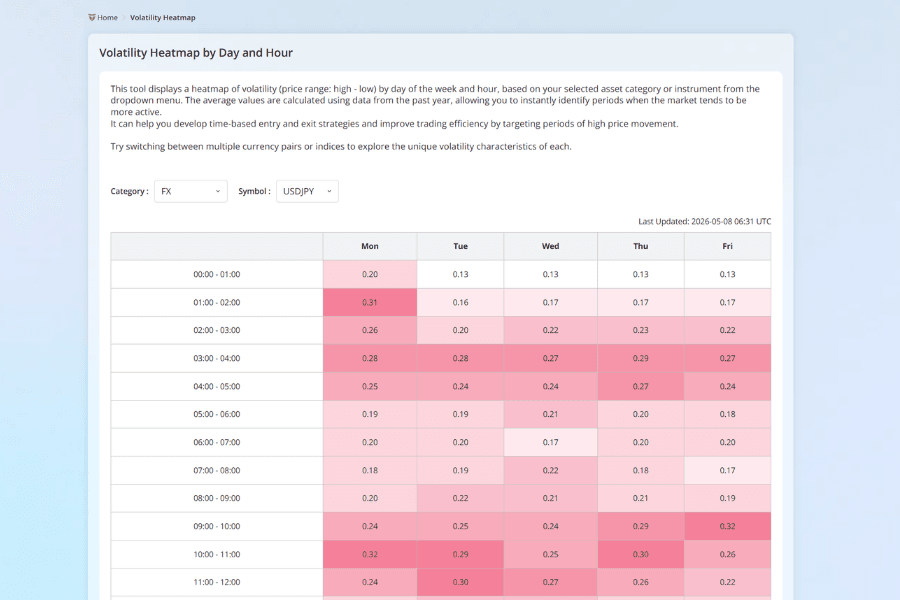
Volatility is not spread evenly across the trading day. The London–New York overlap tends to combine high volatility with tight spreads, making it the best window for scalping conditions.
The early Asian hours are the reverse: the market is quiet while spreads run wider, so a trade can be eaten by cost before it reaches its target.
Rather than judging by impression, it is more reliable to look at the actual distribution. The Titan FX volatility heatmap shows the range of each instrument across a day-by-hour grid, so you can see directly whether the hours available to you carry enough movement.
Choosing the instrument
Major pairs generally carry the tightest spreads and the deepest liquidity, which makes them the default choice for scalping. That is an average across the whole session, though — conditions on the same pair can differ considerably from one hour to the next.
Minor pairs and crosses may look like they move more, but the spread widens alongside the range, so the trade-off often does not hold up once converted. Looking only at the size of the range is a reliable way to reach the opposite conclusion.
What to avoid
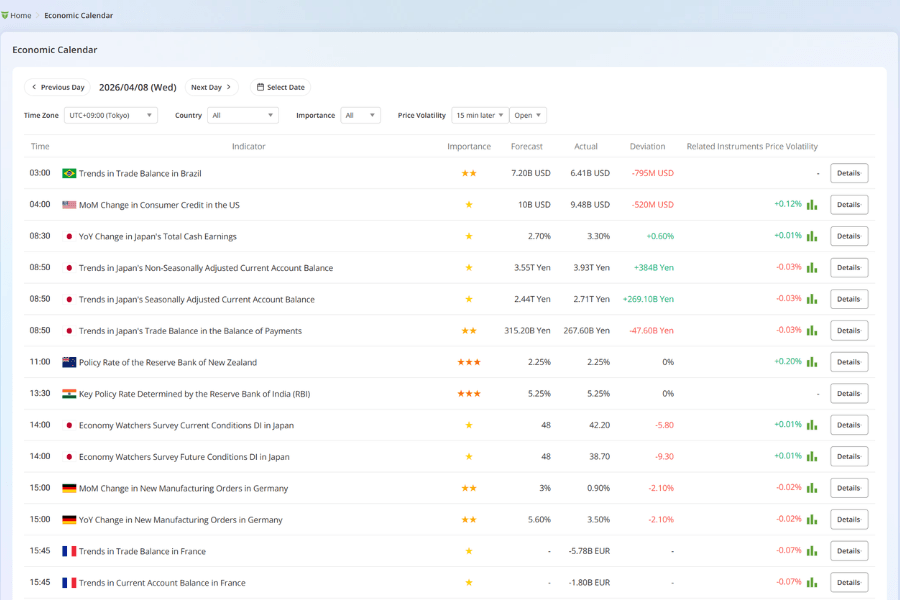
The window around a major economic release is the least favorable environment scalping can face: spreads widen sharply, quotes gap, and slippage increases noticeably. The range does get bigger, but the cost and the uncertainty grow faster.
Non-farm payrolls (NFP), the consumer price index (CPI) and FOMC decisions are the clearest examples. Checking the release times for the day in advance and standing aside through those windows is more effective than any entry technique.
6. Risk Controls That Make Scalping Sustainable
The high frequency of scalping magnifies every flaw. The same mistake a swing trader makes once a week, a scalper makes fifty times a day.
- Make the stop a fixed rule: when the target is only a few pips, one loss left to run cancels a dozen wins. The stop distance belongs to the plan before entry; decided in the moment, it tends to keep moving further away.
- Control risk per trade: even with a small target, size has to be read as a percentage of capital. A high number of trades is not a reason to increase the size of each one.
- Set a daily loss limit: continuing to trade through a losing streak is usually driven by wanting it back rather than by a signal. Decide in advance what daily loss ends the session.
- Record cost in the journal: a trade log that captures the price move but not the spread and commission will systematically overstate how well the strategy performs.
- Take the time and attention cost seriously: scalping demands constant focus, and the decay in execution that comes with fatigue lands directly in the fill price.
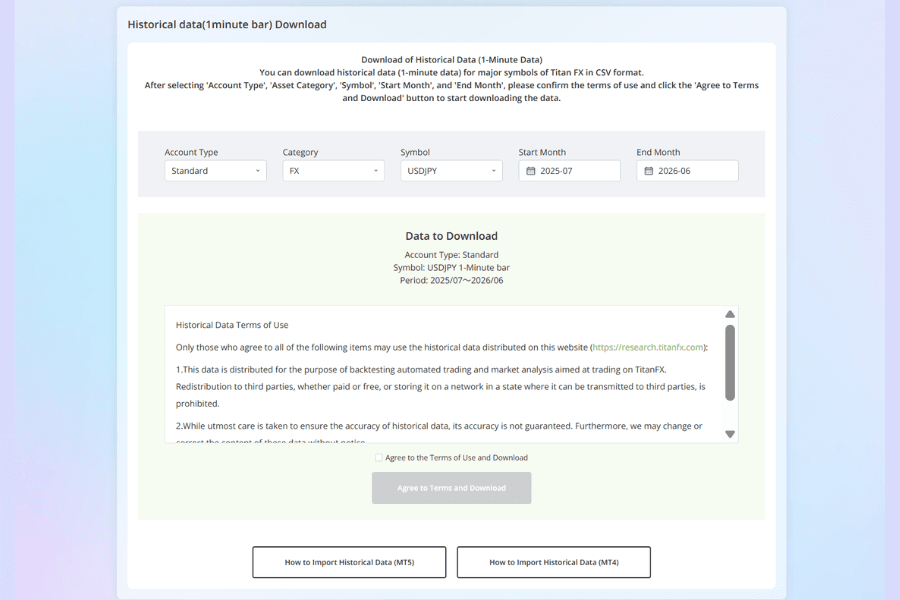
Judging whether a set of scalping rules genuinely works also requires backtest data fine enough to support it. Daily data cannot reconstruct entries and exits that happen within minutes; minute-level data is the minimum for the result to mean anything.
7. Scalping FAQ
Q1: Is scalping suitable for beginners?
It is generally not recommended as a starting style. It demands fast, fixed execution while a beginner is still building the judgment behind the rules, and the high share of cost leaves far less room for error than other styles.
If you want to try it, confirm in a demo environment that you can execute the same set of rules consistently before committing real money.
Q2: Does scalping require an automated trading program?
No. Discretionary scalping is entirely workable and is where most people start. Automation buys execution speed and consistency of discipline, at the cost of having to write the rules out in full with no room to adjust in the moment. The dividing line is usually not effectiveness but whether your strategy is defined clearly enough to be written as rules.
Q3: How many trades a day is reasonable for scalping?
There is no standard number. Trade count is the result of the strategy's conditions appearing, and should not be a target in itself. Entering when the conditions are not there in order to fill a quota only accumulates cost faster than profit — the most common source of losses in scalping.
Q4: How much capital does scalping require?
Account size determines the absolute loss you can absorb per trade; it does not determine whether the strategy works. The real threshold is the cost structure. On a small account, fixed commission and spread take up a higher share of usable capital, which compresses the room the strategy has to survive in.
Q5: Is scalping the same as high-frequency trading (HFT)?
They are not on the same level. High-frequency trading is millisecond automated trading run by institutions on low-latency infrastructure, competing on hardware and network distance. Scalping is a short-term style a retail trader can execute, on a scale of seconds and minutes. Both seek short exposure, but the technical threshold and competitive conditions are not comparable.
Q6: Should I keep trading when the spread widens?
In most cases, no. A wider spread means cost takes a larger share of the target, and an expectancy that was marginal may already have turned negative. Rather than adjusting the strategy to accommodate it, write "no entry above a given spread" into the rules.
8. Conclusion
Scalping compresses the time frame of trading to its limit, and in doing so maximizes the influence of cost and execution.
The same set of entry and exit rules needs a 60% win rate to break even on a 5-pip target and barely over half on a 200-pip target. The difference is not in the rules; it is in the weight of the cost relative to the target.
That also sets the order of preparation. First establish what the spread, commission and slippage actually are during the hours you trade. Convert the commission into pips and add it to the spread — remembering that the converted figure changes with the instrument. Then go back and check whether the target size still leaves room.
Refining the signal is worth continuing. But if the cost structure does not work to begin with, no signal will make up the difference.
Further Reading
- Volatility
- Stop Loss
- Risk-Reward Ratio
- What is a Lot?
- How to Set a Stop Loss? 5 Common Methods Compared
Titan FX Trading Strategy Lab. We produce educational content for investors covering FX, commodities (crude oil, precious metals, agricultural products), stock indices, U.S. equities, and cryptocurrencies.
Primary Sources (by category)
- Official documentation and broker rules: Titan FX account type specifications (spread, commission and execution model for Standard, Blade and Micro); Titan FX trading conditions
- Trading platform documentation: MetaQuotes MT4/MT5 user guides on spread display, order types and execution
- Research and reference: general treatments of scalping and trading cost structure in major trading education resources (Investopedia, BabyPips)