

Swing Trading
What it targets is the smoothest stretch inside a trend: entering where a pullback ends and momentum resumes, exiting where momentum runs out. Calling the exact top and bottom was never the point. Because it does not require watching the screen, swing trading often gets described as the style that works alongside a full-time job — and that description is only half right. What you save is monitoring time; what you take on in exchange is overnight and weekend exposure.
This article covers what swing trading is, how it differs from other styles, the entry and exit logic most commonly used, the holding costs you will pay, and who it genuinely does and does not suit.
- Positions run days to weeks, and the target is one move — not the entire distance from bottom to top.
- The difference from day trading is not just duration but holding overnight, which changes both the cost structure and the kind of risk you carry.
- The mainstream entry is a trend pullback: confirm the trend first, then wait for the pullback to end.
- Holding costs include swap and weekend gaps, and neither appears in the P&L calculation you make at entry.
- It suits people who cannot watch the screen, and does not suit anyone who cannot sit through unrealised drawdown.
1. What Is Swing Trading?
Definition: taking one move, not the whole thing
Swing trading holds a position for days to weeks with the goal of capturing one block of price movement. Put plainly, it takes one segment of a rally or a decline and gives up on catching the absolute low and high from the outset.
More precisely, the "swing" here is the stretch from the end of one pullback to the start of the next as a trend advances. An uptrend is usually built from alternating impulse legs and pullbacks, and swing trading aims to take one or two of those legs. Holding from beginning to end is not the objective.
The difference from day trading is not only duration
Most explanations rank trading styles by holding time. That is not wrong, but it leaves out the part that matters most: swing trading holds positions overnight.
Three things follow from that single fact. Swap is paid or received, the position is exposed to news outside trading hours, and it faces gaps at the open. Day trading closes out before the session ends, so none of the three exist. What separates the two styles is the type of risk taken on, not simply how long the trade lasts.
Common timeframes
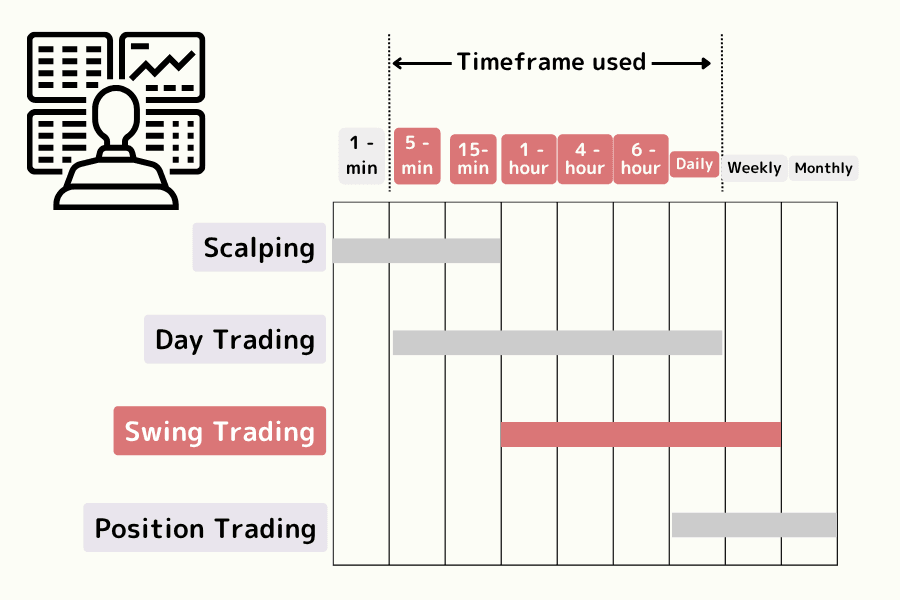
Swing traders typically read direction on the daily chart and locate entries on the 4-hour or 1-hour. The daily gives the structure of the trend; the shorter timeframe supplies the timing and the precise level.
Looking at only one timeframe creates situations where direction and signal disagree — a buy signal on the 1-hour while the daily sits in the middle of a downtrend, for instance. Signals like that rarely work out well.
2. How It Differs From Other Trading Styles
The four main styles separate cleanly on holding time, main cost, main risk, and how closely you have to watch.
| Trading style | Holding time | Main cost | Main risk | Monitoring |
|---|---|---|---|---|
| Scalping | Seconds to minutes | Spread (very high trade count) | Execution speed and slippage | Constant |
| Day trading | Minutes to one day | Spread | Sharp intraday moves | Throughout the session |
| Swing trading | Days to weeks | Swap + spread | Overnight and weekend gaps | One check per day |
| Position trading | Weeks to years | Swap (substantial once compounded) | Trend reversing while held | Weekly check |
The cost structure is the dividing line
The column worth pausing on is cost. Swing trading sits exactly where the cost structure changes over.
For scalping and day trading, cost is almost entirely spread, and it grows with trade frequency. Swing trading cuts the number of trades sharply, so spread carries less weight — but holding cost now has to be counted. By the time you reach position trading, holding cost is one of the main variables driving the result.
This also explains a common misreading. Treating swing trading as "day trading, but easier" does not hold up: the way costs accumulate and the kind of risk involved are different from the start.
3. Entry Logic: Three Patterns
Swing trading entries fall into three broad types, and the first two assume a trend is already in place.
Pattern 1: buying the pullback in a trend (the most common)
The standard approach, in two steps:
- Step one, confirm the direction of the trend. Usually read from the arrangement of moving averages or the structure of highs and lows.
- Step two, wait for the pullback to finish. Once the trend is confirmed, do not chase — wait for price to pull back toward support and show a sign that the decline has stalled, then enter.
The advantage is that entry sits close to the stop, so the risk-reward works out reasonably. The drawback is that it takes patience: most of the time is spent waiting, and the number of actual orders is small.
Pattern 2: entering on a range breakout
Price consolidates sideways for a period, forms a continuation pattern, and you enter when it breaks out.
The direction is unambiguous and the move that follows is often fast. The trade-off is a higher rate of false breaks. In practice traders usually require a close beyond the level, or wait for the retest after the break, rather than jumping in the moment it clears.
Pattern 3: entering on a reversal (harder)
Taking a position against the prevailing direction when a reversal pattern appears late in a trend.
The potential return is larger because entry sits close to the turn, but the judgement is the hardest of the three — trends tend to persist longer than expected. For beginners, the two trend-following patterns leave considerably more room for error.
The shared prerequisite: there has to be movement
All three patterns rest on one condition: the market needs enough volatility.
Swing trading profits come from a substantial price move. When a market sits in a narrow range for a long stretch, even a correct read on direction will not produce enough distance to cover costs. That is the environment in which swing trading spins its wheels.
4. Exit Logic
Exits matter no less than entries, and swing trading exits carry a particular constraint: you are not watching the whole time.
Stop-loss: place it up front
Since you are not at the screen, the stop-loss has to go on at the same moment as the entry. Planning to "cut it manually if it goes wrong" does not work in this style — the unfavourable news tends to arrive while you are asleep.
Place it where the reason for the trade breaks down. For a trend-pullback entry, that means below the low of that pullback, with some buffer.
Take profit: three common methods
| Method | How it works | Best suited to |
|---|---|---|
| Fixed risk-reward | Set 1:2 and exit when it is reached | Easiest to keep disciplined |
| Prior high / low | Target the next clear resistance or support | When there is structure to reference |
| Trailing stop | Raise the stop as price advances, hold until hit | Clear trends you want to ride |
A fixed risk-reward ratio is the easiest to systematise; a trailing stop captures larger legs but also gives back part of an unrealised gain. None is superior — what matters is deciding which one before entering, since changing your mind mid-position is the outcome most worth avoiding.
Structure-break exit: when the reason is gone
Beyond price and time, there is an exit justified by the original rationale no longer holding.
If you entered on a trend pullback, the premise is that the trend continues. Once an uptrend stops producing higher highs and higher lows, or price breaks the support structure you were relying on, that premise has failed — even if the profit target has not been reached.
This method is especially practical in swing trading because it does not depend on a pre-set price target. The market is under no obligation to travel to the level you chose.
Time-based exit: the overlooked dimension
There is also an exit that has nothing to do with price: if the position has not moved as expected within the expected window, step aside.
Swing trading logic is built on the view that a substantial move is about to unfold. If price sits flat for a week or two after entry, the original premise has already lapsed. There is little point holding on even before the stop is touched — the capital and the swap cost are both spinning idle.
5. The Two Costs of Holding Overnight
This is the most substantive difference from day trading, and the part beginners most often leave out of the maths.
Cost 1: swap
Holding overnight generates swap, and whether you pay or receive depends on the direction held and the interest rate differential between the two currencies.
The daily amount is not large, but swing positions run for days to weeks, and the accumulation has a real effect on the result. Here is the point that gets misread: whether swap is positive or negative is set by the instrument's rate structure and the direction you hold, and has nothing to do with whether the position is currently up or down. On the same instrument, long and short frequently carry opposite signs.
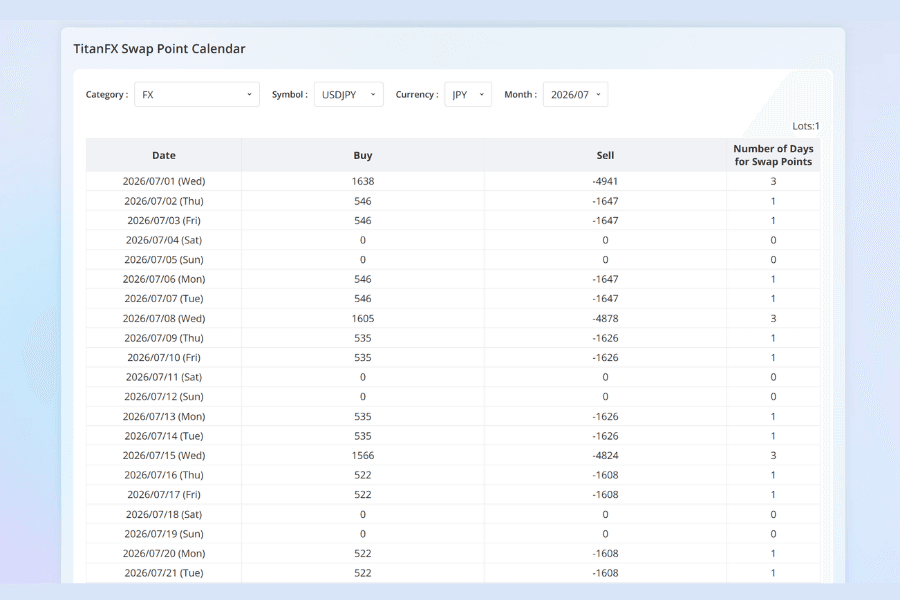
None of this needs working out by hand. Titan FX's Swap Point Calendar lets you look up the daily amount for both the buy and sell side on any instrument, along with how many days of swap are applied that day. Checking it before opening a swing position folds the cost into the entry decision.
The record also makes two things visible: the buy and sell figures on one instrument often carry opposite signs, and one day each week is charged three days of swap to cover the two-day weekend closure — so that day's figure runs roughly triple.
Cost 2: weekend and holiday gaps
The larger effect comes from gaps.
Events during a market closure are not reflected in price until it reopens and prices them in all at once. That means a stop-loss can be jumped over. The stop still triggers, but it fills at the post-gap level, so the actual loss exceeds the amount you set.
The risk cannot be eliminated, though it can be managed: reduce position size ahead of major events and long holidays, or close out rather than carry through. This is where risk management diverges most sharply from day trading.
6. Who Is It For? Advantages and Limits
Advantage 1: no screen-watching
Checking the chart once a day is usually enough. For anyone with a full-time job, this is swing trading's most practical appeal.
Advantage 2: higher signal quality
Longer timeframes strip out the noise of shorter ones. A single daily signal has far more transacted volume behind it than a 5-minute one, so the odds of being misled by one large order or a momentary spike are lower.
Advantage 3: trading costs weigh less
Fewer trades means spread accounts for a smaller share of total cost. Over the same period, day trading might place dozens of orders where swing trading needs a handful.
Limit 1: overnight and weekend risk
Covered in the previous section. This is the price paid for not having to watch the screen — the two are opposite sides of the same coin.
Limit 2: capital turns over slowly
A single position may run for weeks, and that capital is unavailable for other opportunities meanwhile. Holding several positions at once also calls for attention to the correlation between them: three highly correlated positions are, in risk terms, close to one position tripled.
Limit 3: it demands patience
Qualifying opportunities are infrequent. The judgement itself is rarely the hardest part — sitting on your hands when there is no signal is. That is why trading psychology carries particular weight in this style.
Who it does not suit
Two cases follow directly from those limits:
- Anyone who cannot sit through unrealised drawdown. A swing position will normally go through several adverse pullbacks before reaching its target. If seeing red makes you want to close, this style will have you exiting repeatedly at exactly the wrong moments.
- Anyone who measures progress by trading frequency. Swing trading is mostly waiting. Treating "being in a trade" as progress leads to forcing entries when there is no signal, which lowers the quality of the whole record.
7. Swing Trading FAQ
Q1: How do I choose between swing trading and day trading?
Start with whether you can watch the market. If you cannot follow prices during the day, day trading is barely workable. Then consider whether you can tolerate overnight and weekend price moves — if not, swing trading is unsuitable even when you do have the time.
Q2: Is swing trading suitable for beginners?
Relatively, yes. The longer timeframe makes signals steadier and removes the need for instant reactions. But beginners should pay particular attention to holding costs and gap risk, neither of which exists in day trading and both of which are easy to overlook.
Q3: Which timeframe should I use?
The common combination is the daily for direction and the 4-hour or 1-hour for entries. Which one you pick matters less than fixing it. The usual failure is switching timeframes when a signal disappoints, searching until you find a chart that supports what you already thought.
Q4: Which indicators does swing trading need?
There is no required set. In practice traders read direction from moving averages or trendlines, then use a measure of movement — ATR, for instance — to size the stop. The number of indicators does not help on its own; stacking tools that do the same job only makes signals look more numerous without making the read any more accurate.
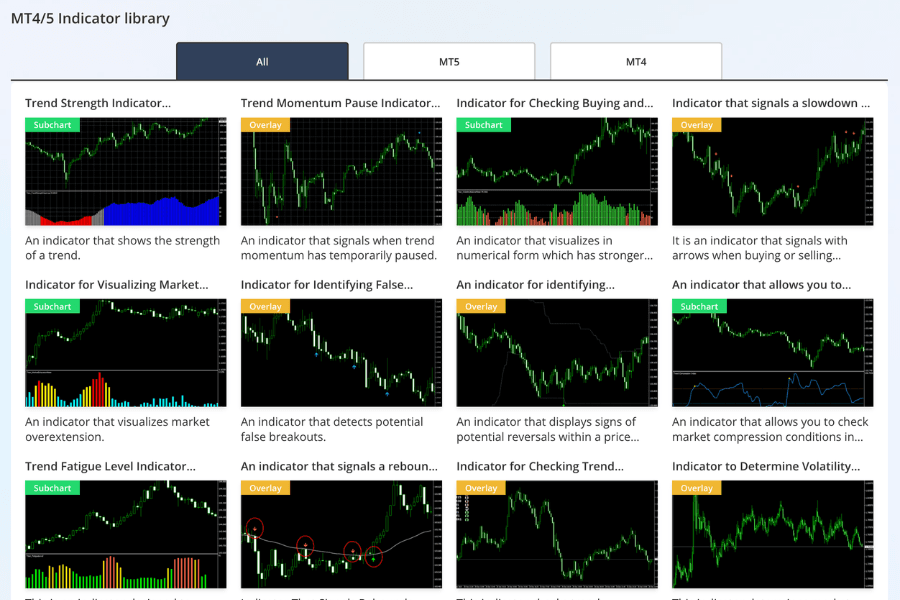
If you want to compare tools directly, Titan FX's custom indicator page offers dozens of free MT4/MT5 downloads, each with a thumbnail and a description of what it does. The ones most relevant to swing trading are those that gauge trend strength and momentum, those that measure the state of volatility, and those that show trend across several timeframes in a single panel — the last category maps directly onto the "long timeframe for direction, short one for entry" approach described earlier.
Q5: Does swing trading have a high win rate?
Most swing traders weight the risk-reward ratio more heavily than the win rate itself. With a profit target set at twice the risk, a win rate below 50% can still carry a positive expectancy. Judging by win rate alone, while ignoring the size of each win and loss, leads to the wrong conclusion.
Q6: How many positions should I hold at once?
There is no fixed answer, but correlation between positions deserves attention. Holding several highly correlated instruments effectively amplifies the risk of a single position.
Q7: How wide should the stop be?
Wider than in day trading, because it has to absorb normal daily-chart movement. The common approach is a multiple of recent range rather than a fixed pip count. A stop that is too tight gets taken out repeatedly by ordinary pullbacks.
Q8: Do I need to adjust the stop every day while holding?
Frequent adjustment is unnecessary. If you use a trailing stop, moving it up by your predefined rule as price advances is enough. Moving a stop further away while the position is losing is not advisable — it cancels the risk control you set in the first place.
8. Summary
Seen from here, swing trading takes on a shape more specific than "a trade you hold for a few days." Its value lies in offering a rhythm for participating in the market that does not require watching the screen, rather than in producing larger returns.
Three points are worth carrying away. First, what it takes is one block of movement rather than the entire run, so both entry and exit should rest on a defined reason instead of waiting for the best possible price. Second, the essential difference from day trading is holding overnight, which introduces swap and gaps — two costs day trading does not have — and both need to be counted in advance. Third, because you are not watching, the stop-loss has to be placed at entry. That is the discipline floor for this style.
Further Reading- Forex Trading Hours & Time Zones: Global Markets and Sessions
- What Is a Position in FX Trading?
- Trend Following in Forex: Strategies, Indicators, and Tips
- Forex Trading Strategy: A Complete Guide for Beginners
- Technical Analysis: Tools, Indicators & Strategies Explained
Titan FX Research. Investor-education content covering forex (FX), commodities (oil, precious metals, agricultural products), stock indices, US equities, and crypto assets across global markets.
Primary Sources (by Category)
- Trading styles and theory: Alexander Elder, Trading for a Living — multiple-timeframe analysis and the classification of trading styles; Van K. Tharp, Trade Your Way to Financial Freedom — the effect of position sizing and exit rules on results
- Market mechanics: how swap is calculated in forex and its relationship to the interest rate differential; opening gaps caused by the weekend closure and their effect on stop-loss execution
- Market data: Titan FX live rates, swap listings, and trading-session data