
 Home
Home- Investment Guide: Strategies for Stocks, Forex, and Metals
- Can You Lose Money in Forex? Risks & Defense Guide
Can You Lose Money in Forex? Beginner's Guide to Risks and Defense

Forex appeals to many beginners because of its high liquidity, around-the-clock access, and low entry threshold. Yet anyone who has actually traded knows that what looks like easy participation hides meaningful risks behind every price move. Most newcomers learn this the hard way: not through small calibration losses, but through a sudden, hard-to-recover drawdown that makes them question whether they should have started at all.
The honest answer to "Can you lose money in forex?" is yes — and the probability is materially higher when you are still building a trading framework. What matters far more than the binary yes/no is why you lose. Some losses come from market conditions you cannot influence. Others come from operational mistakes you can absolutely fix. Treating these two sources the same way is one of the most expensive errors a new trader makes.
This guide separates environmental causes (the rules of the game you cannot change) from behavioral causes (the mistakes you actually control), then layers on a defense framework that beginners can implement immediately.
- Forex losses arise from two distinct sources: market environment (spreads, swaps, liquidity shocks, and leverage mechanics) and trader behavior (no plan, emotional revenge trading, and overtrading) — and beginners typically blow up due to the second category, not the first.
- The single most important survival metric is risk per trade as a percent of account equity: keep it pinned to 1-2 percent and you absorb a long losing streak without account-ending damage.
- Setting a stop-loss is not enough on its own — slippage during gap events, stops that are too tight for normal noise, and revenge averaging are the three patterns that turn a modest loss into a catastrophic one.
- A demo account is excellent for testing strategy mechanics but cannot reproduce real psychological pressure; transition to live with the smallest available lot (0.01) and scale up gradually.
- High leverage does not directly cause losses — oversized positions do. Whether you trade at 500x or 100x, your true risk equals "max possible loss in dollars / account equity" and that ratio must stay disciplined.
- 1. Can You Really Lose Money in Forex? Confronting Market Reality
- 2. Environmental Sources of Loss: Rules You Cannot Change
- 3. Behavioral Sources of Loss: The Trader Mistakes That End Accounts
- 4. Beginner Defense Framework: How to Materially Reduce Loss Risk
- 5. Conclusion: Building Long-Term Risk Defense Thinking
- 6. FAQ: Common Questions on Forex Losses
1. Can You Really Lose Money in Forex? Confronting Market Reality
Yes, losses are very real in forex, and statistically they hit beginners harder than experienced traders. This is not pessimism — it is structural reality.
Forex margin trading, at the directional level, behaves close to a zero-sum game: one trader's gain typically corresponds to another's loss. Once you add real-world frictions — spreads, execution slippage, and overnight financing costs (swaps) — the system becomes negative-sum from the retail trader's perspective. In other words, the average participant must overcome a consistent cost drag before they ever start "winning" against other participants.
The currency market is dominated by central banks, commercial banks, hedge funds, and corporate treasury desks. There is a structural information and infrastructure gap between these participants and individual retail traders. Without a deliberate risk framework, retail participants tend to be the side that absorbs losses during volatility regime changes.
This does not mean retail traders cannot succeed. It means the question is not whether losses occur — losses are inevitable, even for professionals — but whether those losses stay controlled. Distinguishing "normal market drawdown within risk parameters" from "uncontrolled loss caused by missing rules" is the most important diagnostic skill a beginner can develop.
2. Environmental Sources of Loss: Rules You Cannot Change
The moment you place a trade, you accept a set of costs and uncertainties that apply uniformly to every participant. These cannot be negotiated away with experience — they can only be acknowledged and managed.

Environmental Factor 1: Spread and Swap as Compounding Costs
Every trade begins with a built-in cost: the spread, defined as the difference between the bid and ask price. Higher trading frequency multiplies this cost dramatically. A scalper who opens 20 trades per day on EUR/USD at 0.4 pips of effective spread is paying meaningful drag against any positive expectancy the strategy may have.
Holding overnight introduces a second cost: the swap (rollover financing). Depending on the currency pair and direction, swap can be positive or negative, but for retail traders going long higher-yielding currencies during tightening cycles, the cost compounds materially over weeks. Position sizing models that ignore this drag systematically underestimate true breakeven thresholds.
Environmental Factor 2: Liquidity Shocks and Black Swan Events
Currency markets respond to central bank policy, macroeconomic data releases, and geopolitical events simultaneously. Around scheduled high-impact events — non-farm payrolls (NFP), CPI prints, FOMC decisions, BOJ meetings — and unscheduled shocks (geopolitical flare-ups, surprise interventions, natural disasters), liquidity in the order book can evaporate within seconds.
When this happens, the orderly continuous-pricing model breaks down. Prices gap past stop levels, and your stop-loss order fills at the next available price rather than your specified one — a phenomenon known as slippage. Realized losses can therefore exceed the planned risk by multiples. This is the territory of black swan events — rare but high-impact moves that defeat the assumptions baked into normal risk models.
The 2015 Swiss National Bank de-pegging of CHF, the GBP flash crash of October 2016, and the COVID-March-2020 dollar funding squeeze are all real-world examples where retail accounts using "normal" stop placement saw stops execute at prices catastrophically far from intended levels.
Environmental Factor 3: The Double-Edged Nature of Leverage
Forex uses a margin-based model that allows traders to control a notional position much larger than the deposited capital. Titan FX, for instance, offers up to 1,000x on Standard and Blade accounts; up to 2,000x on Micro accounts (conditions apply).
Leverage is a tool that magnifies both directions of price movement equally. With high leverage, even a small adverse price move can consume a meaningful fraction of margin. If margin level falls below the broker's stop-out threshold, positions are forcibly liquidated — destroying any chance of waiting out the move and recovering.
The mistake that causes leverage-driven blowups is not "leverage is too high" — it is "position size is too large for the leverage being used." The correct framing is: leverage is a multiplier on whatever position size you choose. Choose the position size first, based on risk tolerance; let leverage simply enable that position size with less capital lockup.
3. Behavioral Sources of Loss: The Trader Mistakes That End Accounts
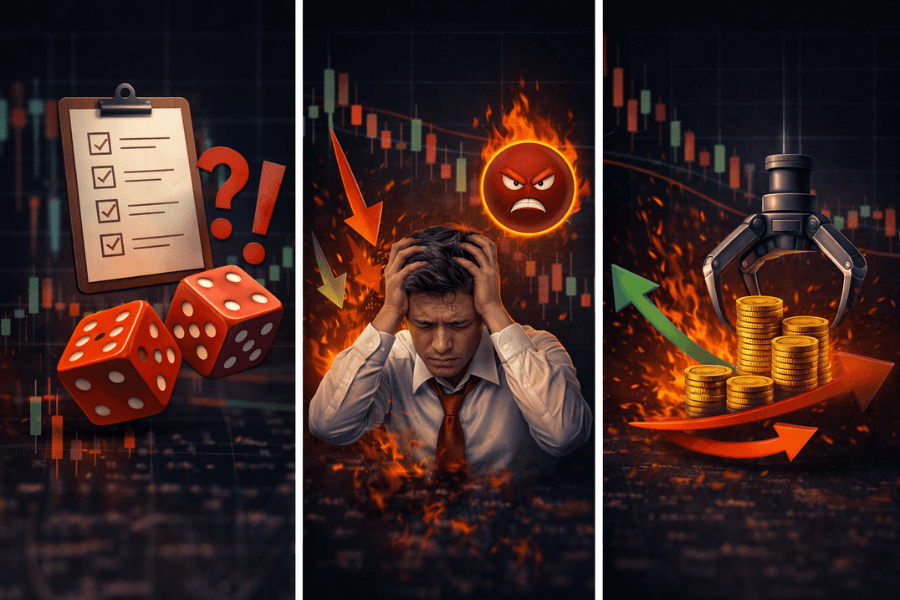
While environmental factors set the floor of unavoidable cost, the dominant cause of catastrophic blowups in retail forex is behavioral. The market does not destroy accounts — traders destroy their own accounts by overriding the rules they set for themselves.
Behavioral Factor 1: Trading Without a Defined Plan
Many newcomers enter trades on vague intuition — "the chart looks bullish," "someone on social media said this pair is moving" — without specifying entry trigger, profit target, or stop level in advance. A trade with no predefined exit conditions is structurally a gamble, not an investment. When price moves against the position, the absence of pre-committed rules means decisions get made under stress, almost always poorly.
Documented institutional risk frameworks insist on written-down trade thesis, target, and invalidation criteria before execution for exactly this reason. Even a one-line note recording "long EUR/USD on breakout above 1.0820, target 1.0890, stop 1.0790" constrains your behavior when the market starts pulling on emotional triggers.
Behavioral Factor 2: Emotional Trading and Revenge Averaging
This is the most lethal behavioral mistake. After a losing streak, the impulse to "win it back" pushes traders to double position size or average into a losing trade — adding to a position that is already moving against them. Behaviorally, this is loss aversion combined with the sunk-cost fallacy, and it has been documented extensively in academic prospect theory and behavioral finance research.
The mechanical danger is that revenge averaging exponentially increases exposure at exactly the moment risk control should be tightest. When the next adverse move arrives, the larger position size translates into a far larger drawdown — sometimes account-ending. Survivorship bias makes this look survivable: the rare time it works gets remembered, while the times it wipes out the account are no longer there to share their stories.
Behavioral Factor 3: Overtrading and Chasing Extremes
Beginners often feel anxious sitting flat — as if not having a position means missing opportunity. This produces overtrading: opening positions without a quality signal, simply to feel engaged. Each marginal-quality trade adds a small negative expectancy multiplied across many entries, eroding capital over time even without any single dramatic loss.
A related pattern is "chasing": buying after a sharp rally because it "must keep going" or shorting after a steep drop because "it cannot bounce yet." Empirically, fills at extreme prices have asymmetric reversal risk. The same psychology that makes you want to chase is the psychology that just convinced everyone else to chase, leaving the trade vulnerable to mean-reverting flows.
4. Beginner Defense Framework: How to Materially Reduce Loss Risk
The objective at the beginner stage is not maximizing gain per trade. It is avoiding the kind of single-event blowup that ends a trading career. A trader who survives 12 months of disciplined operation has an exponentially higher chance of becoming consistently profitable than one who chases returns in month one.
Defense Strategy 1: Strict Stop-Loss Discipline and Per-Trade Risk Cap
Every trade should have a pre-defined maximum loss. The widely accepted target among professionals is 1 to 2 percent of account equity per trade. On a 1,000 USD account, that means accepting a 10-20 USD loss before mechanical exit. This level of cap means a streak of ten consecutive losses costs roughly 10-18 percent of equity — survivable, recoverable, and psychologically manageable.
The stop-loss (stop order) distance should reflect the market's actual volatility, not a fixed pip count. Using ATR (Average True Range) or a multi-day high-low range to set stop distance dynamically prevents the "stopped out by routine noise" problem that plagues fixed-pip stops in high-vol regimes.
Further reading:
Defense Strategy 2: Use a Demo Account to Build a Foundation
Before live trading, validate strategy mechanics in a demo account (Demo Account). Demos let you practice platform mechanics, observe the strategy's drawdown profile, and identify your own behavioral weak points without risking real capital.
That said, demo cannot reproduce the psychological weight of real money. The standard transition path is: stabilize on demo → switch to live at the smallest possible lot (0.01) → scale up gradually as your psychological tolerance and execution discipline both prove out. Many new traders compress this transition; the ones that survive long-term tend to expand it.
Implementation Notes: Convert Risk Awareness into a Repeatable Process
The best defense against emotional trading is to remove the moment of decision under stress. This is where systematic tools come in:
- Technical indicators externalize entry and exit triggers so they are not invented mid-trade.
- Expert Advisors (EAs) automate execution of pre-defined rules, eliminating in-trade discretion entirely.
- An economic calendar lets you flatten or reduce positions before known volatility events.
Combined with MT4/MT5 platforms, these tools transform "I should manage risk" (intent) into "my system manages risk on autopilot" (process). Process is repeatable; intent is not.
Why Titan FX CFD Trading Conditions Help
| Advantage | What It Means in Practice |
|---|---|
| High Leverage | Up to 1,000x on Standard and Blade accounts; up to 2,000x on Micro accounts (conditions apply) — flexibility for capital efficiency, not an obligation to use it. |
| Tight Spreads | Competitive pricing such as EUR/USD from approximately 0.2 pips, lowering the breakeven threshold for any strategy. |
| Fast Execution | High-throughput order matching that minimizes slippage during volatility spikes. |
| Advanced Platforms | MT4 and MT5 with full technical analysis, custom indicators, and EA support. |
| Free Tools | Technical indicators and EAs included at no extra cost. |
| Multilingual Support | Customer service in Chinese, English, and Japanese. |
| Educational Resources | FX education content and ongoing market reports. |
| Flexible Funding | Multiple deposit and withdrawal methods, with minimum deposit from 1 USD. |
| Zero-Cut System (Negative Balance Protection) | Account balance never goes negative even in extreme volatility events. |
Before entering a trade, you can use the Margin Calculator to estimate the required margin and position size and keep your risk within plan.
5. Conclusion: Building Long-Term Risk Defense Thinking
Forex losses come from two sources: market behavior you cannot change, and trader behavior you absolutely can. Environmental losses are inevitable but bounded; behavioral losses are avoidable but tend to be unbounded when they occur — which is why almost every account-ending failure traces back to behavior, not market.
For beginners, the operational priority is not "predict price direction." It is "build a structural framework that survives the inevitable streak of bad outcomes." That means: validate strategies on demo, transition to live at minimum lot size, cap risk-per-trade at 1-2 percent, build process around tools rather than improvisation, and protect against tail risk with a broker that offers negative balance protection.
The market will keep generating opportunity for as long as you are still in it. The most important question at the beginner stage is whether you are structuring your operations to still be in the market 12 months from now. If you are, the rest of the learning curve takes care of itself.
6. FAQ: Common Questions on Forex Losses
Q1. When are traders most likely to lose money in forex?
The highest-risk periods are around scheduled high-impact data releases (US NFP, CPI, FOMC, ECB, BOJ), unscheduled geopolitical events, and central bank surprises. Liquidity thins out, bid-ask spreads widen, and stop-loss orders are increasingly likely to fill at significantly worse prices than specified — slippage can multiply realized loss several times beyond planned risk. Standard risk management practice is to flatten or reduce positions ahead of known events and reopen exposure only after volatility normalizes.
Q2. I had a stop-loss in place, so why did I still lose so much?
Two patterns dominate stop-loss failures. First, stops set too tight relative to normal market noise — the position gets stopped out repeatedly during routine fluctuations, accumulating losses that look small individually but compound quickly. Second, in gap events, a stop-loss does not guarantee execution at the specified price; it converts to a market order that fills at the next available bid/ask, which can be substantially worse. Combining ATR-based dynamic stops with avoiding open positions through major scheduled events addresses most of this.
Q3. If I am profitable on a demo account, will I be profitable on a live account?
Not automatically. The technical mechanics carry over — order placement, indicator readings, chart analysis — but the psychological dimension does not. Demo losses do not feel like real losses, and demo wins do not feel like real wins, so emotional discipline is never genuinely tested. Most traders who succeed long-term re-prove their strategy at minimum lot size in live conditions for several months before scaling up, because that is when behavioral risk gets stress-tested for the first time.
Q4. Is high leverage always dangerous?
High leverage is a tool, not a verdict. The actual risk driver is position size relative to account equity, not the leverage figure on your account. At 500x leverage, holding 0.01 lots and holding 1 lot are 100x apart in real risk. The right framing is: pick your position size based on a fixed risk-per-trade percentage (typically 1-2% of equity), and let leverage simply make that position size capital-efficient to hold. As long as the per-trade risk percent stays disciplined, leverage at 500x or 1,000x is no more dangerous than 100x.
Q5. What should I do after a losing streak?
Step 1: stop trading temporarily and audit the recent losing trades. Distinguish between "the strategy itself is no longer working" (regime change) and "I executed the strategy poorly" (behavioral slip). The remediation is different for each. Step 2: when you resume, cut position size to half of normal until your psychological balance and execution rhythm return. Step 3 (the critical one): never try to win it back faster by averaging in or doubling size. That is the textbook loss-aversion trap from prospect theory and is responsible for the majority of single-event account blowups in retail forex.
Further Reading
- Why most traders cap position risk at 2%
- Five common stop-loss strategies compared
- Top 10 mistakes new forex traders make
- What is the Zero-Cut System (Negative Balance Protection)?
- Forex margin trading basics
Titan FX Research and Review Team — covering forex (FX), commodities (oil, precious metals, agricultural products), stock indices, US equities, and crypto assets, producing educational content for retail and institutional investors.
Primary Sources by Category
- Official data and regulators: Vanuatu Financial Services Commission (VFSC), Financial Commission (external ADR body), Bank for International Settlements (BIS) Triennial Central Bank Survey on FX turnover and currency composition.
- Market data and liquidity: BIS OTC Foreign Exchange Turnover statistics, CFTC Commitments of Traders Reports (COT) on FX positioning, IMF COFER (Currency Composition of Official Foreign Exchange Reserves).
- Academic research: Daniel Kahneman & Amos Tversky, "Prospect Theory: An Analysis of Decision under Risk" (1979); John L. Kelly Jr., "A New Interpretation of Information Rate" (1956); behavioral finance literature on loss aversion, overconfidence, and the disposition effect.
- Industry and third-party references: Investopedia (Forex Risk Management entries), Bloomberg Markets (FX flow coverage), Reuters (central bank reporting), and Titan FX internal product specifications and risk disclosure documentation.