

Petrodollar

The term is often described as a treaty between the United States and Saudi Arabia, complete with a fifty-year term. That version does not survive a check against the record, and understanding why changes what you expect to happen next.
This article covers the definition and origin, what actually happened in 1974, how the mechanism works, the difference between pricing and settlement currency, how far de-dollarisation has gone, and what it means for traders.
- Petrodollars are the dollar income from selling oil; recycling is that money flowing back out again
- There was US-Saudi financial cooperation in 1974, but no verifiable treaty requiring dollar-only oil sales for fifty years
- Pricing currency and settlement currency are different; changing one does not change the other
- De-dollarisation so far shows up mainly in some settlement arrangements and reserve allocation, not in oil pricing
- Measure the oil and dollar relationship with correlation coefficients rather than assuming a fixed inverse rule
- 1. What Is a Petrodollar? Definition and Origin
- 2. What Actually Happened in 1974: The Fifty-Year Agreement That Was Not
- 3. How the Mechanism Works: From the Invoice to the Recycled Cash
- 4. Pricing Currency and Settlement Currency Are Not the Same Thing
- 5. How Far Has De-Dollarisation Gone? What Changed and What Did Not
- 6. How Traders Use It: Measure the Oil and Dollar Relationship Yourself
- 7. Petrodollar FAQ
- 8. Summary
1. What Is a Petrodollar? Definition and Origin
A petrodollar is simply a dollar an oil producer receives for selling crude.
When a producer ships a cargo of crude, the invoice is settled in dollars; neither side's own currency comes into it. Most of the world's oil trade is done this way, so producers accumulate large dollar balances year after year, and those balances are what the term refers to.
There is no special currency involved. It is an ordinary dollar, and it gets its own name because the amounts are large, concentrated in a small number of countries, and consequential for global markets depending on where they go.
That money does not stay put. Part of it pays for imported goods and services and ends up with trading partners; the surplus that is not spent immediately goes into overseas deposits, bonds, equities, funds and direct investment. That return journey into the global economy is petrodollar recycling.
The timeline starts in the 1970s. After the Bretton Woods system broke down in 1971, the dollar was no longer convertible into gold and countries moved to floating exchange rates. The 1973 oil shock sent crude prices sharply higher and left producers holding unprecedented dollar balances. Where that money went became a central question in international finance, and the term dates from those years.
2. What Actually Happened in 1974: The Fifty-Year Agreement That Was Not
The most widely circulated version runs like this: in 1974 the United States and Saudi Arabia signed an agreement under which Saudi Arabia would sell oil only in dollars in exchange for American military protection, the term was fifty years, and in 2024 it expired and was not renewed.
That version conflicts with the record in several places.
Two things did happen in 1974. In June, the two countries set up a Joint Commission on Economic Cooperation, intended to channel Saudi dollar surpluses into American goods and services. Later that year, Saudi Arabia agreed to invest oil revenue in US Treasuries. The security and economic cooperation was real.
What circulates grafts a third, unsourced item onto those two facts: a treaty committing Saudi Arabia to dollar-only oil sales for fifty years. When fact-checkers requested records from the US Government Accountability Office, the relevant 1979 report made no mention of any formal petrodollar agreement, and the office replied that it held no other documents. Economists looking at the period describe the cooperation as informal. With no such treaty in the public record, there is nothing that could have expired in 2024.
An arrangement to buy Treasuries and a promise to sell oil only in dollars for fifty years are two different things.
This distinction matters for what you expect. Contracts expire; conventions do not. What holds the system together is years of accumulated trading practice and capital flows, so it changes gradually rather than stopping on a given date.
3. How the Mechanism Works: From the Invoice to the Recycled Cash
Follow the money from one cargo of crude, in four steps.
Step one: the price is quoted in dollars. International benchmark crude is quoted in dollars. Brent and WTI are both expressed as so many dollars per barrel, and most long-term contracts and spot trades use that as the pricing basis.
Step two: the buyer sources dollars first. Where a trade is priced and settled in dollars, the payer needs dollars before anything else. A refiner in a country that does not use the dollar has to convert its own currency in the FX market before it can pay. That conversion is the real-economy demand for dollars that oil trade generates.
Step three: the producer receives dollars. The seller ends up holding dollar deposits, which accumulate into substantial foreign currency income and, for many producers, form the main source of their foreign exchange reserves. The money at this point is what the term petrodollar describes.
Step four: the money flows out again. Income does not sit idle. It goes two ways. One is imports: equipment, food, construction and services bought from other countries, with the payment landing there. The other is investment: surpluses not spent immediately are placed into overseas deposits, bonds, equities, funds and direct investment, often through sovereign wealth funds. US Treasuries have historically been an important destination, though not the only one. This step is the recycling.
Put together, the four steps create a persistent, trade-driven demand for dollars, while producer surpluses return those dollars to international financial markets. This reinforces the dollar's position as a reserve currency without being the same thing: even if oil were priced in another currency, the dollar's share in reserves, FX turnover and cross-border funding would not disappear alongside it.
4. Pricing Currency and Settlement Currency Are Not the Same Thing
Steps one and two above used the same currency, but the two functions can be separated.
The pricing currency is the basis described in the previous section: the currency the contract uses to express the price.
The settlement currency is what actually changes hands. Buyer and seller can agree to pay in a different currency, with the amount converted from the dollar price at the prevailing rate.
So a cargo paid for in euros can still have a dollar-denominated price behind it. Stories like that are often read as oil moving away from dollar pricing, but the two mean quite different things. Changing the settlement currency reduces dollar demand at the payment stage; the pricing benchmark stays where it is.
In practice the bar for changing the pricing basis is far higher. Futures market liquidity, hedging instruments and long-term contracts are all built on the existing benchmark, and it takes the main benchmarks, long-term contracts and derivatives markets moving together before the pricing system has changed at any depth.
5. How Far Has De-Dollarisation Gone? What Changed and What Did Not
The forces behind de-dollarisation are real. Financial sanctions made some countries more conscious of the risk in holding assets in a single currency, bilateral local-currency settlement agreements have increased, and central bank reserve allocations have become more diversified. The clearest changes so far are in some settlement arrangements and in the diversification of reserves.
What has changed- Some transactions between producers and buyers now settle in local currencies
- Some central banks have increased allocations to gold and other assets, making official reserves more diverse (the reasons include diversification and price moves, not only de-dollarisation)
- Regional payment and clearing arrangements have multiplied, reducing dependence on any single system
- International benchmark crude is still priced predominantly in dollars
- The dollar still accounts for a major share of FX turnover, cross-border lending and trade finance
- The main crude futures contracts and hedging instruments remain dollar-denominated
The movement so far is concentrated in settlement and reserves; pricing and funding, which are the core, have not shifted. Geopolitical events put this topic back in the news regularly, and the thing to separate is whether an additional channel has appeared or the benchmark itself has been replaced.
6. How Traders Use It: Measure the Oil and Dollar Relationship Yourself
The inverse relationship is a tendency, not a rule
Petrodollars are often cited to support the idea that oil and the dollar move in opposite directions.
There are two strands of reasoning. Oil is priced in dollars, so a stronger dollar makes crude more expensive in other currencies and can suppress demand. Separately, moves in the oil price change the flow of money between producers and importers.
But both can be driven by the same third factor: global growth expectations, US interest rates, a supply shock, or a flight to safety. In those conditions they move together. The direction and the strength of the relationship both change from one period to the next.
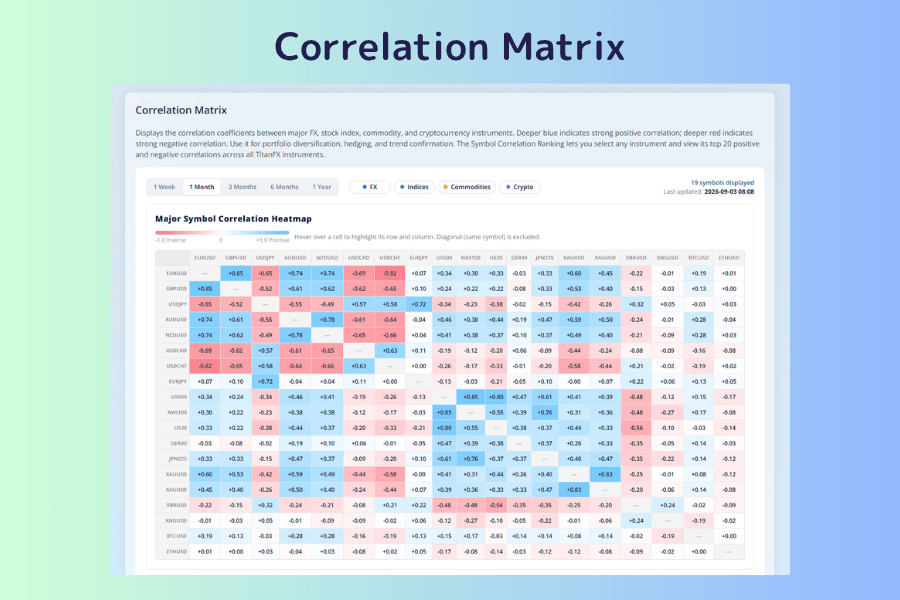
Which cells to look at in the correlation matrix
The correlation matrix lists pairwise correlation coefficients for 19 major instruments, and the crude oil in it is Brent (XBRUSD). There is no dollar index in the matrix, so the dollar has to be read from the dollar pairs.
Start with the direction of each pair: EURUSD rising means a weaker dollar, USDJPY rising means a stronger one.
For "oil and the dollar move inversely" to hold, two cells have to agree:
- Brent × EURUSD is positive (dollar weaker, oil firmer)
- Brent × USDJPY is negative (dollar stronger, oil softer)
Open it and the opposite combination shows up often enough, meaning oil and the dollar are moving together. The period selector runs from one week to one year, and the same cell can change sign when you switch, which is exactly why the inverse relationship should not be treated as a rule.
Two common misuses
-
Reading production cuts off the fiscal breakeven oil price. That figure reflects how dependent a government's budget is on oil revenue, and sustained prices below it do increase fiscal pressure. But OPEC and OPEC+ output decisions also weigh demand, inventories, spare capacity and coordination among members.
-
Using the dollar index to gauge the dollar against producers. The US Dollar Index is made up of six currencies weighted heavily toward the euro, and no producer currency is in it. It is suited to tracking the dollar against those six.
For trading crude directly, contract specifications and methods are covered in the article on crude oil CFDs.
7. Petrodollar FAQ
Q1: Is a petrodollar a type of currency?
No. The term covers the dollars oil producers earn from exports and the way those dollars return to financial markets. The currency itself is an ordinary US dollar.
Q2: Did the 1974 petrodollar agreement actually exist?
There is no verifiable formal treaty. What was established in June 1974 was the US-Saudi Joint Commission on Economic Cooperation, alongside a set of security and economic arrangements. Fact-checkers who requested records from the Government Accountability Office found no formal petrodollar treaty, so there was nothing to expire.
Q3: If oil stopped being priced in dollars, would the dollar collapse?
A change in the pricing currency for oil is not enough on its own to conclude that the dollar would lose its international role. Oil pricing is one source of dollar demand among several; the depth of the FX market, the scale of dollar assets, cross-border funding and official reserves all support it. Any shift in the pricing benchmark would be long and gradual.
Q4: Does settling oil in another currency mean leaving the petrodollar system?
It depends on whether the settlement currency changed or the pricing currency did. Most cases are the former: the price is still quoted in dollars and only the payment is converted. That reduces dollar demand at the payment stage without changing the pricing basis.
Q5: Do oil and the dollar always move in opposite directions?
No. They show a negative correlation over some periods, but both the strength and the sign can change with market conditions, and they often move together when risk aversion or a supply disruption is driving the market. Calculate the correlation over the period you actually trade.
Q6: Does this topic matter to an ordinary trader?
It matters for understanding where money flows, not for calling turning points. Knowing how oil revenue makes its way back into dollar assets makes it easier to see why large moves in crude reach the bond and currency markets rather than staying within energy.
8. Summary
Petrodollars are the dollar income from selling crude, and recycling is that money flowing back out. The mechanism runs in four steps: oil is quoted in dollars, the buyer sources dollars first, the producer receives them, and the surplus returns to the global economy through imports and overseas investment.
The structure formed gradually in the 1970s after Bretton Woods broke down and the oil shock hit; it is an accumulation of trading practice and capital flows. There was US-Saudi financial cooperation in 1974, but the public record contains no treaty requiring dollar-only oil sales for fifty years.
When assessing how it is changing, keep pricing currency and settlement currency apart. The adjustment so far is concentrated in some settlement arrangements and in reserve allocation, while benchmark crude is still priced predominantly in dollars.
The most practical point for trading: treat the inverse relationship between oil and the dollar as a tendency, and measure the correlation over the period you care about.
Further Reading
- Global Crude Oil Types: WTI, Brent, and Dubai Key Comparisons
- What Are EIA Crude Oil Inventories? Release Time, Six Key Numbers and Price Reaction
- Plaza Accord
- Why Invest in the US Dollar: DXY, Fed Policy and Allocation Strategy
The financial market research team at Titan FX. We produce educational content for investors across foreign exchange, commodities (crude oil, precious metals, agricultural products), stock indices, US equities and digital assets.
Primary Sources (by Category)
- History and fact-checking: US Government Accountability Office (GAO) 1979 report and response; fact-checks of the claim that a petrodollar agreement expired
- Statistics: International Monetary Fund (IMF) Currency Composition of Official Foreign Exchange Reserves (COFER); Bank for International Settlements (BIS) triennial FX survey
- Market tools: Titan FX Research Correlation Matrix