

Granville's Eight Rules: Trading Guide,Tips and Trading Signals

Granville's Rules read the relationship between price and a moving average (MA) to time entries and exits, using eight signals — four to buy and four to sell — to catch trend reversals and continuations.
In the field of technical analysis, moving averages (MA) are a fundamental yet highly practical tool. The "Granville's Eight Rules," proposed by Joseph Granville, analyze the interaction between price and moving averages to form a logical, rule-based strategy that helps investors identify optimal entry and exit points with greater precision.
Because the rules are explicit and the logic intuitive, even newcomers to technical analysis can quickly get to grips with this classic framework and apply it to real entry and exit decisions.
This comprehensive guide explores all eight signals, explaining their decision logic, real-world applications, common pitfalls, and advanced integrations. Whether you're new to trading or looking to refine your strategy, you’ll gain actionable insights to strengthen your technical approach.
- Granville's Rules time trades from the position of price relative to a moving average (MA)
- They consist of eight signals — four to buy and four to sell
- Deviation from, re-approach to, and breaks of the MA are the core of each signal
- Most effective in clear trends; range markets produce more false signals
- Combining other indicators with strict risk management is key to accuracy
- 1. Core Concepts of Granville's Rules
- 2. Visual Guide to Granville's 8 Rules: 4 Buy + 4 Sell Signals
- 3. Practical Case Studies of Granville's Rules
- 4. Common Mistakes and Key Considerations (Beginner Essentials)
- 5. Advanced Strategies: Integration with Other Indicators
- 6. Granville's Rules FAQ
- 7. Conclusion
1. Core Concepts of Granville's Rules
1-1. What Are Granville's Rules?
Granville's Rules are a technical analysis framework used to anticipate trend reversals and continuations based on the relationship between price and moving averages (MA). Originally developed by Joseph Granville in 1963, this decades-old methodology remains widely applied across stocks, futures, forex, and other major financial markets.
1-2. Mechanism: How Granville's Rules Work
The core principle lies in analyzing the dynamic interaction between price and moving averages to identify trend shifts. Instead of forecasting exact price extremes, it focuses on identifying momentum changes to guide rule-based trading decisions.
Put simply:
- Moving averages indicate the market's average cost perception
- Price reflects real-time buying and selling pressure
Key signals often arise when price and MA demonstrate:
For example, a sustained price breakout above a moving average may signal strengthening bullish momentum and entry potential.
Granville’s approach also considers excessive deviations—when price stretches too far from its MA, it can indicate overbought or oversold conditions, warranting counter-trend caution.
In essence, Granville's Rules integrate: trend identification + deviation analysis making them highly effective for spotting both trend initiations and reversal setups.
Further reading: Bias (BIAS) Concept and Calculation
2.Visual Guide to Granville's 8 Rules: 4 Buy + 4 Sell Signals
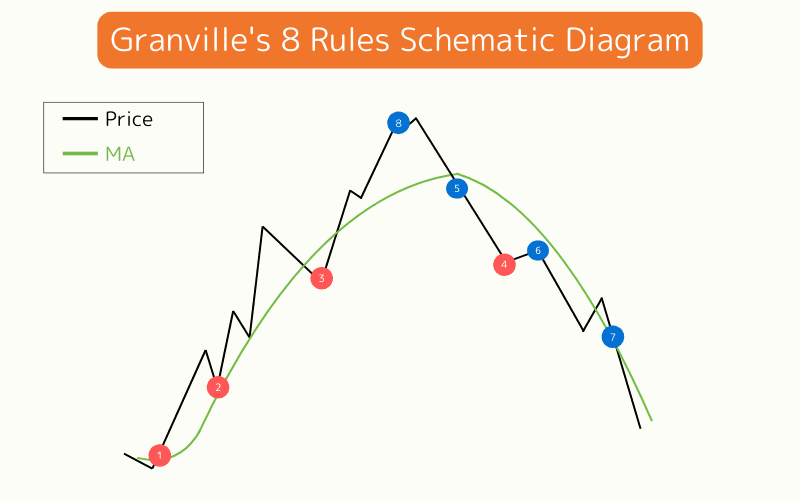
Granville’s methodology classifies price–moving average interactions into eight distinct patterns: four buy signals and four sell signals, each designed to capture potential trend reversals or continuation entries. These signals are visual, rule-based, and suitable for both discretionary and system traders.
Buy Signals
| Signal Pattern | Market Interpretation |
|---|---|
| ① Price breaks and holds above MA | Bullish trend initiation, entry confirmation |
| ② Price pulls back and bounces near MA | Successful retest of support, potential long entry |
| ③ False breakdown while MA is rising | Hidden strength; trend likely to continue |
| ④ Deep oversold deviation from MA | Mean reversion expected; rebound opportunity |
Sell Signals
| Signal Pattern | Market Interpretation |
|---|---|
| ⑤ Price breaks and holds below MA | Bearish trend initiation, breakdown confirmation |
| ⑥ Price rejected near MA resistance | Failed retest; potential short entry |
| ⑦ False breakout while MA is falling | Trend remains weak; bearish continuation |
| ⑧ Overbought deviation from MA | Mean reversion expected; pullback likely |
3. Granville's Rules in Live Market Conditions
We'll now examine practical chart examples demonstrating how to apply these signals across different market trends.
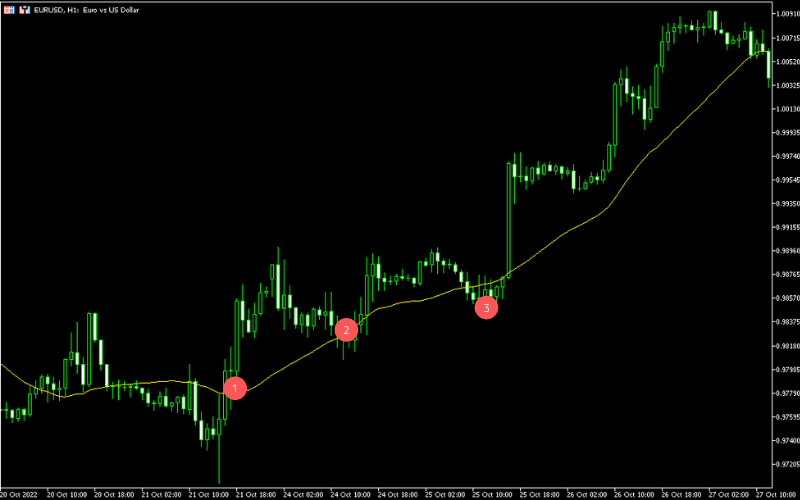
Buying Opportunities in Uptrends: Signals ①②③
EUR/USD H1 Chart with 20-period MA illustrates three classic buy signals:
Breakout & Sustained Close Above MA (①)
Confirmed bullish trend initiation
Successful Retest at MA Support (②)
Pullback to MA with subsequent bounce (optimal risk/reward entry)
False Breakdown with MA Still Rising (③)
Brief dip below MA followed by rapid recovery (continuation pattern)
Selling Opportunities in Downtrends: Signals ⑤⑥⑦ + Overbought ⑧
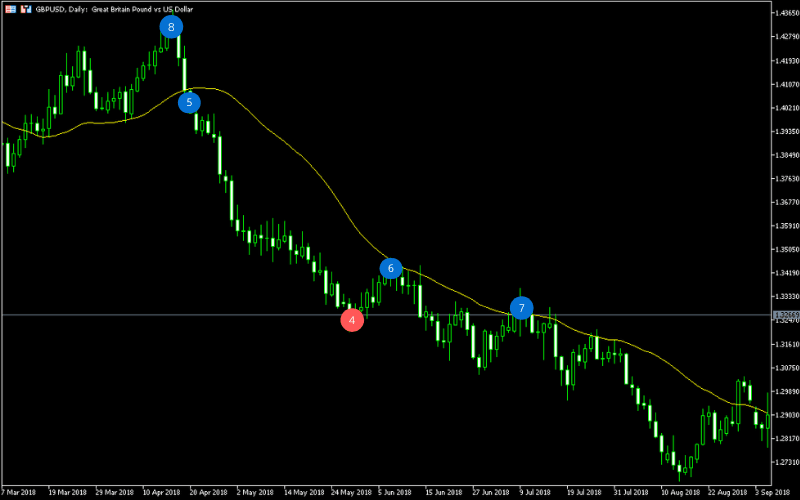
GBP/USD D1 Chart with 25-period MA demonstrates bearish signals:
Breakdown & Close Below MA (⑤)
Bearish trend confirmation
Rejection at MA Resistance (⑥)
Failed rally presenting secondary short entry
False Breakout with MA Still Falling (⑦)
Temporary spike above MA before resuming downtrend
*Overextension Above MA (⑧)
Price deviates too far from MA, signaling potential mean reversion
4. Common Pitfalls & Essential Considerations (Beginner's Guide)
While Granville's Rules provide clear trading logic, practitioners should beware these frequent mistakes - especially crucial for newcomers:
Key Consideration 1: Ignoring Higher Timeframe Trend Context
The rules perform best in established trends but generate false signals during ranging markets.
Pro Tip:
- First confirm the macro trend using longer-period MAs (e.g., 50/100-day)
- Then apply Granville signals in the trend's direction
Key Consideration 2: Treating All 8 Signals Equally
Signal reliability varies significantly:
High-Probability Signals
• Breakouts (①⑤)
• Retests (②⑥)
Require Additional Confirmation
• Deviation reversals (④⑧) - Need supporting indicators
Key Consideration 3: Single MA Period Dependency
Different MA periods provide conflicting guidance:
| Period | Pros | Cons |
|---|---|---|
| Short (e.g., 10-day) | Responsive | Whipsaws |
| Long (e.g., 50-day) | Stable | Lagging |
Best Practice:
Combine multiple periods (e.g., 20-day + 50-day MA crossover)
Key Consideration 4: Risk Management Neglect
Even valid signals require protection:
- Set stop-losses below recent swing lows/weak candles
- Limit risk to 1-2% per trade
- Avoid trading before high-impact news events
Key Consideration 5: Chasing Extended Moves
When price deviates >5% from MA:
• Exercise caution regardless of signals
• Confirm with:
- Bollinger Bands
- RSI for overbought/oversold conditions
5. Advanced Strategies: Integration with Other Indicators
Granville's Rules excel in trending markets. Combine with these indicators to filter false signals:
5-1. Momentum Indicators
RSI (Relative Strength Index)
- Buy Signals ①/②/④: More reliable when RSI < 30 (oversold)
- Sell Signals ⑤/⑥/⑧: Strengthened when RSI > 70 (overbought)
MACD
- Buy Signals ①/③: Confirm with MACD histogram turning positive or bullish crossover
- Sell Signals ⑤/⑦: Validate with bearish crossover
5-2. Price Structure
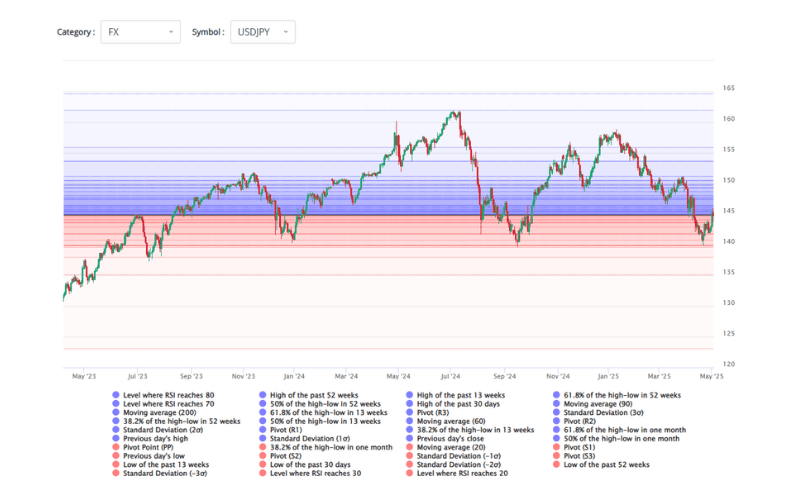
Support/Resistance
Signal strength amplifies when:
- Buy Signal ② aligns with key support
- Sell Signal ⑥ coincides with resistance
Essential Support/Resistance Tools
Candlestick Patterns
Confluence with reversal patterns increases probability:
5-3. Multi-Timeframe Confirmation
For any signal:
- Align with mid-term MA direction (e.g., 50MA)
- Ensure no opposition from long-term MA (e.g., 200MA)
- Seek higher timeframe confirmation (e.g., H4 support for daily signals)
5-4. Volatility Filter - ATR
- High ATR during deviation signals ④/⑧ warns of sharp reversals
6. Granville's Rules FAQ
Q1. Are these rules 100% accurate? Can I trade using them alone?
No technical tool is infallible. Always combine with:
- Momentum indicators (MACD/RSI)
- Candlestick patterns
- Risk management protocols
Q2. Should I enter every MA touch?
Validate with:
✔ Trend alignment
✔ Reversal candle patterns
✔ Support/resistance confluence
✔ Volume confirmation
Q3. Optimal MA Periods?
| Trading Style | Recommended MAs |
|---|---|
| Intraday (M15-H1) | 10MA, 20MA |
| Swing (H4-Daily) | 25MA, 50MA |
| Multi-TF Analysis | 20MA + 60MA combo |
Q4. Risk Management Setup
- Stop-loss: Recent swing high/low or technical level
- Position sizing: 1-2% risk per trade
- News avoidance: Reduce exposure before high-impact events
7. Conclusion
Granville's Eight Rules remain a timeless framework for identifying trend transitions through price-MA dynamics. The 4 buy/4 sell signals offer actionable patterns suitable for traders at all levels.
Key Takeaways:
-
- Best applied in trending markets
- Requires multi-indicator confirmation
- Demands strict risk control
- Effectiveness improves with experience
Mastering this system builds a solid foundation for developing robust trading strategies across financial instruments.
Further Reading
Titan FX Trading Strategy Lab. We produce educational content for investors across forex, precious metals, energy, indices, US stocks, and crypto, covering technical analysis and how markets work.
Primary Sources (by Category)
- Educational & research: Investopedia, CMT Association
- Market & data: Bloomberg, Reuters, and TradingView chart analysis and commentary