

Alligator Indicator Explained: The Three Lines, Sleep and Wake Signals, and Fractal Entries
The Alligator is a trend-reading indicator designed by Bill Williams, built from three smoothed moving averages shifted forward on the chart: the blue Jaw, the red Teeth, and the green Lips. When the three lines twist around each other, the alligator is "sleeping" — the market is ranging; when they separate and line up in order, the alligator "wakes and feeds" — a trend is in progress. The metaphor comes from his 1995 book "Trading Chaos", and the indicator belongs to the same trading system as the Fractals indicator.
Telling ranges from trends is the single most important call a trend follower has to make. Moving-average indicators are everywhere; what the Alligator does differently is compress the question "is this an environment for trend trades?" into the relative position of three lines, readable at a glance: wait while they are intertwined, and only consider following once the mouth opens.
This article covers the structure and calculation of the three lines, how to read the sleeping, waking, and eating states, the fractal-breakout pairing for entries, the caveats in practice, and the MT4/MT5 setup.
- The Alligator consists of three smoothed moving averages (SMMA): Jaw 13-period shifted 8, Teeth 8-period shifted 5, Lips 5-period shifted 3 — all calculated on the median price ((high + low) ÷ 2).
- Lines intertwined = the alligator sleeps (range; stand down on trend signals); lines separated and stacked Lips-Teeth-Jaw = the alligator feeds (trend in progress).
- Williams' original system pairs the Alligator with fractal breakouts for entries: the mouth's direction plus a fractal break, each filtering the other.
- All three lines are smoothed, shifted moving averages, so lag is baked in; the indicator's role is a state filter, and entry timing belongs to price-structure confirmation.
- The Alligator is built into MT4/MT5 under the "Bill Williams" group — nothing to install.
- 1. What Is the Alligator Indicator?
- 2. How the Alligator's Three Lines Are Calculated
- 3. How to Read the Alligator: Sleeping, Waking, and Eating
- 4. How to Pair the Alligator with Fractals
- 5. Caveats When Using the Alligator
- 6. Alligator Settings and Display in MT4/MT5
- 7. Alligator Indicator FAQ
- 8. Summary
1. What Is the Alligator Indicator?
The Alligator is a trend indicator made of three moving averages that are first smoothed and then displaced toward the future on the chart. Its designer is Bill Williams, author of "Trading Chaos". Each line has a name and a color: the blue Jaw reacts slowest, the red Teeth sits in the middle, and the green Lips reacts fastest and hugs current price most closely.
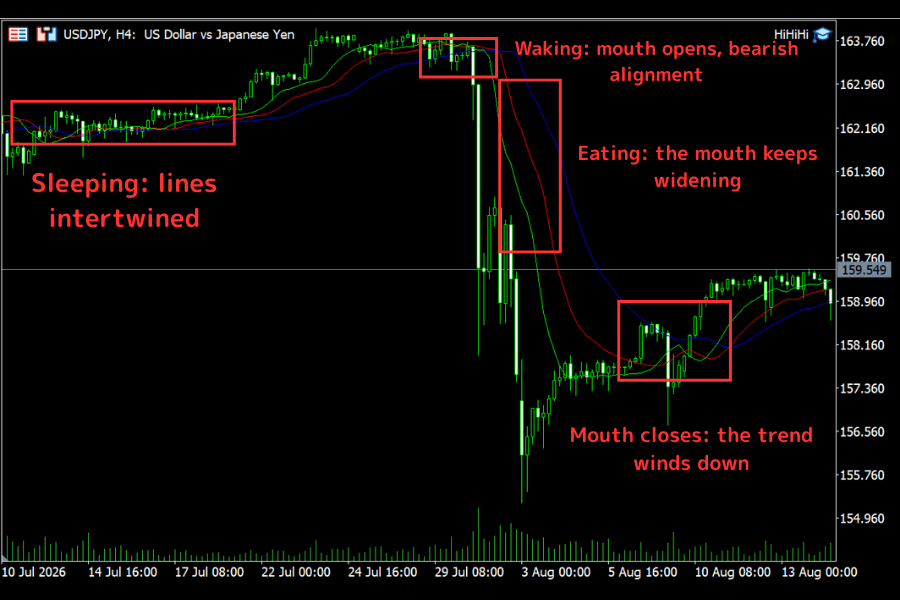
Williams described the market through the alligator's routine. Most of the time the animal sleeps — the three lines twist together with no clear direction, the market is ranging, and trend trades have no edge. After enough sleep the alligator opens its mouth — the lines separate and stack in order, and a trend gets under way. When the meal is over, the mouth closes — the lines bunch up again, the trend winds down, and the market drifts back into a range.
The metaphor earns its keep by turning "what state is the market in" into a shape you can see on the chart. For a trend follower, the first question the Alligator answers is not which way to trade — it is the more basic one: whether this is the moment to act at all.
2. How the Alligator's Three Lines Are Calculated
All three lines start from the median price ((high + low) ÷ 2), take a smoothed moving average (SMMA), and then shift the whole line forward (to the right) by a set number of bars:
| Line | Color | SMMA period | Forward shift | Role |
|---|---|---|---|---|
| Jaw | Blue | 13 | 8 | Slowest; the longer-term center of gravity |
| Teeth | Red | 8 | 5 | Medium speed |
| Lips | Green | 5 | 3 | Fastest; closest to current price |
Two design details are worth understanding. First, the SMMA is an even smoother cousin of the ordinary moving average, deliberately dull to single-bar noise. Second, the forward shift only moves the already-calculated lines to the right for display — the data behind them is still historical price, and no predictive power is gained. What matters in reading the Alligator is always the separation and convergence of the three lines relative to each other.
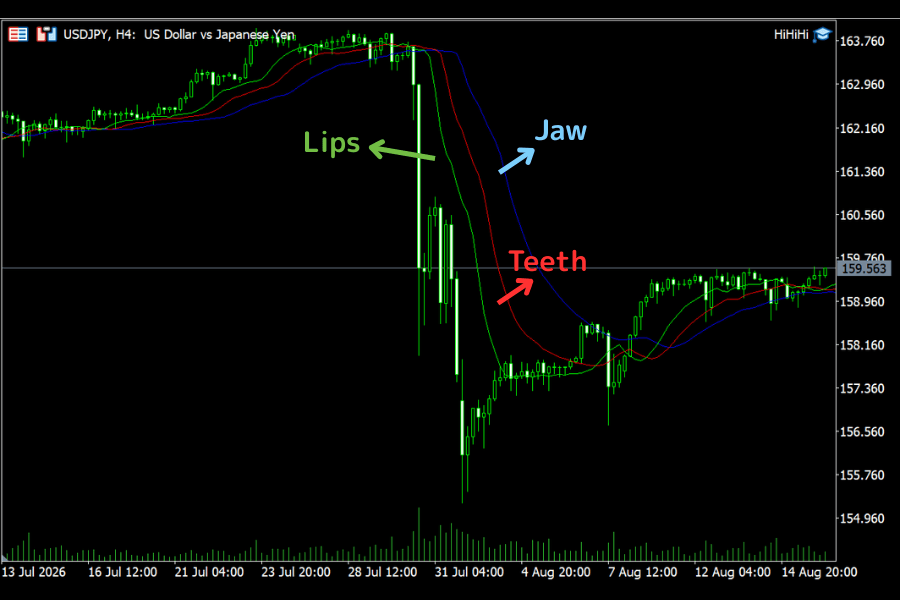
The 13/8/5 periods and 8/5/3 shifts are Williams' original settings and the MT4/MT5 defaults. In practice, start with the defaults: they are the baseline of the original system, and changing periods or shifts alters the indicator's sensitivity to trend states — the fractal pairing then needs to be re-validated before you rely on it.
3. How to Read the Alligator: Sleeping, Waking, and Eating
Reading the Alligator revolves around the relative position of the three lines and the direction of the open mouth, in three typical states.
State 1: Sleeping — the Lines Intertwine
The three lines cross back and forth while price weaves through the cluster. This is the market's range phase: the averages lose directional meaning, and trend signals fail here most often. Williams' advice is blunt — don't wake a sleeping alligator; step aside and watch. His metaphor has a second half: the longer the alligator sleeps, the hungrier it gets — so a mouth opening after a long tangle deserves special attention. A long consolidation, however, is no guarantee that the move that follows will be any bigger.
State 2: Waking — the Mouth Opens and the Order Forms
The Lips (green) leave the cluster first, crossing the Teeth and the Jaw, and then the three lines begin to separate. In an uptrend the stacking runs Lips, Teeth, Jaw from top to bottom (green, red, blue); a downtrend is the exact mirror. Only when the open mouth and the correct stacking appear together do you have a complete waking signal — if only the Lips are darting around while the other two stay tangled, it is usually still sleep-phase noise.
State 3: Eating and Closing — the Trend Runs and Ends
Three lines pointing the same way, the gap widening, price running along the outside of the Lips — that is the feeding phase, the body of the trend. When price starts slipping back between the Lips and Teeth and the gap narrows, the alligator is full and closing its mouth: the once-clear trend structure is weakening. What follows may be a pullback, a range, or a reversal — stop extrapolating the old trend either way. The decisions that remain are exits and tightening stops; the window for adding to trend positions has passed.
As an aside: if you want a more direct view of how the three lines converge and diverge, the Gator Oscillator — from the same Bill Williams family — plots the distances between the Alligator's lines as a histogram, making the mouth's rhythm easy to see.
4. How to Pair the Alligator with Fractals
The Original Pairing: Fractal Breakouts
The Alligator and the Fractals indicator come from the same system, and Williams' original entry rule is their combination: with the mouth open upward, the buy signal is a break of the nearest up fractal sitting above the Teeth (the red line); with the mouth open downward, the mirror applies. The Alligator answers "should I trade, and which way" while the fractal breakout answers "at what price" — state filter and trigger, each doing its own job. That division of labor is exactly why the two sit side by side in the "Bill Williams" group.
Cross-Checking with Momentum
The Alligator reads market state purely from moving-average structure; the Momentum indicator measures the speed of price change — a separate dimension. If momentum expands in the same direction after the mouth opens, the two dimensions confirm each other. If price makes a new high and momentum fails to follow, keep a question mark over the trend's staying power even while the mouth is still open.
5. Caveats When Using the Alligator
① Lag is intrinsic — no setting removes it. All three lines are smoothed and then shifted, so signals arrive half a step late by construction: by the time waking is confirmed, the move has usually traveled some distance; by the time the closing mouth is confirmed, the retracement has already happened. Shortening the periods buys sensitivity at the cost of more noise signals during sleep phases — a trade-off, not a fix.
② Crosses during the sleep phase carry no trend meaning. While the lines are tangled, crossings between price and the three lines are frequent and meaningless, and any golden-cross/death-cross reading should be suspended. The precondition for everything is state first: ask whether the alligator is awake before discussing direction.
③ Wait for price confirmation to guard against false wake-ups. A mouth that opens and immediately closes is a false waking — the same animal as a false breakout. Two practical safeguards: wait for the fractal breakout to trigger before entering (see Section 4), and wait for a closing-price confirmation in the mouth's direction so a one-bar flash of opening cannot drag you in.
④ Let stops follow structure. For trend positions, the nearest opposite fractal is the original system's stop anchor; if you are used to channel tools, the shorter-period opposite band of a Donchian Channel is another common choice. Size positions to the instrument's volatility so that the money at risk per trade stays constant. The indicator supplies the state; risk control is still yours to finish.
6. Alligator Settings and Display in MT4/MT5
The Alligator is built into MT4/MT5 — nothing to install. In MT5, go to "Insert" → "Indicators" → "Bill Williams" → "Alligator" in the menu above the chart, and the three lines are drawn over the candles on the main chart.
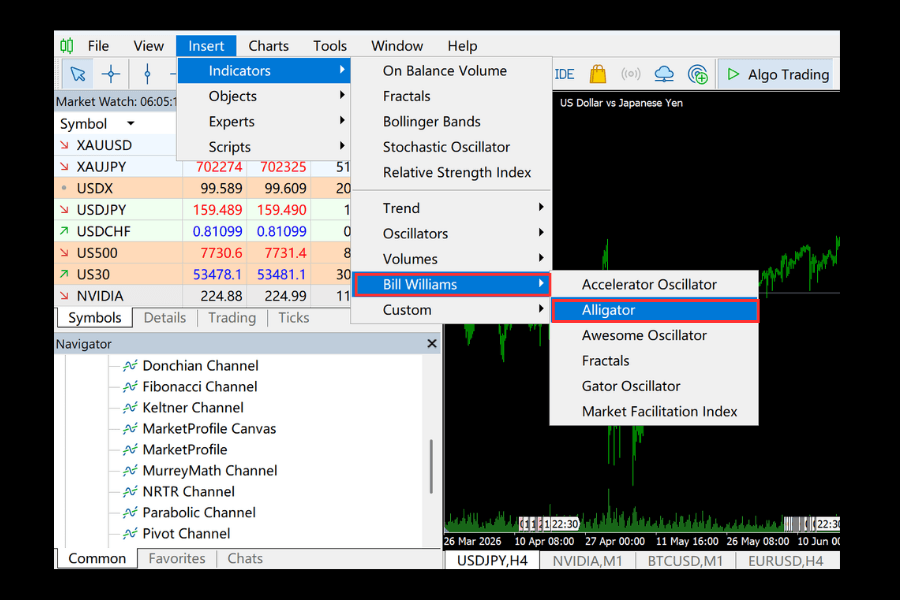
The settings window lets you adjust each line's period, shift, and color. The defaults are the original parameters (Jaw 13/8, Teeth 8/5, Lips 5/3) with the applied price set to Median Price (HL/2) — best left as they are. In MT4 the menu naming differs slightly: go to "Insert" → "Indicators" and pick "Alligator" from the Bill Williams group. The display works the same way as MT5.
For the full list of indicators available on the platform, see the page below.
All Custom Indicators7. Alligator Indicator FAQ
Q1: What do the Alligator's three lines represent?
The blue Jaw is a 13-period SMMA shifted 8 bars — the slowest line, tracking the longer-term center of gravity of price. The red Teeth is 8 periods shifted 5, the middle speed; the green Lips is 5 periods shifted 3, the fastest and closest to current price. The separation, convergence, and stacking order of the three make up the sleeping/waking/eating framework.
Q2: Can the Alligator's parameters be changed?
They can, but start with the defaults. The 13/8/5 periods and 8/5/3 shifts are Williams' original settings and the baseline for the fractal pairing. Shorter periods raise sensitivity to recent price action and add range-phase noise in equal measure. Backtest any change before relying on it, and don't assume shorter automatically means better.
Q3: How is the Alligator different from an ordinary moving-average crossover?
Similar ingredients, different use. A standard two-MA crossover treats the cross itself as the trade signal. The Alligator's focus is the tangling and opening of three lines — it first classifies the market as ranging or trending, and leaves the actual entry price to the fractal breakout. That extra layer of state filtering is what separates it from plain crossover systems.
Q4: Can I trade while the alligator is sleeping?
Under the Alligator's trend-following logic, sleep-phase trend signals are best left alone. If you still want to participate, you need a separate range strategy — defining the range boundaries yourself, cutting position size, and shortening targets. The Alligator's sleep state only says trend quality is poor; it does not mark the range's edges for you. The worst habit is running trend signals back and forth inside a range.
Q5: Which instruments and timeframes suit the Alligator?
It applies across instruments and timeframes — major forex pairs, gold, and equity indices are all common hosts. Smaller timeframes produce more frequent signals and feel short-term noise more; larger timeframes reflect bigger trend structures. The right combination depends on your holding period and backtesting. Whatever the market, the precondition never changes: state first, entries second.
Q6: Do the Alligator and Fractals have to be used together?
Using the Alligator alone as a state reader is perfectly workable, but Williams designed the two as a pair: the Alligator filters state and direction, and Fractals supply the concrete breakout price. Without the latter, entry timing needs another basis; without the former, fractal breakouts misfire easily in ranges. Together, each covers the other's blind spot.
8. Summary
The Alligator translates moving-average structure into a metaphor you can read at a glance: tangled lines are sleep — a range; an opening mouth with the right stacking is waking — a trend igniting; a widening gap is feeding — the trend in progress; re-convergence closes the show. It answers the trend follower's first question — whether to act at all — and hands "where to act" to the fractal breakout.
Keep its two innate traits in mind: it lags, and it suffers in ranges. Position the Alligator as a state filter, leave signal confirmation to fractals and price structure, and leave survival to stops and position sizing — and this alligator will reliably stand first watch for you in trending markets.
Further Reading
- Parabolic SAR: How to Read It, Parameter Settings, and Trailing Stops
- MACD Indicator Explained: Complete Beginner's Guide with Trading Examples
- RSI Indicator: Calculation, Interpretation, and MT4/MT5 Use
- Stochastic Oscillator: Definition, Setup, and Trading Tips
- Ichimoku Kinko Hyo: Principles, Setup, and Trading Strategies
Titan FX Research Team. We cover a broad set of financial instruments — foreign exchange, commodities (crude oil, precious metals, agricultural products), equity indices, US equities, and digital assets — producing practical, research-backed educational content for traders.
Primary Sources (by Category)
- Theory: Bill Williams, "Trading Chaos" (1995), the original source of the Alligator and Fractals; the moving-average chapters of John J. Murphy, "Technical Analysis of the Financial Markets"
- Platform documentation: the Alligator indicator definition and parameters in the MetaQuotes MT4/MT5 official guides
- Market data: the Titan FX MT4/MT5 indicator list and price data across instruments