

What Is Broadcom (AVGO)? Business, AI Chips, Earnings, Dividend and Stock History
The build-out of AI data centers has driven rapid growth in Broadcom's AI chip sales. In the third quarter of fiscal 2026, AI semiconductor revenue reached $16.7 billion, up 221% from a year earlier. A large software business and a steadily rising dividend also set Broadcom apart from most chipmakers.
This guide explains what Broadcom does, its semiconductor and software businesses, the role of its custom AI chips, its latest earnings, its dividend and stock split, how the share price has moved and what drives it, and how to invest in Broadcom stock.
- Broadcom grew out of Avago Technologies, which bought Broadcom Corporation in 2016 and took its name. Hock Tan is CEO
- The company has two segments, semiconductor solutions and infrastructure software, which made up about 70% and 30% of revenue in Q3 fiscal 2026
- Its AI business centers on custom AI chips (ASICs) and networking chips. OpenAI and Broadcom have announced a plan to deploy 10 gigawatts of custom AI accelerators
- Q3 fiscal 2026 revenue was $29.6 billion, up 86%, and Broadcom expects about $34.8 billion in Q4
- The target annual dividend for fiscal 2026 is $2.60 per share. The stock hit a record close in June 2026 and was down about 30% by mid-October
- 1. What Does Broadcom Do?
- 2. Broadcom's Two Businesses: Semiconductors and Software
- 3. Broadcom's AI Business: Custom AI Chips and Networking
- 4. Broadcom's Latest Earnings
- 5. Broadcom's Dividend and Stock Split
- 6. Broadcom Stock Price History and Drivers
- 7. How to Invest in Broadcom Stock
- 8. Broadcom FAQ
- 9. Conclusion
1. What Does Broadcom Do?
Broadcom is a technology company with both a semiconductor business and an enterprise software business. On the chip side, it makes networking chips, custom AI chips, and wireless and broadband chips. On the software side, it sells VMware cloud infrastructure, mainframe software and security software, mostly to large enterprises.
Most of its chips are made by foundries such as TSMC, and only a small number of products are made in-house. The company is headquartered in Palo Alto, California, and listed on Nasdaq. It is a member of the Nasdaq-100 (NAS100) and the Philadelphia Semiconductor Index (SOX).
Broadcom's history
Today's Broadcom was built through a series of large acquisitions:
-
2005, Avago is formed: Avago Technologies took over Agilent's semiconductor business, and Hock Tan became CEO in 2006
-
2016, Broadcom acquired: Avago bought Broadcom Corporation, and the combined company kept the Broadcom name
-
2018 to 2019, move into software: Broadcom bought CA Technologies and then Symantec's enterprise security business
-
2023, VMware acquired: The deal closed in November 2023 and made infrastructure software the company's second pillar
2. Broadcom's Two Businesses: Semiconductors and Software
Revenue is split into two segments. The table shows fiscal 2025 (ended November 2, 2025) and Q3 fiscal 2026 (ended August 2, 2026):
| Segment | Main products | Fiscal 2025 revenue | Q3 fiscal 2026 revenue | Q3 change from a year earlier |
|---|---|---|---|---|
| Semiconductor solutions | Custom AI chips, network switch chips, wireless RF components, broadband and storage chips | $36.9 billion | $20.8 billion | +127% |
| Infrastructure software | VMware cloud infrastructure, mainframe software, security software | $27.0 billion | $8.8 billion | +29% |
| Total | $63.9 billion | $29.6 billion | +86% |
AI drives most of the semiconductor growth. Outside AI, wireless RF components for smartphones are another key product line, and Apple is one of the main customers.
Software revenue is steadier. After buying VMware, Broadcom moved from perpetual licenses to subscriptions, which increased recurring revenue. Some enterprise customers and industry groups have criticized the new licensing terms, so renewals are worth watching.
3. Broadcom's AI Business: Custom AI Chips and Networking
Nvidia and AMD sell general-purpose AI accelerators (GPUs) that any customer can buy. Broadcom takes a different approach: it designs AI chips for individual customers. These are called custom AI accelerators, or ASICs (Broadcom calls them XPUs).
The AI business has two parts:
-
Custom AI chips: Large cloud and AI companies set the requirements, and Broadcom handles chip design and volume production. In October 2025, OpenAI and Broadcom announced a plan to deploy 10 gigawatts (GW) of OpenAI-designed AI accelerators, starting in stages in the second half of 2026 and targeting completion by the end of 2029
-
AI networking chips: AI data centers have to link huge numbers of chips together, and Broadcom's Ethernet switch chips handle those connections. They are used in both GPU clusters and custom chip clusters
Custom chips can be tuned for a customer's performance and power needs, but they take a long time to develop, and the revenue is concentrated in a few large customers.
4. Broadcom's Latest Earnings
Broadcom's fiscal year ends in early November, so "Q3 fiscal 2026" covers May to early August 2026. Broadcom reported Q3 results on September 2, 2026:
| Item | Q3 fiscal 2026 | Change from a year earlier |
|---|---|---|
| Revenue | $29.6 billion | +86% |
| AI semiconductor revenue | $16.7 billion | +221% |
| Non-GAAP gross margin | About 75% | — |
| Non-GAAP EPS | $3.32 | +96% |
| Free cash flow | $13.7 billion | +95% |
For Q4, Broadcom guided to revenue of about $34.8 billion, including $21.7 billion of AI semiconductor revenue, up about 93% and 236% from a year earlier.
Q4 and full-year results are expected in December 2026. Like most US companies, Broadcom reports outside regular hours, so the first price reaction often comes in after-hours trading.
5. Broadcom's Dividend and Stock Split
Broadcom pays a quarterly cash dividend. In December 2025, it raised the quarterly dividend from $0.59 to $0.65 and set a target annual dividend of $2.60 per share for fiscal 2026.
At the October 19, 2026 close of about $335, the dividend yield is about 0.8%. The yield is low after the stock's large rise, so the dividend's appeal lies mainly in its annual increases.
In July 2024, Broadcom carried out a 10-for-1 stock split: each share became 10 shares, and the share price was adjusted to one-tenth. All prices in this guide are split-adjusted.
6. Broadcom Stock Price History and Drivers
The chart below shows Broadcom's daily closing price over the past five years, adjusted for the stock split.
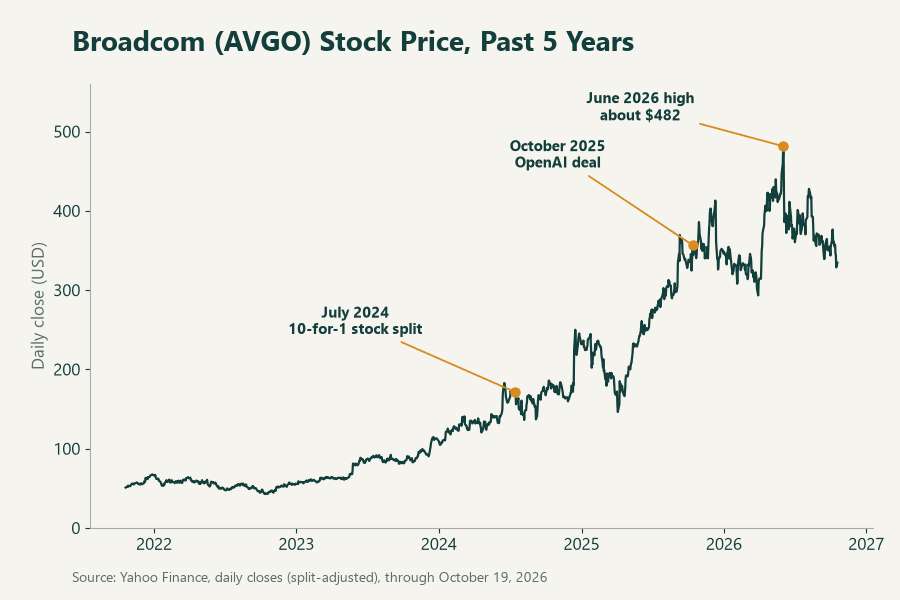
From 2023 to 2025, the stock rose sharply with AI demand and ended 2025 at about $346, roughly six times its 2022 year-end close. On October 13, 2025, the day the OpenAI deal was announced, the stock rose about 10%.
On June 2, 2026, Broadcom closed at a record of about $482. It then fell steadily, closing at about $335 on October 19, about 30% below the high and slightly below its 2025 year-end close.
These are the main factors that move Broadcom stock:
-
AI revenue growth: Investors focus most on quarterly AI semiconductor revenue and the next quarter's guidance. Even strong growth can send the stock lower if it falls short of expectations
-
Spending by large customers and cloud providers: Custom chip revenue is concentrated in a few cloud and AI companies. If a large customer slows data center spending or changes suppliers, demand for both AI chips and networking chips is directly affected
-
TSMC capacity: Capacity for advanced process nodes and advanced packaging determines whether chips ship on schedule
-
Software renewals: VMware subscription renewal rates affect the stability of the software segment
-
Valuation: After a large rally, the P/E ratio already prices in a lot of growth, so AI news that disappoints can trigger sharp declines
7. How to Invest in Broadcom Stock
There are three main ways to get exposure to Broadcom's share price:
| Method | Features | Best suited for |
|---|---|---|
| Buying shares | You own the stock directly and receive dividends | Long-term holding, a focus on dividend growth |
| CFDs | You do not own the shares; profit or loss is settled on price changes, and you can go long or short | Short- to medium-term trading, or selling short in a decline |
| Stock indices (such as NAS100) | Exposure to large tech stocks including Broadcom | Exposure to the tech sector as a whole, less single-company risk |
Titan FX offers CFDs on Broadcom. The instrument page brings together the live price, chart, technical analysis and an overall signal for each timeframe:
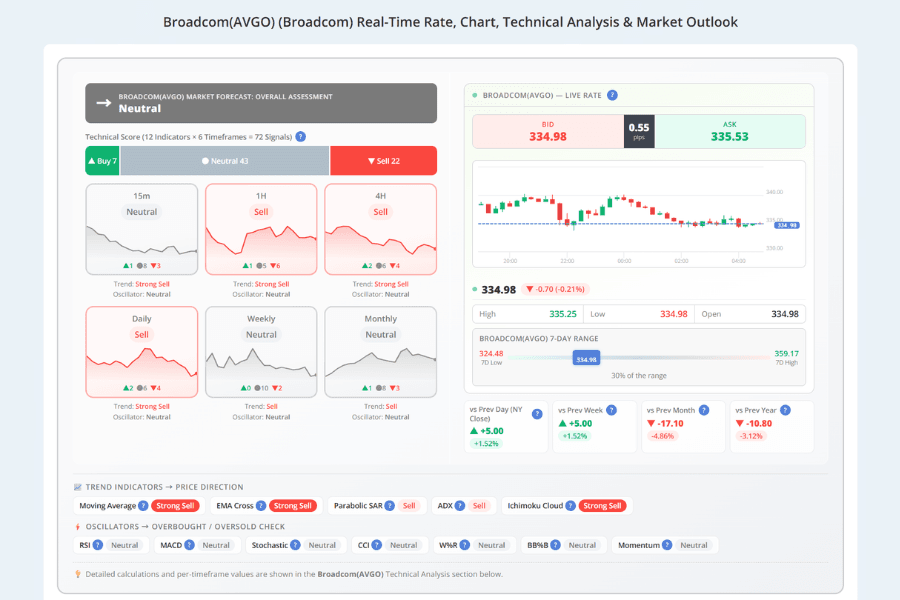
If you hold a CFD position, a dividend adjustment is applied on the ex-dividend date, and whether it is credited or charged depends on the direction of your position. Before you trade, check the required margin with the Margin Calculator.
8. Broadcom FAQ
Q1. Is Broadcom part of the Magnificent 7?
No. The Magnificent 7 are Apple, Microsoft, Alphabet, Amazon, Meta, Nvidia and Tesla. Broadcom is not one of them.
Q2. Does Broadcom pay a dividend?
Yes. Broadcom pays a quarterly cash dividend, currently $0.65 per share, and its target annual dividend for fiscal 2026 is $2.60 per share. Record dates usually fall in late March, June, September and December, with payment at the end of the same month.
Q3. Who makes Broadcom's chips?
Most are made by foundries such as TSMC. Broadcom designs the chips, and its custom AI chips use TSMC's advanced process nodes and advanced packaging, so TSMC's capacity affects Broadcom's shipments.
Q4. When does Broadcom report earnings?
Broadcom's fiscal year ends in early November, so it usually reports in March, June, September and December, about a month later than most US companies. For how stocks tend to move around reporting dates, see What Is Earnings Season?
9. Conclusion
Broadcom runs both a semiconductor business and an enterprise software business. Custom AI chips and networking chips drive growth on the chip side, while VMware anchors the software side, and the company pays a quarterly dividend.
The stock is highly sensitive to AI news. AI revenue growth, spending by large customers and cloud providers, TSMC capacity and software renewals are the main things to watch, and the next big event is Q4 earnings in December 2026.
Further Reading
Titan FX Trading Strategy Lab. We produce investor-education content covering forex, commodities (crude oil, precious metals, agricultural goods), stock indices, US equities, and digital assets.
Primary Sources (by Category)
- Company materials: Broadcom Q3 fiscal 2026 and Q4 fiscal 2025 earnings releases; OpenAI and Broadcom partnership announcement
- Market data: Yahoo Finance (AVGO daily closes, dividend and stock split history)