

Base and Quote Currency: How to Read a Pair, Trade Direction and Pip Value

The base currency is the currency on the left of a pair and the quote currency is the one on the right. The exchange rate tells you how much of the quote currency one unit of the base currency is worth. When EUR/USD trades at 1.14350, one euro buys 1.14350 US dollars.
The two positions look like a formatting detail, but they decide which currency you buy when you hit the buy button, which currency your profit is calculated in, and how your margin is worked out.
Most traders know that the left one is the base currency, and then get stuck on questions like "am I buying dollars when I buy EUR/USD?" or "why is one pip on USD/JPY worth 1,000 yen?".
This article starts with how to read a quote, then covers what actually happens when you buy or sell a pair, why pairs are written in a fixed order, and what the base currency, the quote currency and your account currency each decide.
- The left side of a pair is the base currency and the right side is the quote currency; the rate is how much quote currency one unit of base currency is worth
- Buying a pair means buying the left side and selling the right side; selling does the opposite
- Pair order follows market convention; when you need the rate the other way round, take the reciprocal
- Lot size is measured in the base currency, pip value lands in the quote currency, and your statement shows the account currency
- The base currency you pick when opening an account is your account currency, which is a different thing from a pair's base currency
- 1. What Are Base and Quote Currencies?
- 2. What the Exchange Rate Number Tells You
- 3. What You Are Really Buying and Selling
- 4. Why EUR/USD and Not USD/EUR?
- 5. Three Currencies, Three Jobs: Lots, Pip Value and Your Statement
- 6. Quote Currencies Beyond Forex: Gold, Indices and Crypto
- 7. Frequently Asked Questions
- 8. Summary
1. What Are Base and Quote Currencies?
A currency pair is made up of two currencies separated by a slash, and each position has its own name.
-
Base currency: the currency on the left of the slash. When you read the rate, one unit of this currency is the reference.
-
Quote currency: the currency on the right of the slash. It does the pricing, so the rate is expressed in this currency.
Say EUR/USD is quoted at 1.14350. The base currency is the euro, the quote currency is the US dollar, and the full meaning is "1 EUR = 1.14350 USD". Apply the same rule to USD/JPY at 157.700 and you get "1 USD = 157.700 JPY".
The quickest way to read any pair: say the slash as "one of the left equals how many of the right".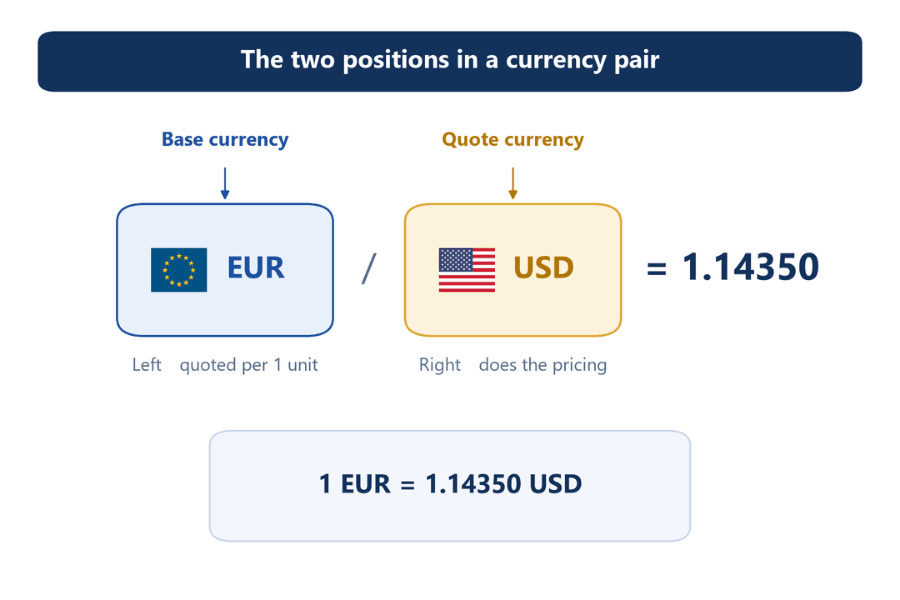
The quote currency also goes by other names. You will see it called the counter currency or the terms currency, and older textbooks sometimes use "variable currency". They all refer to the same thing: the currency on the right.
| Term | Other names in use | Position | Role in the rate |
|---|---|---|---|
| Base currency | Base, first currency | Left | Quoted per 1 unit |
| Quote currency | Counter currency, terms currency | Right | Does the pricing; the number moves with the rate |
One caution: "base currency" has a second meaning on account pages, where it refers to the currency your account is denominated in. Section 5 covers the difference.
2. What the Exchange Rate Number Tells You
An exchange rate is a relative price, so a single number says two things at once. When EUR/USD moves from 1.14350 to 1.15350, you can call it a stronger euro or a weaker dollar. Both describe the same move.
The direction is always the same.
-
The rate goes up: the base currency has gained against the quote currency. USD/JPY rising means a stronger dollar and a weaker yen.
-
The rate goes down: the base currency has lost ground. EUR/USD falling means a weaker euro against the dollar.
The size of the number says nothing about how strong a currency is. USD/JPY at 157 and EUR/USD at 1.14 are quoted in different units, so there is nothing to compare.
Rates are also split into direct and indirect quotes depending on which side your home currency sits on: your home currency on the right makes it a direct quote, on the left an indirect one. That is a separate layer, and beginners only need the left-right rule to get started.
3. What You Are Really Buying and Selling
Every forex trade is an exchange of two currencies, so trading a pair always means buying one and selling the other at the same time.
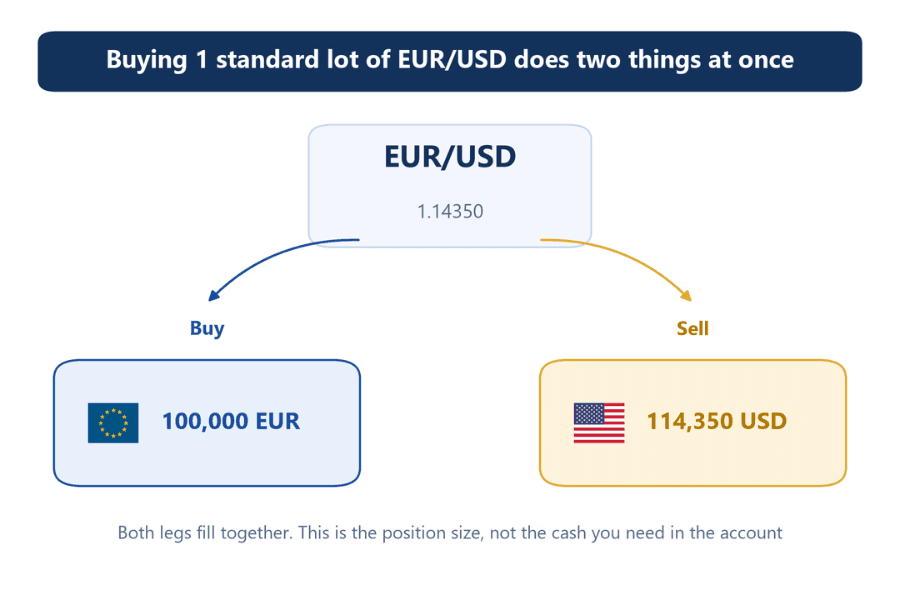
Buying a pair means buying the left and selling the right. Selling a pair means selling the left and buying the right.-
Buying (going long): you buy the base currency and sell an equivalent amount of the quote currency.
-
Selling (going short): you sell the base currency and buy an equivalent amount of the quote currency.
Buy one standard lot of EUR/USD at 1.14350 and, because a standard lot is 100,000 units of the base currency, the trade is: buy 100,000 euros, sell 114,350 dollars. That figure is the size of the position, not the cash you need in the account; section 5 covers what you actually put up.
Closing the trade means opening an equal position in the opposite direction to cancel it out, and the difference between the two prices is your profit or loss.
The two prices on the order ticket
A forex quote shows a bid and an ask at the same time, and both are stated from the base currency's point of view.
| Price | What you do | At the same moment |
|---|---|---|
| Ask | Buy the base currency | The higher of the two |
| Bid | Sell the base currency | The lower of the two |
Say EUR/USD shows an ask of 1.14360 and a bid of 1.14340. To buy EUR/USD you deal at the ask of 1.14360; to sell it you deal at the bid of 1.14340.
"Ask is higher, bid is lower" describes two prices quoted at the same moment. It does not mean the strategy is to buy high and sell low: you still aim to buy when the market price is low and sell once it has risen.
The gap between the two is the spread, quoted in pips. In the example above the difference is 0.00020, or 2 pips. The spread is a cost you pay the moment you open, which is why closing a position straight away leaves you down by roughly the spread even if the market has not moved.
Which pair to trade when you have a view on one currency
The ask on EUR/USD is the price of buying euros. A common beginner mistake is to see the dollar in EUR/USD and assume that a bullish dollar view means buying the pair.
In fact, buying EUR/USD means buying the base currency, the euro, and selling the quote currency, the dollar, so the direction is the opposite. If you expect the dollar to rise against the euro, the trade is to sell EUR/USD.
Before acting on a view about one currency, check which side of the pair it is on.
| Your view | What to do (dollar example) |
|---|---|
| Bullish dollar | Sell pairs with the dollar on the right, such as EUR/USD and GBP/USD, or buy pairs with the dollar on the left, such as USD/JPY and USD/CAD |
| Bearish dollar | Buy EUR/USD or GBP/USD, or sell USD/JPY or USD/CAD |
| Bullish euro, bearish yen | Buy EUR/JPY and express both views in one pair |
That last one is a cross currency pair, meaning neither side is the US dollar.
4. Why EUR/USD and Not USD/EUR?
The order of a currency pair comes from a convention the forex market settled on long ago. Most platforms follow the same ranking, and whichever currency comes first sits on the left as the base currency.
The order commonly used is EUR, GBP, AUD, NZD, USD, CAD, CHF, JPY.
The euro comes first, so whenever the euro is involved it usually sits on the left, which gives EUR/USD, EUR/GBP and EUR/JPY. The yen comes last and is normally on the right in major pairs.
The US dollar sits in the middle: it goes on the right against the euro, pound, Australian dollar and New Zealand dollar, and on the left against the Canadian dollar, Swiss franc and yen. That is why EUR/USD and USD/JPY both exist.
The ranking roughly follows each currency's history and trading habits. It works as a memory aid, but it is not a rule handed down by an exchange or an international body. Two practical points follow.
-
A pair is normally quoted one way only: the convention is EUR/USD, and no separate USD/EUR is listed alongside it. To see the rate the other way round, take the reciprocal: 1 ÷ 1.14350 is about 0.8745, so one dollar is about 0.8745 euros.
-
Where the dollar sits defines the category: pairs that include the dollar are majors or dollar pairs, pairs without it are crosses, and the two differ in spread and liquidity.
| Currency | Position in the order | Usual side |
|---|---|---|
| EUR | 1 | Usually on the left in major pairs |
| GBP | 2 | On the right only against the euro |
| AUD, NZD | 3, 4 | On the right against the euro and pound |
| USD | 5 | Either side, depending on the other currency |
| CAD, CHF | 6, 7 | Usually on the right |
| JPY | 8 | Usually on the right in major pairs |
5. Three Currencies, Three Jobs: Lots, Pip Value and Your Statement
Three currencies show up when you work out the money, and each one has its own job. Keep the three layers apart and your statement stops being confusing.
| Layer | What this layer decides | US dollar account trading EUR/JPY |
|---|---|---|
| Base currency | The notional size of the position | Euro |
| Quote currency | Pip value and the raw profit or loss | Yen |
| Account base currency | The amount shown and settled in the account | US dollar |
Lots are measured in the base currency
A lot converts into the base currency. One standard forex lot is 100,000 units of the base currency: one lot of EUR/USD is 100,000 euros, one lot of USD/JPY is 100,000 dollars. The same "one lot" is not the same amount of money.
Contract sizes depend on the account type. On Titan FX Standard and Blade accounts, one forex lot is 100,000 units with a 0.01 lot minimum; on a Micro account one lot is 1,000 units with a 0.1 lot minimum. Check the platform's contract specifications before you trade.
Lots multiplied by the contract size gives the notional amount: what the position is worth in the base currency. Half a lot of EUR/USD is 50,000 euros, two lots is 200,000 euros. Pip value and margin are both calculated from this figure.
Pip value lands in the quote currency
Pip value is how much your profit or loss changes when the price moves by one pip. The size of a pip depends on how the pair is quoted: the fourth decimal place for most pairs, the second decimal place for yen pairs.
The result is denominated in the quote currency.
| Pair and lot size | Notional amount | One pip | Pip value |
|---|---|---|---|
| EUR/USD, 1 standard lot | 100,000 EUR | 0.0001 | 10 USD |
| USD/JPY, 1 standard lot | 100,000 USD | 0.01 | 1,000 JPY |
| GBP/JPY, 1 standard lot | 100,000 GBP | 0.01 | 1,000 JPY |
| EUR/USD, 1 micro lot | 1,000 EUR | 0.0001 | 0.1 USD |
GBP/JPY and USD/JPY have the same pip value because the quote currency is the yen in both.
Your statement shows the account base currency
When you open a trading account you choose a currency for it, usually called the account base currency. Titan FX offers US dollars, euros, Japanese yen and Singapore dollars.
When the quote currency and the account currency differ, the platform converts at the prevailing rate. On a dollar account with USD/JPY at 157.700, a pip value of 1,000 yen works out at about 6.34 dollars, and that figure changes as the rate moves.
Most traders pick the currency they deposit and withdraw in. Whether it actually saves conversion costs also depends on your funding method and the instruments you trade.
Margin comes back to the base currency
The result is in the base currency, then converted into your account currency.
Take one standard lot of EUR/USD at an assumed leverage of 1:500: the margin is 100,000 ÷ 500 = 200 euros. With EUR/USD at 1.14350, that is about 228.70 dollars on a dollar account.
Those 200 euros are the "cash you actually put up" mentioned in section 3, as opposed to the 100,000 euro notional.
Leverage varies by account type and instrument. The full method is covered in the article on margin calculation.
Swap points follow the same logic: they come from the interest-rate difference between the two currencies and are converted into your account currency when they are credited.
Open the Margin Calculator6. Quote Currencies Beyond Forex: Gold, Indices and Crypto
The same reading applies to CFDs outside forex.
-
Gold: XAU/USD is written like a currency pair, and the number is what one ounce of gold is worth in dollars. Profit and loss are in dollars too.
-
Stock indices: instruments such as US30 have no slash, but they still have a quote currency. US30 is priced and settled in dollars, while the Nikkei is priced in yen.
-
Crypto: BTC/USD reads exactly like a currency pair — what one bitcoin is worth in dollars.
The unit in the quote and the size of one lot are two different things. Gold is quoted per ounce, but one lot is not one ounce: on Titan FX Standard and Blade accounts one gold lot is 100 ounces, and on a Micro account it is 10 ounces.
Index and crypto contracts have their own specifications as well, so work out pip value from each instrument's contract size instead of reusing the forex numbers.
If you are not sure which instrument to start with, how to choose a currency pair sets out a screening routine built around our tools.
7. Frequently Asked Questions
Q1: Is the base currency of a pair the same as my account base currency?
No. Both are called base currency, which is where the confusion comes from, but a pair's base currency is the one on the left of the slash and changes with the instrument you trade, while your account base currency is the currency you chose when you opened the account and never changes with the trade. Read the context: a pair means the left-hand currency, an account means the account's denomination.
Q2: EUR/USD is up. Is the euro stronger or the dollar weaker?
Both statements work, because an exchange rate is a relative price. To see which side is driving, look at other pairs containing the same currencies: if EUR/JPY and EUR/GBP are also rising, the euro is the bigger factor; if several dollar pairs show a weaker dollar at the same time, the dollar is.
Q3: Am I buying dollars when I buy EUR/USD?
No. Buying EUR/USD means buying euros and selling dollars. The dollar is the quote currency here, so buying the pair means giving up dollars for euros. To go long the dollar, buy a pair with the dollar on the left or sell one with the dollar on the right.
Q4: Why is there no USD/EUR?
Market convention puts the euro ahead of the dollar, so this pair is always quoted as EUR/USD and no reversed version is listed alongside it. When you need to know how many euros one dollar buys, take the reciprocal: 1 ÷ 1.14350 is about 0.8745.
Q5: Which currency are pip value and profit calculated in?
Pip value is calculated in the quote currency, profit and loss settle in the quote currency first, and the platform then converts the result into your account currency for display. When all three match you never notice the conversion, as on a dollar account trading EUR/USD. When they differ there is an extra step: a dollar account trading EUR/JPY converts yen into dollars.
Q6: USD/JPY is 157. Does that make the yen the weaker currency?
The size of the number tells you nothing about relative strength. USD/JPY at 157 simply means one dollar is worth about 157 yen, which is a unit conversion. To judge strength, compare percentage moves over the same period, or use a tool such as a currency strength meter for a like-for-like ranking.
8. Summary
The base currency is the currency on the left of a pair and the quote currency is the one on the right, and the rate is how much quote currency one unit of the base currency is worth. A rising rate means the base currency has gained.
Buying a pair means buying the left side and selling the right; selling does the opposite. Check which side a currency sits on before you act on a view about it, and the direction takes care of itself. Pair order comes from market convention, and the reciprocal gives you the rate the other way round.
When it comes to the money, remember the three layers: lots are in the base currency, pip value is in the quote currency, and the figure on your statement is in your account currency. Keep them separate and reading quotes, placing orders and checking statements all get easier.
Further Reading
- Forex Glossary & Beginner's Guide: Terms Every Trader Should Know
- FX Trading Basics: What Is Forex Margin? Pros, Cons, and How to Start
- What Is Leverage Trading? Types, Calculation Methods, and Investment Strategies
- Position Sizing: How to Calculate Forex Lot Size and Pip Value
- Financing cost
Titan FX Trading Strategy Lab. We produce investor-education content covering forex, commodities (crude oil, precious metals, agricultural goods), stock indices, US equities, and digital assets.
Primary Sources (by Category)
- Contract specifications and accounts: Titan FX website — trading accounts page (account base currencies USD, EUR, JPY and SGD; Standard and Blade forex contract size of 100,000 units with a 0.01 lot minimum), Zero Micro account page (1,000 units per lot with a 0.1 lot minimum), precious metals page (100 ounces per gold lot on Standard and Blade, 10 ounces on Micro)
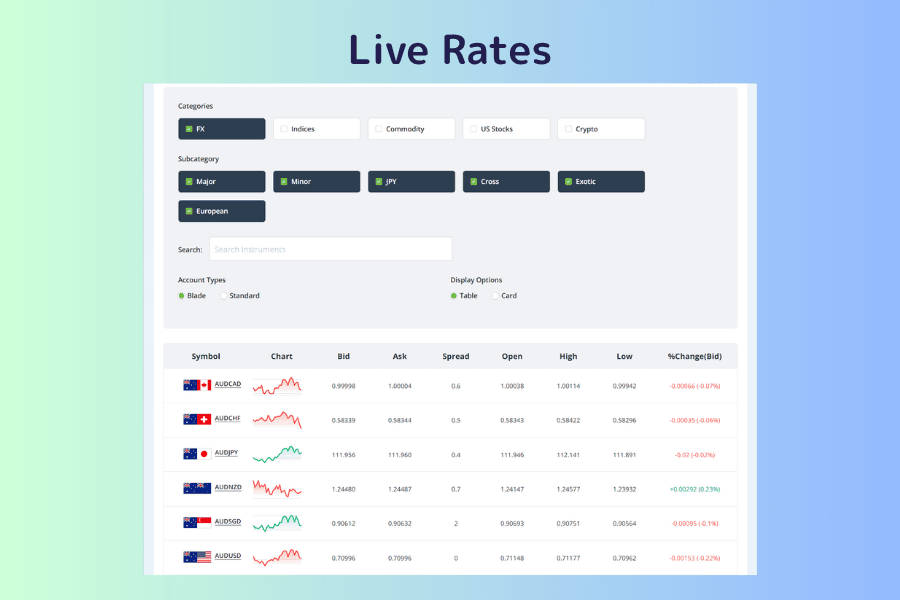
- Market tools: Titan FX Research — Live Rates (forex), margin calculator