

Soft Landing
The term comes up repeatedly in the later stages of a hiking cycle, because that is exactly when the outcome is still undecided. Inflation has come off its highs, activity data is starting to weaken, and the market is trying to work out where this one stops.
This article covers the definition and origin of the term, how it differs from a hard landing and a no landing, which indicators point to the direction of travel, the 1994 to 1995 episode, why it is difficult to achieve, and what each outcome means for different assets.
- A soft landing is an outcome, not something a central bank can select directly
- A hard landing means a sharp slowdown or recession; a no landing means neither growth nor inflation cools
- Direction has to be read from labor, inflation, rate pricing, earnings and credit together
- Policy works with a lag, and that is the core reason this is hard to achieve
- For trading, first establish which scenario the market has priced
- 1. What Is a Soft Landing? Definition and Origin
- 2. Soft, Hard and No Landing: Three Different Endings
- 3. Which Way Is It Heading? Five Things to Watch
- 4. Has It Ever Worked? The United States in 1994 to 1995
- 5. Why It Is Difficult: The Policy Lag
- 6. What Does a Soft Landing Mean for FX, Equities and Bonds?
- 7. Soft Landing FAQ
- 8. Summary
1. What Is a Soft Landing? Definition and Origin
When an economy overheats, prices rise. The central bank raises borrowing costs through rate hikes, demand and investment cool, and inflation follows them down. If that process runs its course, inflation returns to the range the central bank wants, the economy avoids a marked or sustained recession, and unemployment does not jump, the episode is called a soft landing after the fact.
Falling inflation is not always the work of rate hikes alone. Supply chains repairing themselves, energy prices easing and labor supply expanding can all be helping at the same time, which complicates any later judgment about how much the policy achieved.
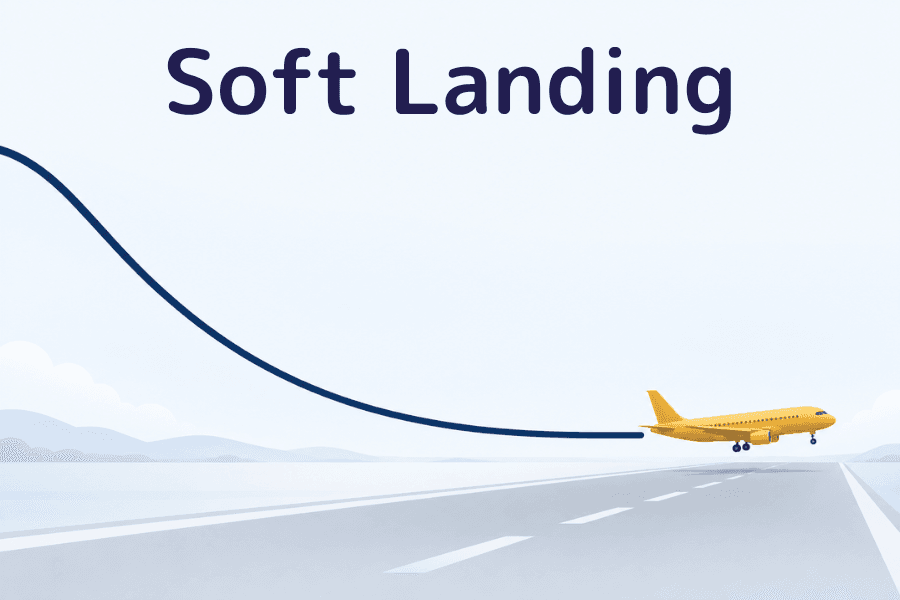
The phrase comes from aviation. An aircraft has to slow down to land; too little and it runs off the runway, too much and it stalls. Only the narrow path between the two ends in an intact aircraft. A central bank faces something similar: hike too little and inflation is not contained, hike too much and demand is pushed into recession.
A soft landing is not a target a central bank can set directly. What it decides is the policy rate and the direction of monetary policy; how the economy responds depends on conditions outside its control.
2. Soft, Hard and No Landing: Three Different Endings
These are three possible endings to the same hiking cycle, and what separates them is where growth and inflation are heading at the same time.
| Ending | Inflation | Activity | Labor market | Typical policy setting |
|---|---|---|---|---|
| Soft landing | Keeps cooling | Slows but stays resilient | Cools gradually | Restrictive stance held, or eased in steps |
| Hard landing | Usually falls fast | Sharp slowdown or recession | Unemployment rises clearly | Pressure to cut builds |
| No landing | Cooling stalls or reverses | Stays strong | Still tight | High rates for longer, possibly further tightening |
A hard landing has a downward loop inside it: demand is squeezed too hard, firms cut investment and headcount, and falling incomes suppress consumption further. Inflation usually falls here too, but because demand has shrunk rather than because supply and demand have rebalanced.
A no landing is a scenario label used by markets rather than a defined state; there is no agreed measure for it the way there is for GDP or unemployment. It is more awkward than it sounds, because an economy that has not broken is an economy where rates can stay high for longer.
A worse combination is stagflation: growth stalls while inflation stays high. Hiking deepens the downturn and cutting feeds inflation, so policy has no option that satisfies both.
3. Which Way Is It Heading? Five Things to Watch
No single indicator answers this. Read the five together and the direction becomes clearer.
How the labor market cools
When a labor market cools, unemployment usually drifts up. What matters is how it gets there. Fewer job openings, shorter hours and a lower quits rate describe the gentle route; jumps in layoffs and a run of rising jobless claims describe the other one.
Three series belong together here. Non-farm payrolls show how many jobs were added, job openings (JOLTS) show how far labor demand has fallen, and the unemployment rate shows whether cooling has turned into job cuts. Slowing hiring alongside a stable unemployment rate and an orderly decline in openings and quits is closer to the gentle version.
The last stretch of inflation
The early part of CPI coming off its highs can be helped along by energy and goods prices normalizing and by base effects. The closer it gets to target, the more attention shifts to whether services, shelter and wage-related pressures are still easing, and that stretch tends to decide whether a central bank feels able to stop.
How the market prices the rate path
When the market suddenly prices in faster cuts, the question is whether inflation is falling faster than expected or whether concern about growth and jobs is building. The same set of cut expectations can sit on top of completely different scenarios.
The dot plot and the path implied by rate futures can be read against each other, and the gap between them is information in itself.
Corporate earnings and investment
Leading indicators such as the ISM manufacturing index, capital spending plans and company guidance usually register changes in demand before GDP does. GDP is quarterly and gets revised, so it is not something to lean on alone for a real-time read on a turning point.
Credit conditions
Bank lending standards, corporate credit spreads and default rates. When financial conditions tighten faster than the real economy is cooling, the risk of a hard landing rises.
The release schedule for all of this can be laid out on an economic calendar, and comparing month to month is more useful than reading any single print.

4. Has It Ever Worked? The United States in 1994 to 1995
The episode cited most often is the United States in 1994 to 1995.
The Federal Reserve took the federal funds rate from 3% to 6% in a little over a year, a large move at a brisk pace. The market widely expected the economy to be pushed into recession. Growth slowed and then steadied, inflation was contained, and no recession arrived.
The conditions were not easy to reproduce. Inflation started from a level that was not especially high, productivity was improving, and global supply chains had not taken a major hit. Looking at a longer span of cross-country experience, bringing inflation down without a marked recession has not been common, which is why a soft landing is treated as a difficult outcome.
Whether a given cycle counts as a soft landing is normally confirmed once the data is complete. While it is happening, the discussion tends to stay at the level of probabilities.
5. Why It Is Difficult: The Policy Lag
The central reason is that monetary policy does not take effect immediately.
After a hike, borrowing costs show up first in new lending, then in corporate investment decisions and household spending, and only then in employment and prices. That transmission from policy to the real economy is usually counted in quarters, and the length differs from cycle to cycle.
This creates a structural problem. When a central bank decides whether to keep hiking, the data in front of it reflects the policy of several quarters ago. Even once current data has started to soften, part of the effect of earlier hikes is still working its way through.
Two more factors raise the difficulty. First, where inflation is driven by the supply side, such as energy prices or supply chain disruption, there is only so much hiking can do, though it still suppresses demand. Second, market reactions amplify or offset policy, with financial conditions loosening or tightening before the central bank has moved at all.
6. What Does a Soft Landing Mean for FX, Equities and Bonds?
The three endings imply different pricing logic. What follows are common scenarios; the actual reaction depends on how much the market has already reflected.
-
FX: an exchange rate is a relative price, and the market compares the resilience and rate paths on both sides. An economy that stays resilient while cut expectations lag its peers can find support from the rate differential; as hard landing expectations build, cuts get priced in early and money tends to rotate toward safe-haven currencies.
-
Equities: a soft landing usually implies earnings still have support while the pressure from rates eases, so the market is more willing to pay up for risk assets. A no landing works the other way, with high rates continuing to hold valuations down.
-
Bonds: as expectations for a sharp slowdown and cuts increase, medium and long-dated government yields can fall; where the economy stays resilient and rates need to hold at a high level, the room for yields to decline is limited.
-
Commodities: demand-sensitive markets such as crude oil and industrial metals track global growth expectations, so rising hard landing risk tends to weigh on them. Gold also has to be read against real rates, the dollar and safe-haven demand.
The practical approach is to establish which ending the market is currently pricing, then watch whether each new release reinforces that or revises it. Once a recession is priced, a firm employment print moves the market far more than the same print would in an optimistic setting.
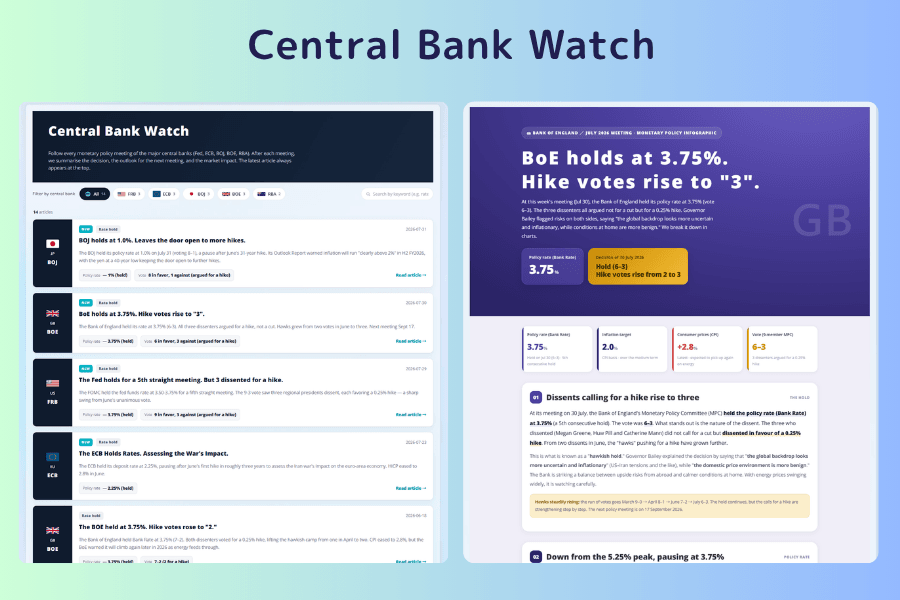
Policy stances and meeting outcomes for the major central banks can be checked in one place, and comparing how their timing differs helps with reading rate differentials.
7. Soft Landing FAQ
Q1: Is there a precise numerical definition of a soft landing?
There is no single agreed definition. The common approach is to look at the quarters after a hiking cycle ends and ask whether growth turned negative, how far unemployment rose, and whether inflation returned to around target. Different institutions use different thresholds, so the same period can produce different verdicts.
Q2: How does a soft landing relate to the business cycle?
A soft landing describes one way the business cycle can pass from expansion into slowdown. The cycle itself still runs; what differs is whether the slowdown leads back to expansion or continues into recession.
Q3: If a central bank says it is aiming for a soft landing, does that mean it expects one?
No. That is a statement of policy intent rather than a forecast of the outcome. Central banks acknowledge the lags and the incomplete information they work with, and the result depends on the data that follows.
Q4: Inflation has come down, so is that a soft landing?
It depends on the state of the economy as well. If inflation is falling because demand has collapsed, that is the hard landing process. Inflation and growth have to be read together.
Q5: Does a central bank cut rates straight after a soft landing?
Not necessarily. The timing of rate cuts depends on the mix of inflation, employment and financial conditions, and easing too early risks inflation turning back up. The gap between the last hike and the first cut differs every time.
Q6: Is the term only used for the United States?
No. It applies to any economy in a hiking cycle and comes up in discussion of the euro area, the UK and Australia. Attention concentrates on the United States because the path of the federal funds rate affects funding costs worldwide.
8. Summary
A soft landing is one ending to a hiking cycle: inflation back near target, growth slower but not in recession. What separates it from a hard landing and a no landing is where growth and inflation are heading at the same time.
Reading the direction takes the way the labor market is cooling, the last stretch of inflation, how the market prices the rate path, corporate earnings and credit conditions; no single indicator settles it. The lag in policy transmission is the core of the difficulty, and the reason successful episodes have not been common.
For traders, rather than calling the final outcome, it is more practical to confirm which scenario the market is pricing and then follow how new data revises it.
Further Reading
- Hawks
- What Is Quantitative Tightening (QT)?
- Deflation
- Forex Fundamental Analysis: Concepts, Objectives, Influencing Factors and Methods
The financial market research team at Titan FX. We produce educational content for investors across foreign exchange, commodities (crude oil, precious metals, agricultural products), stock indices, US equities and digital assets.
Primary Sources (by Category)
- Policy and data: Federal Reserve policy statements and the Summary of Economic Projections (SEP); monetary policy reports from other central banks
- Statistics: US Bureau of Labor Statistics employment and price data; US Bureau of Economic Analysis GDP releases
- Market tools: Titan FX Research Economic Calendar, Central Bank Watch, economic indicators by country