

What Is the MSCI Index? Index Family, Review Schedule, and Market Impact
The MSCI Index refers to the family of stock indexes calculated and maintained by index provider MSCI, spanning global, regional, and single-market benchmarks used by fund managers worldwide. From the all-encompassing ACWI down to single-market indexes for Taiwan, Japan, and beyond, the family forms a shared coordinate system that global capital uses to measure performance and allocate positions.
Every February, May, August, and November, MSCI reviews index constituents and weights. Around each announcement and implementation, markets such as Taiwan and Hong Kong often see foreign-fund flows and a burst of closing-auction volume — the so-called "MSCI effect." Understanding how these reviews work hands traders a class of market events whose timing is known in advance.
This guide walks through the MSCI index family and market classification, the free float-adjusted market-cap weighting behind index construction, the annual review schedule and implementation mechanics, how index changes move markets and individual stocks, and how traders can prepare for review events.
- The MSCI Index is a family of stock indexes calculated by MSCI, used as benchmarks by a vast pool of passive and active money worldwide
- The family runs from global (ACWI) and developed markets (World) down to emerging markets and single-market indexes
- Construction uses free float-adjusted market-cap weighting; inclusion depends on size, liquidity, and foreign accessibility
- Reviews take place in February, May, August, and November; May and November are Semi-Annual Index Reviews with a broader scope and typically higher market attention
- Around announcements and implementation dates, flow-driven volatility is common — markets call it the "MSCI effect"
- 1. What Is the MSCI Index?
- 2. Which MSCI indexes exist? ACWI, World, EM, and single markets
- 3. How are the indexes built? Free-float weighting and inclusion criteria
- 4. How often does MSCI rebalance? The Feb-May-Aug-Nov schedule
- 5. How do MSCI changes move markets?
- 6. How should traders handle MSCI reviews?
- 7. FAQ: Common questions about the MSCI Index
- 8. Conclusion: Put index reviews on your event calendar
1. What Is the MSCI Index?
The MSCI Index is the collective name for the stock indexes calculated and maintained by MSCI across global, regional, and single markets. Formerly Morgan Stanley Capital International, MSCI is now an independent listed company whose core business is building and maintaining indexes, classifying markets, and providing investment analytics.
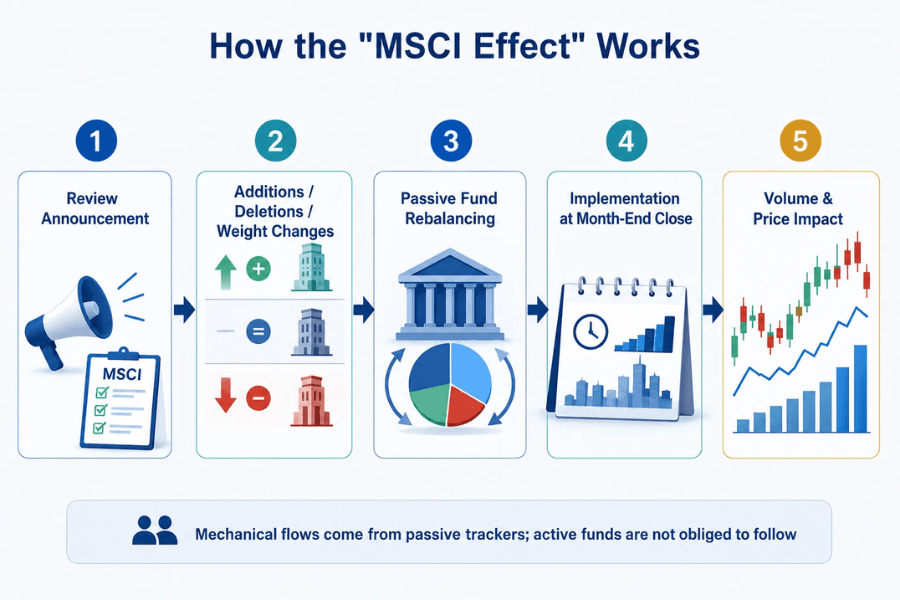
The key to understanding MSCI is the word "benchmark." A large universe of index funds and ETFs tracks MSCI indexes directly, and an even larger set of active funds measures performance against them. For passive funds that track an index directly, every change in constituents and weights translates into mechanical rebalancing demand; active funds are under no obligation to follow, but the yardstick they are measured against moves all the same — which is exactly why MSCI reviews draw so much market attention.
If stock-index basics are still new to you, start with what a stock index is before coming back to how MSCI operates as an index provider.
2. Which MSCI indexes exist? ACWI, World, EM, and single markets
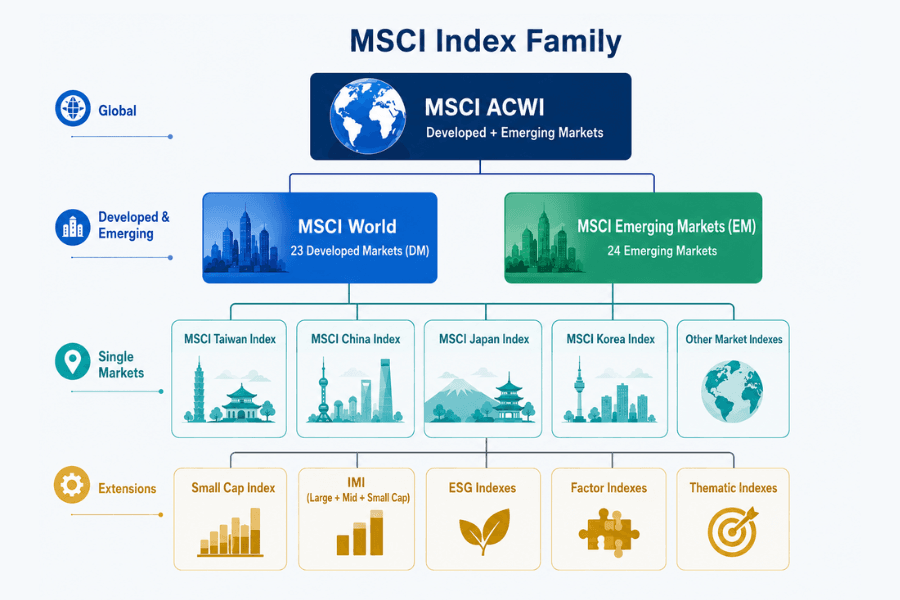
MSCI's indexes form a family that cascades from global to local:
| Index | Coverage | Typical use |
|---|---|---|
| MSCI ACWI | Developed + emerging markets | The overall benchmark for global equity allocation |
| MSCI World | 23 developed markets | The developed-market (DM) allocation benchmark |
| MSCI Emerging Markets (EM) | 24 emerging markets | The mainstream benchmark for EM allocation |
| MSCI single-market indexes | Taiwan, China, Japan, Korea, and more | Reference points for foreign allocation to individual markets |
| Size extensions: Small Cap and IMI | Small Cap covers each market's small caps; IMI = large + mid + small | Small-cap allocation and broader market coverage |
| ESG, factor, and thematic indexes | Constituents screened by strategy | Tracking targets for ETFs and thematic investing |
One common misconception deserves a call-out: despite the name, MSCI World does not include emerging markets. For combined developed-plus-emerging coverage, the relevant index is MSCI ACWI. Market counts (23 developed markets in World and 24 emerging markets in EM as of 2026) can also shift as MSCI's market classification evolves.
Underpinning the family is MSCI's market classification framework: every market is classified as developed (DM), emerging (EM), or frontier (FM), and the classification itself is reviewed periodically. Note that providers can disagree — Korea, for example, sits in emerging markets at MSCI but in developed markets at FTSE Russell — the classic illustration that DM-versus-EM status is a provider's decision, not a universal fact.
3. How are the indexes built? Free-float weighting and inclusion criteria
MSCI indexes are capitalization-weighted and adjusted for free float: MSCI scales each company's investable value by the share of stock that actually trades freely, so government stakes, strategic holders, and other non-floating blocks are generally not counted in full. A company's index weight therefore reflects its free float-adjusted market capitalization relative to peers — and the heavier the weight, the bigger its pull on the index.
At the security level, inclusion runs through several screens:
-
Size and free-float market cap: the stock must clear its market's size segment. The MSCI Standard Index holds large and mid caps, targeting roughly 85% of each market's free float-adjusted capitalization; adding small caps produces the broader IMI (Investable Market Index)
-
Liquidity: trading must be active enough for foreign investors to enter and exit at reasonable cost
-
Foreign accessibility: trading conditions such as the remaining foreign ownership headroom ("foreign room") under local ownership caps
Keep the layers straight: whether an entire market is classified as developed, emerging, or frontier belongs to a separate market classification framework, which weighs the market's overall size, liquidity, openness, and investability — a different question from whether a single stock qualifies. Changes in market openness (loosening foreign-ownership limits, for example) act on this classification layer.
4. How often does MSCI rebalance? The Feb-May-Aug-Nov schedule
MSCI conducts four regular Index Reviews a year, in two flavors:
| Review months | Type |
|---|---|
| February, August | Quarterly Index Review |
| May, November | Semi-Annual Index Review — broader in scope, typically higher market attention |
Results are usually announced around the middle of the review month and cover additions, deletions, and changes to weights and free-float factors. Changes are implemented as of the close of the month's last business day, with the new composition effective from the next trading day. Actual announcement and implementation dates vary each year — check MSCI's official calendar.
The implementation mechanics are the key to reading the price action: passive funds tracking an index must rebalance right at the implementation point to minimize tracking error. That is why the implementation day's close often brings a surge in volume and brief price swings — the phenomenon markets casually call the "MSCI effect."
5. How do MSCI changes move markets?
The impact of an MSCI review is easiest to read on three levels:
Stock level: additions and deletions
For funds tracking the affected index, newly added stocks attract mechanical buying and deleted stocks face corresponding selling; the actual price reaction also depends on how much the market pre-priced, the size of the change, and the stock's own liquidity. Timing-wise, separate two moments: the announcement day carries the information shock — the market's first sight of the official outcome — while the implementation day carries the flow shock, when passive money actually rebalances. The two sessions can behave very differently, and "up on the announcement, flat on implementation" is a common script.
Market level: weight increases and decreases
A market's weight change directly shifts the theoretical allocation of passive tracking money; total foreign flows, however, also depend on active managers' decisions, market conditions, and currency moves. Taiwan is the textbook case: foreign net buying and selling often shift visibly around weight announcements, but the direction and size do not map one-to-one onto the weight change — with the heaviest index names feeling the most direct impact.
Structural level: market upgrades and downgrades
Moving from frontier to emerging, or emerging to developed, changes the pool of capital that can allocate to a market. China A-shares — added to MSCI Emerging Markets in stages from 2018, with the inclusion factor raised afterward — remain the most-watched structural case in recent years.
For traders, what an MSCI review moves is the market-wide flow of funds. In practice, that flow is usually traded through CFDs on each market's representative index — for example the FTSE Taiwan Index (TWFTSE), the Hang Seng Index (HK50), or the FTSE China A50 Index (CN50). Be clear on one point: these indexes are calculated by FTSE Russell, Hang Seng Indexes, and other providers — they are not MSCI indexes. But when MSCI changes redirect foreign flows, indexes mirroring the same underlying market reflect the same tide.
6. How should traders handle MSCI reviews?
With four reviews a year, building event discipline beats predicting outcomes:
-
Put the schedule on the calendar: the February, May, August, and November announcement and implementation dates are predictable volatility windows — plan position size and leverage ahead of them
-
Don't bet on inclusion lists: research houses' predicted lists regularly differ from the official announcement, and trading on list-guessing carries outsized risk
-
Read the closing surge for what it is: implementation-day closing volume is mostly a one-off passive rebalance, not necessarily a change in trend
-
Cut leverage around the event: when weight changes stack on top of other headlines, index and heavyweight volatility can amplify — observing with light exposure beats betting heavy on direction
Start Trading Global Index CFDs
Trade the world's major stock index CFDs with Titan FX — long or short, with flexible leverage and competitive spreads.
7. FAQ: Common questions about the MSCI Index
Q1. How does the MSCI Index differ from the S&P 500 or FTSE indexes?
The S&P 500 is a single index measuring US large caps. MSCI and FTSE Russell are index providers, each maintaining a full system of global, regional, country, and strategy indexes. The two firms differ in market classification and methodology details (Korea's classification being the classic example) and attract different pools of tracking money, so the same market can carry different weights and constituents across systems.
Q2. How often does MSCI review its indexes, and when do changes take effect?
Four regular reviews a year: February and August are Quarterly Index Reviews, while May and November are Semi-Annual Index Reviews with a broader scope. Announcements usually come around mid-month, and changes are implemented as of the close of the month's last business day. Exact dates are published each year in MSCI's official calendar.
Q3. What is the "MSCI effect"?
It refers to the price and volume moves around review announcements and implementation days, driven by passive funds' compulsory rebalancing. The signature image is the implementation day's closing-volume surge, as tracking funds complete their swaps right at the closing price — a one-off flow event. Note that "MSCI effect" is market slang, not an official MSCI term.
Q4. How large is the impact on markets like Taiwan or Hong Kong?
The impact runs on two levels: market-weight changes shift passive trackers' allocation ratios, while stock additions and deletions bring direct buying and selling pressure. The actual size of the move depends on the stock's liquidity, the magnitude of the weight change, and how much money tracks the affected index. As for persistence, the common rhythm is pre-positioning at the announcement and a drift back to fundamentals after implementation.
Q5. Can individual traders trade MSCI indexes directly?
MSCI indexes are benchmarks; the direct vehicles are the ETFs that track them and futures on some exchanges. In practice, many traders also ride the same flows through CFDs on each market's representative index — Taiwan, Hong Kong, or China A-share benchmarks. Keep the distinction clear: those CFDs track indexes calculated by FTSE Russell, Hang Seng, and other providers, not MSCI indexes themselves; the connection is that they mirror the same market's flows and sentiment.
Q6. Do stocks added to an MSCI index always rise?
Not necessarily. Inclusion delivers a single factor — passive buying whose size can be estimated in advance — so the market often finishes trading it before the event, and the implementation date can even bring "sell the news" pressure. Over any longer horizon, fundamentals drive the price. Treating inclusion as a flow event rather than a buy signal is the sturdier mental model.
Q7. What is the difference between MSCI World and MSCI ACWI?
MSCI World covers developed markets only (23 as of 2026) and excludes emerging markets; MSCI ACWI covers both developed and emerging markets. Both names sound global, but the coverage differs: ACWI is the single-index answer for both blocs, while World serves as the pure developed-market benchmark.
8. Conclusion: Put index reviews on your event calendar
The MSCI Index owes its influence to the benchmark role: with global passive and active money measured against it, every adjustment corresponds to real flows. Once you understand the index family and market classification, the free float-adjusted weighting logic, and the February-May-August-November review rhythm, these events stop being surprises and become entries on a calendar.
For traders, MSCI reviews are classic event-driven material — predictable in timing, clear in transmission, and unrewarding to forecast. Put announcement and implementation dates on the calendar, keep leverage modest around the event, read the closing-volume surge as the one-off flow it is, and watch sentiment gauges such as the VIX index for context — that is the most practical preparation an index review allows.
Further Reading
- S&P 500 (US500): constituents and trading guide
- Nasdaq 100 (NAS100): constituents and trading guide
- Dow Jones Industrial Average (US30): constituents and trading guide
- Nikkei 225 (JPN225): constituents and trading guide
- What is a CFD?
Titan FX Trading Strategy Lab. We produce investor-education content covering forex, commodities (crude oil, precious metals, agricultural goods), stock indices, US equities, and digital assets.
Primary Sources (by Category)
- Index provider: General descriptions of MSCI's index methodology, market classification framework, and regular Index Review announcements
- Classification comparisons: Differences between MSCI and FTSE Russell market classifications (the Korea case)
- Investor education: Exchange and regulator materials on index investing and passive flows