

What Are Chinese ADRs? ADR, VIE, Hong Kong Listings and Delisting Risk Explained
The same company can trade in both New York and Hong Kong, with the two lines of stock linked at a fixed ratio. What investors hold is an interest in the offshore listed holding company; where a company uses a VIE structure, the holding company controls the parts of its onshore business that are closed to foreign ownership through a set of contracts rather than direct shareholding. That structure, plus separate regulation in the US and China, gives these stocks risks that ordinary US shares rarely carry.
This guide covers the definition of Chinese ADRs and the leading names, the two structures of ADR and VIE, the difference between a secondary and a dual primary listing in Hong Kong, the regulatory and delisting risks on both the US and Chinese sides, and the ways to trade them. For individual companies, continue to our three company guides on Alibaba, Baidu and JD.com.
- Most Chinese ADRs trade as American depositary shares (ADS), each representing a fixed number of ordinary shares (1:8 for Alibaba and Baidu, 1:2 for JD.com)
- As of March 2025, 286 Chinese companies were listed on the three major US exchanges with a combined market value of US$1.1 trillion (USCC)
- Under a VIE structure, investors hold equity in an offshore holding company, while the restricted onshore business is controlled by contract
- Hong Kong listings come as secondary or dual primary listings; a primary listing is one of the necessary conditions for inclusion in Stock Connect
- Delisting risk comes from both sides: the US Holding Foreign Companies Accountable Act and the Chinese military companies list, and China's data-security reviews and overseas-listing filing regime
- Titan FX offers CFDs on Alibaba, Baidu and JD.com, and on the Hang Seng, H-shares and China A50 indices
- 1. What are Chinese ADRs? Definition, scale and leading names
- 2. ADR and ADS: how US-listed Chinese stocks trade
- 3. The VIE structure: offshore equity, onshore contractual control
- 4. Secondary listing versus dual primary listing: what is the difference?
- 5. Regulation and delisting risk: watch both the US and China
- 6. How to trade Chinese ADRs: ADRs, Hong Kong shares, ETFs and CFDs
- 7. FAQ: common questions about Chinese ADRs
- 8. Conclusion: read the structure first, then the company
1. What are Chinese ADRs? Definition, scale and leading names
Chinese concept stocks (China Concept Stocks) are companies whose main business, revenue and assets are in mainland China but whose shares are listed on an exchange outside the mainland. In everyday market usage the term mostly refers to Chinese companies listed in the United States; the Hong Kong market has its own categories such as H-shares, red chips and Mainland enterprises. This guide focuses on the US-listed names and uses the Hong Kong side to explain homecoming listings and the two-market trading structure.
For scale, the US-China Economic and Security Review Commission (USCC) counted 286 Chinese companies listed on the New York Stock Exchange, Nasdaq and NYSE American as of March 7, 2025, with a combined market capitalization of US$1.1 trillion.
On the Hong Kong side, the "Mainland enterprises" category in the exchange's annual statistics (H-share companies plus companies incorporated offshore and controlled by mainland entities or individuals) numbered 1,552 at the end of 2025, accounting for 58% of listed companies, 79% of market capitalization and 91% of average daily equity turnover.
The Chinese ADRs that US investors meet most often, with the two structural facts that matter — how many shares one ADS represents, and the Hong Kong listing status — are set out below:
| Company | Main business | US ticker | HK code | One ADS represents | Hong Kong listing status |
|---|---|---|---|---|---|
| Alibaba | E-commerce, cloud | BABA | 9988 | 8 ordinary shares | Dual primary listing (since August 2024) |
| Baidu | Search, AI | BIDU | 9888 | 8 Class A ordinary shares | Dual primary listing (since September 2026) |
| JD.com | First-party e-commerce, logistics | JD | 9618 | 2 Class A ordinary shares | Secondary listing |
| NetEase | Games | NTES | 9999 | 5 ordinary shares | Dual primary listing (since June 2026) |
| PDD Holdings | E-commerce | PDD | Not listed in Hong Kong | 4 Class A ordinary shares | — |
ADS ratios differ by company, so when comparing US and Hong Kong prices, multiply by the ratio first and then convert the currency. Hong Kong listing status changes: Alibaba, Baidu and NetEase were all upgraded from secondary listings, while a US-only name such as PDD has no Hong Kong market to fall back on.
Most of these companies set up a holding company in the Cayman Islands or a similar jurisdiction before listing in the US, and that fact shapes the two structures below. ADS, offshore incorporation and VIE are a common combination, but the details differ from company to company, so check the corporate structure and VIE disclosures in the annual report (Form 20-F) when judging a specific name.
2. ADR and ADS: how US-listed Chinese stocks trade
Many large Chinese ADRs list in the US through an American depositary receipt (ADR) program. ADR refers to the depositary-receipt mechanism as a whole; the unit investors actually buy and sell is the ADS (American depositary share), each representing a fixed number of ordinary shares. The company deposits ordinary shares with a depositary bank, which issues dollar-denominated ADS in the US.
Three things to know about this structure:
-
Price linkage: BABA's dollar price is roughly the Hong Kong-dollar price of 9988 multiplied by eight and converted into US dollars. ADS and ordinary shares are interchangeable, so obvious price gaps are closed by conversion and arbitrage, while exchange rates, trading hours, conversion costs and each market's own supply and demand can still push live prices apart for a while.
-
Fees and dividends: the depositary bank charges a depositary fee, and dividends are converted into US dollars by the bank before payment, with possible withholding tax and currency losses along the way; the actual treatment depends on the company's place of incorporation and the investor's residence.
-
Shareholder rights: ADS holders vote through the depositary bank, a process that differs from holding ordinary shares directly.
ADRs are not specific to Chinese companies. TSMC's ADR is a Taiwanese company under the same mechanism, and that guide's explanation of deposit, conversion and price gaps applies directly. What makes Chinese ADRs different is that the ordinary shares behind the ADS belong to an offshore holding company, and between that holding company and the onshore business there may sit the VIE described next.
3. The VIE structure: offshore equity, onshore contractual control
China restricts foreign ownership in industries such as the internet, education and media, so an offshore listed company cannot hold those onshore businesses directly. The VIE (variable interest entity) structure is widely used in these industries: the onshore operating company is held by Chinese founders, and the offshore listed entity, through a wholly foreign-owned enterprise (WFOE) set up in China, obtains control and the economic benefits of the operating company through a set of agreements and consolidates it into its accounts. The approach was first used when Sina listed in the US in 2000.
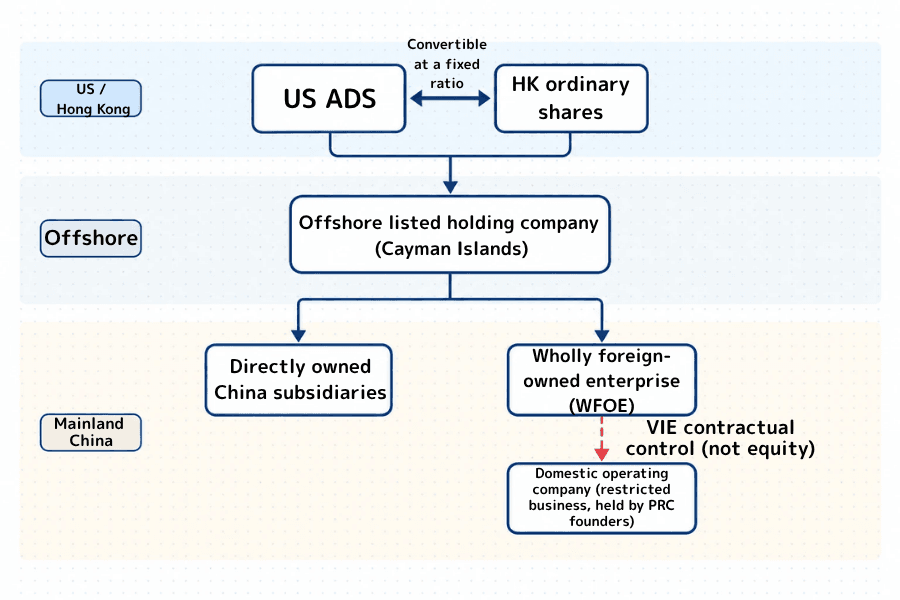
Holding a Chinese ADR's ADS means holding an interest in the offshore listed holding company. That holding company may own some Chinese subsidiaries directly, but its control over the restricted onshore operating company rests on contracts, not equity. This brings three layers of risk:
-
Contract risk: the enforceability of the agreements under Chinese law, and whether the operating company's shareholders (usually the founders) honor them, lack the clear protection that equity provides.
-
Policy risk: the "double reduction" policy of July 2021 required academic tutoring providers to become non-profit and barred foreign control through contractual arrangements; US-listed education stocks fell sharply at the time. Policy can change within a short period whether an industry may keep taking foreign capital through a VIE.
-
Cash-transfer risk: the operating company's cash has to pass through the WFOE to the offshore holding company and then to investors, and each step is subject to China's foreign-exchange, tax and regulatory rules.
The regulatory framework became somewhat clearer in 2023. The China Securities Regulatory Commission's Trial Measures for the Administration of Overseas Securities Offering and Listing by Domestic Companies took effect on March 31, 2023, bringing both direct and indirect overseas listings under a filing regime that companies using VIE structures must also follow. That gives the overseas-listing process clear rules, but it does not amount to unconditional legal recognition of the VIE structure itself; the enforceability of the contracts and future regulation remain sources of risk.
4. Secondary listing versus dual primary listing: what is the difference?
In 2018 the Hong Kong exchange amended its listing rules to let innovative companies already listed overseas return to Hong Kong through a secondary listing, and opened the door to weighted voting rights; Alibaba's Hong Kong listing in November 2019 was the start of that wave. The Chinese ADRs that have listed in Hong Kong since then fall into two categories:
| Secondary listing | Dual primary listing | |
|---|---|---|
| Main regulating market | The US; Hong Kong waives some listing rules | The US and Hong Kong are both primary venues, and both rulebooks apply in full |
| Hong Kong stock short name | Carries an "S" marker | No "S" marker |
| Stock Connect eligibility | Generally not eligible | Meets one of the necessary conditions; index, market-cap and other inclusion rules still apply |
| If the US listing status changes | The Hong Kong listing status and waivers have to be re-handled under exchange rules | Hong Kong is already a primary venue and can continue under its own rules |
| Examples | JD.com (9618) | Alibaba (August 2024), NetEase (June 2026), Baidu (September 2026) |
An upgrade can be applied for voluntarily or triggered passively: exchange rules treat a secondary-listed company whose trading has largely migrated to Hong Kong as a primary listing, which is how NetEase's upgrade in June 2026 came about.
The most practical consequence for investors is Stock Connect. A primary listing is one of the necessary conditions for inclusion; after Alibaba joined in September 2024 and Baidu in September 2026, mainland Chinese money could buy through the southbound channel, changing the investor base.
5. Regulation and delisting risk: watch both the US and China
The US side: audits, lists and executive orders
-
Audit inspections: the Holding Foreign Companies Accountable Act (HFCAA) took effect in December 2020, requiring foreign companies listed in the US to let the Public Company Accounting Oversight Board (PCAOB) inspect their audit working papers or face delisting.
-
Where it stands: in December 2022 the PCAOB confirmed it could fully inspect audit firms in mainland China and Hong Kong, and the near-term risk of delisting for lack of inspection fell sharply; but the same month Congress shortened the trigger from three consecutive years to two, the PCAOB reassesses every year, and the mechanism can restart at any time.
-
Executive orders: in January 2021 the New York Stock Exchange delisted China Mobile, China Telecom and China Unicom under an executive order banning US investment in companies linked to the Chinese military.
-
Chinese military companies list: in June 2026 the US Department of Defense added Alibaba, Baidu and others to its list under Section 1260H of the National Defense Authorization Act. It is not a sanctions list and does not restrict trading in these companies' securities, but it shows that this kind of risk has not gone away.
The Chinese side: data security and overseas-listing reviews
-
Data-security reviews: days after DiDi listed on the New York Stock Exchange in June 2021, the Cyberspace Administration of China opened a data-security review of the company and removed its app from stores; the company delisted from the NYSE in June 2022, the most prominent example of this kind of risk.
-
Overseas-listing filings: the filing regime in force since 2023 formalized such reviews — companies involving data security or foreign-restricted industries must complete a filing before listing.
What happens to the shares after a delisting
A delisting does not mean the shares are worthless; the outcome depends on whether the company has a second market.
-
Also listed in Hong Kong, with ADS and ordinary shares interchangeable: investors can usually convert their ADS into Hong Kong shares through the depositary and their broker, though conversion takes time, costs money and depends on broker support.
-
Listed only in the US: after a delisting the shares may move to over-the-counter (OTC) trading, where both liquidity and transparency fall.
Our delisting guide walks through the full process from warning to removal.
6. How to trade Chinese ADRs: ADRs, Hong Kong shares, ETFs and CFDs
| Route | What it gives you | Suits |
|---|---|---|
| US-listed ADRs outright | Priced in US dollars, traded in US hours, ownership of the depositary shares | Long-term investors with a US brokerage account |
| Hong Kong ordinary shares | Priced in Hong Kong dollars, traded in Asian hours; dual-primary names can be bought through Stock Connect | Asian-hours investors, and those who want less dependence on the US market and the ADS structure |
| Chinese ADR or China ETFs | A basket that reduces single-company business and structural risk, but cannot diversify away policy risk or the systemic risk of the VIE regime | Medium-term allocators |
| Contracts for difference (CFDs) | Margin trading, long or short, no ownership of the shares | Traders working the swings |
At Titan FX, the Chinese ADRs available as CFDs are Alibaba, Baidu and JD.com, and a view on the Chinese market as a whole can be expressed through CFDs on the Hang Seng Index (HK50), the Hang Seng China Enterprises Index (HSCEI) and the China A50 Index (CN50). Our comparison of sub-brokerage and CFDs works through the cost differences between shares and CFDs line by line.
Three extra things to watch when trading Chinese ADRs:
-
News gaps: regulatory news often lands after the US close or over a weekend. Many dual-listed large Chinese ADRs report results after the Hong Kong close and before the US open, so the first reaction happens in US pre-market trading and Hong Kong does not react until the next day; timing varies by company, so check the investor-relations notice before results. Our guide to US market hours lays out each session.
-
Price gaps between the two markets: ADS and Hong Kong shares drift apart for a while because of currency and session timing; a visible gap does not mean a risk-free arbitrage.
-
Concentration: holding an individual Chinese ADR alongside an index or ETF that tracks the Chinese market creates overlapping exposure, and how much overlap depends on that company's weight in the index.
Trade US Stock CFDs with Titan FX
Titan FX offers 100+ US stock CFDs on MT4/MT5 with up to 20:1 leverage, tight spreads, and full long/short flexibility.
7. FAQ: common questions about Chinese ADRs
Q1: Are Chinese ADRs the same thing as Hong Kong's "China stocks"?
They overlap but are not identical. The "Mainland enterprises" in Hong Kong exchange statistics include H-shares incorporated on the mainland and offshore-incorporated companies controlled by mainland entities or individuals; what the market calls Chinese ADRs mostly means privately owned Chinese companies listed in the US, some of which are also listed in Hong Kong.
Q2: Is it better to buy the US ADR or the Hong Kong shares?
They track the same company; the difference is the trading conditions. The ADR is priced in US dollars during US hours and has related markets such as US-listed options; the Hong Kong shares are priced in Hong Kong dollars during the Asian day, and dual-primary names may also attract mainland money through Stock Connect. Decide by your own hours, currency, broker access and costs.
Q3: Can the VIE structure make the shares worthless?
In extreme cases it can, because investors have only contractual control over the restricted onshore operating company. The education stocks of 2021 showed that policy can change within a short period whether an industry may keep taking foreign capital through a VIE. The 2023 filing regime gave the process rules, but it did not change the contractual nature of the control.
Q4: What happens to my shares if a Chinese ADR is delisted in the US?
If the company is also listed in Hong Kong and its ADS and ordinary shares are interchangeable, you can usually convert the ADS into Hong Kong shares through your broker, though that takes time, costs money and depends on broker support. If the company is listed only in the US, the shares may move to over-the-counter trading, where selling becomes harder and more expensive.
Q5: Why do Chinese ADRs so often jump in pre-market and after-hours trading?
On top of results, Chinese ADRs carry regulatory news from both the US and China and the uncertainty of the VIE and cross-border listing structure. That news often arrives outside trading hours, so the reaction concentrates in pre-market, after-hours and opening gaps, and short-term swings around policy events can be markedly larger.
Q6: Are Chinese ADR ETFs suitable for beginners?
An ETF diversifies away the business and structural risk of any single company, which suits those who do not want to pick stocks; but it cannot diversify away Chinese policy, cross-border regulation or the systemic risk of the VIE regime, and the indices the ETFs track differ (some are mostly US ADRs, others mostly Hong Kong shares). Check the holdings before buying.
Q7: Can I trade Chinese ADRs with a CFD?
Yes. A CFD trades the price difference, can be held long or short and can be leveraged, but it carries no ownership of the shares; positions incur overnight financing and a dividend adjustment across the ex-dividend date. Titan FX currently offers CFDs on three Chinese ADRs: Alibaba, Baidu and JD.com.
8. Conclusion: read the structure first, then the company
Chinese ADRs come with one more layer of structure to understand than ordinary US stocks: the same company may have two trading units, ADS and Hong Kong shares, linked at a fixed ratio; the ADS represents equity in an offshore holding company, while the restricted onshore business is controlled through VIE contracts; the Hong Kong listing is either secondary or dual primary, which affects Stock Connect eligibility and what happens in a US delisting; and regulatory risk comes from US audits and lists as well as Chinese data-security and filing reviews.
Understand those four layers before turning to a company's business and results, and you will not mistake structural risk for company risk. The three most representative names are a good place to start: Alibaba, Baidu and JD.com each have a full company guide.
Further Reading
- What Is Earnings Season? US Reporting Calendar and Trading Guide
- What Is Market Cap Ranking? Calculation, US-Stock Rankings, and How to Use It
- How to Read Financial Statements: Income, Balance & Cash Flow
- What Is US Pre-Market Trading? Times, Rules, and Strategy
- What Is a Listed Company? Why Firms List, Market Tiers, and What to Watch
Titan FX Trading Strategy Lab. We produce investor-education content covering forex, commodities (crude oil, precious metals, agricultural goods), stock indices, US equities, and digital assets.
Primary Sources (by Category)
- Statistics: The US-China Economic and Security Review Commission's list of Chinese companies listed on major US stock exchanges (March 2025); Mainland-enterprise statistics in HKEX's 2025 market statistics
- Company announcements: Disclosures by Alibaba, Baidu, JD.com, NetEase and PDD Holdings on ADS-to-share ratios, Hong Kong secondary and dual primary listing conversions, and Stock Connect inclusion
- Regulation: The US Holding Foreign Companies Accountable Act and its December 2022 amendment, the PCAOB's December 2022 inspection determination, the US Department of Defense's June 2026 update of the Chinese military companies list, the CSRC's Trial Measures for the Administration of Overseas Securities Offering and Listing by Domestic Companies, and Chapter 19C of the HKEX Listing Rules
- Investor education: Regulator materials on depositary receipts, VIE structures and the risks of cross-border listings