

JD.com (JD) Stock Explained: First-Party E-commerce and Logistics, Profit Recovery after the Food Delivery War, ADS and 9618
Two things need to be clear before reading this stock. First, what sets it apart from most platform-style e-commerce companies is first-party retail: most of its revenue comes from goods JD.com buys, warehouses and delivers itself, so revenue is large and margins are thin. Second, in 2025 it poured money into new businesses such as food delivery, and group profit was visibly squeezed; in the first half of 2026 the new-business losses began to narrow while the core retail margin held at a high level.
What the market is watching now is how much profit the thin-margin first-party model can release once the food-delivery spending recedes.
This guide breaks down JD.com's revenue structure, the relationship between the ADS and the Hong Kong-listed 9618 shares, the four forces that move the share price, the numbers to watch in each set of results, and the ways to trade the stock along with their risks.
- JD is an American depositary share (ADS): one ADS represents two Class A ordinary shares with a secondary listing in Hong Kong (9618)
- JD.com is built on first-party e-commerce: second-quarter 2026 revenue was RMB 346.4 billion, of which product revenue was RMB 267.1 billion; operating margin was only 1.3% — big scale, thin profit
- Heavy spending on new businesses such as food delivery in 2025 was a major reason full-year net income fell from RMB 41.4 billion to RMB 19.6 billion; in the second quarter of 2026 the new-business loss narrowed to RMB 9.9 billion and group operating income swung from a RMB 0.9 billion loss a year earlier to a RMB 4.5 billion profit
- JD Retail's 4.6% operating margin is a record for a peak promotional season; JD Logistics revenue grew 24%, but that includes the on-demand delivery business transferred from New Businesses
- A first-party model has to be watched for inventory: trailing-twelve-month inventory turnover days stretched from 34.1 a year earlier to 40.5, rising for four consecutive quarters
- US$1 billion of buybacks in the first half of 2026 and an annual dividend of US$1 per ADS; on a CFD the dividend is settled as a dividend adjustment
- Beyond buying the shares, CFDs allow long and short participation; Titan FX offers a CFD on JD.com (JD)
- 1. What kind of company is JD.com (JD)?
- 2. Where JD.com's revenue comes from: first-party retail, logistics and new businesses
- 3. How JD relates to the Hong Kong-listed 9618
- 4. Four forces that move the JD share price
- 5. Four numbers to watch in JD.com's results
- 6. How to trade JD: routes, costs, and risks
- 7. FAQ: common questions about JD.com stock
- 8. Conclusion: how much profit can JD.com release once the food-delivery losses narrow?
1. What kind of company is JD.com (JD)?
JD.com was founded in Beijing in 1998 by Richard Liu, starting from an electronics counter in Zhongguancun, moving online in 2004, and then building its "authentic goods, fast delivery" position on its own logistics network and first-party merchandise. It listed on Nasdaq on May 22, 2014 at $19 per ADS under the ticker JD, and completed a secondary listing in Hong Kong on June 18, 2020 under the stock code 9618.
Its biggest difference from platform-style e-commerce is first-party retail. Alibaba's Taobao and Tmall mainly charge merchants service fees, and the merchants sell the goods; more than three-quarters of JD.com's revenue is product revenue from goods it buys and sells to consumers itself, with the full price of the goods booked as revenue, which makes its scale look far larger and its margin far lower. JD.com also runs a third-party marketplace, advertising, logistics, and service businesses in healthcare and industrial supplies, and describes itself as a supply chain-based technology and service provider.
Full-year 2025 revenue was RMB 1,309.1 billion, up 13%, but net income attributable to shareholders fell from RMB 41.4 billion the year before to RMB 19.6 billion. Heavy investment in new businesses such as food delivery was one of the main reasons for the drop.
2. Where JD.com's revenue comes from: first-party retail, logistics and new businesses
The accounts divide JD.com into three segments. The second-quarter 2026 (April to June) figures are as follows.
| Segment | Q2 2026 revenue (RMB) | Year on year | Operating income (loss) |
|---|---|---|---|
| JD Retail | 295.4 billion | −4.7% | 13.5 billion, margin 4.6% |
| JD Logistics | 64.1 billion | +24.3% | 2.3 billion, margin 3.5% |
| New Businesses | 7.3 billion | −47.6% | (9.9 billion) |
Group revenue was RMB 346.4 billion, down 2.9% (the segments add up to more than the total; the difference is the elimination of transactions between segments). JD Retail covers the main site's first-party and marketplace businesses plus JD Health and JD Industrials; New Businesses covers JD Food Delivery, Jingxi, JD Property and the overseas businesses.
The point of this table is that retail is shrinking, logistics is growing and the new businesses are stemming the bleeding, but the year-on-year rates of the last two segments first need a reporting change stripped out. JD Retail revenue fell 4.7%, yet its 4.6% operating margin is a record for a peak promotional season.
On October 31, 2025, JD Logistics took over the on-demand delivery business from New Businesses, and from 2026 that business switched from serving internal segments such as JD Food Delivery to serving third-party merchants on the platform directly. So the 47.6% fall in New Businesses revenue cannot be read straight as food delivery halving, and JD Logistics' 24.3% growth is not all organic growth of the existing logistics business. To track the change in food-delivery spending, the segment loss is a cleaner measure than revenue: it narrowed from RMB 14.8 billion a year earlier to RMB 9.9 billion.
What the goods are
Cut another way, revenue splits into products and services. Product revenue was RMB 267.1 billion, down 5.4%: electronics and home appliances RMB 157.9 billion, down 11.8%, and general merchandise RMB 109.2 billion, up 5.6%. Service revenue was RMB 79.3 billion, up 6.8%, made up of marketplace and marketing at RMB 30.9 billion and logistics and other services at RMB 48.4 billion.
Electronics and home appliances are the business JD.com started in, and the company attributes this quarter's double-digit decline to a high base: the same period of 2025 was when trade-in subsidies for appliances were driving strong growth in the category. General merchandise and service revenue are still growing and are the healthier part of the revenue mix.
The food-delivery year
JD.com entered food delivery in February 2025, attacking the market with subsidies, zero commissions and directly employed riders, and the New Businesses segment lost RMB 14.8 billion in the second quarter of 2025 alone. A year later, in the second quarter of 2026, the company described the scale of its food-delivery investment as having narrowed significantly, and the New Businesses loss was RMB 9.9 billion. That spending moving from expansion to contraction, together with JD Retail holding a high margin, are the two sources of profit improvement the company itself named.
3. How JD relates to the Hong Kong-listed 9618
What you buy in the US market is an American depositary share issued under an ADR program, which is not the same unit as the Class A ordinary shares traded in Hong Kong. Each JD ADS represents two JD.com Class A ordinary shares. The dollar price of JD is roughly the Hong Kong-dollar price of 9618 multiplied by two and converted into US dollars. ADS and Hong Kong ordinary shares are interchangeable, so obvious price gaps are usually closed by conversion and arbitrage; exchange rates, trading hours, conversion costs and each market's own supply and demand can still push live prices apart for a while. Depositary fees, dividend conversion and tax treatment differ from holding ordinary shares directly, and our guide to TSMC's ADR explains the full mechanism.
JD.com's Hong Kong listing is still a secondary listing, with Nasdaq as its primary venue — unlike Alibaba and Baidu, which have completed dual primary listings. The group also has three separately listed subsidiaries in Hong Kong: JD Logistics (2618), JD Health (6618), and JD Industrials (7618), listed in December 2025, all of whose figures are consolidated in the group accounts.
JD.com is a constituent of the Hang Seng Index and the Hang Seng China Enterprises Index, with a small weight in both. Holding JD alongside a Chinese or Hong Kong index or ETF that contains JD.com creates overlapping exposure; how much overlap depends on JD.com's actual weight in that index or ETF.
4. Four forces that move the JD share price
Chinese consumption and the subsidy base
First-party e-commerce revenue follows consumption directly. Subsidies such as the appliance trade-in program lifted sales in 2025 and became a high base to climb over in 2026; when and how far the subsidies are withdrawn shows up straight away in the electronics and appliances line. When reading the retail segment, look at revenue growth and margin together — this quarter combined shrinking revenue with a record margin.
The profit and loss of the food-delivery war
The New Businesses loss is what crushed net income in 2025 and is the source of the profit recovery in 2026. The market watches two things: how fast the loss narrows, and whether food delivery brings new users and order frequency to the main site. Renewed spending or a competitor stepping up would reverse this line.
Logistics growth and automation
JD Logistics revenue grew 24.3%, part of which comes from the reporting change of folding in on-demand delivery; what remains after stripping that out is the growth of the existing business. This quarter it put thousands of unmanned delivery vehicles into regular operation across more than 20 provinces and opened night-time autonomous delivery routes in Shenzhen. Logistics is the core asset of JD.com's supply-chain capability, and more worth tracking than revenue are its operating margin (3.5% this quarter) and revenue from third-party customers, which decide whether logistics can turn from a group cost center into a service business that earns on its own.
Policy and cross-border regulation
The domestic side is the most direct for JD.com: rules on price competition in instant retail and food delivery, rider labor protection and platform regulation each affect the subsidy intensity and fulfillment costs of the new businesses, while the pace at which appliance subsidies are withdrawn is written straight into the retail segment's base (see the previous section).
On the cross-border side, the Holding Foreign Companies Accountable Act once put Chinese ADRs under delisting pressure; the risk fell markedly after the PCAOB secured full inspection access to audit firms in mainland China and Hong Kong in December 2022, but the mechanism remains. JD.com is still a secondary listing in Hong Kong, a structure and rulebook different from Alibaba's and Baidu's, but that on its own does not tell you how high or low its delisting risk is.
5. Four numbers to watch in JD.com's results
JD Retail's operating margin. The profit of the first-party model lives here, and it was 4.6% this quarter. Read it with revenue growth: promotions, subsidies and a rising share of low-margin categories compress the margin, while a rising share of high-margin marketplace and marketing revenue improves it. The company attributed this quarter's record to margin improvement in certain key categories and a favorable mix from marketplace and marketing revenue outperforming.
The New Businesses operating loss. RMB 9.9 billion this quarter against RMB 14.8 billion a year earlier. With revenue no longer comparable after the on-demand delivery transfer, the segment loss is the cleanest number for tracking food delivery, and its quarter-to-quarter change says more about the stage of the food-delivery war than group net income does.
Inventory turnover days. A first-party model carries its own inventory, a risk that platform e-commerce does not show. The second-quarter results disclosed trailing-twelve-month inventory turnover days of 40.5, up from 34.1 a year earlier and longer for four consecutive quarters. Slower turnover does not necessarily mean weaker demand — category mix and stocking strategy matter too — but when slowing revenue and rising inventory days appear together, it calls for a closer look.
Free cash flow and shareholder returns. As of the end of June 2026, trailing-twelve-month free cash flow was RMB 31.4 billion, and cash and cash equivalents, restricted cash and short-term investments totaled RMB 235.1 billion. In the first half of 2026 the company bought back US$1 billion of shares, about 2.5% of shares outstanding, and paid a cash dividend of US$1 per ADS for 2025. Our guide to the cash flow statement breaks down all three cash flows.
Keep in mind that JD.com's revenue is several times that of its peers but its margin is in the low single digits, so a small swing in revenue produces a large swing in profit. A single quarter's EPS or P/E ratio has limited value on its own; pairing it with the segment figures in the income statement is steadier.
6. How to trade JD: routes, costs, and risks
Three ways in
| Route | What it gives you | Suits |
|---|---|---|
| Buying JD ADS outright | Ownership, dividends, no expiry, full purchase price required | Long-term investors |
| China e-commerce or tech ETFs | Holds several Chinese names at once, spreads single-stock risk | Medium-term allocators |
| Contracts for difference (CFDs) | Margin trading, lower capital requirement, long or short | Traders working the swings |
Buying shares means paying the full price and only being able to go long, with returns coming from the share price and dividends. A CFD is traded on margin, so the same capital supports a larger position, and you can go short when earnings or policy news turn against the stock. Our comparison of sub-brokerage and CFDs works through the costs line by line.
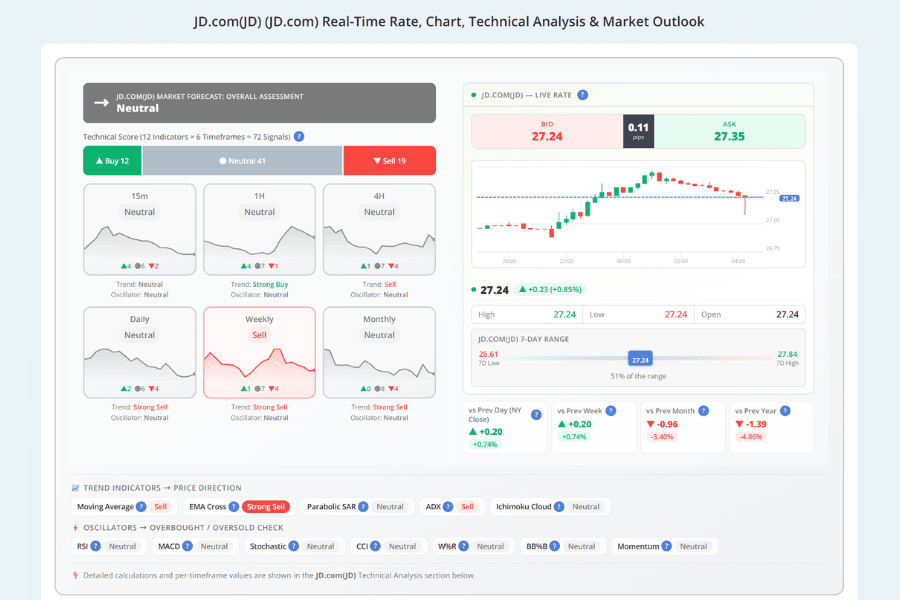
Titan FX offers a CFD on JD.com (JD) across all three account types, with available leverage varying by instrument and account. The product page shows live pricing, charts, automatically calculated support and resistance, and the trading costs for each account.
Sessions and gaps
The regular US session runs from 9:30 a.m. to 4:00 p.m. Eastern Time; holiday closures and session rules are covered in our guide to US market hours. In recent years JD.com has mostly reported after the Hong Kong close and before the US open (the second-quarter 2026 release came at 6:00 a.m. Eastern on August 13); check each quarter's investor-relations notice for the actual time. JD can gap at the open, and an order resting at the old price will not necessarily fill as intended. Our earnings season guide covers the reporting calendar.
Risk and position sizing
Set stops to the stock, not the index. A single stock moves considerably more than a broad index, and applying index habits to stop placement gets you shaken out by ordinary noise.
Leverage cuts both ways. When using leverage, decide first how much you are willing to risk on the trade, then work back from your stop distance to the position size.
The VIE and cross-border holding structure. What investors hold is an ADS in an offshore holding company, while the restricted onshore business is consolidated through variable interest entity contracts. That structure carries additional legal and regulatory risk.
Holding costs and dividend adjustments. Overnight financing on a CFD accumulates with the days held. JD.com has paid an annual cash dividend in recent years — US$1 per ADS for 2025, paid in April 2026 — and future dividends and their amounts are subject to board announcements. A CFD held across the ex-dividend date receives a dividend adjustment on a long position and pays it on a short, and the amounts can be checked in the Dividend Calendar.
Trade JD CFDs with Titan FX
Titan FX offers JD.com (JD) stock CFDs with up to 20:1 leverage, tight spreads, and the flexibility to go long or short without owning the shares.
7. FAQ: common questions about JD.com stock
Q1: Should I buy JD in the US or 9618 in Hong Kong?
They track the same company; the difference is the trading conditions. JD is priced in US dollars during US hours and has related markets such as US-listed options; 9618 trades in Hong Kong dollars during the Asian day. Decide by your own hours, currency, broker access and costs.
Q2: Why aren't the JD and 9618 prices exactly aligned?
One ADS corresponds to two ordinary shares, and the two trade in different time zones and currencies. Exchange-rate moves, staggered sessions and each market's own supply and demand let live prices drift apart slightly, which is normal.
Q3: JD.com's revenue is larger than Alibaba's, so why is its market value so much smaller?
Because the revenue is booked differently. JD.com books the full price of the goods it sells first-party, while Alibaba mainly recognizes merchant commissions, advertising and service fees. So revenue scale alone is not a fair comparison; it has to be read with margins, free cash flow and GMV. JD.com's group operating margin this quarter was 1.3%, and the retail segment's was 4.6%.
Q4: Does JD.com pay a dividend?
Yes, once a year in recent years. The cash dividend for 2025 was US$1 per ADS (US$0.50 per ordinary share), paid in April 2026; future dividends and their amounts are subject to board announcements. CFD holders receive or pay a dividend adjustment depending on the direction of the position.
Q5: Is food delivery still losing money?
Yes, but the loss is narrowing. The New Businesses segment lost RMB 9.9 billion in the second quarter of 2026 against RMB 14.8 billion a year earlier, and the company says the scale of its food-delivery investment has narrowed significantly. The 47.6% fall in New Businesses revenue includes the reporting effect of the on-demand delivery business moving to JD Logistics, so the loss is a truer measure than revenue, and its quarter-to-quarter change is the thing to watch.
Q6: Is the delisting risk for Chinese ADRs still live?
The level of risk has clearly fallen. After the PCAOB secured full inspection access to audit firms in mainland China and Hong Kong in December 2022, the most pressing delisting trigger was removed, but the mechanism of the Holding Foreign Companies Accountable Act remains. JD.com is currently a secondary listing in Hong Kong, a structure different from Alibaba's and Baidu's dual primary listings, but that on its own does not tell you how high or low its delisting risk is.
Q7: Can I trade JD with a CFD, and how does that differ from owning shares?
Yes. A CFD trades the price difference, can be held long or short, and can be leveraged, but it carries no ownership of the shares. Positions incur overnight financing and a dividend adjustment across the ex-dividend date, so the suitable holding period is usually shorter than for shares.
8. Conclusion: how much profit can JD.com release once the food-delivery losses narrow?
JD.com's results have to be read with two rulers. The revenue ruler measures the scale of the first-party model: RMB 346.4 billion in a single quarter is far more than most platform e-commerce companies. The profit ruler measures the cost of that model: a group operating margin of 1.3%, and only 4.6% even in the retail segment.
The biggest change of the past year is in the new businesses. Spending on food delivery and other new businesses in 2025 was a major reason net income halved; in the first half of 2026 the spending narrowed, group operating income turned positive, and the retail margin held at a record for a peak promotional season. Logistics is the other line: how much growth remains after stripping out the on-demand delivery reporting effect, and whether regular operation of unmanned delivery vehicles can lift its margin, are where JD.com differs most from other e-commerce companies.
To read this stock, look first at whether the retail margin holds around 4%, then at how far the New Businesses loss narrows, then at how much growth logistics and service revenue keep after adjusting for the reporting change, and finally do not miss the number peculiar to a first-party model: inventory turnover days. Only when these numbers move the right way together does profit catch up with scale.
Further Reading
- How to Read Financial Statements: Income, Balance & Cash Flow
- Amazon (AMZN) Stock Investing Guide: Business Model, Growth Engines, and CFD Trading
- What Is Market Cap Ranking? Calculation, US-Stock Rankings, and How to Use It
- What Is Operating Margin? Formula, Benchmarks, and How to Use It for US Stocks
- What Is US Pre-Market Trading? Times, Rules, and Strategy
- What Are Chinese ADRs? ADR, VIE, Hong Kong Listings and Delisting Risk Explained
Titan FX Trading Strategy Lab. We produce investor-education content covering forex, commodities (crude oil, precious metals, agricultural goods), stock indices, US equities, and digital assets.
Primary Sources (by Category)
- Company results: JD.com's second-quarter and interim 2026 results announcement — segment revenue and operating income, the note on the transfer of the on-demand delivery business to JD Logistics, product and service revenue, operating income, net income, inventory turnover days, free cash flow, and cash and short-term investments — and the full-year 2025 results announcement for revenue and net income
- Company announcements: JD.com's disclosures on the ADS-to-Class A share ratio, the 2025 annual dividend, first-half 2026 share repurchases, and the Hong Kong listings of JD Logistics, JD Health and JD Industrials
- Investor education: Regulator materials on depositary receipts, VIE structures, cross-border listings, and the risks of contracts for difference