

Alibaba (BABA) Stock Explained: Segments, ADR and 9988, AI Spending and Risk

Three things about this stock are regularly misread. BABA in New York and 9988 in Hong Kong are the same company traded in different units. Its fiscal year does not run from January to December. And its 2026 segment structure looks very little like the e-commerce company most investors still picture.
This guide covers what Alibaba actually earns from, how the ADS relates to the Hong Kong shares, the four forces that move the stock, the numbers worth tracking in each report, and how to trade it.
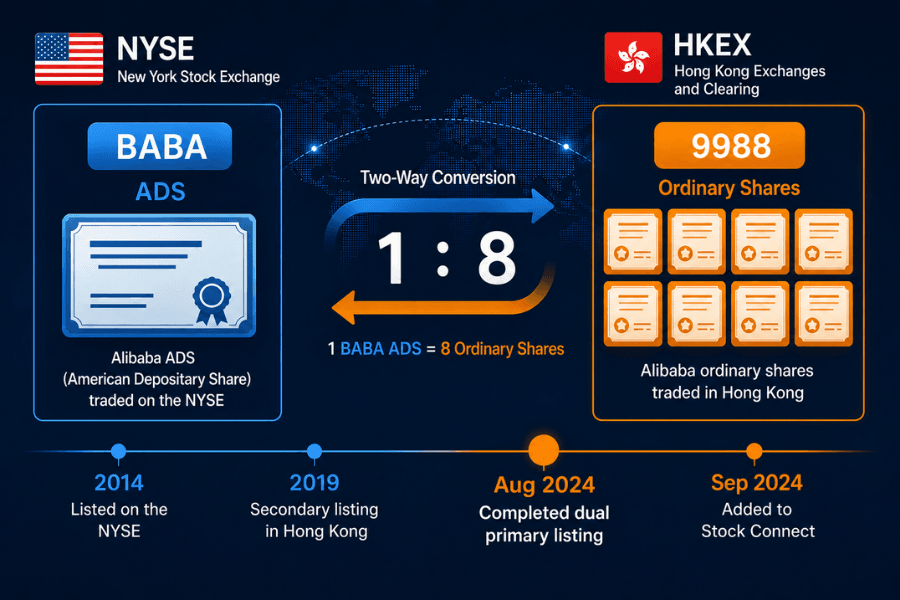
- BABA is an American Depositary Share; each one represents eight ordinary shares listed in Hong Kong as 9988, and the two are convertible in both directions
- The June 2026 quarter reorganized reporting into four segments: e-commerce, AI Cloud and Compute, AI Labs and Applications, and all others; e-commerce is the revenue base but grew only 4%
- AI Cloud and Compute grew revenue 45% with adjusted EBITA up 133%, and AI-related products have posted triple-digit growth for twelve consecutive quarters — this is where the valuation case sits
- The cost shows up in cash flow: capital expenditure up 75%, free cash flow in outflow, and an HK$80 billion placement in August 2026 diluting existing holders by about 3.8%
- The fiscal year runs April to March, so check the period before comparing figures; from 2026, customer management revenue needs the company's like-for-like number
- Beyond buying shares or ETFs, CFDs allow both long and short positions; Titan FX offers CFDs on Alibaba Group (BABA)
- 1. What is Alibaba (BABA)?
- 2. What does Alibaba do? Four segments and where revenue comes from
- 3. How do BABA and Hong Kong's 9988 relate?
- 4. Four forces that move BABA
- 5. Three numbers to track in each report
- 6. How to trade BABA: routes, costs, and risks
- 7. FAQ: Common questions about Alibaba stock
- 8. Conclusion: a company converting resources into compute
1. What is Alibaba (BABA)?
Alibaba was founded in Hangzhou in 1999 as a business-to-business wholesale marketplace, and later grew Taobao, Tmall, Alipay and Alibaba Cloud out of that base. On September 19, 2014 it listed on the New York Stock Exchange at an offer price of US$68 under the ticker BABA. In Hong Kong it trades under two codes: 9988 on the HKD counter and 89988 on the RMB counter.
One thing catches people out immediately: Alibaba's fiscal year does not follow the calendar. It runs from April 1 to March 31, so "fiscal 2026" covers April 2025 through March 2026 — six months out of step with companies that close their books in December.
Revenue for fiscal 2026 was RMB 1.02 trillion, up 3% year over year. That growth looks thin because the period included the disposal of two retail assets, Sun Art and Intime; on a like-for-like basis excluding them, revenue grew 11%.
2. What does Alibaba do? Four segments and where revenue comes from
From the June 2026 quarter, Alibaba reorganized its reporting into four segments. This table is the fastest way to see where the company stands today.
| Segment | Revenue, June 2026 quarter | YoY |
|---|---|---|
| Alibaba E-commerce Group | RMB 205.9bn | +4% |
| AI Cloud and Compute Services | RMB 48.4bn | +45% |
| AI Labs and Applications | RMB 3.3bn | +16% |
| All others | RMB 28.8bn | +1% |
Group revenue for the quarter was RMB 269.0bn, up 9%. The four segments add up to slightly more than the group total because inter-segment transactions are eliminated. The former Cloud Intelligence Group was combined with the in-house chip unit to form AI Cloud and Compute Services, while the model labs, the Qwen consumer business and QwenWork were pulled out of "All others" to form AI Labs and Applications.
The point of that table is the gap between two numbers. E-commerce is more than four times the size of AI Cloud and Compute but grew 4%; the cloud business is far smaller and grew 45%, with AI-related product revenue posting triple-digit growth for the twelfth consecutive quarter. Scale still comes from e-commerce, while the cloud has become the main variable in how the market values the company.
Two AI segments, one earning and one spending
Within the same quarter, the two AI lines look nothing alike on the bottom line. AI Cloud and Compute Services posted adjusted EBITA of RMB 5.6bn, up 133% year over year. AI Labs and Applications lost RMB 13.9bn, a sharply wider loss than a year earlier.
Reading them separately is what makes Alibaba's AI position legible: selling compute to enterprise customers has started to generate profit, while in-house models and consumer applications are still in the spending phase. The E-commerce Group's adjusted EBITA fell 1%, with subsidies offsetting the improvement in monetization.
Is e-commerce still growing?
It is, though not at the pace the term growth stock implies. Growth of 4% reflects a Chinese market that now has several serious platforms competing, plus continued subsidy spending on instant commerce through Taobao Instant Commerce. Compared with Amazon, which follows the same e-commerce-funds-cloud model, Alibaba has a lower cloud share of revenue and a more crowded retail market, so its cloud business needs a longer runway to carry the valuation.
3. How do BABA and Hong Kong's 9988 relate?
What trades in New York as BABA is an American Depositary Share issued under an ADR structure, which is a different unit from the ordinary shares traded in Hong Kong. Each BABA ADS represents eight Alibaba ordinary shares.
That ratio sets the relationship between the two prices: BABA in US dollars is roughly the 9988 price in Hong Kong dollars multiplied by eight and converted. When a gap opens, arbitrage closes it, because ADSs and Hong Kong ordinary shares are convertible in both directions.
The depositary bank, depositary fees, dividend conversion and tax treatment all work differently from holding ordinary shares directly. Our guide to TSMC ADR covers that mechanism in full.
From secondary listing to dual primary listing
Alibaba first took a secondary listing in Hong Kong in November 2019, completed a dual primary listing on the Main Board on August 28, 2024, and was added to Stock Connect on September 10, 2024, opening the stock to mainland Chinese money through the southbound channel.
That change means Hong Kong is no longer a market attached to a New York primary listing. If the US listing environment shifts again, Alibaba keeps its primary listing status in Hong Kong — though that does not make the regulatory and cross-border risks around the ADS disappear.
Watch for doubled exposure
Alibaba is a significant constituent of both the Hang Seng Index and the Hang Seng China Enterprises Index. Holding BABA alongside an index position tracking Chinese equities puts the same directional bet on twice, and portfolio sizing should account for that overlap.
4. Four forces that move BABA
Chinese consumption and the competitive field
E-commerce is still the revenue base, so Chinese consumer demand sets the floor. Competition matters just as much: general marketplaces, content commerce and instant delivery are all being fought over at once, and subsidy spending compresses margins. Read the segment's revenue growth and its profitability together — either one alone will mislead you.
How fast the cloud commercialises
The revenue and EBITA figures in section 2 are the main reason the market has been willing to re-rate this company. What matters is where that case is fragile: if cloud growth slows materially, or if margins compress under price competition, the AI growth premium comes back out of the valuation. Track whether growth is accelerating or decelerating rather than the absolute level.
Capital spending, free cash flow, and dilution
In the June 2026 quarter, capital expenditure was RMB 67.7bn, up 75% year over year, and free cash flow was an outflow of RMB 44.7bn. Fiscal 2026 as a whole showed the same combination of heavy capex and negative free cash flow.
In August 2026 that program took another step. Alibaba announced a placement of 710 million new shares at HK$112.70, raising roughly HK$80 billion, and stated that the net proceeds would go entirely into full-stack AI capabilities and AI infrastructure. It was the company's first share issue since its 2019 Hong Kong listing, and the new shares amount to about 3.8% of the existing ordinary share count.
The company gets more capital for compute; existing shareholders get diluted; and the payback depends on whether AI demand holds. Capital expenditure, free cash flow and the share count all belong on a quarterly watchlist.
Policy and cross-border regulation
On April 10, 2021, China's State Administration for Market Regulation fined Alibaba RMB 18.23bn over exclusive-dealing practices, and that round of regulatory tightening was a major reason Chinese ADR valuations fell through 2021 and 2022. On the cross-border side, the US Holding Foreign Companies Accountable Act once put Chinese listings under delisting pressure; the risk dropped substantially after the Public Company Accounting Oversight Board obtained full inspection access to Chinese audit firms at the end of 2022, but the mechanism still exists. Policy shifts are hard to forecast, so treat this as a risk that needs headroom rather than a variable you can model.
5. Three numbers to track in each report
Cloud revenue growth alongside adjusted EBITA. Revenue growth tells you about demand; EBITA tells you whether that demand is converting into profit. Read together, they show whether the AI business is reaching scale economics or still buying growth.
Customer management revenue (CMR). This is the measure of how well Taobao and Tmall monetize, but from 2026 the accounting basis needs attention. CMR in the June 2026 quarter was RMB 82.5bn, down 7% as reported; excluding the contra-revenue impact of a new business development program, it grew 1% on a like-for-like basis. Comparing the headline growth rate alone will point you in the wrong direction, so check the like-for-like figure the company provides.
Free cash flow. Operating cash flow minus capital expenditure. The point at which this turns positive again marks the end of the heaviest build-out phase, and it is an important signal. Our guide to the cash flow statement breaks down all three cash flows.
One habit to keep: line up the fiscal year. The "June 2026 quarter" is the first quarter of Alibaba's fiscal 2027. Large investments and asset disposals also swing quarterly earnings sharply, which limits how much a single quarter's EPS or P/E ratio can tell you — read them next to the income statement and operating margin.
6. How to trade BABA: routes, costs, and risks
Three ways in, and the one with the lowest entry cost
| Route | What it gives you | Suits |
|---|---|---|
| Buying BABA ADS outright | Ownership, dividends, no expiry, full purchase price required | Long-term investors |
| China or tech ETFs | Spreads single-stock risk across several Chinese names | Medium-term allocators |
| Contracts for difference (CFDs) | Margin trading, lower capital requirement, long or short | Traders working the swings |
The biggest differences are the capital required and the directions available. Buying shares means paying the full price and only profiting if the stock rises. A CFD is traded on margin, so the same capital supports a larger position, and you can go short when earnings or policy news turn against the stock. Our comparison of sub-brokerage and CFDs works through the costs line by line.
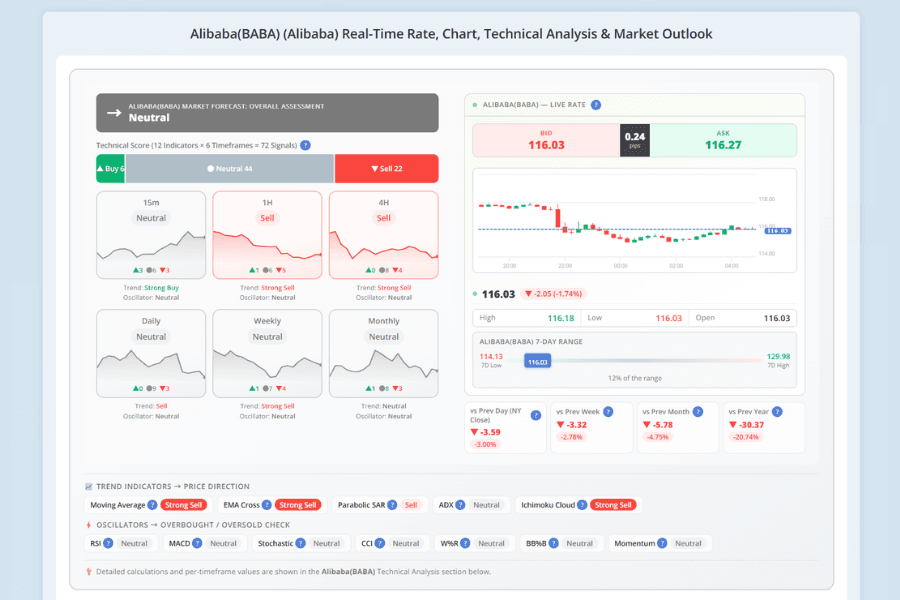
Titan FX offers CFDs on Alibaba Group (BABA) across all three account types, with available leverage varying by instrument and account. You can trade both directions without holding the underlying shares, and dividends are settled as a dividend adjustment while a position is open. The product page shows live pricing, charts, automatically calculated support and resistance, and the trading costs for each account.
Sessions and gaps
The regular US session runs from 9:30 a.m. to 4:00 p.m. Eastern Time. Holiday closures and session rules are covered in our guide to US market hours.
Results and material announcements can land outside regular US hours, and with Hong Kong and New York in different time zones, 9988 and BABA do not finish reacting at the same moment. After news breaks, the US open can gap straight to a new level, and an order resting at the old price will not necessarily fill as intended. Our earnings season guide covers the reporting calendar, and the pre-market trading guide explains how the opening price forms.
Risk and position sizing
Set stops to the stock, not the index. A single stock moves considerably more than a broad index, and applying index habits to stop placement gets you shaken out by ordinary noise.
Leverage cuts both ways. When using leverage, decide first how much you are willing to risk on the trade — 1% to 2% of account equity is a common rule — then work back from your stop distance to the position size.
The VIE and cross-border holding structure. What investors hold is an ADS in an offshore holding company, while parts of the restricted onshore business are consolidated through variable interest entity contracts. That structure differs from owning equity in the operating company directly and carries additional legal and regulatory risk.
Holding costs. Overnight financing on a CFD accumulates with the days held, so build it into the plan before holding for the medium term.
Trade BABA CFDs with Titan FX
Titan FX offers Alibaba (BABA) stock CFDs with up to 20:1 leverage, tight spreads, and the flexibility to go long or short without owning the shares.
7. FAQ: Common questions about Alibaba stock
Q1: Should I buy BABA in the US or 9988 in Hong Kong?
Both track the same company, so the choice comes down to trading conditions. The US listing has deeper liquidity and a more developed derivatives market and trades in the US session; the Hong Kong line trades during Asian hours and is priced in Hong Kong dollars. Pick based on your hours, your funding currency, and the access you have.
Q2: Why aren't the BABA and 9988 prices exactly aligned?
Because they trade in different time zones and different currencies. Moves in the Hong Kong dollar against the US dollar, sessions that do not overlap, and separate supply and demand on each side all produce small deviations in the live prices. That is normal.
Q3: Why is Alibaba's fiscal year different from other companies'?
It runs from April 1 to March 31. So "fiscal 2026" covers April 2025 to March 2026, and the "June 2026 quarter" is the first quarter of fiscal 2027. Check that both sides of any historical comparison cover the same period.
Q4: Does Alibaba pay a dividend?
Yes. The annual cash dividend for fiscal 2026 was US$0.13125 per ordinary share, or US$1.05 per ADS, paid in July 2026. CFD positions do not receive the cash dividend itself; it is settled as a dividend adjustment.
Q5: Is Alibaba still a growth stock?
Look at the parts separately. The e-commerce segment grows in single digits and behaves like a mature business, while AI Cloud and Compute Services is still growing at 45% and looks like a growth business. The company sits at the boundary between the two, which is why opinions on its valuation diverge so widely.
Q6: Is the delisting risk for Chinese ADRs still live?
The risk level has dropped substantially. The direct trigger for delisting was removed at the end of 2022, though the underlying legislation still stands — section 4 has the detail. Alibaba's dual primary listing in Hong Kong also gives it a second venue that can operate independently, which sets it apart from most Chinese ADRs.
Q7: Can I trade BABA with a CFD, and how does that differ from owning shares?
You can. A CFD is traded on the price difference, allows both long and short positions, and can use leverage, but it does not confer ownership of the shares. Positions incur overnight financing, so the holding period is typically shorter than for shares.
8. Conclusion: a company converting resources into compute
Alibaba's accounts now describe a company whose scale and whose growth sit in different segments. E-commerce contributes the overwhelming share of revenue but grows in single digits; AI Cloud and Compute is far smaller, yet its 45% revenue growth and 133% EBITA increase are what set the multiple the market is willing to pay.
The largest change of the past two years is not in revenue but in where resources are going. Capital expenditure up 75%, free cash flow in sustained outflow, and in August 2026 an HK$80 billion placement putting share capital into the same program — current profit, cash flow and equity are all being converted into future compute capacity. Whether that generates an adequate return depends on the durability of AI demand, which is a question without an answer yet, and it is the uncertainty that comes with holding this stock.
Further Reading
- How to read financial statements: income, balance and cash flow
- What is a balance sheet? Formula, three components and how to read it
- US value stock primer: definition, traits and avoiding the value trap
- What is market cap ranking? Calculation, US rankings and how to use it
- What is US after-hours trading? Times, rules and strategy
- Baidu (BIDU) Stock Explained: AI at Half of Revenue, Apollo Go, and the Hong Kong 9888 Dual Primary Listing
- JD.com (JD) Stock Explained: First-Party E-commerce and Logistics, Profit Recovery after the Food Delivery War, ADS and 9618
- What Are Chinese ADRs? ADR, VIE, Hong Kong Listings and Delisting Risk Explained
Titan FX Trading Strategy Lab. We produce investor-education content covering forex, commodities (crude oil, precious metals, agricultural goods), stock indices, US equities, and digital assets.
Primary Sources (by Category)
- Company results: Alibaba Group's fiscal 2026 annual results announcement and June 2026 quarter results announcement — segment revenue, adjusted EBITA, customer management revenue, capital expenditure and free cash flow
- Company announcements: Alibaba Group's August 2026 share placement announcement, together with public disclosures on the ADS-to-ordinary-share ratio, the Hong Kong dual primary listing, and the annual dividend
- Regulatory record: The State Administration for Market Regulation's April 2021 penalty decision, and Public Company Accounting Oversight Board statements on audit inspection access
- Investor education: Regulator materials on depositary receipts, VIE structures, cross-border listings, and the risks of contracts for difference