

Baidu (BIDU) Stock Explained: AI at Half of Revenue, Apollo Go, and the Hong Kong 9888 Dual Primary Listing
The easiest mistake to make with this stock is to treat it as a search-advertising company. In the second quarter of 2026, half of Baidu General Business revenue came from the AI-powered business, while traditional online marketing revenue fell 19% year on year. One line is shrinking and one is growing inside the same set of results, and those two opposing lines are the center of how the market is re-pricing the stock.
This guide breaks down Baidu's revenue structure, the relationship between the ADS and the Hong Kong-listed 9888 shares, the four forces that move the share price, the numbers to watch in each set of results, and the ways to trade the stock along with their risks.
- BIDU is an American depositary share (ADS): one ADS represents eight Class A ordinary shares listed in Hong Kong (9888). Hong Kong was upgraded to a dual primary listing on September 1, 2026, and the shares joined Stock Connect on September 7
- Second-quarter 2026 revenue was RMB 31.3 billion, down 4% year on year; AI-powered business revenue was RMB 12.5 billion, up 25%, and accounted for half of General Business revenue for a second consecutive quarter
- AI Cloud Infra revenue grew 50%, with GPU Cloud up 283%; in the same quarter online marketing revenue fell 19%, and management expects advertising to stay under pressure in the second half
- Apollo Go completed roughly 1 million fully driverless rides in the quarter, more than 23 million cumulatively, across a footprint of 28 cities
- Cash and investments stand at RMB 283.1 billion, but quarterly capital expenditure was RMB 11.4 billion and free cash flow was negative RMB 7.95 billion: compute spending is consuming operating cash
- Baidu adopted its first dividend policy in February 2026 and the board expects to declare a first dividend this year; in June it was added to the US Department of Defense's Chinese military companies list, which is not a sanctions list and does not restrict trading in BIDU
- Beyond buying the shares, CFDs allow long and short participation; Titan FX offers a CFD on Baidu (BIDU)
- 1. What kind of company is Baidu (BIDU)?
- 2. Where Baidu's revenue comes from: AI business versus traditional advertising
- 3. How BIDU relates to the Hong Kong-listed 9888
- 4. Four forces that move the BIDU share price
- 5. Three numbers to watch in Baidu's results
- 6. How to trade BIDU: routes, costs, and risks
- 7. FAQ: common questions about Baidu stock
- 8. Conclusion: can AI growth fill the advertising gap?
1. What kind of company is Baidu (BIDU)?
Baidu was founded in Beijing in 2000 by Robin Li as a Chinese-language search engine and has since grown into maps, the iQIYI streaming service, Baidu AI Cloud, the ERNIE large language models, and the Apollo autonomous-driving platform. It listed on Nasdaq on August 5, 2005 at $27 per ADS under the ticker BIDU, and completed a secondary listing in Hong Kong on March 23, 2021 under the stock code 9888.
In its accounts, Baidu reports two parts: Baidu General Business (formerly Baidu Core, covering search, AI Cloud, intelligent driving and more) and the separately listed streaming platform iQIYI. Combined revenue for the second quarter of 2026 (April to June) was RMB 31.3 billion, down 4% year on year, of which General Business contributed RMB 25.2 billion and iQIYI RMB 6.3 billion. The Baidu App had 644 million monthly active users in June 2026.
2. Where Baidu's revenue comes from: AI business versus traditional advertising
Since 2026, Baidu has reported the AI-related revenue inside General Business under an "AI-powered business" heading, split into three lines. It is the fastest way to understand where the company stands today.
| General Business component | Q2 2026 revenue (RMB) | Year on year |
|---|---|---|
| AI Cloud Infra | 7.3 billion | +50% |
| AI Applications | 2.5 billion | +3% |
| AI-native marketing services | 2.6 billion | flat |
| AI-powered business total | 12.5 billion | +25% |
| Online marketing revenue (traditional advertising) | 13.1 billion | −19% |
The RMB 12.5 billion AI-powered business is half of the RMB 25.2 billion General Business, and it has held at that level for two quarters (the ratios in the results tables: 52% in the prior quarter, 50% in this one). Online marketing revenue in the same quarter was RMB 13.1 billion, down 19%.
The point of this table is that the two lines are moving in opposite directions. Traditional search advertising is still the largest single source of revenue, but it is shrinking at a double-digit pace. AI Cloud Infra is only a little over half its size yet growing at 50%, and within it GPU Cloud revenue rose 283%, accelerating from 184% in the prior quarter. Which line changes speed first determines when the company's revenue as a whole returns to growth.
Why advertising is shrinking
Search result pages are being rebuilt around AI-generated content, and management says it has deliberately held back monetization of AI search to prioritize the product and user experience; AI chat tools have also taken a share of search demand. On the second-quarter earnings call, management said it expects the advertising business to remain under pressure in the second half. The RMB 2.6 billion of AI-native marketing services is the other end of that transition, and it is flat for now.
Three names that do not appear on the revenue table
Apollo Go is Baidu's driverless ride-hailing service. On the earnings call, management said it completed roughly 1 million fully driverless rides in the second quarter of 2026, taking cumulative rides past 23 million by the end of June. The results release lists a footprint of 28 cities, more than 350 million kilometers driven, of which more than 240 million were fully driverless, the first permit for fully driverless testing in Hong Kong during the quarter, and testing or operations under way in London, Dubai and Switzerland. It sits inside AI Applications and is still small.
ERNIE is the model layer underneath AI Cloud and AI Applications. Management said on the call that daily active users of the ERNIE assistant grew 83% year on year and that revenue from external customers' token usage on the Qianfan platform rose more than ninefold.
Kunlunxin is Baidu's in-house AI-chip subsidiary. Management cited the cost advantages of self-developed chips as one support for improving AI Cloud margins, but the results do not break out how much of GPU Cloud growth comes directly from Kunlunxin. Baidu began a spin-off of Kunlunxin in January 2026 and has filed a listing application with the Hong Kong exchange; the spin-off needs regulatory approval, Kunlunxin is expected to remain a Baidu subsidiary afterward, and neither the timing nor the completion is certain.
3. How BIDU relates to the Hong Kong-listed 9888
What you buy in the US market is an American depositary share issued under an ADR program, which is not the same unit as the Class A ordinary shares traded in Hong Kong. Each BIDU ADS represents eight Baidu Class A ordinary shares. The dollar price of BIDU is roughly the Hong Kong-dollar price of 9888 multiplied by eight and converted into US dollars. Ordinary shares and ADS remain interchangeable after the dual primary listing, so obvious price gaps are closed by conversion and arbitrage; exchange rates, trading hours, conversion costs and each market's own supply and demand can still push live prices apart for a while. Depositary fees, dividend conversion and tax treatment differ from holding ordinary shares directly, and our guide to TSMC's ADR explains the full mechanism.
On September 1, 2026, Baidu's Hong Kong listing status was upgraded from secondary listing to primary listing, making it a dual primary listed company on Nasdaq and Hong Kong, with no new shares issued in the process. It is the same path Alibaba took in 2024: Hong Kong is no longer a secondary market attached to the US listing, so even if the US listing environment changes again, Baidu keeps a primary listing venue that can operate on its own.
On September 7, 9888 was then added to both the Shanghai and Shenzhen legs of Stock Connect, allowing eligible investors in mainland China to trade Baidu's Hong Kong shares through the southbound channel. That widens the pool of potential investors in 9888, but it does not mean liquidity or valuation will necessarily rise.
Baidu is a constituent of the Hang Seng Index and the Hang Seng China Enterprises Index, with a small weight in both. Holding BIDU alongside a Chinese or Hong Kong index or ETF that contains Baidu creates overlapping exposure; how much overlap depends on Baidu's actual weight in that index or ETF.
4. Four forces that move the BIDU share price
Whether AI Cloud growth holds up
The numbers in chapter 2 are the main reason the market is willing to re-rate this company, and also its most fragile point. GPU Cloud's 283% growth sits on a relatively small base; if growth slows, or price competition compresses cloud margins, the AI growth premium gets marked down with it. When tracking it, the acceleration or deceleration of the growth rate says more than the absolute figure.
The pace of the advertising decline
Online marketing revenue is down 19%. As the advertising decline narrows, the gap the AI business has to fill gets smaller; and even before advertising stops falling, total revenue can return to growth as long as the gains from AI and other businesses exceed what advertising loses. Shifting search results to AI-generated content is Baidu's own choice, and the pace of monetization is its own decision too. What to watch is whether each quarter's decline is narrowing, and whether AI-native marketing services can take over.
Compute spending and cash flow
In the second quarter of 2026, Baidu's operating cash flow was RMB 3.4 billion, positive for a fourth consecutive quarter, but capital expenditure in the same quarter was RMB 11.4 billion, leaving free cash flow at negative RMB 7.95 billion, or negative RMB 8.27 billion excluding iQIYI. The RMB 283.1 billion of cash and investments is a thick cushion, so there is no near-term shortage of money; the question is when the spending starts to pay back. GPU Cloud's growth rate is the report card on that investment.
Policy and cross-border regulation
In June 2026, the US Department of Defense added Baidu to its list of Chinese military companies under Section 1260H of the National Defense Authorization Act. Baidu said it does not agree with the designation. The list is not a sanctions list, it does not restrict investors from trading Baidu's securities, and the related US government procurement limits do not affect Baidu's business; but the episode itself shows how quickly US-China regulatory risk can change the risk premium the market demands.
Earlier, the Holding Foreign Companies Accountable Act put Chinese ADRs under delisting pressure. In December 2022 the Public Company Accounting Oversight Board (PCAOB) secured full inspection access to audit firms in mainland China and Hong Kong, and the most pressing risk receded, but the legal mechanism remains. The dual primary listing gives Baidu a second listing venue that can operate independently and reduces its dependence on a single market.
The other side is autonomous-driving regulation: every city Apollo Go expands into needs a local permit, so the pace is not the company's alone to decide.
5. Three numbers to watch in Baidu's results
The AI-powered business's share of General Business, and AI Cloud Infra's growth rate. The first has held at half for two consecutive quarters; the second was 50% this quarter. Read together, they tell you whether AI's gains are filling the advertising gap or advertising is simply shrinking faster.
AI Cloud revenue growth also needs to be read alongside General Business's operating margin, which was 12% this quarter (15% on a non-GAAP basis). Cloud revenue bought with low prices and growth that improves margins do not mean the same thing for valuation. Management says GPU Cloud is accounting for a growing share of AI Cloud Infra revenue, contributing to a healthier revenue mix and strengthening long-term profitability.
The year-on-year decline in online marketing revenue. This quarter it was −19%. Every point the decline narrows shrinks the gap the AI business has to fill.
Free cash flow. This quarter it was negative RMB 7.95 billion for the group and negative RMB 8.27 billion excluding iQIYI, driven mainly by RMB 11.4 billion of capital expenditure. An improvement in free cash flow shows whether the pressure between AI investment and operating cash flow is easing; judging whether compute spending has peaked also requires looking separately at the capex figure and management's guidance. Our guide to the cash flow statement breaks down all three cash flows.
One caution: iQIYI is part of the consolidated accounts but has its own stock (NASDAQ: IQ), so use the General Business figures when looking at Baidu itself.
Quarterly profit is also swayed by investment gains and losses and one-off items. Net income this quarter was RMB 2.3 billion, down 68%, with non-GAAP net income of RMB 2.6 billion. A single quarter's EPS or P/E ratio has limited value on its own; pairing it with operating margin is steadier.
6. How to trade BIDU: routes, costs, and risks
Three ways in
| Route | What it gives you | Suits |
|---|---|---|
| Buying BIDU ADS outright | Ownership, no expiry, full purchase price required | Long-term investors |
| China tech ETFs | Holds several Chinese names at once, spreads single-stock risk | Medium-term allocators |
| Contracts for difference (CFDs) | Margin trading, lower capital requirement, long or short | Traders working the swings |
Buying shares means paying the full price and only being able to go long. A CFD is traded on margin, so the same capital supports a larger position, and you can go short when earnings or policy news turn against the stock. Our comparison of sub-brokerage and CFDs works through the costs line by line.
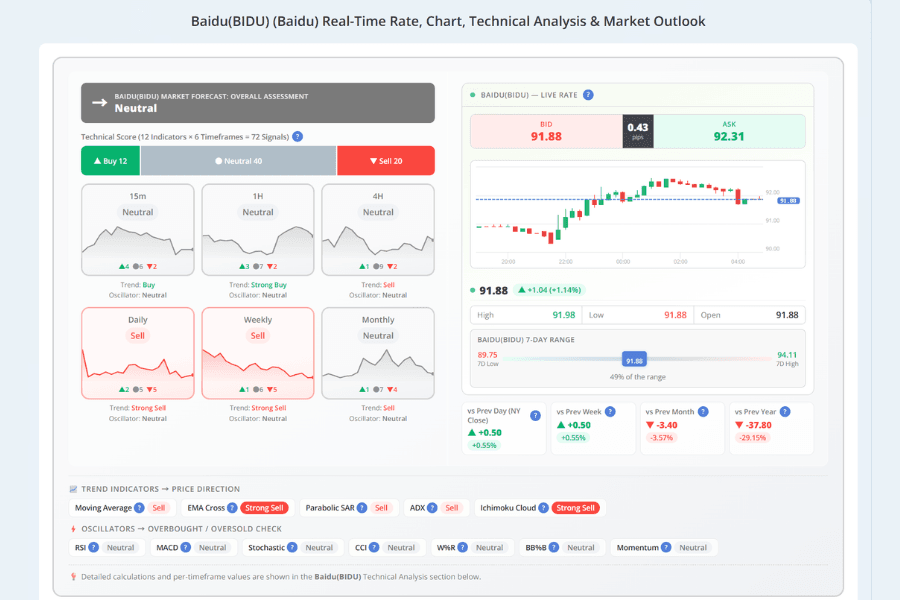
Titan FX offers a CFD on Baidu (BIDU) across all three account types, with available leverage varying by instrument and account. The product page shows live pricing, charts, automatically calculated support and resistance, and the trading costs for each account.
Sessions and gaps
The regular US session runs from 9:30 a.m. to 4:00 p.m. Eastern Time; holiday closures and session rules are covered in our guide to US market hours. Baidu reports before the US open and after the Hong Kong close (the second-quarter 2026 release came at 5:00 a.m. Eastern on August 18), so BIDU's pre-market trading reacts first, the regular session can gap at the open, and an order resting at the old price will not necessarily fill as intended; 9888 in Hong Kong does not react until the next day. Our earnings season guide covers the reporting calendar.
Risk and position sizing
Set stops to the stock, not the index. A single stock moves considerably more than a broad index, and applying index habits to stop placement gets you shaken out by ordinary noise.
Leverage cuts both ways. When using leverage, decide first how much you are willing to risk on the trade, then work back from your stop distance to the position size.
The VIE and cross-border holding structure. What investors hold is an ADS in an offshore holding company, while the restricted onshore business is consolidated through variable interest entity contracts. That structure carries additional legal and regulatory risk.
Holding costs and dividend adjustments. Overnight financing on a CFD accumulates with the days held, so build it into the plan before holding for the medium term. Baidu adopted its first dividend policy in February 2026 and the board expects to declare a first dividend this year; once dividends begin, a CFD held across the ex-dividend date receives a dividend adjustment on a long position and pays it on a short, and the amounts can be checked in the Dividend Calendar.
Trade BIDU CFDs with Titan FX
Titan FX offers Baidu (BIDU) stock CFDs with up to 20:1 leverage, tight spreads, and the flexibility to go long or short without owning the shares.
7. FAQ: common questions about Baidu stock
Q1: Should I buy BIDU in the US or 9888 in Hong Kong?
They track the same company; the difference is the trading conditions. BIDU is priced in US dollars during US hours and has related markets such as US-listed options; 9888 trades in Hong Kong dollars during the Asian day. Since September 2026 both are primary listings and 9888 is also in Stock Connect. Decide by your own hours, currency, broker access and costs.
Q2: Why aren't the BIDU and 9888 prices exactly aligned?
One ADS corresponds to eight ordinary shares, and the two trade in different time zones and currencies. Exchange-rate moves, staggered sessions and each market's own supply and demand let live prices drift apart slightly, which is normal.
Q3: Is Baidu still a search company?
On the revenue side there is no longer a single answer. Traditional advertising is still the largest single source but is down 19%, while the AI-powered business is half of General Business and growing 25%. Management describes Baidu as having moved from an internet-centric company to an AI-first one; what the market is really watching is when AI's new revenue is enough to keep filling what advertising loses, so that total revenue grows again.
Q4: Does Apollo Go matter to the share price?
Its contribution to the results is still small, and it sits inside AI Applications, which grew 3%. The market watches it for its scale: roughly 1 million fully driverless rides in the second quarter, 23 million cumulatively, 28 cities. In valuation terms it can be thought of as a long-dated option outside the existing business; growing ride counts do not mean it is profitable yet, and it is the pace of commercialization, per-vehicle economics and overseas regulatory permits that will change how the market values it over the long run.
Q5: Does Baidu pay a dividend?
Not in the past, but it is expected to from 2026. Baidu adopted its first dividend policy in February 2026, and the board expects to declare a first dividend during 2026, which may take the form of regular or special dividends; the actual timing and amount are for the board to decide based on results and capital needs. The same announcement approved a new US$5 billion buyback program, under which US$259 million had been repurchased by the time of the second-quarter results. CFD holders receive or pay a dividend adjustment depending on the direction of the position.
Q6: Is the delisting risk for Chinese ADRs still live?
The level of risk has clearly fallen. After the PCAOB secured full inspection access to audit firms in mainland China and Hong Kong in December 2022, the most pressing delisting trigger was removed, but the mechanism of the Holding Foreign Companies Accountable Act remains and cannot be treated as permanently gone. Baidu completed its dual primary listing in Hong Kong in September 2026, giving it a second venue that can operate independently; in June the same year it was added to the US Department of Defense's Chinese military companies list, which does not restrict trading in BIDU but shows that cross-border regulatory risk persists.
Q7: Can I trade BIDU with a CFD, and how does that differ from owning shares?
Yes. A CFD trades the price difference, can be held long or short, and can be leveraged, but it carries no ownership of the shares. Positions incur overnight financing, so the suitable holding period is usually shorter than for shares.
8. Conclusion: can AI growth fill the advertising gap?
Baidu's results today are two lines heading in opposite directions. Online marketing revenue is down 19% yet still the largest single source of revenue; the AI-powered business is up 25% and half of General Business, with GPU Cloud growing 283%. Total revenue down 4% is simply the sum of the two.
The cost is written in the cash flow: RMB 11.4 billion of capital expenditure in a quarter and free cash flow of negative RMB 7.95 billion. The RMB 283.1 billion of cash and investments is a thick cushion, but the payback period depends on whether AI Cloud demand holds and when the advertising decline narrows. Apollo Go and Kunlunxin are two cards not yet cashed in.
To read this stock, look first at the AI business's share and AI Cloud's growth rate, then at the advertising decline, and finally at when free cash flow turns positive. The direction of those three numbers decides whether the market treats Baidu as an AI growth company or as a company in transition that still revolves around search advertising.
Further Reading
- JD.com (JD) Stock Explained: First-Party E-commerce and Logistics, Profit Recovery after the Food Delivery War, ADS and 9618
- What Are Growth Stocks? Valuation, Risks & U.S. Examples
- How to Read Financial Statements: Income, Balance & Cash Flow
- Income Statement Explained: From Revenue to Net Income
- What Is US Pre-Market Trading? Times, Rules, and Strategy
- What Are Chinese ADRs? ADR, VIE, Hong Kong Listings and Delisting Risk Explained
Titan FX Trading Strategy Lab. We produce investor-education content covering forex, commodities (crude oil, precious metals, agricultural goods), stock indices, US equities, and digital assets.
Primary Sources (by Category)
- Company results: Baidu's second-quarter 2026 results announcement — total revenue, General Business and iQIYI revenue, the three AI-powered business lines, online marketing revenue, operating income, net income, cash and investments and free cash flow — and the earnings-call remarks on Apollo Go, the ERNIE assistant, Qianfan and the advertising outlook
- Company announcements: Baidu's disclosures on the ADS-to-Class A share ratio, the February 2026 dividend policy and US$5 billion buyback program, the January Kunlunxin spin-off and Hong Kong listing application, the June statement on the US Department of Defense Chinese military companies list, the August extraordinary general meeting and the September 1 effectiveness of the Hong Kong primary listing, and the September 7 inclusion in Shanghai and Shenzhen Stock Connect
- Investor education: Regulator materials on depositary receipts, VIE structures, cross-border listings, and the risks of contracts for difference