

Death Cross Explained: Definition, Patterns, Sell Timing, and Strategy

A Death Cross is one of the most representative bearish signals in technical analysis: it forms when a short-term moving average crosses below a medium- or long-term moving average, signaling that the market trend may shift from consolidation or an uptrend to a downtrend. Many traders treat it as a key risk indicator for reducing positions, taking profits, or even opening short positions.
This article explores the death cross from its definition, common patterns, calculation method, and practical strategies, and offers a detailed comparison with the Golden Cross. It also explains how to apply the death cross effectively across different markets (such as stocks and forex) for risk management and trend-reversal analysis.
In particular, we will introduce how to use the professional moving-average indicator tools offered by Titan FX to help you spot potential downtrends earlier and strengthen your capital management—benefiting both newcomers and professional traders alike.
- Bearish reversal signal: short-term MA crossing below the longer MA flags weakening trend.
- Classic combo: the 50-day crossing below the 200-day is the most-watched setup.
- Two patterns: a single crossover versus a sustained bearish alignment.
- Multiple confirmation: pair with RSI, MACD, Bollinger Bands, and volume to cut false signals.
- Professional tools: Titan FX MA Cross, GMMA, Perfect Order Monitor, and MA Trend detect crossovers instantly.
1. What Is a Death Cross
1-1. Definition and Significance of the Death Cross
The Death Cross is one of the most representative bearish reversal signals in technical analysis. It typically appears when a short-term moving average (such as the 5-day line) crosses down through a medium- or long-term moving average (such as the 20-day line).
This crossover signals that short-term market momentum is weakening and can no longer support the existing trend, potentially foreshadowing that the stock or asset price will enter a medium- or long-term decline. For this reason it is often regarded as a strong sell or risk-warning signal, and it is widely applied across stocks, forex, cryptocurrency, and other markets.
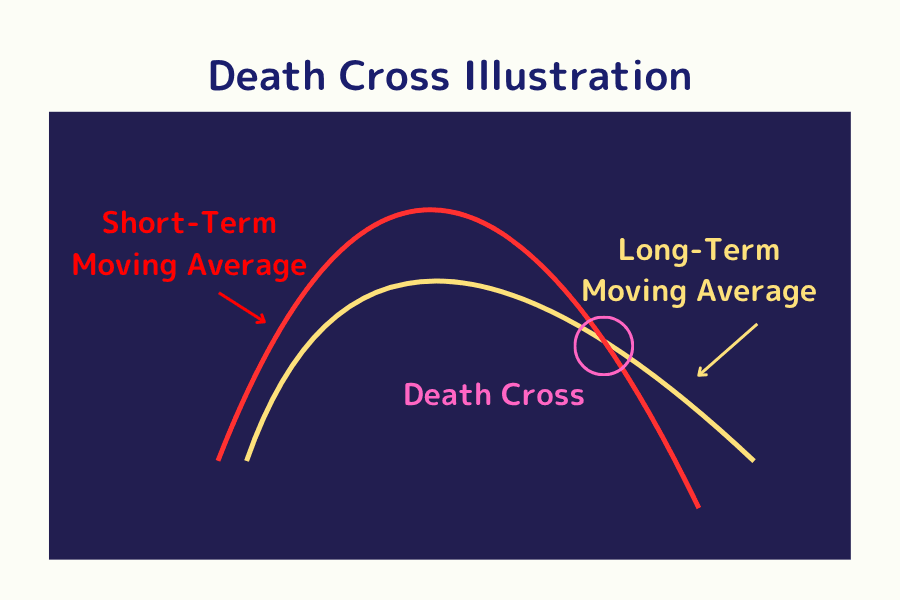
Beyond moving averages, similar crossover phenomena also exist in other technical indicators (such as MACD and the KD stochastic oscillator). When the short-term indicator falls below the long-term indicator, it can likewise be called a "death cross."
1-2. Common Moving-Average Combinations for the Death Cross
The death cross can use different moving average period combinations depending on the chart timeframe. Below are common settings:
| Timeframe Type | Short-term | Medium-term | Long-term |
|---|---|---|---|
| Daily | 5-day | 20-day, 50-day | 100-day, 200-day |
| Weekly | 13-week | 26-week | 52-week |
| Monthly | 12-month | 24-month | 60-month, 120-month |
In real markets, the "50-day crossing below the 200-day" is the most frequently cited death cross combination. In the US stock market in particular, it is viewed as a clear signal of a medium- to long-term bearish trend shift.
Short-term traders, meanwhile, can choose different parameter combinations to monitor based on their own trading horizon, such as the "5-day and 25-day" or "13-week and 26-week" pairings.
1-3. Death Cross Calculation Formula
On charting tools, a death cross is usually shown as the short-term line crossing down through the medium- or long-term line.
If you judge it from changes in the moving-average values, you can precisely confirm when a death cross has formed using the following two conditions:
- ① Current day: short-term moving-average value < medium- or long-term moving-average value
- ② Previous day: short-term moving-average value > medium- or long-term moving-average value
This means the short-term moving average, which was previously positioned above, has reversed and crossed down through the long-term moving average—a clear technical signal of a death cross.
1-4. A Real Chart Example of the Death Cross
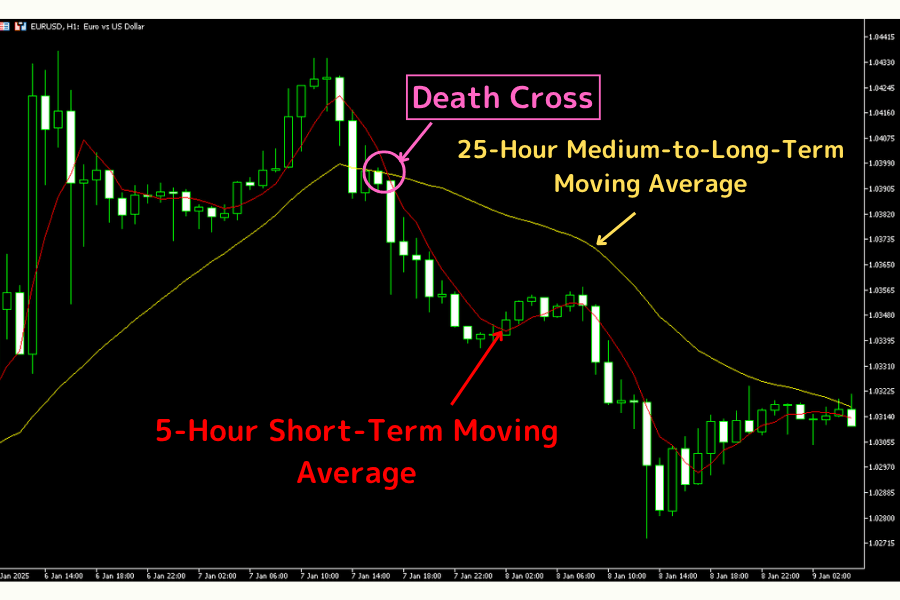
Take the 1-hour chart of EUR/USD as an example:
- The red line represents the 5-hour moving average (short-term line)
- The yellow line represents the 25-hour moving average (long-term line)
After the market has risen for a stretch, the short-term moving average begins to decline and ultimately crosses down through the long-term moving average, forming a death cross.
Afterward, the price shows a clear pullback and even turns into a bear market—the textbook application of the death cross as a sell signal or risk-management trigger.
2. Death Cross vs. Golden Cross
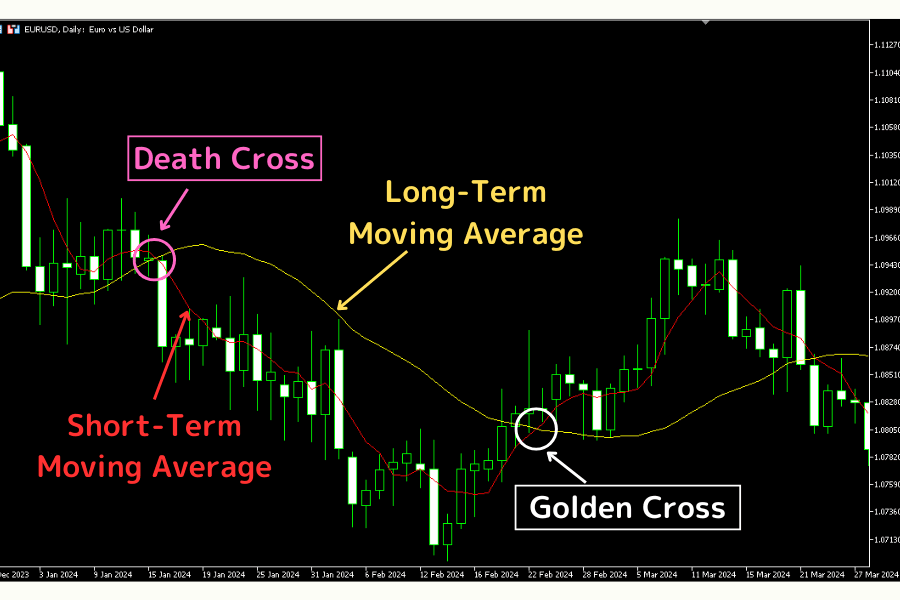
In technical analysis, the Death Cross and the Golden Cross are a pair of opposite-direction yet equally significant trend-reversal signals.
Both crossover patterns are based on the direction in which the short-term moving average crosses the medium- or long-term moving average, used to judge whether the market may be entering a bullish or bearish trend. They are widely applied across markets such as stocks, forex, and cryptocurrency.
Death Cross vs. Golden Cross Comparison Table
| Item | Death Cross | Golden Cross |
|---|---|---|
| Definition | Short-term MA crosses down through the medium- or long-term MA | Short-term MA crosses up through the medium- or long-term MA |
| Trend Implication | A bearish trend may be unfolding | A bullish trend may be unfolding |
| Market Sentiment | Selling pressure rises; turns cautious or bearish | Buying interest strengthens; turns aggressive or bullish |
| Response Strategy | Reduce positions, take profits, hedge, or open shorts | Open longs, increase holdings, or add on the trend |
| Applicable Markets | Stocks, forex, crypto, and other diverse assets | Stocks, forex, crypto, and other diverse assets |
To make the visual difference clearer, the chart below shows the typical patterns of the death cross and golden cross:
3. Typical Death Cross Patterns and Sell Timing
The death cross sell signal can broadly be divided into the following two patterns:
- Sell Signal ①: Typical Death Cross
- Sell Signal ②: Sustained Death Cross (Bearish Alignment)
Sell Signal ①: Typical Death Cross
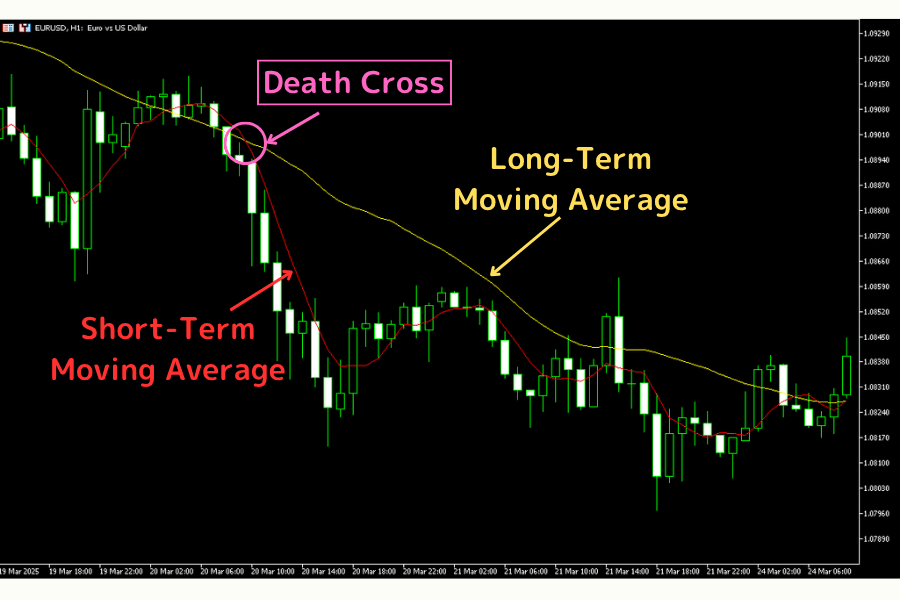
In this pattern, the medium- or long-term moving average is flat or sloping slightly downward, the short-term moving average crosses down through it from above, and the candlesticks sit below both moving averages.
This is the most classic and common death cross pattern, indicating that the market is weakening in the short term and the trend may reverse downward. When this pattern appears, it is generally seen as a clear sell signal, and traders are advised to consider:
- Closing out existing long positions
- Setting a stop-loss to prevent losses from widening
- Or evaluating whether to open short positions
Sell Signal ②: Sustained Death Cross (Bearish Alignment)
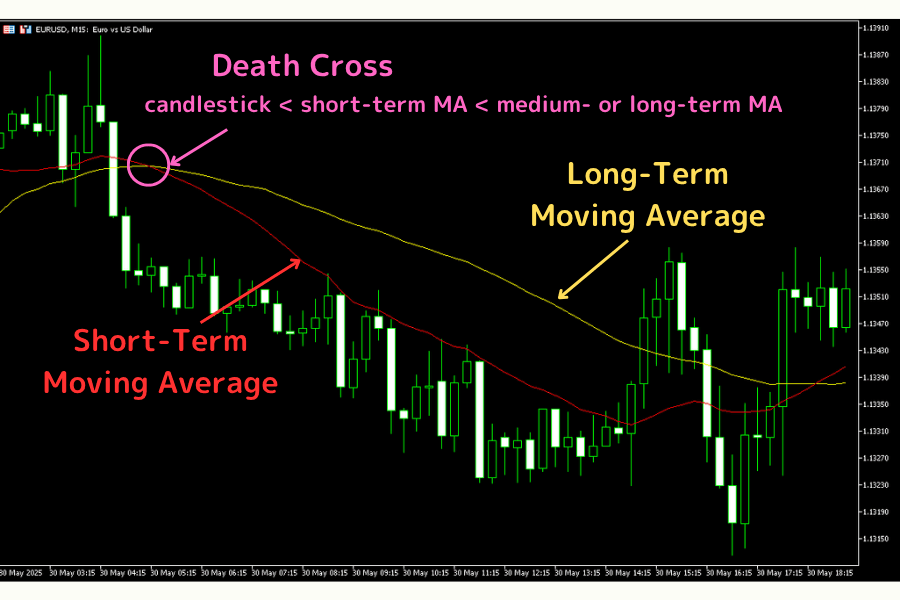
In this pattern, the price structure shows the order "candlestick < short-term MA < medium- or long-term MA," with all three trending downward.
This indicates strong bearish momentum and a clearly defined downtrend structure. The longer this alignment persists, the more it signals sustained bearish market confidence, with prices prone to continued weakness.
In this situation, it is an ideal time for trend-following operations, suitable for:
- Continuing to hold existing short positions
- Evaluating whether to add to short positions
- Or using a trailing stop to track the trend's extension
4. Practical Applications and Trading Strategies
How the death cross is applied in practice varies depending on the trading market, timeframe, and trader's style. Below are common and practical response strategies to help investors take defensive action or set up short positions when a trend weakens.
- 4-1. Flexibly combine different MA types
- 4-2. Confirm reversals with other technical indicators
- 4-3. Apply it flexibly to each market's characteristics
4-1. Flexibly Combine Different MA Types
Combining SMA and EMA
- The SMA (Simple Moving Average) smooths the trend response, while the EMA (Exponential Moving Average) is more sensitive to price changes.
- In short-term trading, when the "5-day EMA crosses below the 20-day SMA," it is often viewed as a potential death cross signal.
Multiple MA Combinations
- Observe moving averages of different periods simultaneously, such as the 5-day, 25-day, and 75-day.
- If the short-term MA crosses down through the medium- and then the long-term MA in sequence, forming a "multiple death cross" within the year, it can be regarded as confirmation of a bearish trend shift.
Further reading: How to Choose the Most Suitable Parameter Periods
4-2. Confirm Reversals with Other Technical Indicators
RSI (Relative Strength Index)
When the RSI falls below 50 or even into the 30–40 range while a death cross appears at the same time, it indicates strengthening bearish momentum and sustained selling pressure.
MACD
When the MACD line crosses below the signal line (DIF crossing below DEA) and this overlaps with a death cross, it is treated as a double confirmation of a trend reversal.
Bollinger Bands
If the death cross appears as the price breaks below the Bollinger Bands middle band or even the lower band, accompanied by rising volume, it indicates strong downward pressure.
4-3. Apply It Flexibly to Each Market's Characteristics
Stock Market
- After a stock has risen over the long term, a "death cross + shrinking volume" situation is often a sign of major players distributing shares.
- Pairing it with fundamental events (such as poor earnings reports, layoff announcements, or rate-hike expectations) can further strengthen the strategy's rationale.
Forex Market
- In major currency pairs such as the euro (EUR/USD) and the British pound (GBP/USD), the death cross often occurs in tandem with risk-off sentiment in the market.
- It can be combined with key data such as the non-farm payrolls and rate decisions when designing trading strategies.
Commodity Market
- In markets such as crude oil and gold, when the price breaks below a long-term support zone and a death cross then appears, it is often a signal that the bearish trend will continue.
- It can be supplemented by the CFTC Commitments of Traders report or fundamental supply-and-demand changes to aid judgment.
5. Making Use of Titan FX Professional Indicator Tools
To help traders effectively capture bearish reversal signals such as the death cross along with the overall market trend, Titan FX offers several professional technical indicator tools related to moving averages.
These tools not only detect in real time when a death cross or golden cross occurs, but also help assess trend strength and monitor bearish alignments, enabling traders to guard against risk in advance or plan short strategies and improve overall trading efficiency.
Below is an introduction to each tool:
Titan FX MA Cross Indicator
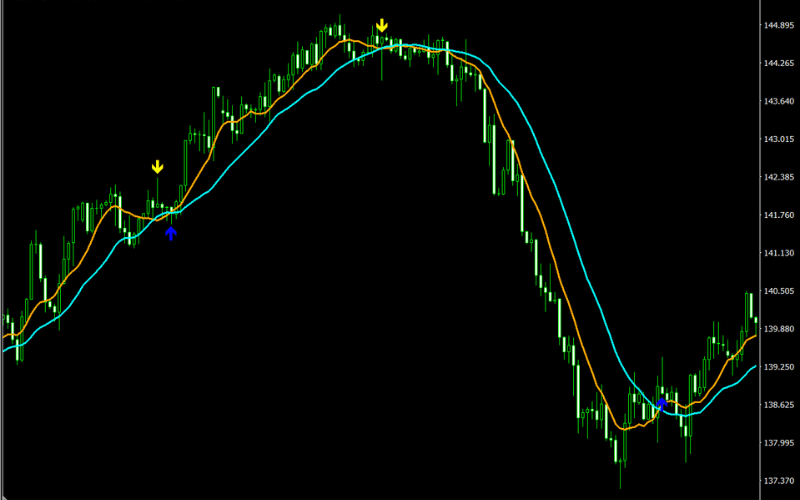
It automatically detects crossovers between short-term and long-term moving averages and marks them immediately when a death cross occurs, helping traders capture trend reversals at the earliest moment and respond to potential downside risk in advance.
See the detailed introduction and installation guide for the Titan FX MA Cross indicator
Titan FX GMMA Multiple Moving Average Indicator
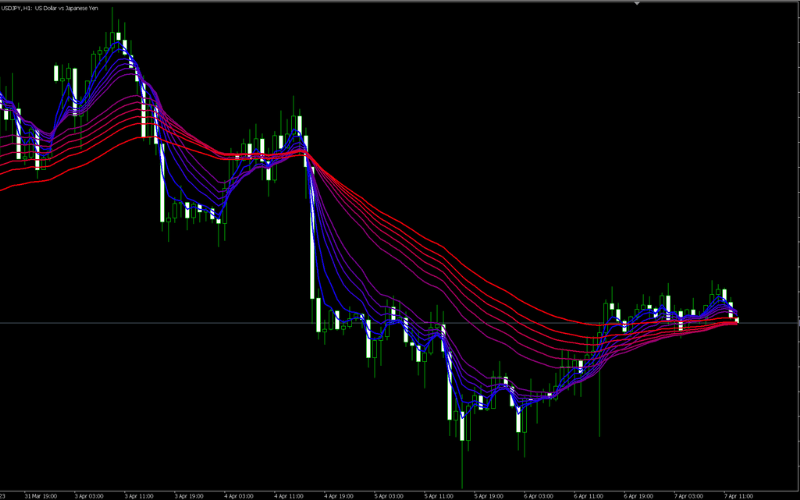
Through the GMMA's multiple moving-average structure, you can observe whether a bearish alignment is spreading and intensifying and identify whether a trend is accelerating in its deterioration—useful for analyzing medium-term weakening or accelerating decline phases.
See the detailed introduction and installation guide for the Titan FX GMMA indicator
Titan FX Perfect Order Monitor
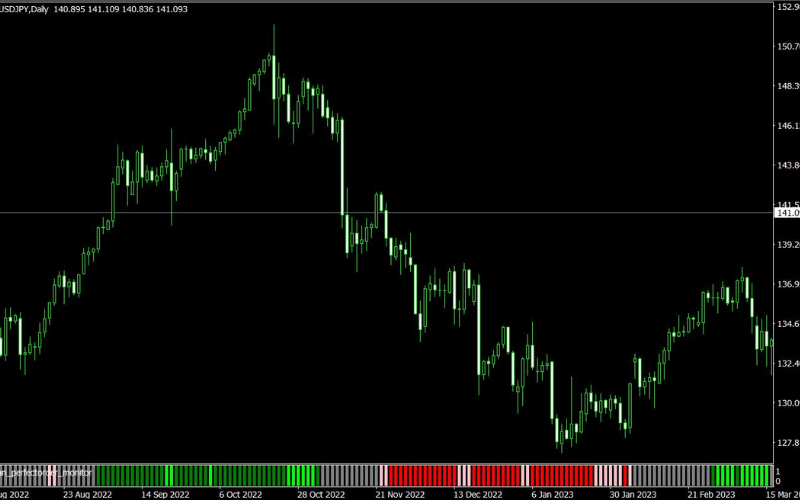
Although it was originally designed to detect a bullish perfect order, it can also serve as a tool for observing the early signs of a "bullish alignment breaking down → turning into a death cross," flagging whether the market is entering a reversal zone.
See the detailed introduction and installation guide for the Titan FX Perfect Order Monitor
Titan FX MA Trend Indicator
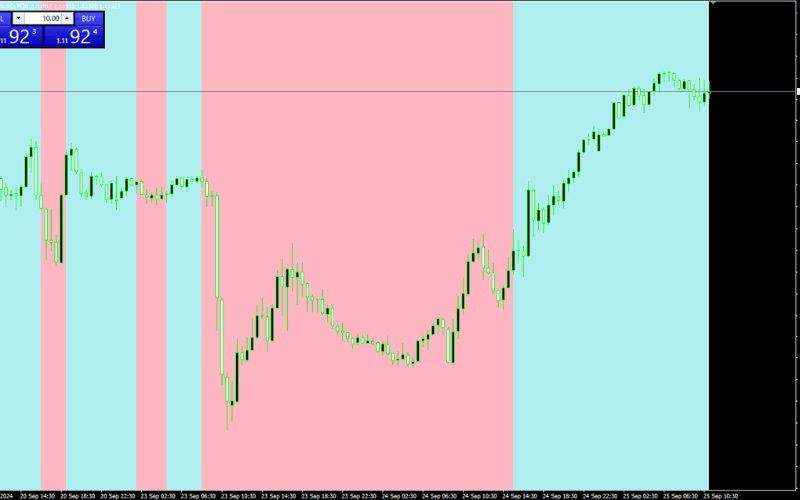
It visually displays the trend strength and direction among multiple moving averages. When the short-, medium-, and long-term moving averages all turn downward, it can quickly identify whether bearish momentum is strengthening.
See the detailed introduction and installation guide for the Titan FX MA Trend indicator
Titan FX Trend Analysis Tool
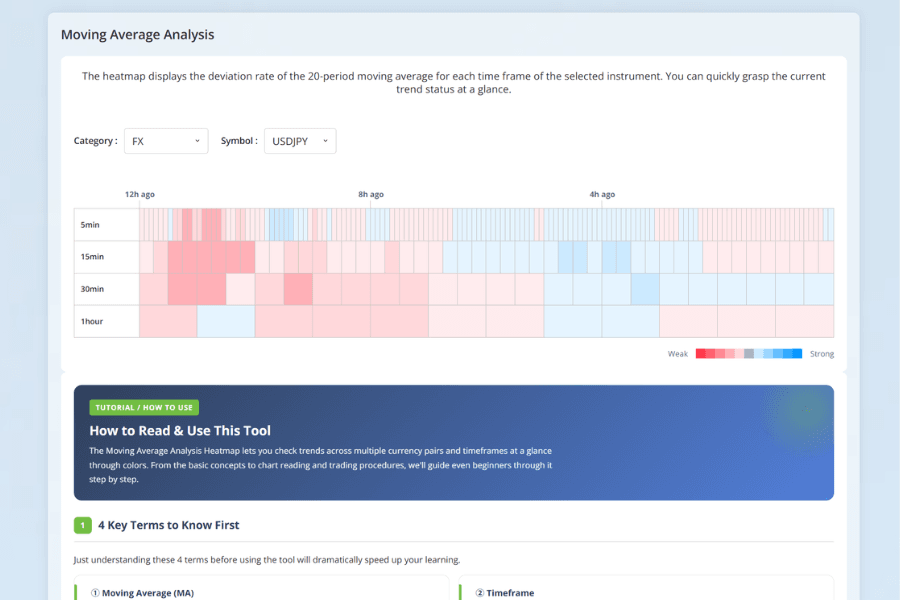
It integrates RSI, MACD, and multiple MA signals to provide a more comprehensive read on bullish and bearish trends. When a death cross and RSI/MACD weaken at the same time, it can serve as a strong risk warning.
See the detailed introduction to the Titan FX Trend Analysis tool
6. Points to Watch When Using the Death Cross
Although the death cross is an important bearish reversal signal, there are still potential pitfalls and judgment risks in practice. Below are three key points to watch:
- Point 1: False signals (false breakdowns)
- Point 2: Lag
- Point 3: Range-bound or choppy back-and-forth markets
Point 1: False Signals (False Breakdowns)
A death cross does not necessarily mean the trend will definitely fall. This is especially true when using short-term MA combinations (such as the 5-day and 10-day), which are prone to false breakdowns that can trigger premature selling.
Recommendations:
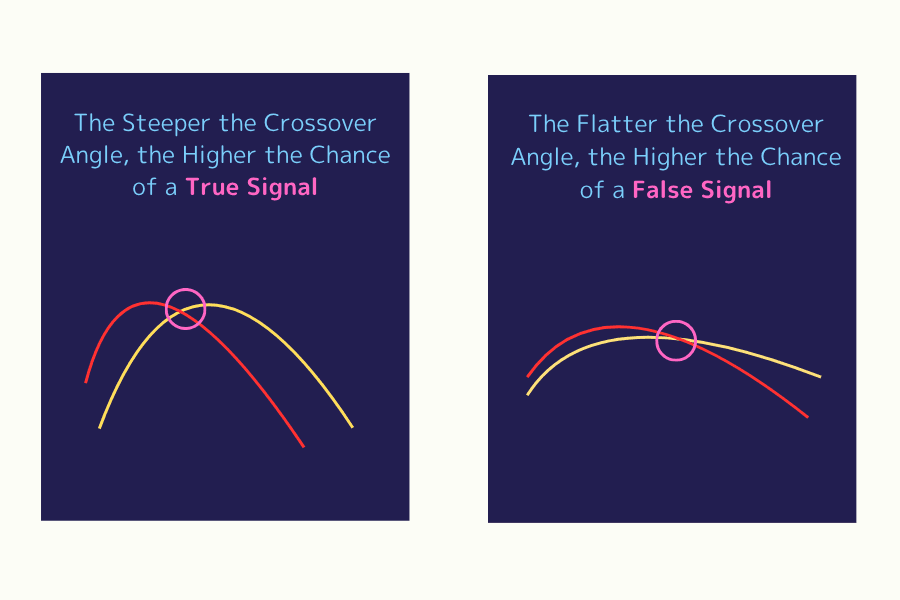
- Observe the angle of the MA crossover: the steeper the downward angle, the more valid the signal; if the angle is gentle, more observation is needed.
- Pair it with volume analysis: if volume clearly expands at the moment of the crossover, genuine selling pressure may be beginning.
Point 2: Lag
Moving averages are lagging indicators, and a death cross usually appears only after the market has already been falling for some time. This means that over-relying on it may cause you to miss more favorable exit points.
Recommendations:
- Short-term traders can use the 5-day and 20-day MA combination to increase sensitivity.
- Pair it with leading signals from the RSI or MACD to confirm whether a trend turning point has already occurred.
Point 3: Range-Bound Markets or False Trend Reversals
In consolidating or choppy back-and-forth markets, a death cross can quickly rebound after appearing, creating the risk of being whipsawed.
Recommendations:
- Use tools like Bollinger Bands and the ADX to confirm trend strength and avoid entering during consolidation periods.
- Watch whether the price breaks below an important support level (such as a prior low or the lower Bollinger Band) before considering action, to avoid entering shorts too early.
7. Death Cross FAQ
Q1. Does a death cross always mean prices will fall?
Not necessarily. Although a death cross is often viewed as a signal of a weakening trend, if it appears in a range-bound zone or a false-breakdown environment, it can lead to misjudgment. It is advisable to use other indicators such as RSI and volume for supplementary confirmation.
Q2. Which markets is the death cross suitable for?
The death cross applies broadly to stocks, forex, cryptocurrency, futures, and other markets. It offers good reference value especially when there is a clear bullish-to-bearish shift or a bearish alignment.
Q3. What is the difference between a death cross and a golden cross?
A death cross is when the short-term MA crosses down through the medium- or long-term MA, suggesting the trend may shift from bullish to bearish; the golden cross is the opposite—the short-term MA crosses up through the medium- or long-term MA, suggesting the trend may shift from bearish to bullish. The two are opposite in direction but both use MA crossovers as the basis for judging a trend reversal.
Q4. Why is the "50-day crossing below the 200-day" the most-watched?
Because this medium- to long-term MA combination effectively filters out short-term noise, when the 50-day crosses below the 200-day it indicates that medium- to long-term momentum has clearly weakened. Because this parameter set has high market participation and strong consensus, it is often viewed as a clear medium- to long-term bearish signal in markets such as US stocks.
Q5. How can I reduce false signals from a death cross?
Observe the angle of the MA's downward turn and whether volume expands at the same time: the steeper the angle and the more pronounced the volume, the more reliable the signal. At the same time, use multiple confirmations with indicators such as RSI, MACD, and Bollinger Bands; in range-bound markets, avoid entering based on the death cross alone.
Q6. Which Titan FX tools can detect a death cross?
Titan FX offers MA Cross (automatically marks crossovers), GMMA (observes the spread of bearish alignments), the Perfect Order Monitor, MA Trend (trend strength), and the Trend Analysis tool (integrating RSI/MACD) to help detect crossovers in real time and monitor trend strength. You can view the full introduction and installation guides on the Titan FX indicator tools page.
8. Conclusion
The death cross is a common and practical trend-reversal tool in technical analysis.
When the short-term MA crosses below the medium- or long-term MA, it usually foreshadows that the market may enter a downtrend or a phase of rising risk.
However, the death cross is not an absolute bearish signal. You must remain alert to situations such as false signals, lag, and interference from range-bound markets, and avoid trading blindly.
It is advisable to pair it with multiple indicators such as RSI, MACD, and Bollinger Bands to strengthen signal confirmation, and to assess risk comprehensively in light of market structure and fundamentals.
In addition, making good use of customizable moving-average indicator tools such as those offered by Titan FX can further improve your ability to identify trend turning points and manage your trading positions—helping all kinds of traders respond calmly to market changes.
Further Reading
- What Is the Golden Cross? A Complete Guide to the Bullish Signal
- What Is a Moving Average (MA)? Types, Calculation, and Usage
- What Is MACD? Indicator Principles and Trading Applications
- What Is the RSI (Relative Strength Index)? Reading Overbought and Oversold
- What Are Bollinger Bands?
The financial market research and analysis team at Titan FX. Covering a wide range of financial products—including forex (FX), commodities (crude oil, precious metals, agricultural products), stock indices, US stocks, and crypto assets—the team produces educational content for investors.
Primary Sources by Category
- Platform & Tool Information: Titan FX official indicator tools (MA Cross, GMMA, Perfect Order Monitor, MA Trend, Trend Analysis), Titan FX MT4/MT5 platforms
- Market Data: Titan FX real-time quotes and charts, major currency pairs and commodity movements
- Educational Resources: Titan FX Research technical analysis tutorials (moving averages, MACD, RSI, Bollinger Bands)